Chapter 7: Choice under Uncertainty and the Economics of Information
 Call Kai
 Learn
 Practice Test
 Spaced Repetition
 Match
 Flashcards
 Knowt Play
1/102

There's no tags or description
Looks like no tags are added yet.
103 Terms
What is choice under uncertainty?
Making decisions without knowing which outcome will occur
Bc most economic decisons made w/o complete info
Cant know all possible outcomes when making a decision
What are economic decisions under uncertainty +why?
Gambles
Bc outcomes are uncertain
Proability
Measures the likelihood of an outcome occurring.
What is the probability of heads on a fair coin?
50%
Ie over many tosses, each outcome should occur approximately 50% of the time.
Important property of a gamble
Its expected value
Expected value
The sum of all possible outcomes, weighted by its respective probability of occurrence
ie weighted average of all possible outcomes (weights = respective probabilities)
What does expected value measure?
Average payoff expected over many repetitions of the gamble
Expected value formula
EV = Σ (probability x outcome)
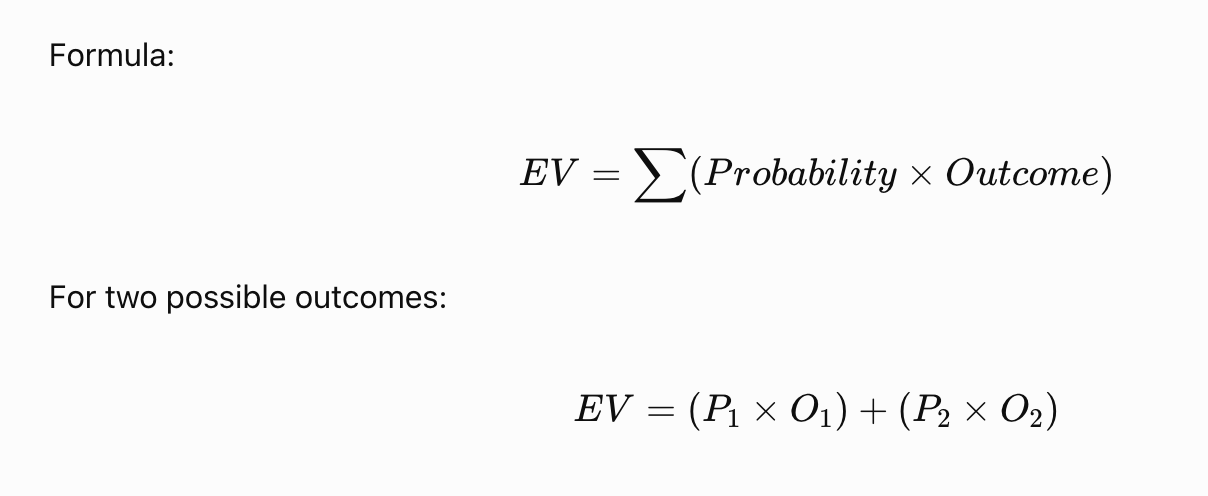
Does a higher EV mean a gamble is more attractive?
NOT necessarily
People also consider how desirable or unpleasant the outcomes are
Positive vs negative expected value
Positive EV = expected net gain.
Negative EV = expected net loss.
What does a gamble’s attractiveness depend on?
Its expected value
AND the desirability of its possible outcomes

Fair coin toss:
Which gamble has the highest EV?
Which gamble is most likely to be accepted?
Why do most people reject Gamble 3?
Which gamble has the highest EV? | Gamble 3 (€5,000). |
Which gamble is most likely to be accepted? | Gamble 1, because its potential loss is very small. |
Why do most people reject Gamble 3? | The potential loss of €10,000 is extremely unpleasant. |

The von Neumann-Morgenstern Expected Utility Model
People choose the alternative that has the highest expected utility
EU maximisation
Expected utility
EU of a gamble = expected value of utility over all possible outcomes
The weighted average of the utility of all possible outcomes
What does expected utility maximisation assume?
A utility function U that assigns a numerical measure to the satisfaction associated with different outcomes.
According to the Expected Utility Model, what option do people choose?
Option w the highest expected utility (EU)
Not necessarily the highest EV
What does utility measure?
The satisfaction associated with an outcome.

Expected utility formula
EV = Σ (probability x utility)
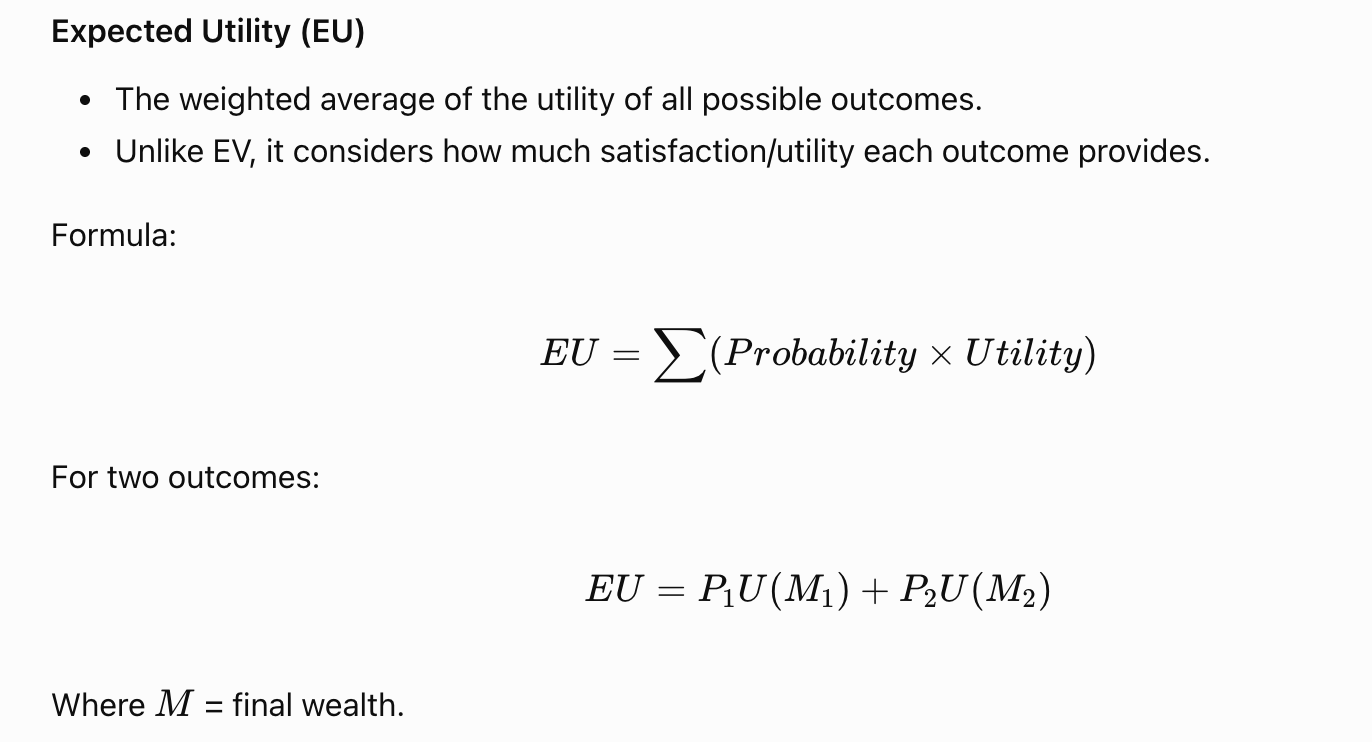
When should you accept vs reject a gamble?
Accept: EU gamble > U(M0)
Reject: EU gamble < U(M0)
Indifferent: EU gamble = U(M0)
M0 = initial wealth
If you refuse a gamble what is your utility
Same utility as initial wealth
U(M0)

Example for a fair coin toss
Gamble | Heads | Tails | Expected value |
|---|---|---|---|
1 | +€100 | -€0.50 | €49.75 |
2 | +€200 | -€100 | €50 |
3 | +€20,000 | -€10,000 | €5,000 |

Do expected values have the same rankings as expected utilities for a set of alternatives?
Not neccessarily
Bc utility is usually a non linear function of wealth
Expected utility vs expected value
EV calculates the average monetary outcome.
EU calculates the average utility of the outcomes.
Is utility function usually concave or convex + explain?
Concave
Concave UF = curves downwards
As wealth increases, slope decreases
Diminishing marginal utility
ie curve lies above the chord connecting any two points on it.
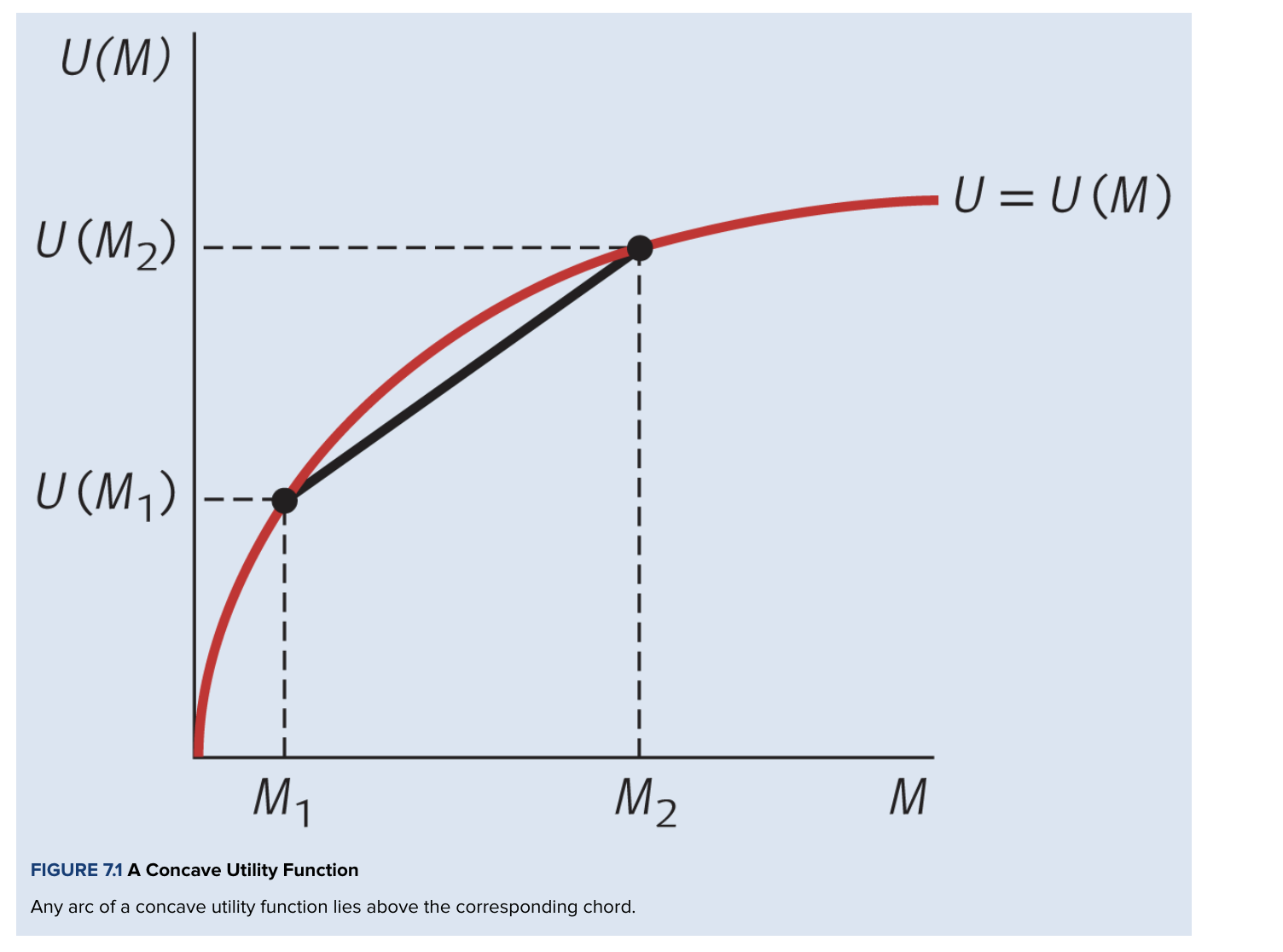
Feature of marginal utility for a concave utility function
Diminishing marginal utility
As wealth increases, MU decreases
Diminishing marginal utility of wealth
The more wealth a consumer has, the additional utility from 1 extra unit of wealth decreases
Each additional unit of wealth provides less additional utility

What is marginal utility?
Slope of the utility function
What type of person is someone with a concave utility function (of wealth)?
Risk averse
Risk averse
Preferences described by a utility function with diminishing marginal utility of wealth (concave UF)
Prefer certainty over a gamble with the same expected value
Always refuse a fair gamble (EV = 0)
What type of utility function represents risk aversion?
Concave utility function
Fair gamble
Gamble with an expected value of 0
EV of your wealth if you accept the gamble = certain value of your wealth if you refuse it
ie Expected wealth from gambling = wealth from refusin

Why do risk-averse people reject fair gambles?
Bc utility lost from losing exceeds the utility gained from winning
Due to diminishing marginal utility
So EU gambling < U (initial wealth)

Geometric interpretation of the expected utility of a gamble
2 points in the utility function: winning and losing
Join point with straight line (chord)
EU lies on this chord
Concave UF: curve is above the chord
So EU gamble < U(EV wealth)
For a fair gamble EU gamble <U(M0)
If the probability of winning is half, where does EU lie?
Halfway between the chord joining the winning and losing gamble
Utility function for risk averse person

Where does expected utility lie geometrically?
On the chord joining the utilities of the possible outcomes.
Where does EU lie if probabilities are unequal?
At a weighted position along the chord.
Will risk-averse people accept every positive-EV gamble?
No.
If the potential loss makes the EU too low → reject

Example- unequal probabilities
Remember: Probabilities do not have to be 50/50. Always multiply each utility by its respective probability.
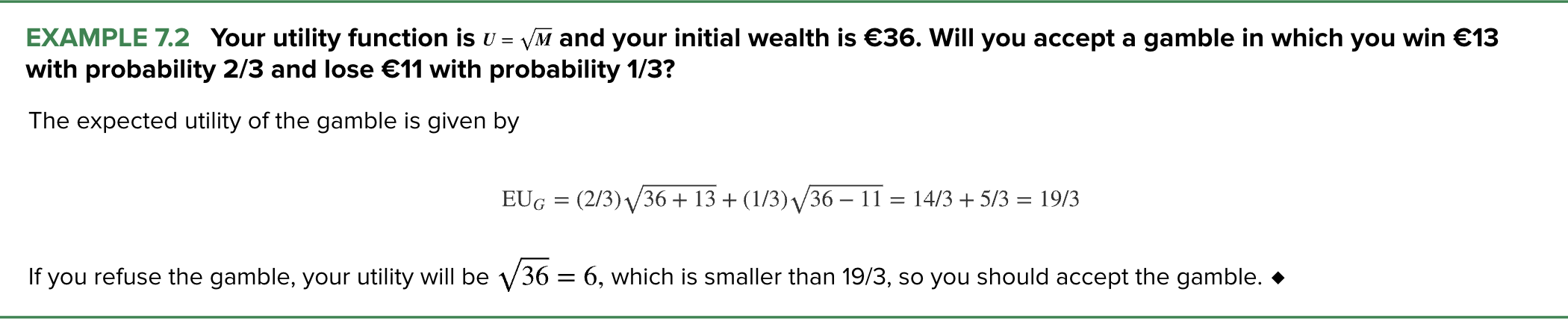
What do you need to do to initial wealth BEFORE applying the utility function to calculate EU?
Add/subtract the gamble's winnings/losses from initial wealth
If probability of winning is p, what is the probability of losing?
1-p
Expected utility with unequal probabilities

What determines the position of EU on the chord?
Depends on probabilities of winning or losing
Where will EU lie if there is a higher probability of winning?
Closer to the winning endpoint
Are most people risk averse or risk seeking?
Averse
Increase wealth → DMU (concave)
Risk seeking
Someone whose preferences are described by a utility function with increasing marginal utility of wealth.
Convex UF
Slope increases as wealth increases.
Prefer taking a fair gamble over receiving the certain outcome.
EU fair gamble > U(M0)
EU of accepting fair gamble > U of refusing it
Utility function for risk averse people
Convex
Chord lies above curve

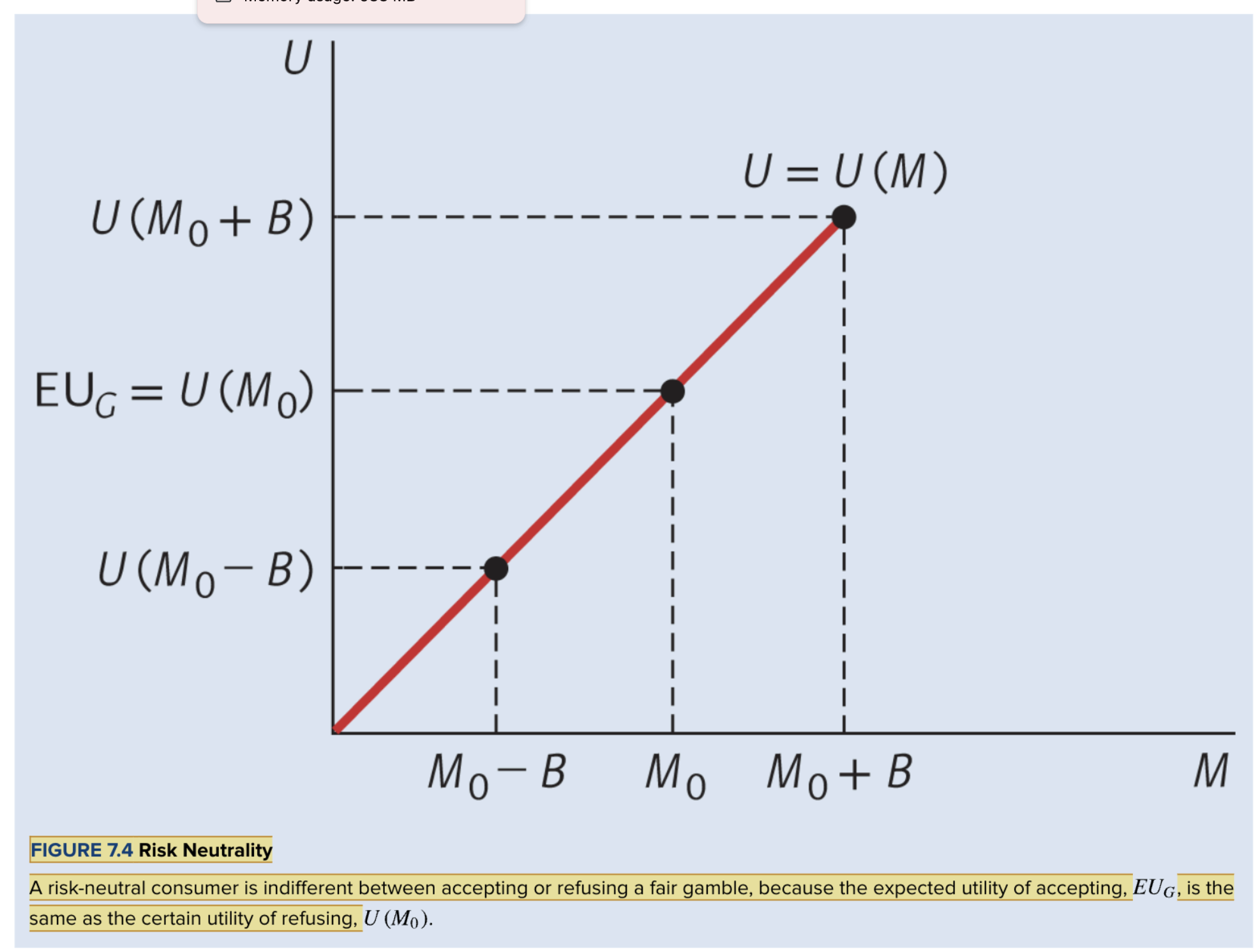
Risk neutral
Preferences described by a utility function with constant marginal utility of wealth
Linear UF
Indifferent betw accepting + refusing a fair gamble
EU fair gamble = U(M0) (aka U of refusing it)
Utility function for a risk neutral person
How many possible outcomes can a gamble have?
Many

What must all probabilities in a gamble add up to?
1 (100%)


Risk averse vs risk seeking vs risk neutral
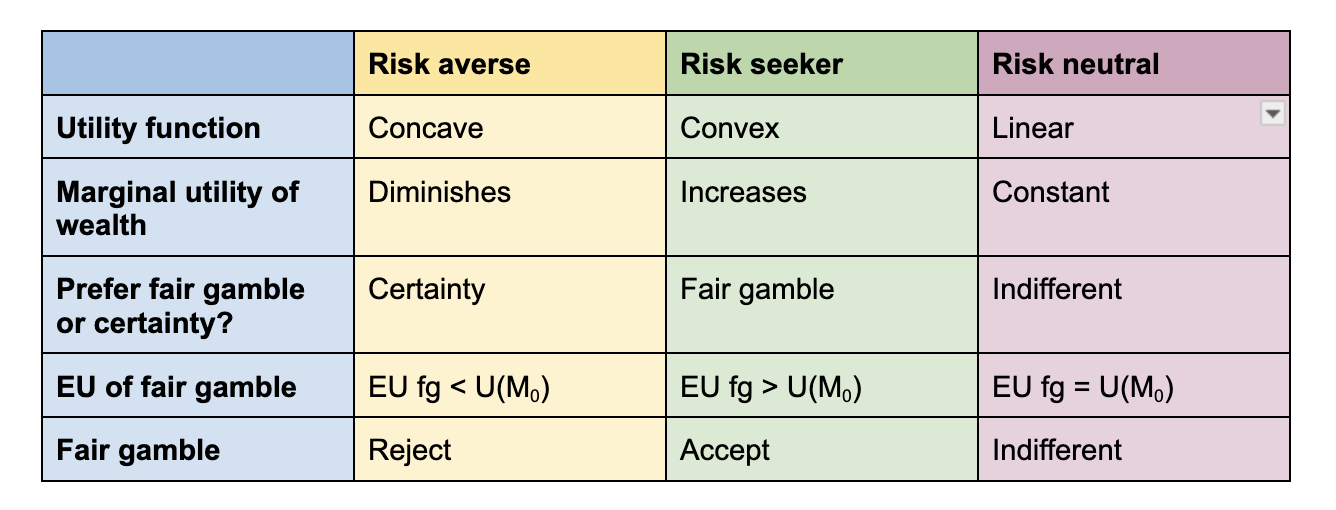
Why do concave utility curves make risk feel costly?
Bc diminishing marginal utility
Information that reduced uncertainty has?
Economic value
Why does info that reduces uncertainty have economic value?
Helps ppl make better decisons
By revealing / predicting possible outcomes
Ppl make better decisions based on the outcomes they learn about
Eg career guidance
Does only perfect info have economic value?
No. Even imperfect
Anything that reduces uncertainty (even a little) has economic value

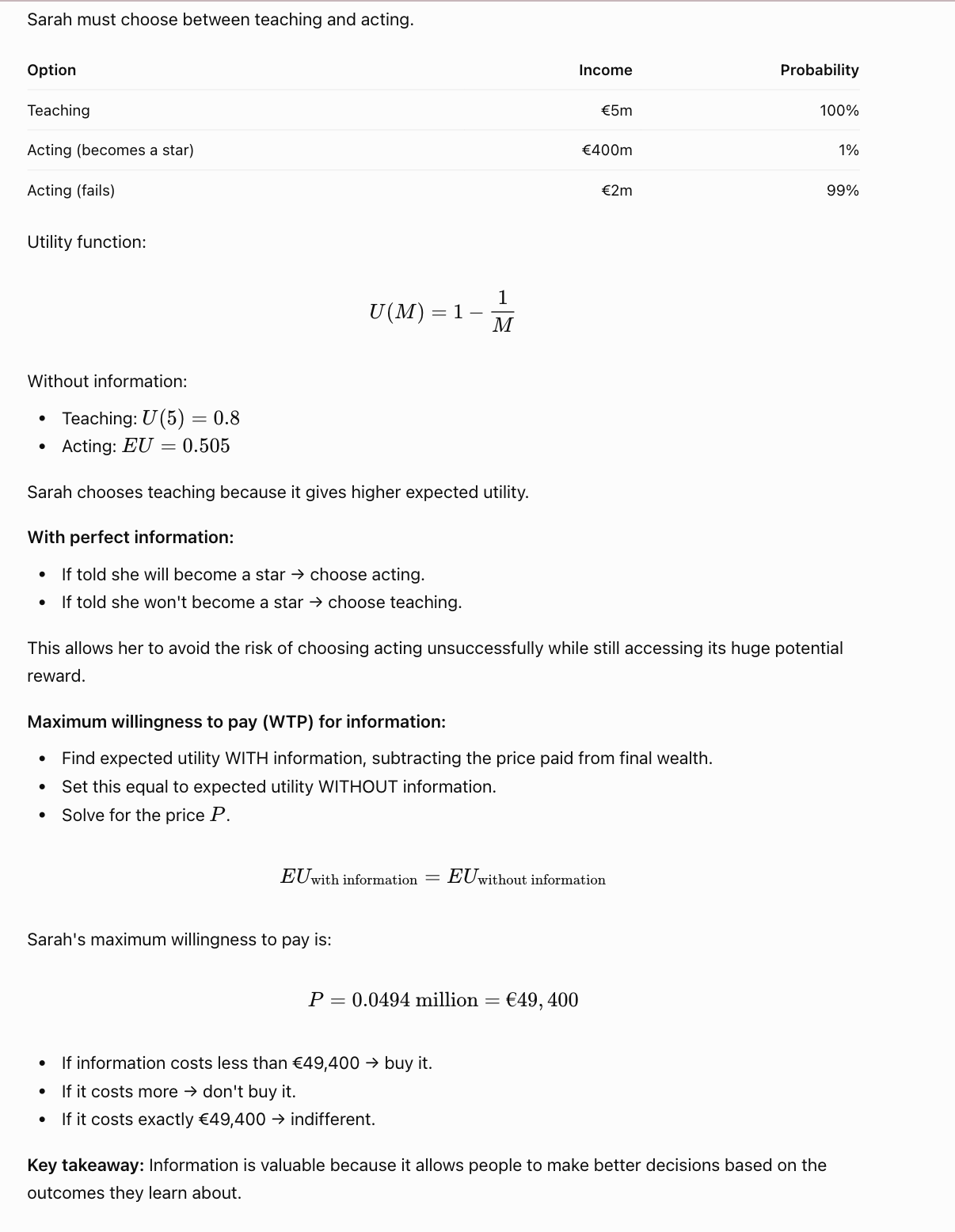
Why is information valuable?
It allows people to choose more effectively between alternatives.