Bacteriophages
 Call Kai
 Learn
 Practice Test
 Spaced Repetition
 Match
 Flashcards
 Knowt Play
1/10

There's no tags or description
Looks like no tags are added yet.
11 Terms
Bacteriophage steps
Entry of phage WHAT
WHAT of bacteriophage gene + Degrade host WHAT
Assembly of WHAT within host cell
WHAT phages
Bacteriophage steps
Entry of phage NUCLEIC ACID
TRANSCRIPTION of bacteriophage gene + Degrade host CHROMOSOMES
Assembly of PHAGES within host cell
FREE phages

Bacteriophages form WHAT when they lyse bacteria
Bacteriophages form PLAQUES when they lyse bacteria

Viral traits we can monitor with plaques
WHAT
WHAT
Viral traits we can monitor with plaques
Plaque morphology (size)
Host range (can it only affect a certain type of bacteria or multiple types of bacteria)

What are the two types of genetic analysis with phages
Mapping the WHAT with recombination between phages
Studying linkage and genetic transfer of the BACTERIAL GENOME
What are the two types of genetic analysis with phages
Mapping the VIRAL GENOME with recombination between phages
Studying linkage and genetic transfer of the WHAT
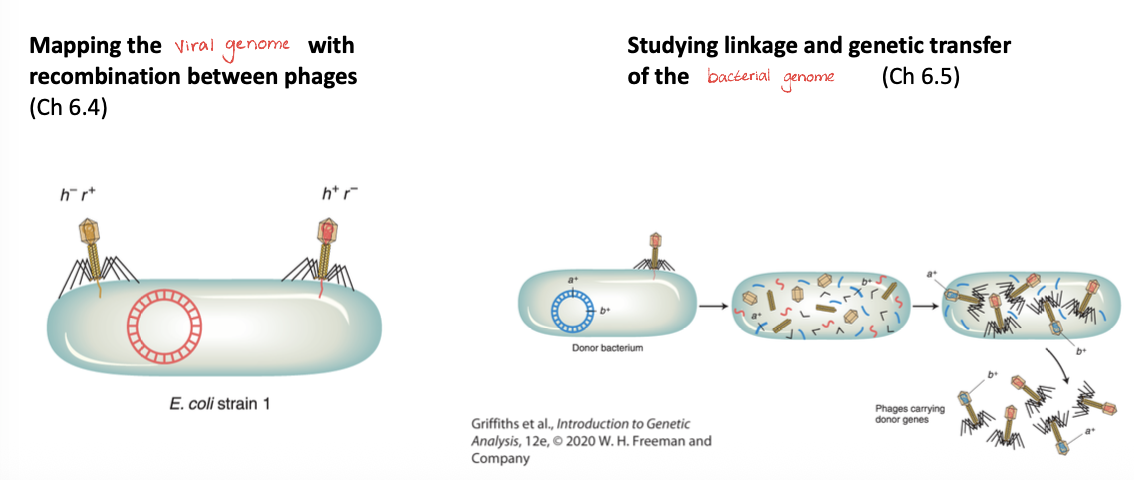
Mapping the viral genome

Bacterial DNA exchange uses WHAT
Bacterial DNA exchange uses TRANDUCTION

Transduction
Random incorporation of bacterial DNA into phage head

The WHAT the bacterial genes are in the chromosome, the more likely they are to be WHAT together into a phage head and be WHAT together (WHAT)
The CLOSER the bacterial genes are in the chromosome, the more likely they are to be PACKAGED together into a phage head and be TRANSDUCED together (COTRANSDUCTION)

If you select for two markers and there is a 0% production of the third marker, then the genes are too WHAT to be packed into the phage head together
If you select for two markers and there is a 0% production of the third marker, then the genes are too FAR APART to be packed into the phage head together

The larger the RECOMBINANT FREQUENCY the WHAT the genes
The larger the RECOMBINANT FREQUENCY the FARTHER the genes
The larger the COTRANSDUCTION the WHAT the genes
The larger the COTRANSDUCTION the CLOSER the genes