14D alcohols and epoxides
 Call Kai
 Learn
 Practice Test
 Spaced Repetition
 Match
 Flashcards
 Knowt Play
1/103

There's no tags or description
Looks like no tags are added yet.
104 Terms
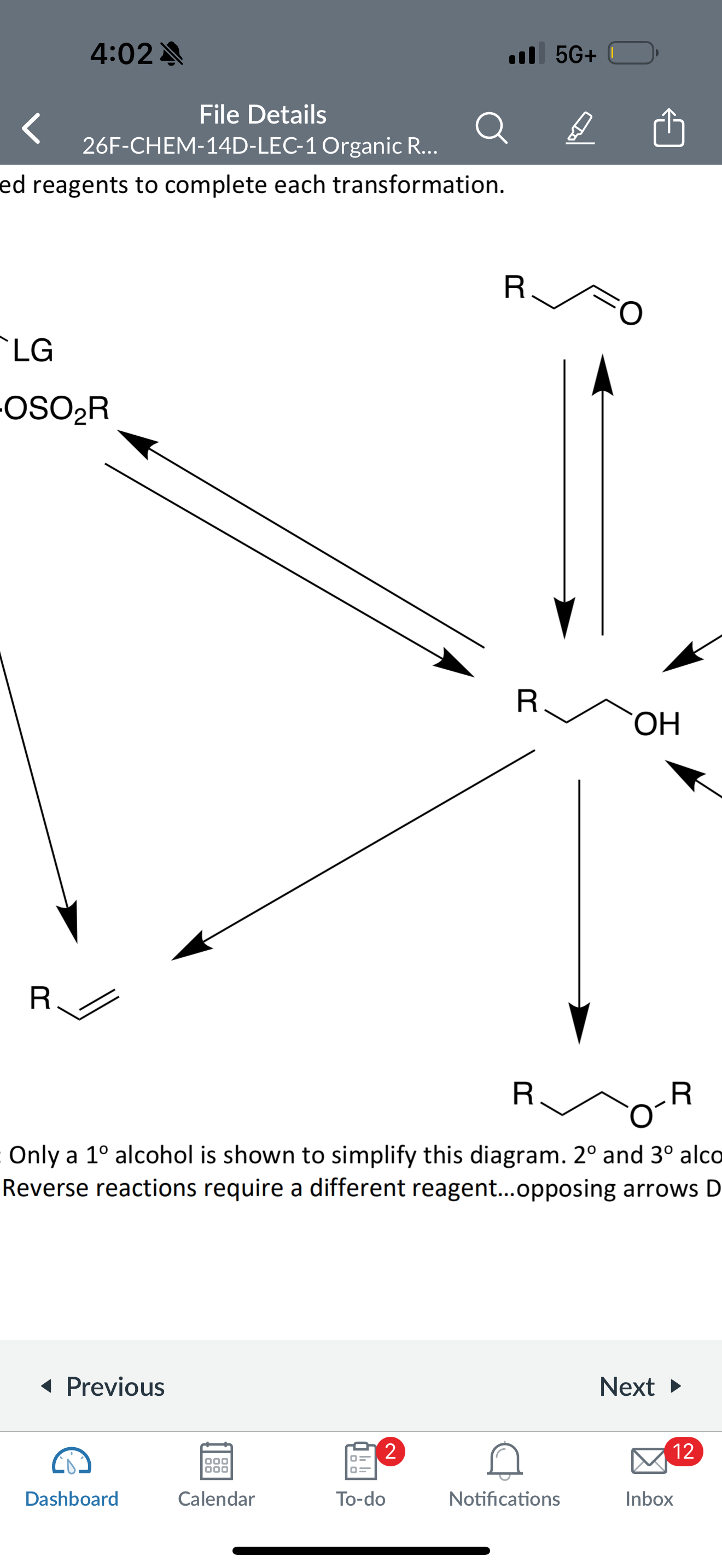
Reaction type: synthesis of alcohols ROH from R-X
R-X → R-OH
LG: X
elec:R. (+)
nuc: OH-
reaction mech: Sn2 with primary haloalkane
when sec or tert haloalkane elimination becomes a possibility
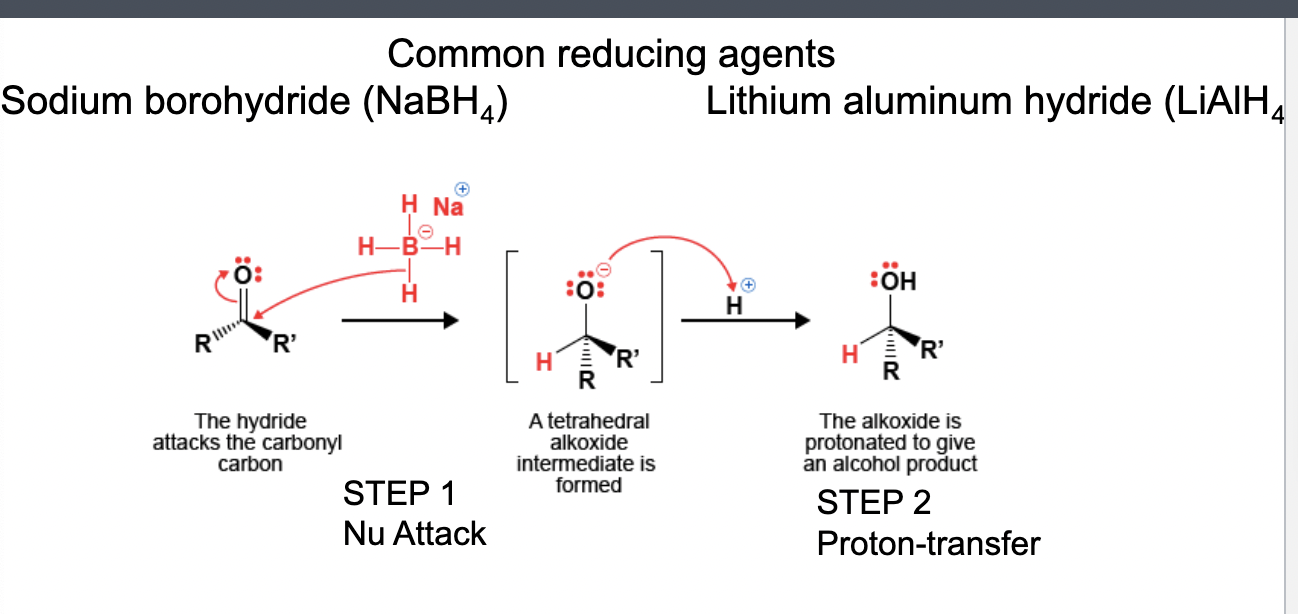
Reaction type: Reduction of aldehydes and ketones from NaBH4 (BH4) and LiAlH4(AlH4)
Step 1: the nucleophile attacks (hydrogen attachment to carbon)
Nuc: Hydride (neg H)
elec: Carbon bound to O
Intermediate:
alkoxide→ oxygen with neg charge
Step 2: proton-transfer (proton attachment
Nuc: Alkoxide
elec: Proton from the solvent
Product: aldehyde and ketone with a H bound to the carbon and H bound to the oxygen
characterized by the attachment of two hydrogens (unlike gringnard)
aldehyde and ketone
aldehyde→ at the end : R-CHO
keotne→ in the middle: R2-CO
what are the common reducing agents for alcohol generation from aldehyde and ketone
BH4 (-)
AlH4(-)
Reaction type: alcohols from organometallic reagents
Step1: Nucleophilic attack and carbon R group attachment
Nuc: carboanion on the R group
Elec: carbon attached to the oxygen
Intermediate: alkoxide with R group
Step2: Proton transfer from solvent
Nuc: alkoxide
elec: solvent proton
organometallic reagents types and associated solvents
-grignard: R-MgBr where R is (-) carboanion
-Organolithium: R-Li2Br where R is (-) carboanion
-essentially function as carbanions and strong base
Ether: polar aprotic solvent
primary, secondary and tertiary alchohols are produced from what when reacting with a organomettalic
primary→ formaldhyde
secondary→ aldehyde (any)
tertiary→ ketone

formaldehyde
simplist aldehyde,R group is a hydrogen CH2O
how to do retrosynthetic analysis
-goal: finding the starting species to produce the product
disconnect either side of the alcohol
the other group that is not attahced to the carbonyl group would be the R group on the organometallic (MgBr) (important, the cabron holdign Oh stays with the aldehyde piece)
the answer the original product would be the section you cut out that is attahced to the cabronyl group
carbonyl group
-on ketones and aldehydes, RCH=O
defintion of oxidation and reduction in alcohols
how to remember the reagents
oxidation-loss of hydrogen/gain of oxygens
reduction-gain of hydrogen
oxidizing agents are loaded with oxygens
reducing agents are loaded with hydrogens
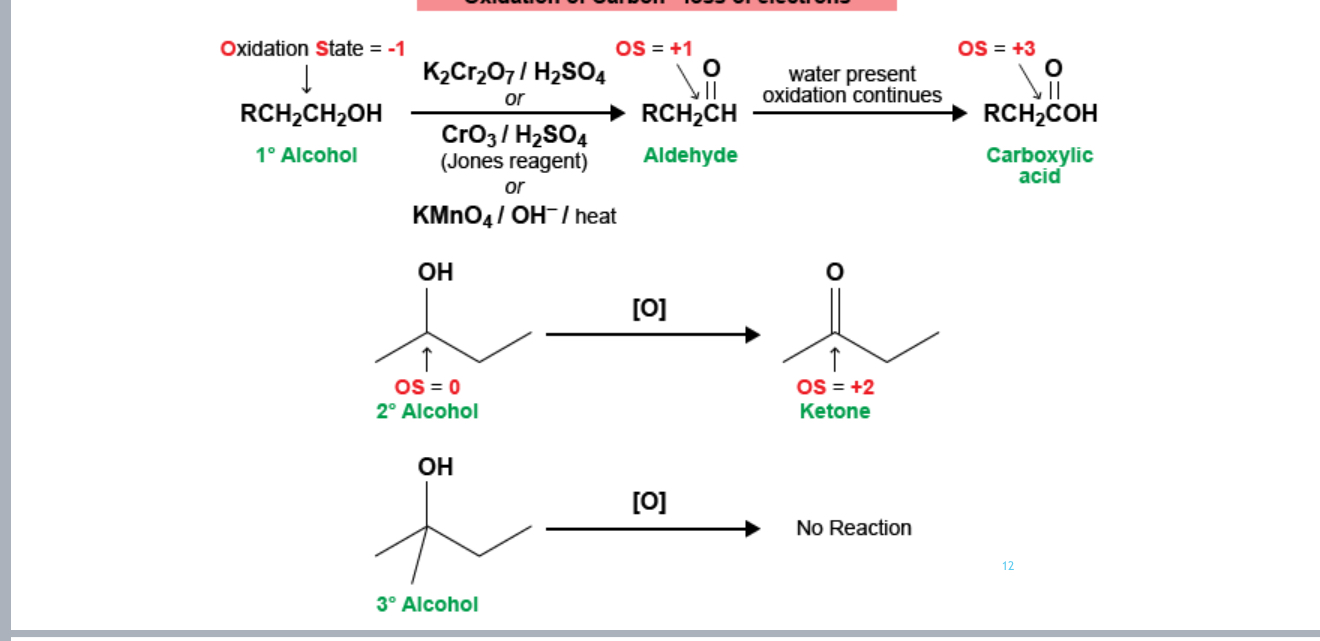
Reaction type: Oxidation of the Alcohols
Reagent: K2Cr2O7/H2SO4 or CrO3/H2SO4 (JOnes) or KMnO4/OH-/heat
Removes hydrogens from the alchohol
-the more hydrogens on the alpha carbon, the more reactive
primary alc→ aldehyde→carboxylic acid
sec alc→ Ketone
tert alc (no hydrogen)→ no reaction
they turn an alcohol’s C–O single bond into a C=O double bond. The key is removing the O–H hydrogen and a hydrogen on the carbon bearing the OH
-the acids with the Cr and Mn species→creates acidic conditions that help the alcohol attach to the chromium oxidizing agent.
Generates the active oxidant: dichromate in acidic water forms chromic acid and related chromium(VI) species.
Makes chromium easier to attack: protonating an oxygen on the chromium reagent increases chromium’s electrophilicity. The alcohol oxygen can then donate a lone pair to chromium, forming the chromate ester
-do not need to know arrow pushing
carboxylic acid
R-COOH
reaction type; partial oxidation of alchohols
-use when you want to stop at aldehyde part when oxidating primary alchohols =→ to do so, use a weaker oxidizing agent/weaker version of cro3
oxidizing agents; PCC + aprotic olvent
primary alcohol + PCC → (in aprotic solvent) species that is the aldehyde version of the primary alcohol
secondary alcohol +PCC→ ketone
reaction type; coversion of alcohol into haloalkane (primary alchohol and methanol) sn2 mechanism
-requires STRONG BINARY ACID where the species bound to H is the halogen
-2 STEPS PT+ sn2
-sn2 can only do primary and meth
step1: PT (proton transfer)
Oxygen on alcohol donates electron to the proton, which the proton transfers the electron to hydrogen on h-x
h on h-x donates the electron to the x creating x- and h2o+-r
nucleophile: the oxygen on the alcohol
electrophile; the halogen
internediate: oxonium formation (oxygen with positive charge)
step 2: sn2
x- donates electron tot the bond connecting oxonium and r group, the bond donates electron to the oxonium creating free h2o (water) and x is bound to where oxonium was
nucleophile; halide (- charge)
electrophile; oxonoium
why conversion of alcohol into haloalkane
why?→ OH group on the alcohol is a bad LG since it is highly basic (wants to donate eleectrons rather than leave with it)(remember, the best LG’s are the weak bases) thus, we convert the LG into a halogen so that then we can undergo substitution to get rid of the group
reaction type; coversion of alcohol into haloalkane (sec and tert alchohol) sn1 mechanism
-requires STRONG BINARY ACID where the species bound to H is the halogen
-3 STEPS PT+ sn1
step1: PT (proton transfer)
Oxygen on alcohol donates electron to the proton, which the proton transfers the electron to hydrogen on h-x
h on h-x donates the electron to the x creating x- and h2o+-r
nucleophile: the oxygen on the alcohol
electrophile; the halogen
internediate1: oxonium formation (oxygen with positive charge)
step 2: sn1 LG leaves
the bond donates electron to the oxonium creating free h2o (water) and carbocation is formed
nucleophile; bond connecting c and oxonium
electrophile; oxonoium
intermediate2: carbocation
step 3: sn1 attack
x- attacks the carbocationm forming bond between carbon (preciously carbocation) and x-
nucleophile; halide (x-)
electrophile; carbocation
reaction type: Conversion of alchols to haloalkanes (WITHOUT BINARY ACID) (remember, the reactants are loaded with haloalkanes)
two reacting species/nucleophiles; PBr3, SOCl2
-sn2 reaction (DIRECT SUBSTITUTION)
-only effective in primary and secondary alcohols, NOT TERTIARY alchohols
remember, that all reactions that include sn2 have INVERSION possible for product
R becomes S, wedges becomes dashes. ‘
You actually don’t have to redraw it first. Here’s an easier way to show SN2 inversion when Br is on a straight bond:
Replace Br with the nucleophile, keeping that straight bond.
Switch the wedged and dashed groups on that same carbon.
Reaction type: conversion of a alcohol into aljyl sulfonates
-why? dont forget that sulfonates (ROSO2R’) are also good leaving groups
reagents: TsCl and pyridine base (pyr)
step 1: substitution of alc to sulfonate
R-OH + TsCl + Pyr → R-OTs
step 2: substitution of sulfonate to R-Nu
R-OTs + H-Nu → R-Nu
(can be bi or uni depending on R group classification)
good leaving groups
Halogens, OH2(+) (oxonium), sulfonates (ROSO2R’)
what is R-OTs
tosylate leaving group (ROSO2R’)
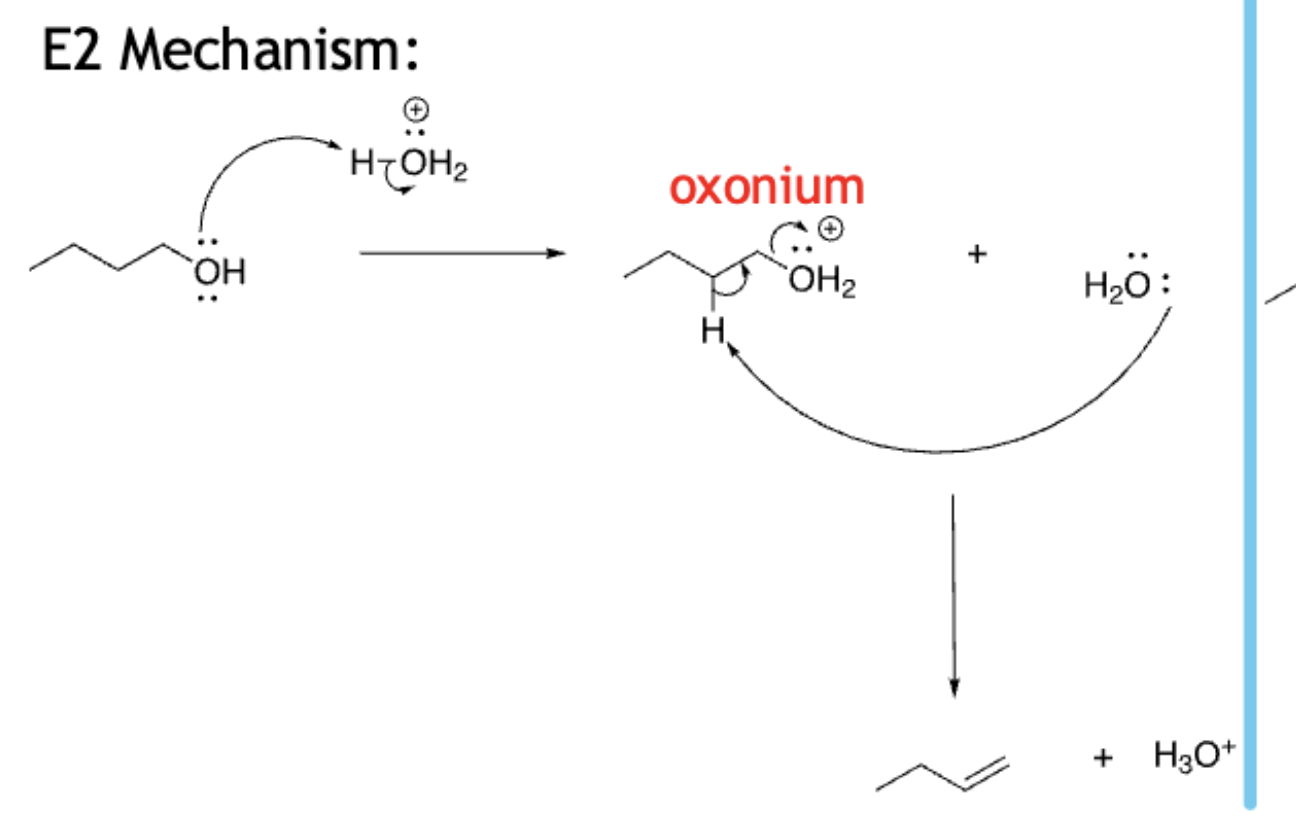
Reaction type Conversion of a PRIMARY alcohol to an alkene; ACID CATALYZED DEHYDRATION (what acid is used?)
acid→ oxoacid (not binary acid) h3, H2SO4, H3PO4
2 STEPS; PT + E2
REMEMBER< since this is E2, if the alcohol was on a ring structure then you would need to consider which beta hydrogen to DB (choose the one that is anti to the leaving group (which is h2o)
step 1: PT
oxygen donates electron to hydrogen on oxoacid, → oxygen becomes oxonium
hydrogen donates electron to the rest of the species, breaking bond between hydrogen and the acid
nucleophile; oxygen on alc
electrophile; hydrogen/part of the acid with pos formal charge
LG; none
transformations that occur; alcohol becomes oxonium, the acid becomes its conjugate base species
step 2: E2 reaction
beta hydrogen is attacked by base/nucelophilic atom on the base
attacked hydrogen leaves and joins conjugate base
extra electron attacks oxonium/LG → oxonium becomes water (ths dehydration)
product; db no alc alkene with acid that we started the reaction with
Nucleophile; conjugate base
electrophile; oxonium
LG: h2o
Reaction type Conversion of a SEC OR TERT alcohol to an alkene; ACID CATALYZED DEHYDRATION (what acid is used?)

E1 ACID-CATALYZED DEHYDRATION OF ALCOHOLS
Conditions: H₂SO₄ or H₃PO₄ + heat. H₃O⁺ may represent the acid in the mechanism.
Usually: secondary or tertiary alcohols, because they can form sufficiently stable carbocations.
3 STEPS: PT → WATER LEAVES → β-H REMOVAL
The last two steps make up the E1 elimination.
REMEMBER:
The double bond forms between the carbocation carbon and an adjacent carbon that loses H.
Usually favor the more substituted alkene: Zaitsev’s rule.
No E2 anti-periplanar requirement, including no trans-diaxial requirement for cyclohexanes: the leaving group has already left before H is removed.
Check for carbocation rearrangements before choosing the β-H. A hydride or alkyl shift may create a more stable carbocation.
Step 1: PT — proton transfer
The alcohol oxygen uses a lone pair to bond to a hydrogen on the acid.
Arrow pushing:
Alcohol oxygen lone pair → H on the acid.
Acid’s O–H bond → acid’s oxygen, breaking that bond.
The alcohol becomes R–OH₂⁺, a protonated alcohol or oxonium ion. Oxygen now has three bonds and a positive formal charge.
Electron donor/base: oxygen on the alcohol.
Electrophile: acidic H. It can be partially positive; it does not need a positive formal charge itself.
Leaving group from the alcohol: none yet.
Transformation: alcohol → oxonium; acid → its conjugate base.
Purpose: convert poor leaving group OH⁻ into a group that can leave as neutral H₂O.
Step 2: Water leaves — carbocation formation
The C–O bond breaks, and both bonding electrons go to oxygen.
Arrow pushing:
C–O bond → oxygen of OH₂⁺.
Water separates from the carbon chain. Oxygen becomes neutral, and the carbon that lost water becomes a carbocation.
Nucleophile/base: none involved in this step.
Electrophilic center produced: the positively charged carbon.
Leaving group: H₂O.
Transformation: oxonium → carbocation + water.
This is usually the slow, rate-determining step.
CHECK NOW: can a hydride or alkyl shift produce a more stable carbocation?
Step 3: β-H removal — double-bond formation
A base, commonly water or the acid’s conjugate base, removes H from a carbon adjacent to the carbocation.
Arrow pushing:
Base lone pair → β-H.
β-C–H bond → bond between the β carbon and carbocation carbon, creating C=C.
The H transfers to the base. The C–H electron pair stays with the carbon skeleton and forms the π bond, giving the carbocation carbon a full octet.
Base/electron donor: water or the acid’s conjugate base.
Proton accepted by the base: β-H.
Electron-deficient center receiving the new π bond: carbocation carbon.
Leaving group: water already left in step 2.
Transformation: carbocation → alkene; acid catalyst is regenerated.
Overall product: alkene + water, with the acid catalyst regenerated.
Memory sequence: protonate OH → lose water → remove neighboring H and form C=C.
conjugate base of h3o is..
h2o
Reaction type: conversion of alcohols into ethers (williamson ether synthesis)
step1: deprotonation of alc with a VERY STRONG BASE
strong base takes away hydrogen from alc to create alkoxide to formt he alkoxide nucleophile (o-)
step 2: sn2 subsitutition
alkoxide attacks a haloalkane, haloalkane leaves and joins with the strong base
the whole group with the alkoxide joins the alkane that was attched to the halogen, forming r-o-r
what is an ether look like
R-O-R
strong bases used for conversion of alcs into ethers
LDA, BuLi, KH, Li, Na, K, Cs
how to know that a reaction is going to be intramolecular
if you start with a chain and end with a cyclic molecule
intramolecular williamson ether synthesis forms epoxides
sn2 reaction within the molecule,
reagent; chain with both LG and OH + STRONG BASE
one step; base removes hydrogen from alc, forms alkoxide, alkoxide sttacked bonds leading to LG, LG leaves, the bond is mended by the LG side of the chain which is now pos to attach tot he negative alkoxide


converison of a ketone or aldehyde into a alcohol (reduction)

alcohols from organometallic reagents

acid retrosynthesis
oxidation of alcohol (oxygen added for carboxylic acid)

conversion of roh into haloalkane through sn2 reaction


conversion of roh into haloalkanes sn1 reaction


conversion of roh into alkenes; acid catalyzed dehydration


conversion of roh into ether

nucleophilic ring opening of oxiranes to produce alcohols


acid catalyzed ring opening (not a basic nucleophile for the ring opening like nucleophi;lic ring opening)


MgBr, Li2Br
grignard: R-MgBr where R is (-) carboanion
-Organolithium: R-Li2Br where R is (-) carboanion
-essentially function as carbanions and strong base
Ether: polar aprotic solvent
NaBH4 (BH4) and LiAlH4(AlH4)
K2Cr2O7/H2SO4
CrO3/H2SO4
KMnO4/OH-/heat
PCC + aprotic olvent
h-x strong binary acid
PBr3, SOCl2
conversion of alcohol to haloalkane without the use of a strong binary acid; direct susbtituion, with Sn2→ thus only occurs with primary or secondary
TsCl and pyridine base (pyr)
a VERY STRONG BASE LDA, BuLi, KH, Li, Na, K, Cs
primary alcohol into haloalkane, sec and tert alc into haloalkane
sn2, sn1
alcohol into tosylate
substitution
primary alcohol into an alkene, sec,tert alcohol into alkene
PT+E2, PT+E1
alcohol into an ether
pt + sn2
aldehyde/ketone into alchol
nucleophilic addition + PT
formaldehyde/other-carbonyl into alcohol using gringard
nucleophic addition + PT
nucleophilic chain opening
sn-2 like opening + PT
acid catalyzed chain opening
PT _+sn2 like opneing + PT
alkoxide is a good… and oxonium is a good…
nucleophile.base and oxonium is a good leaving group