Biochem Exam 2
 Call Kai
 Learn
Learn Practice Test
 Spaced Repetition
 Match
Match Flashcards
 Knowt Play
1/52

There's no tags or description
Looks like no tags are added yet.
Name | Mastery | Learn | Test | Matching | Spaced | Call with Kai | Chat |
|---|
No analytics yet
Send a link to your students to track their progress
53 Terms
Define and distinguish general acid-base catalysis versus covalent catalysis
Acid-base catalysis: acceleration of a reaction achieved by the transfer and acceptance of H+ OR the generation of OH- in solution from water
Covalent catalysis: part/all of a substrate binds covalently to the enzyme to form an intermediate (EX) before transferring to a second substrate
AX + E ⇌ EX + A EX + B ⇌ BX + E

Discuss metal ion catalysis
Essential metal ions that act as inorganic cofactors in enzymes. They bind tightly as electrophilic catalysts, can generate nucleophiles, and participate in substrate binding
Define what a pH curve is and how it informs one about amino acids that function in the catalytic site of an enzyme
A pH curve is the enzyme reaction rate compared to pH levels. Inflection points can indicate pKa values of the ionizable catalytic residues.

Distinguish reversible versus non-reversible inhibition
Reversible inhibition: the inhibitor binds non-covalently, is temporary, and easily dissociates from the enzyme. Includes competitive, uncompetitive, and noncompetitive inhibition
Irreversible inhibition: the inhibitor binds, stays attached, and modifies amino acids. Permanent and includes active-site directed and suicide inhibitors
Define and distinguish competitive, noncompetitive and uncompetitive reversible inhibition
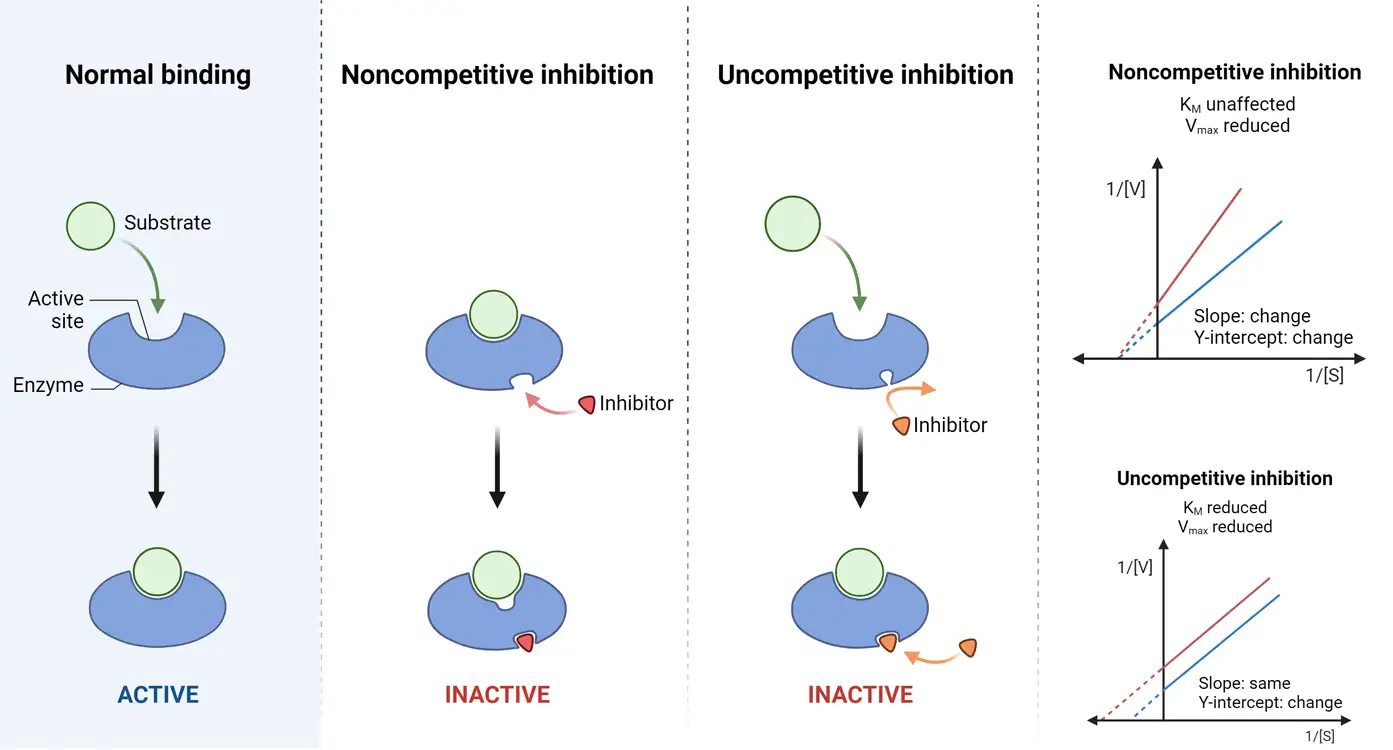
Competitive: inhibitor binds to the free enzyme (E) at the substrate binding site, competing with the substrate
Uncompetitive: inhibitor only binds to the enzyme-substrate complex (ES), decreasing both Vmax and Km
Noncompetitive: inhibitor binds to both E and ES at a site distinct from the active site; decreases Vmax while Km remains unchanged
Describe a Lineweaver-Burk plot and explain how to use it to derive information about enzyme inhibitors
A double-reciprocal plot with 1/v0 vs. 1/[S]. Y-intercept = 1/Vmax and X-intercept = -1/Km. Slope = Km/Vmax
Competitive intersects on the y-axis
Uncompetitive gives parallel lines
Noncompetitive intersects on the x-axis
![<p>A double-reciprocal plot with 1/v0 vs. 1/[S]. Y-intercept = 1/Vmax and X-intercept = -1/Km. Slope = Km/Vmax</p><p></p><p><strong>Competitive</strong> intersects on the y-axis</p><p><strong>Uncompetitive</strong> gives parallel lines</p><p><strong>Noncompetitive</strong> intersects on the x-axis</p>](https://assets.knowt.com/user-attachments/58c6c50a-fa3e-44db-b7e7-7b485850f8a9.jpg)
Describe how irreversible inhibitors can be used to map active sites of enzymes including the use of affinity labels
Irreversible inhibitors covalently modify specific active-site residues
Affinity labels resemble the substrate to target the active site and covalently react with catalytic amino acids, allowing researchers to identify/map catalytic residues

Describe site-directed mutagenesis and how it can be used to study enzymes
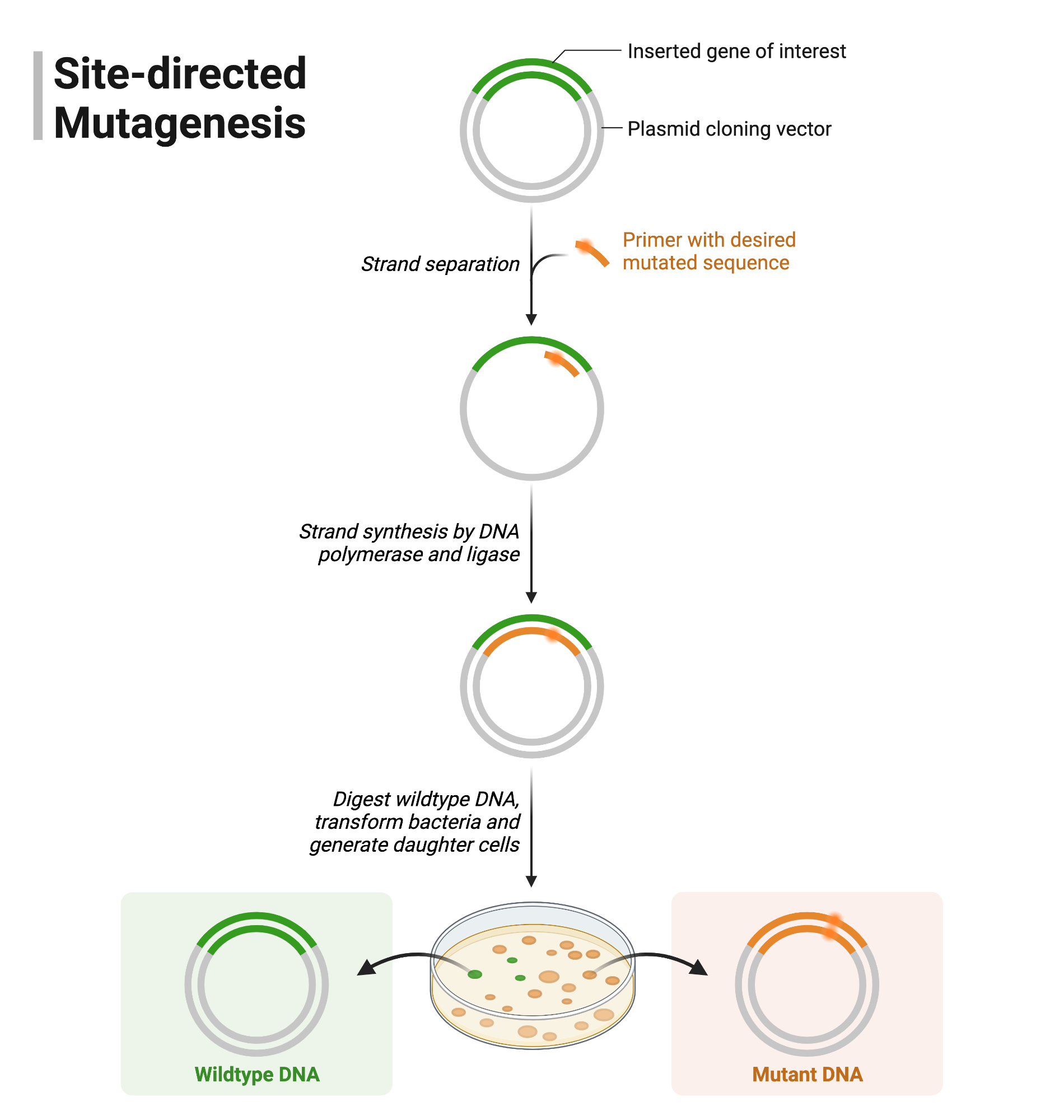
Site-directed mutagenesis is a precise alteration of a specific amino acid codon in an enzyme’s gene to test its role in binding or catalysis
Define what the catalytic site and catalytic residues are
Catalytic sites: a specialized region containing polar/ionizable amino acids + H2O molecules that undergo chemical changes during catalysis
Catalytic residues: the specific amino acid side chains that undergo/interact with chemical changes

Distinguish the substrate binding site(s) and catalytic site of enzymes
Substrate binding sites are pockets that recognize and bind a substrate via non-covalent interactions


Describe what is meant by enzyme mechanism and give some examples
Triose Phosphate Isomerase (TPI): catalyzes aldehyde-ketone interconversion between DHAP + G3P via a proton-shuttling mechanism involving an enediolate intermediate utilizing Glu-165 and His-95
alpha-Chymotrypsin: serine protease uses a catalytic triad (Asp-102, His-57, Ser-195) to perform acyl-enzyme covalent catalysis and general acid-base catalysis with tetrahedral intermediates

Explain what serine proteases are and define their specificity
Serine proteases are digestive enzymes synthesized in the pancreas as an inactive zymogen and activates by proteolysis in the small intestine
Chymotrypsin: deep hydrophobic pocket accepting a large aromatic chain (Tyr, Phe, Trp)
Trypsin: deep pocket with a negatively charged Asp at the bottom accepting positively charged Lys/Arg
Elastase: shallow pocket restricted by bulky Val and Thr side chains, accepting small uncharged amino acids (Ala, Gly)
Describe the three levels of enzyme regulation
Genetic Control: regulation of enzyme concentration via transcription/translation synthesis and degradation
Covalent modification: activation/inactivation by covalent changes or zymogen cleavage
Allosteric regulation: reversible non-covalent binding of effector molecules at allosteric sites
Distinguish the binding mode and chemical modes of enzyme catalysis
Binding mode: proximity effect + transition-state stabilization, providing 10^4 - 10^5 fold rate
Chemical modes: acid-base and covalent catalysis, providing 10- 100-fold rate enhancement
Describe what information an energy diagram gives you about enzyme catalyzed reactions
An energy diagram can illustrate ground states, intermediate energy walls, and activation energy barriers
Compare and contrast proximity effect and transition state stabilization in regards to enzyme catalysis
Proximity effect increases effective reactant concentration to promote transition-state formation by 10^4-10^5 fold-rate
Transition-state stabilization: the enzyme binds transition states 10^10-10^15 times more tightly than substrates, directly lowering activation energy and overall leading to a 10^4-10^5-fold rate increase
Describe the possible functions of the seven amino acids with ionizable side groups in catalytic sites
Aspartate - COO^- allows cation binding/proton transfer
Glutamate - COO^- allows cation binding/proton transfer
Histidine - imidazole provides general acid-base proton transfer
Cysteine - SH provides covalent binding of acyl groups/nucleophile
Tyrosine - phenol allows hydrogen bonding to ligands
Lysine - NH3+ allows anion binding and proton transfer
Arginine - anion binding

Explain the structure, group transferred and type of reaction associated with for each of the major 12 coenzymes
Uh yeah best of luck
Know whether the 12 major essential coenzymes are vitamin-derived or metabolite-derived and whether they are cosubstrates or prosthetic groups
mhm…continue best of luck

For the vitamin-derived coenzymes, know from which vitamin they are derived and where that vitamin-derived structure is in the coenzyme
yep yep
Understand the role of carbohydrates as major recognition and cell-cell interaction determinants
Lymphocyte → lymph nodes
ABO blood → cell-surface antigen
Serves for recognition determinants in cell-cell interaction events
Explain the definition of carbohydrates in regards to polyhydroxyl aldehydes and polyhydroxyl ketones
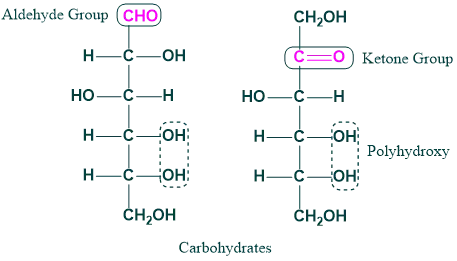
Polyhydroxyl aldehydes: the carbonyl group is located at the end of the molecule
Polyhydroxyl ketones: the carbonyl group is located internally in the molecule
State the different functions of carbohydrates
Energy storage
Metabolic intermediates
Structural framework
Extracellular matrix
Cell-cell recognition + signaling
Define and distinguish the terms: monosaccharides, disaccharides, oligosaccharides, glycans, aldoses, ketoses, glycobiology, glycoconjugate
Monosaccharides: individual monomeric sugar units
Disaccharides: 2 monosaccharides covalently bonded
Oligosaccharides: short chains containing 2-20 linked monosaccharides
Glycan: a term for a carbohydrate polymer
Glycoconjugate: a complex molecule where one or more carbs are linked to a non-carb species such as a protein/lipid
Glycobiology: the study of glycan and glycoconjugates in nature

Discuss D vs L sugars
For sugars containing 1+ chiral centers, this refers to the configuration of the furthest chiral carbon from the aldehyde/ketone group.
D= right
L= left

Understand terms such as triose, tetrose, pentose, hexose, etc.
Triose- 3 carbons
Tetrose- 4 carbons
Pentose- 5 carbons
you get the idea
Define the term epimer and give examples
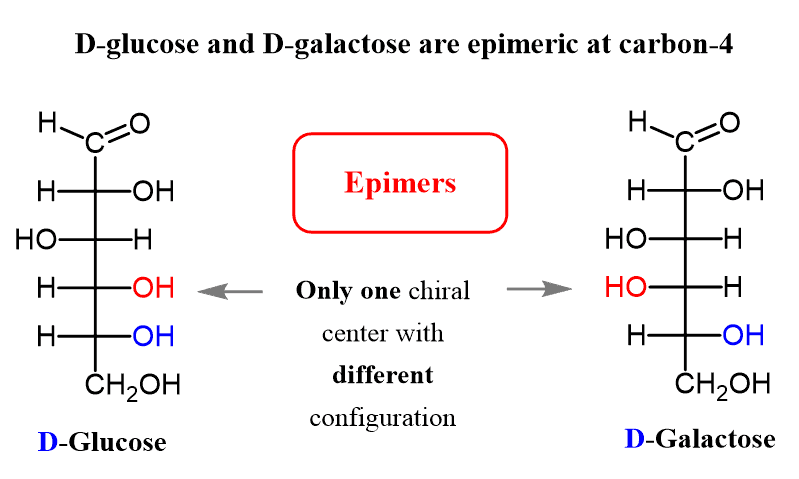
An epimer is a stereoisomer that differs in configuration at only one specific chiral center
Be able to draw the structure of representative tri, tetra, penta, and hexa- aldoses and ketoses and know their common and scientific names
uh… yeah you got it man

Understand hemiacetals and hemiketals and linear vs cyclic sugars
Hemiacetals: a reaction with an aldehyde group
Hemiketal: a reaction with a ketone group
Linear: chains
Cyclic: well…cyclic
Define the terms pyranose and furanose
Pyranose: a 6-membered ring system
Furanose: a 5-membered ring system

Distinguish an alpha versus beta anomeric linkage in carbohydrates
An anomeric carbon is a carbon atom in a cyclic sugar originally part of the carbonyl group in the open-chain form
Alpha anomeric linkage: the OH group on the anomeric carbon is trans relative to the C6 substituent
Beta-anomeric linkage: the OH group on the anomeric carbon is cis relative to the C6 substituent
Give examples of the conformation of cyclic pentose and hexose
Cyclic pentose: Exist in 10 envelope conformations
Cyclic hexose: adopt 2 chair conformation and 6 boat conformations with bulky hydroxyl groups in equatorial positions (most stable)

Explain and give examples of common biological phosphate, acidic, deoxy and amino sugars
Yep you got it
Know the three letter abbreviation of common biological sugars
Yerp
Explain what a glycosidic bond is and distinguish the terms glucoside vs glycoside
Glycoside: any compound where a carbohydrate provides the anomeric carbon
Glycoside: a specific glycoside where glucose provides the anomeric carbon
A glycosidic bond is a condensation bond formed under acidic conditions between the anomeric carbon of a sugar and an alcohol, amine, or thiol
Describe the structure, common and scientific name and source of the major disaccharides maltose, cellobiose, lactose, sucrose
Yerp
Distinguish reducing end vs non-reducing end of an oligo/polysaccharide
Reducing end: end containing a free, unbounded anomeric carbon
Non-reducing end: the end where the anomeric carbon is locked into a glycosidic linkage
Define the terms aglycone and glycoside
Aglycone: the non-sugar organic group attached to the sugar’s anomeric carbon in a glycoside
Glycoside: any compound containing a glycosidic bond where a carbohydrate provides the anomeric carbon
Distinguish between homopolymer vs heteropolymer
Homopolymer: composed of a single repeating monosaccharide species
Heteropolymer: composed of two or more distinct monosaccharide species
Describe the structure and function and distinguish of the glucohomopolymers starch and cellulose
Starch: plant storage polymer consisting of linear amylose and branched amylopectin.
Cellulose: structural component of plant cell walls consisting of unbranched glucose chains that interact via intra/inter-chain hydrogen bonds to form microfibrils and tough fibers
Define Degree of Polymerization (DP)
The total number of monomeric units in a macromolecule or polymer
Distinguish endoglycanase versus glycosidase
Endoglycanase: cleaves internal glycosidic bonds at random positions within a polymer chain
Exoglycosidase: cleaves monosaccharides or disaccharides sequentially from the non-reducing end of the chain
Explain the difference between alpha-amylase and beta-amylase
Alpha-amylase: an endoglycanase present in salive and pancreas that cleaves random internal alpha-1,4-glucosidic bonds
Beta-amylase: an exoglycosidase that acts from non-reducing ends to release maltose dimers
Describe the structure and function of chitin
Structural homopolymer composed of repeating beta (1→4)-linked N-acetylglucosamine residues. Found in arthropod exoskeletons and fungal cell walls

Explain what glycosaminoglycans and proteoglycans are
Glycosaminoglycans: unbranched heteroglycans composed of repeating disaccharides containing an amino sugar
Distinguish N-linked vs O-linked oligosaccharides and glycoprotein
N-linked: sugar attached via an N-glycosidic linkage to the amide nitrogen of an Asparagine residue within the consensus sequence Asn-X-Ser/Thr (X=any amino acid except Pro)
O-linked: sugar attached via an O-glycosidic linkage to the hydroxyl oxygen linkage to the hydroxyl oxygen of Serine or Threonine residues
