phis
 Call Kai
 Learn
 Practice Test
 Spaced Repetition
 Match
 Flashcards
 Knowt Play
1/128

There's no tags or description
Looks like no tags are added yet.
129 Terms
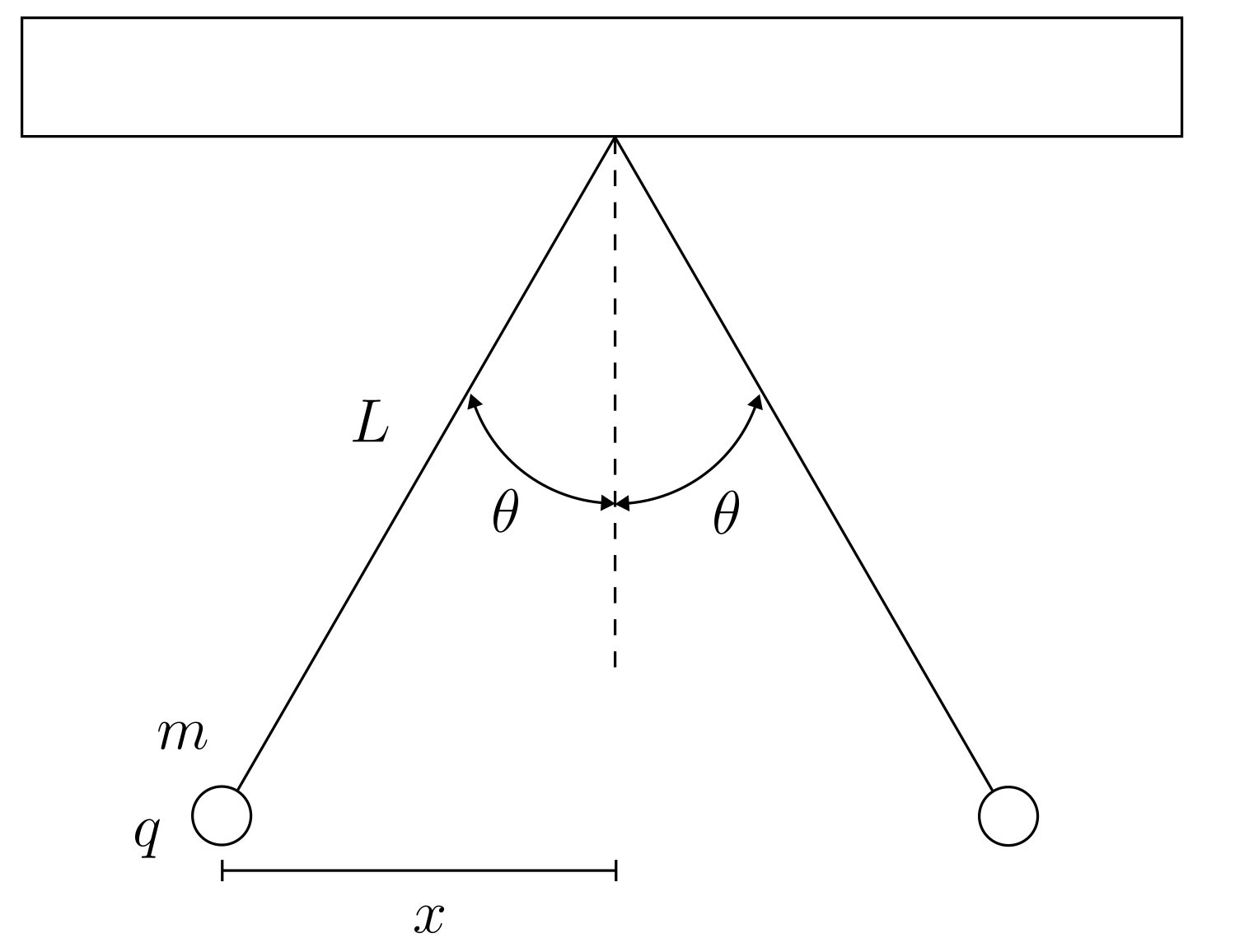
1A 2.1) Find the magnitude of charge on one of the balls. you may use the approximation 𝑠𝑖𝑛(Θ) =𝑡𝑎𝑛(Θ)
q=kL4mgx3
1A 2.2) assume the two balls are losing charge to the air very slowly. That means they'll be slowly approaching each other. If a ball is moving at an instantaneous speed. at what rate is the ball losing charge?
dtdq=23xqdtdx
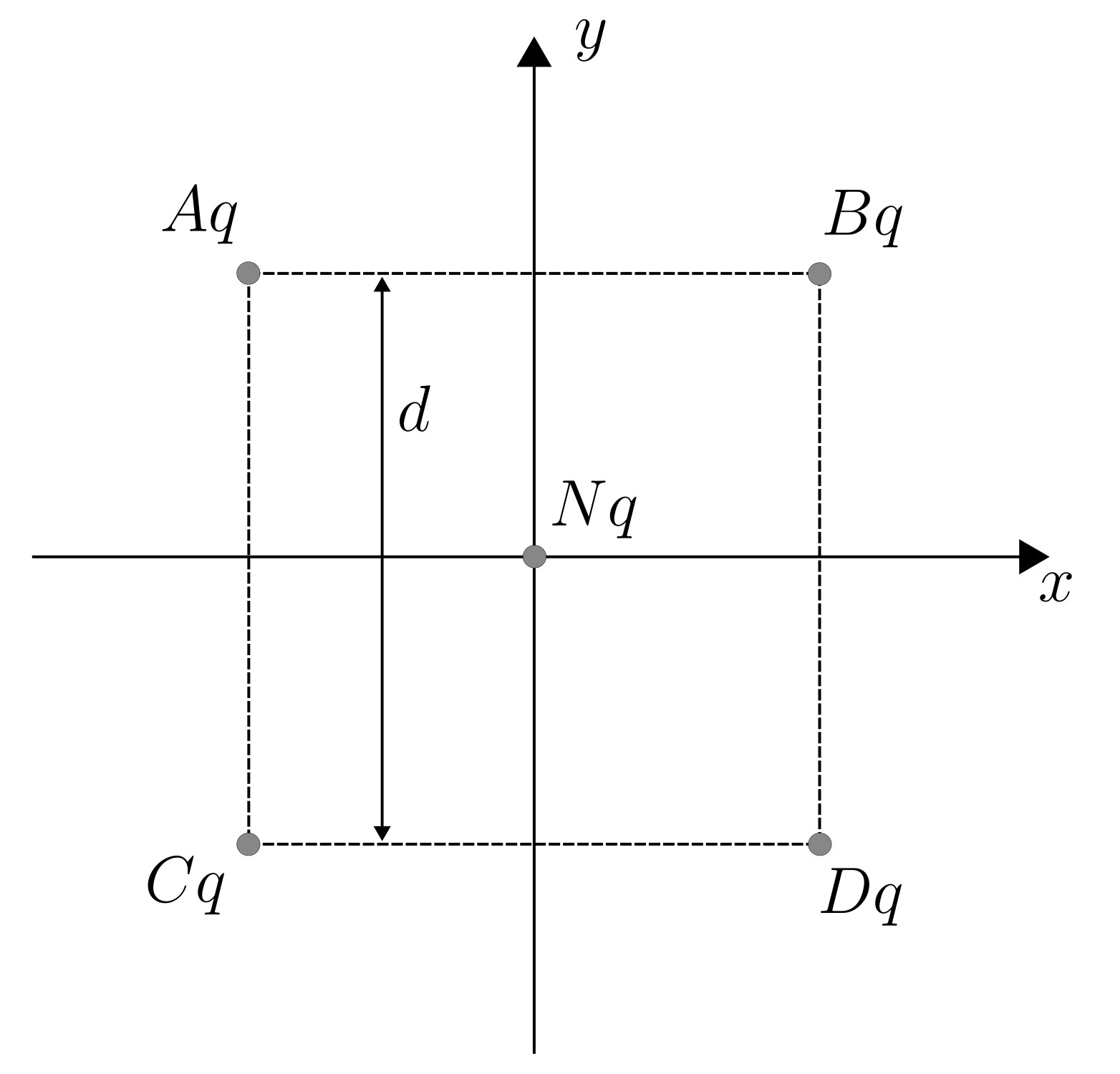
There's a charge at the center of the square of size N𝑞. What is the net x-component of the force on this center charge?
fx=d22kNq2(A−B+C−D)
1A 4.2) A = 8, B = 6, C = 7, D = 6, and N = 1. What is the net force in the y-direction on the center charge?
fy=d22kNq2(−A−B+C+D)
1A 4.3) Consider the situation as described above with A=B=C=D=1,N=-1. For the following, check each box that corresponds to a true statement. Select "None of the above" if none of them are true.
A. The equilibrium point at the center is a stable equilibrium for the negative charge for motion perpendicular to the plane of the square.
B. If one were to double the magnitude of the upper-right-hand positive charge, the negative charge would be in equilibrium.
C. If one were to triple the magnitude of the negative charge, the negative charge would be in equilibrium.
D. The equilibrium point at the center is an unstable equilibrium for the motion of the negative charge in the plane of the square.
E. The sum of the forces on the center charge in the x-direction equals zero.
A, C, D, E
1A 5) Electric forces between two charged objects tend to be much stronger in magnitude than the attractive gravitational force between them. Two particles of masses 8.63 kg and 1.84 kg and charges 6.2 𝜇C and −1.92 𝜇C respectively are separated by a distance 22.8 cm. Find the magnitude of the ratio of the electric to gravitational forces between them.
ratio=FgFe=r2Gm1m2r2k∣q1q2∣=Gm1m2k∣q1q2∣
1A 6.1) Assume that the charges are arranged as before, and that they have the following sizes: 𝑄1 =1.9 𝜇C, 𝑄2 =−3.6 𝜇C, 𝑄3 =2.1 𝜇C. Calculate the total force on 𝑄2. If the net force is to the left, enter it as a negative number. Otherwise, enter it as a positive number.
Fnet,2=F12+F32=k∣Q2∣((r12)2∣Q3∣−(r23)2∣Q1∣)
1A 6.2) We have three charges, 𝑄1, 𝑄2, and 𝑄3, arranged in a straight line. 𝑄2 is 0.38 m to the right of 𝑄1. 𝑄3 is 0.19 m to the right of 𝑄2. Check all of the following statements that are true. If none of them are true, check "None of the above."
A. The force on 𝑄1 because of 𝑄3 will be to the right if those charges are of opposite signs.
B. The force on 𝑄3 because of 𝑄1 will be to the left if those charges are of opposite signs.
C. The force on 𝑄3 because of 𝑄2 will be to the right if those charges are of the same sign.
D. The force on 𝑄1 because of 𝑄2 will be to the right if those charges are of opposite signs.
E. The force on 𝑄2 because of 𝑄3 will be to the left if those charges are of the same sign.
all are true
1A 6.3) Now we're going to change things a bit. The charges still have the same sizes and signs (𝑄1 =1.9 𝜇C, 𝑄2 =−3.6 𝜇C, 𝑄3 =2.1 𝜇C). 𝑄2 is still 0.38 m to the right of 𝑄1. But now we're free to put 𝑄3 anywhere. Find the location at which 𝑄3 will feel zero net force. Write your answer as the distance 𝑄3 is from 𝑄1 with a negative sign if 𝑄3 is to the left of 𝑄1, and a plus sign otherwise.
x=∣Q2∣−∣Q1∣d∣Q1∣ Since Q3 is to the left of Q1, the position coordinate relative to Q1 is −x.
1B 1.1) A non-uniformly charged semicircle of radius 𝑅 =19.3 cm lies in the 𝑥𝑦 plane, centered at the origin, as shown. The charge density varies as the angle 𝜃 (in radians) according to 𝜆 =3.22𝜃, where 𝜆 has units of 𝜇 C per meter.

What is the total charge on the semicircle?
dE=R2kedq=R2ke(λ(θ)Rdθ)=RkeC0θdθ
1B 1.2)
what is the y component of the electric field at the origin?
Ey=−RkeC0∫0πθsinθdθ
1B 2.1)
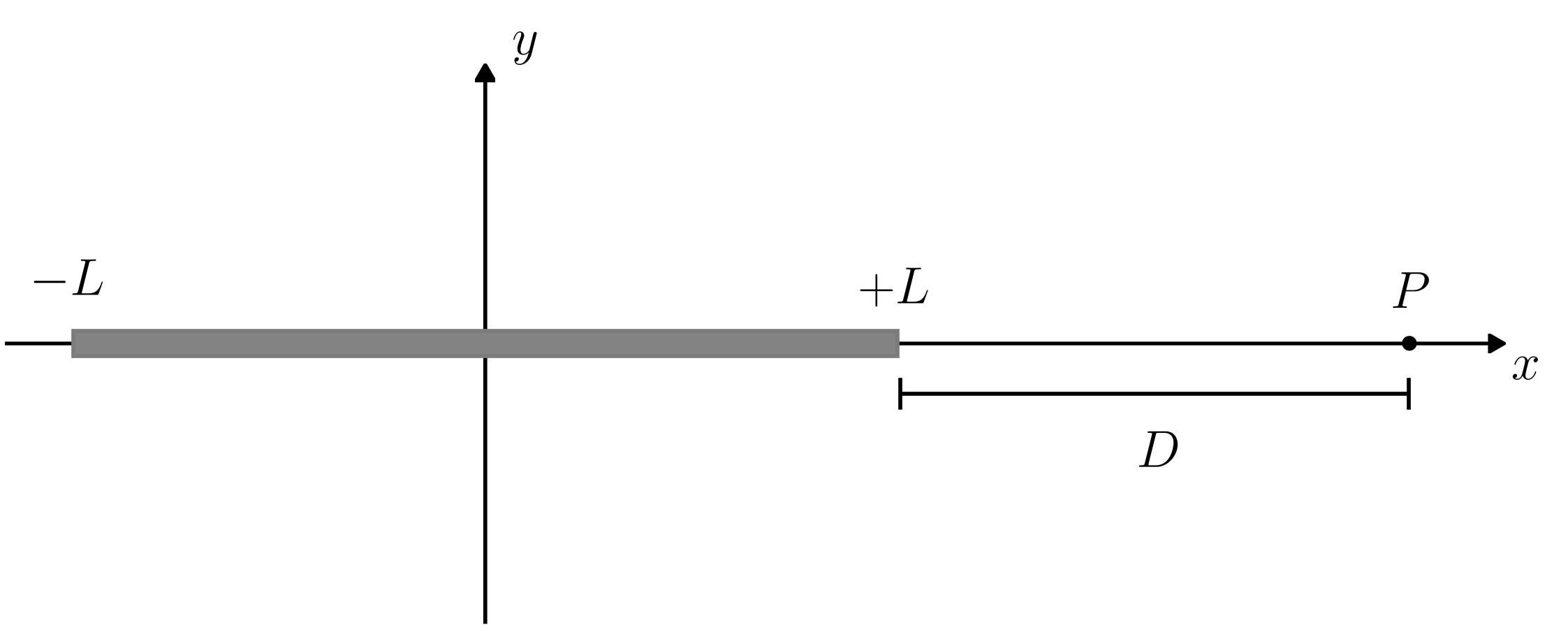
The rod has a charge density which varies according to 𝜆 =𝑎𝑥²
What is the total charge on the rod?
q=∫−LLax2dx=a[3x3]−LL=32aL3
1B 2.2)
What is the 𝑥 component of the electric field at a point on the 𝑥 axis a distance of 𝐷 =3.4 m from the end of the rod? Use a negative sign for a field pointing in the -x direction.
Ex=kea∫−LL((L+D)−x)2x2dx
1B 3.1) An electron with a speed of 𝑣 =8 ×10⁷ m/s enters an electric field of magnitude 𝐸 =4 ×10³ N/C, traveling along the field lines in the direction that slows its motion.
How long does it take the electron to stop?
t=eEmev
1B 3.2) An electron with a speed of 𝑣 =8 ×10⁷ m/s enters an electric field of magnitude 𝐸 =4 ×10³ N/C, traveling along the field lines in the direction that slows its motion.
How far will the electron travel in the field before stopping momentarily?
d=2eEmev2
1B 4.1

Consider the situation as described above and the following statements. Check each box that corresponds to a true statement. Select "None of the above" if none of them are true.
A. The charge on a segment of the rod of infinitesimal length 𝑑𝑦 is given by 𝑑𝑄 =𝑄𝐿𝑑𝑦
B. Given that both charges are positive, the net force on 𝑞 in the 𝑥 direction is to the left.
C. Given that both charges are positive, the net force on 𝑞 in the 𝑦 direction is upwards.
D. The total force on 𝑞 is generally in the +𝑥 direction.
E. The magnitude of the force on charge 𝑞 due to the small segment 𝑑𝑦 is 𝑑𝐹 =𝑘𝑞𝑄4𝐿𝑟2𝑑𝑦
F. The 𝑦-components of the force on 𝑞 cancel.
A, D, F
1B 4.2
Use integration to compute the total force on 𝑞 in the 𝑥 direction.
Fx=LkeqQD∫−L/2L/2(D2+y2)3/2dy

1B 5) We have two equal and opposite point charges near each other (sometimes called an electric dipole). Mark all of the following statements that are true. Choose "None of the above" if none of them are true.
A. A negative charge at point 𝑑 will accelerate towards the top of the page.
B. A positive charge at point 𝑐 will accelerate towards the top of the page.
C. A negative charge at point 𝑒 will accelerate to the left.
D. A positive charge at point 𝑎 will accelerate towards the bottom of the page.
E. A positive charge at point 𝑐 will accelerate leftwards and towards the top of the page.
F. A positive charge at rest at point 𝑏 will remain at rest.
A, B
1C 1) We have an electric flux of magnitude 160 Nm2/ C passing through a flat horizontal surface with an area of 0.58 m2. The flux is due to a uniform electric field, which points 29.9 degrees above the horizontal. Find the magnitude of the electric field.
E=Acos(θ)ΦE

1C 2) Electric Flux Due to a Point Charge. We have point charge of size 4.1 C sitting a distance 𝑑/2 directly above the center of a square of side length 12 mm. What is the magnitude of the electric flux through the square?
Φsquare=61Φtotal=6ε0q
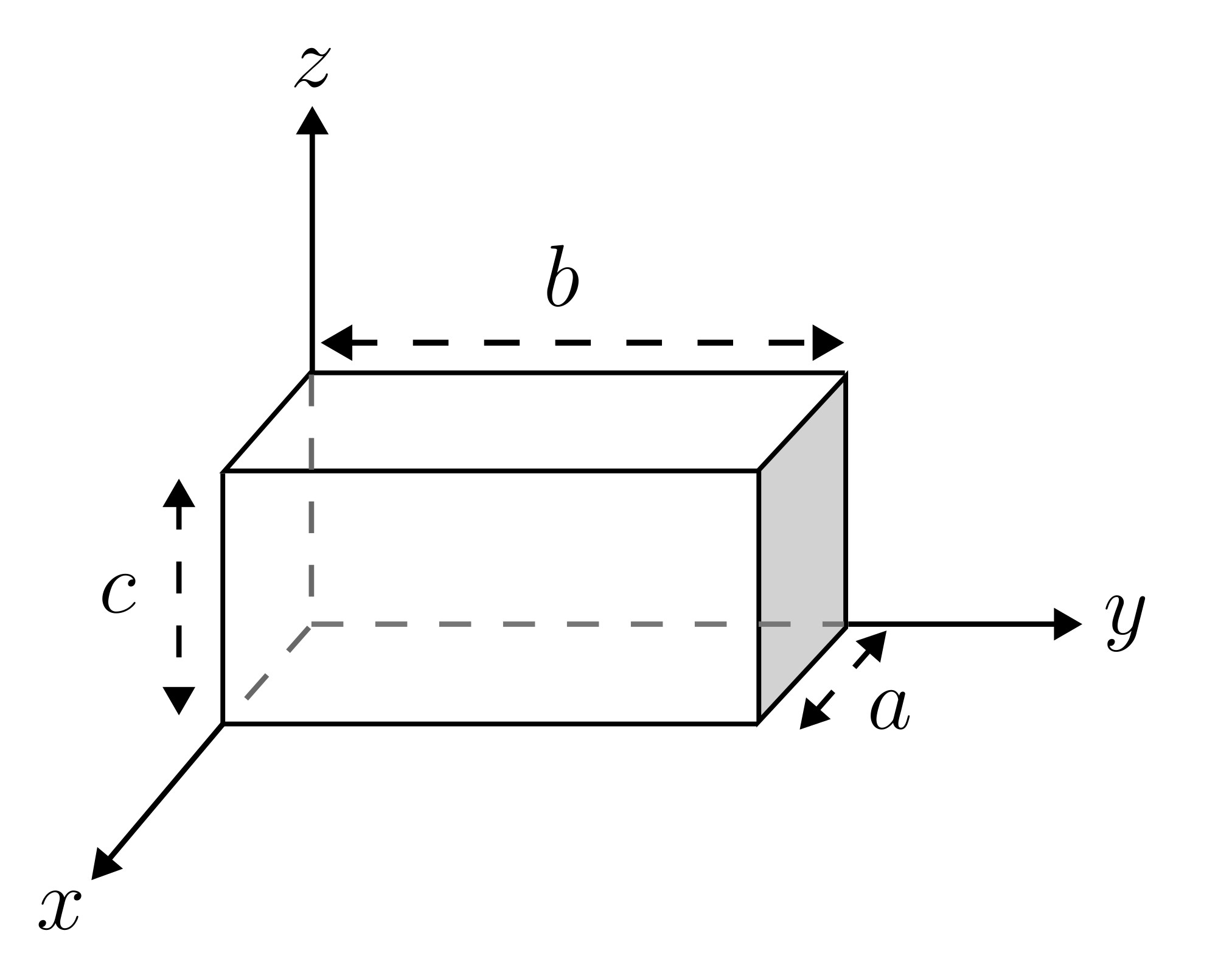
1C 3) What is the magnitude of the electric flux passing through the shaded area?
Φ=∬E⋅dA=>Φ=∫0adx∫0cw2z2dz
1D 1.1) e-field of sphere for r<R
Einside=R3ke⋅Q⋅r
1D 1.2) e-field for sphere for r>R
Eoutside=r2ke⋅Q
1D 1.3) e-fied of conducting sphere for r<R
0 (charge around edges)
1D 1.4) e-field of sphere for r>R
Eoutside, conducting=r2ke⋅Q

1D 2.1)

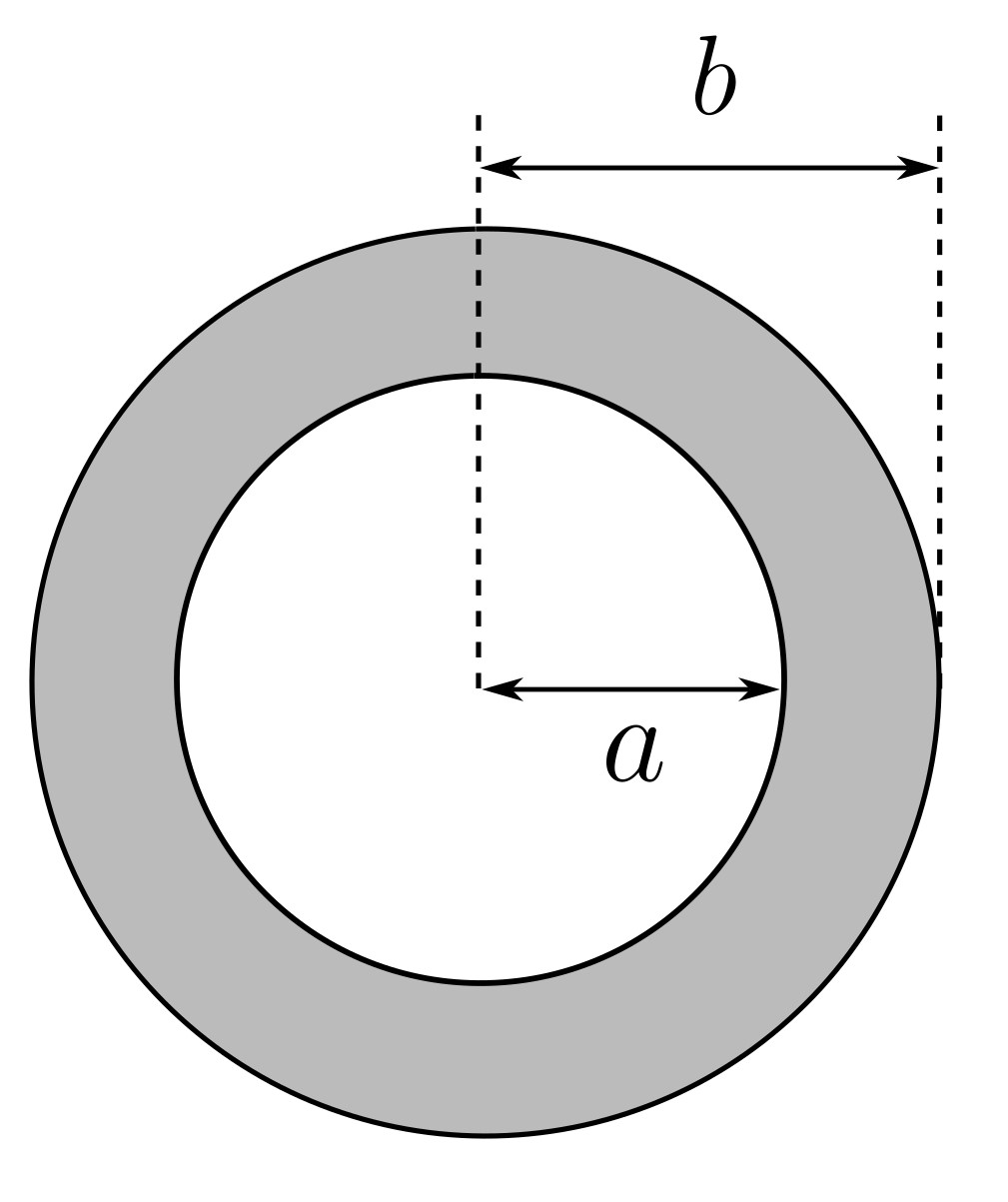
What is the magnitude of the electric field at a distance of 𝑟 =1.78 m from the axis? (a<b<r)
E=2ε0rρ(b2−a2)
1D 2.2)

What is the magnitude of the electric field at a distance of 𝑟 =1.58 m from the axis? (a<r<b)
E=2ε0rρ(r2−a2)

1D 2.3)
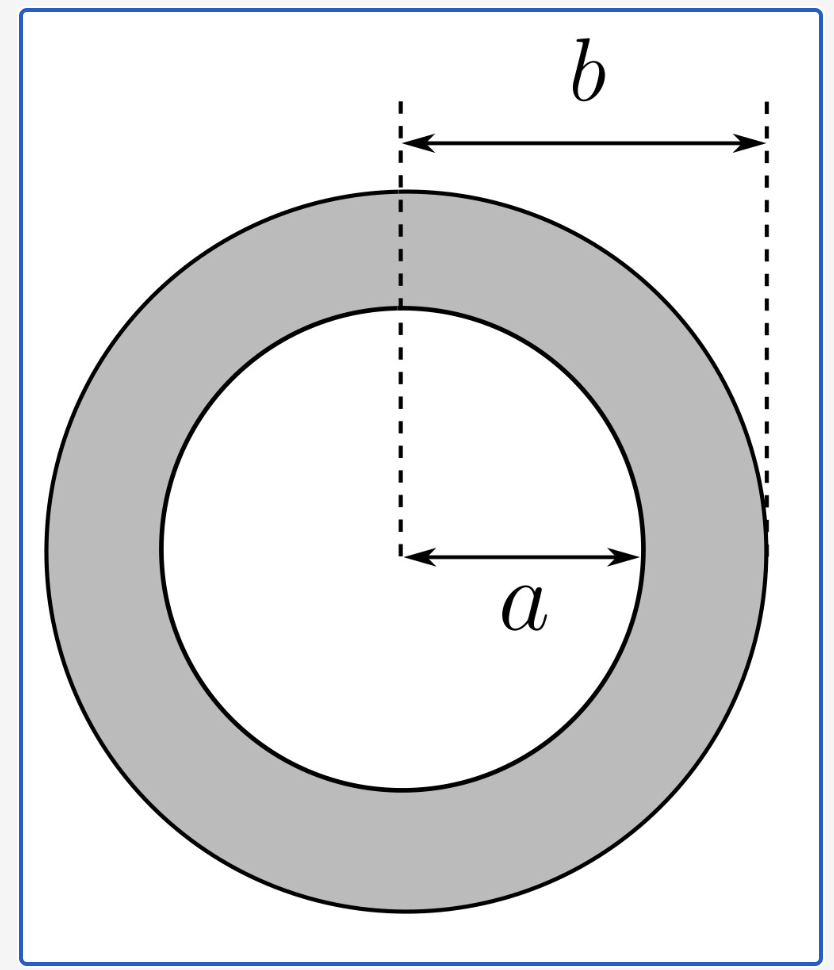
What is the magnitude of the electric field at a distance of 𝑟 =0.5 m from the axis? (r<a<b)
0
1D 3.1) given a Nonuniformly Charged Cylinder and r<R
E=2ε0ρr
1D 3.2) given a Nonuniformly Charged Cylinder and r>R
E=2ε0rρR2
1D 4.1) We have two uniformly charged parallel plates, as shown. Their widths are much larger than the separation between the plates. The magnitudes of the charges on each are equal. 𝑎, 𝑏, and 𝑐 indicate the regions just above, in between, and just below the plates, respectively.
A. If the plates are oppositely charged, there is no electric field in region 𝑐
B. If both plates have the same sign of charge, the fields they make cancel at the point exactly in between the plates, but nowhere else
C. If both plates are negatively charged, the electric field in region 𝑎 points towards the top of the page.
D. If both plates are positively charged, there is no electric field in region 𝑏.
E. The field made by either plate individually is given by 𝜎/𝜖0
A, D
1D 4.2)

Now let's suppose that the plates are squares with side length 2 cm, and that they have equal and opposite charges of magnitude 3.1 𝜇C. What is the magnitude of the electric field in region 𝑏?
Eb=ε0L2q
1D 5) We have a solid metal sphere with total charge 𝑄 and radius 𝑅 centered on the origin. Check each box that corresponds to a true statement. Select "None of the above" if none of them are true. Note that >> and << mean "much larger than" and "much smaller than", respectively.
A. The electric field for 𝑟 >𝑅 is the same as the field that would be made by a point charge with size 𝑄 at the origin.
B. If the shape was something other than a sphere, but still conducting, the field in the interior might be nonzero.
C. The electric field for 𝑟 >>𝑅 is the same as the field that would be made by a point charge with size 𝑄 at the origin.
D. If the sphere were insulating instead of conducting, the interior of the sphere would have to be neutrally charged.
E. The charge on the conducting sphere must all be on the outer surface of the sphere.
F. The electric field for 𝑟 <𝑅 is the same as the field that would be made by a point charge with size 𝑄 at the origin.
G. None of the above are true.
A, E

1E 1.1 A line of charge with a non-uniform charge density 𝜆 =𝑎𝑦, where 𝑎 =−8 nC/m2 lies along the 𝑦 axis with one end at the origin and the other at 𝑦 =ℎ, where ℎ =2.9 m.
What is the total charge on this object?
q=∫0hλdy=∫0haydy
1E 1.1)
Calculate the electric potential of this line of charge at point P on the 𝑥 axis a distance 0.8 m from the origin. Assume the potential equals zero at infinity.
V=∫0hdV=ka∫0hy2+D2ydy V=ka(h2+D2−D)

A. The electric field at point 𝑒 is stronger than the field at point 𝑐.
B. Charge Q3 has the smallest magnitude of all.
C. Charge Q1 is a positive charge.
D. The force on a proton at point 𝑐 would point towards charge Q3.
E. The magnitude of the electric field at point 𝑓 is zero.
F. Charge Q2 is the smallest negative charge.
G. None of the above.
A, F
1E 3) The potential difference between two parallel plates is 326 V. An alpha particle with mass 6.64 ×10⁻²⁷ kg and charge of 3.20 ×10⁻¹⁹ C is released from rest near the positive plate. What is the speed of the alpha particle when it reaches the other plate? The distance between the plates is 49 cm.
ΔK=−ΔU
21mv2=qΔV
v=m2qΔV
1E 4) A spherical rain drop carries a charge of 0.25 nC and has an electric potential of 10.9 kV at the surface. Find the surface area of the drop assuming that the potential equals zero at infinity.
V=RkQ
Rearranging to solve for the radius R:
R=VkQ
2. Surface Area Equation
The surface area A of a sphere is:
A=4πR2
Substituting R into the surface area equation gives the combined setup:
A=4π(VkQ)2

1E 5)
We have two charges A and B of sizes 3.45 ×10⁻⁹ C and −8.15 ×10⁻⁹ C, respectively. Calculate the electric potential at the location marked P
Vtotal=VA+VB=krAqA+krBqB
1F 1) Suppose that an electric field has the following components: 𝐸𝑥 =6𝑥2𝑦𝑧2, 𝐸𝑦 =2𝑥3𝑧2 +2𝑦𝑧, 𝐸𝑧 =4𝑥3𝑦𝑧 +𝑦2, where 𝐄 is measured in V/m and the distances are measured in m. Find the change in voltage associated with going from the origin to the point 𝑥 =−3.60 m, 𝑦 =7.2 m, 𝑧 =3.5 m.
ΔV=−∫(0,0,0)(−3.60,7.2,3.5)E⋅dr V(x,y,z)=−2x3yz2−y2z
1F 2) The electric potential in a certain region of space is given by 𝑉(𝑥,𝑦,𝑧) =𝛼𝑥2𝑦 +𝛽𝑦2𝑧, where 𝛼 =562 V/m3 and 𝛽 =408 V/m3 are constants. Consider the point 𝑃(𝑥,𝑦,𝑧) =4.25,5,2.75, where the coordinates are given in m. calculate each component of the electric field
Ex=−∂x∂V,Ey=−∂y∂V,Ez=−∂z∂V

1F 3)
If we take the potential at the axis to be zero, what is the electric potential at the outer radius of the shell?
V(b)−V(a)=−∫abE(r)dr=−∫ab2ε0rρ(r2−a2)dr
Vb=−2ε0ρ[2b2−a2−a2ln(ab)]
1F 4.1)

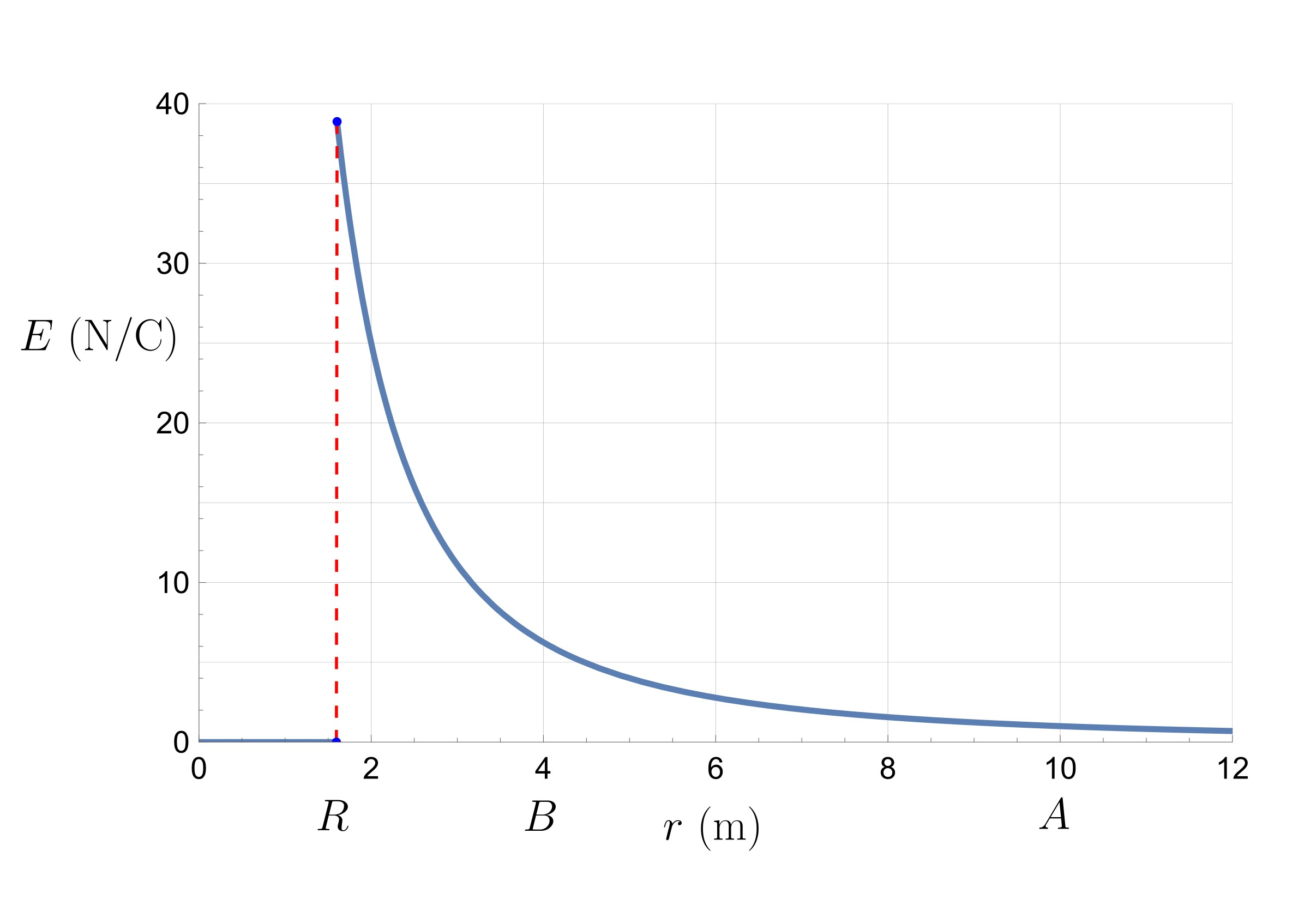
The graph below shows the radial component of some electric field as a function of 𝑟. The field has units of N/C and 𝑟 has units of m. The field is directed radially outward and depends only on 𝑟. These are spherical coordinates, not cylindrical coordinates.
A. All points at a given distance 𝑑 from the origin are at the same electrostatic potential.
B. The electric field falls off as 1/𝑟 for 𝑟 greater than 𝐑.
C. The electric potential is constant for 𝑟 less than 𝐑.
D. The force on a positive charge placed at 𝐀 points radially towards the origin.
E. The above electric field could be that due to a negatively charged spherical shell.
F. The work done by you to bring a point negative charge from infinity to 𝐀 (it starts and finishes at rest) is negative.
A, C, F
1F 4.2)
Determine the work done by this electric field on a 6.7𝜇 C charge that is moved from 𝐀 to 𝐁. Note that 𝐸 is exactly 25 N/C at 𝑟 =2
E(2)=22k=25⟹k=100 N⋅m2/C
E(r)=r2100 N/C(for r≥2)
Wfield=∫rArBF⋅dr=q∫rArBE(r)dr
1F 5)

Two rods of equal length 𝐿 =1.09 m form a symmetric cross. The horizontal rod has a charge of 300 C, and the vertical rod has a charge of −300 C. The charges on both rods are distributed uniformly along their length. Calculate the potential at the point 𝑃 at a distance 𝐷 =3.68 m from one end of the horizontal rod.
Vv=k∫−2L2LR2+y2λvdy=LkQvln(R2+(L/2)2−L/2R2+(L/2)2+L/2)

2A 1)

the charge carriers in wire 1 (of circular cross section and radius 𝑅 have a drift speed down the wire that is not constant across the wire. Instead, the drift speed rises from zero at the outer edge 𝑟 =𝑅 to 𝑣0 at the center (𝑟 =0), according to 𝑣𝑑(𝑟) =𝑣0(1 −(𝑟/𝑅)). The second wire (wire 2) has the same radius, the same density of charge carriers and a constant drift speed given by 𝑣𝑑(𝑟) =𝑓𝑣0. Evaluate the ratio of the current carried by wire 2 to the current carried by wire 1, when 𝑓 =0.44.
dI1=J(r)dA=nqvd(r)⋅(2πrdr)
Given vd(r)=v0(1−Rr):
I1=∫0Rnqv0(1−Rr)(2πrdr)
I1=2πnqv0∫0R(r−Rr2)dr
I1=2πnqv0[2r2−3Rr3]0R=2πnqv0(2R2−3R2)=2πnqv0(6R2)=3πnqv0R2
2. Current in Wire 2 (I2)
Wire 2 has a uniform drift speed vd=fv0:
I2=J⋅A=(nqfv0)⋅(πR2)=fπnqv0R2
ratio=I1I2=3πnqv0R2fπnqv0R2=3f
2A 2)

What fraction of the total current flows through 𝑅2? Enter your answer as a decimal number between 0 and 1. For example, if thirty percent of the current goes through 𝑅2, enter 0.3.
I2=Itotal×R2+R3R3
currentFraction=ItotalI2=R2+R3R3=9+99=189=0.5
2A 3)

What is the total effective resistance of this combination of resistors?
R2341=R21+R31+R41=71+31+101
R561=R51+R61
Req=R1+R234+R56
2B.1.1 A 12 Volt lead-acid car battery, engineered for "up to 500 or more charge/discharge cycles," has a rating of 225 Ampere-hours. A one Ampere-hour battery can provide one Amp of current for one hour. It sells for $180.
DischargeEnergy
If initially fully charged, what is the total electrical energy that the battery can deliver before it needs to be recharged? Enter your answer in Joules (J).
E=QV
2B.1.2
A 12 Volt lead-acid car battery, engineered for "up to 500 or more charge/discharge cycles," has a rating of 225 Ampere-hours. A one Ampere-hour battery can provide one Amp of current for one hour. It sells for $180.
GasolineComparison
The battery has a mass of 23.1 kg. What total mass of such batteries would be required to deliver the same effective mechanical energy as 14 gallons of gasoline? Assume that the efficiency of an electrically powered car is 2.5 times that of a gasoline-powered car for the conversion to mechanical energy, and that energy content of 1 gallon of gas =1.32 ×10⁸ Joules. You're going to get a big number - this is why electric cars didn't become widespread until after the development of lithium ion batteries, which can achieve much higher energy densities.
N=EbatteryEtotal, batteries=9.72×10⁶ J7.392×108 J≈76.05 batteries M=N×msingle battery=76.05×23.1 kg≈1757 kg
2B.2.1
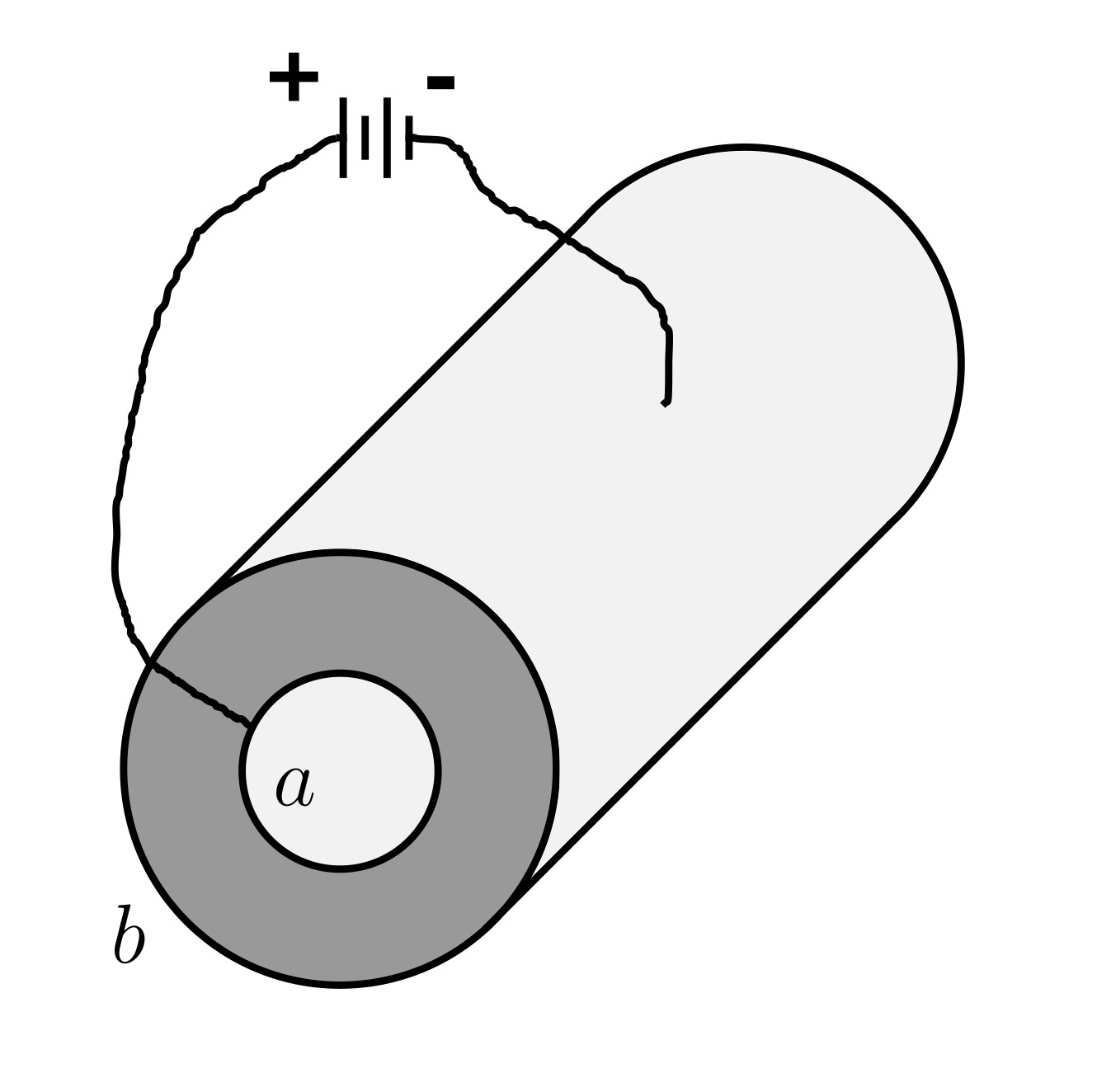
What is the resistance between the two cylinders?
R=∫abρ2πrLdr=2πLρ∫abrdr
R=2πLρln(ab)
2B.2.2
Find the current between the two cylinders if a the voltage between them is 16V
I=RV = I=2πLρln(ab)V=ρln(ab)2πLV
2B.3
A metal wire 2 m long has a circular cross section of radius 0.88 mm and an end-to-end resistance of 70 Ohms. The metal wire is then stretched uniformly so that its cross section is still circular but its total length is now 8 m. What is the resistance of the wire after stretching?
Rnew=Rinitial⋅(L1L2)2
2C.2
A cardiac defibrillator can be used to help an erratic heartbeat return to a regular pattern. A defibrillator contains a capacitor that stores 750 J of energy when it's charged to a voltage of 8500 V. Calculate the capacitance of the capacitor.
U=21CV2
Solving for Capacitance
Rearranging the formula to solve for C:
C=V22U
2C.4.1
Two capacitors 𝐶1 =3.3𝜇 F and 𝐶2 =12.2𝜇 F are connected in series across a 11-Volt battery. They are carefully disconnected so that they are not discharged and are reconnected to each other (but not the battery) in parallel with positive plate to positive plate and negative plate to negative plate.
Charge
Find the charge on 𝐶1 after the capacitors are reconnected.
q1=(C1+C2)22C12C2V
2C.4.2
Two capacitors 𝐶1 =3.3𝜇 F and 𝐶2 =12.2𝜇 F are connected in series across a 11-Volt battery. They are carefully disconnected so that they are not discharged and are reconnected to each other (but not the battery) in parallel with positive plate to positive plate and negative plate to negative plate.
Energy
Find the final energy stored in 𝐶1.
U1=2C1q12
U1=2C11[(C1+C2)22C12C2V]2=(C1+C2)42C13C22V2
2D.1
For all of the following, we're considering parallel plate capacitors. Select all the true statements. If none of them are true, select "None of the above."
A. Capacitance is the property of a device that enables it to store current.
B. Charge is stored in the dielectric medium between the plates of a capacitor.
C. The charges on the two plates of a capacitor are equal in magnitude and sign.
D. The capacitance of a parallel plate capacitor depends on the charge stored on the plates.
E. Adding a dielectric between the plates of an isolated air-filled charged capacitor reduces the charge stored on the device.
F. None of the above.
none of the above
2D.2
Consider two oppositely charged, isolated parallel plates separated by distance 𝐷, with capacitance 𝐶, charge 𝑄, and stored energy 𝑈. 𝐷 is small compared to the dimensions of the plates. Select all the statements that are true. If none of them are true, select "None of the above."
A. When 𝐷 is doubled, 𝑈 increases.
B. When 𝐷 is doubled, 𝐶 is doubled.
C. Inserting a dielectric decreases 𝐶.
D. Inserting a dielectric increases 𝑄.
E. Increasing 𝐷 leaves the electric field unchanged.
F. Inserting a dielectric leaves 𝑈 unchanged.
G. When 𝐷 is halved, 𝑄 stays the same.
H. None of the above.
A,E,G
2D.3
Derive an expression for the capacitance of two concentric hollow spherical conductors of radii 𝑟 and 𝑅.
C=R−r4πϵ0rR
2D.4
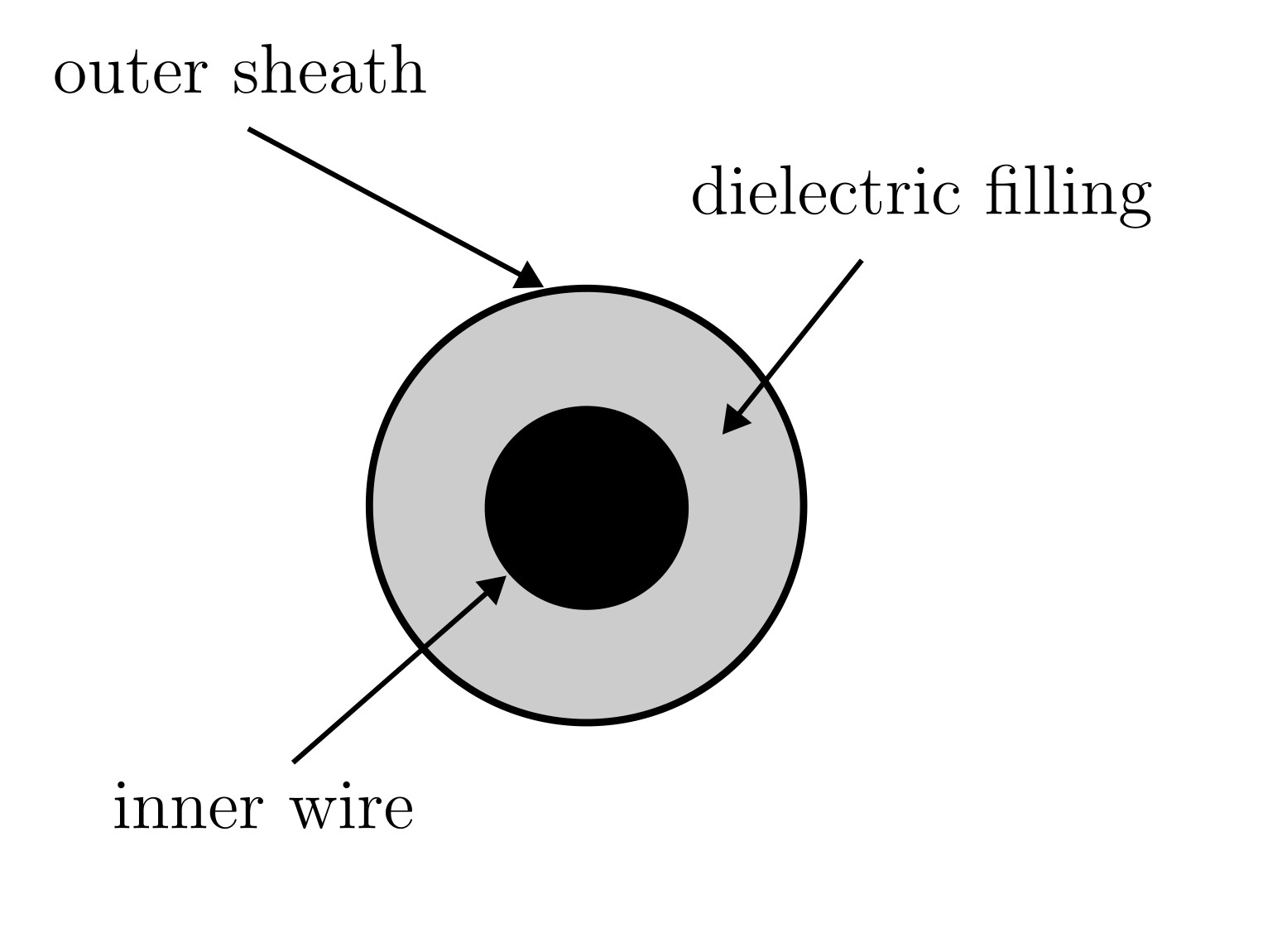
U=21CV2=ln(dido)πκϵ0LV2
2D.5.1
Two identical capacitors 𝐶𝑎 and 𝐶𝑏, each of capacitance 7.7𝜇 F, are connected in parallel across a constant total voltage of 690 V. Initially, neither capacitor contains a dielectric. Then we insert a dielectric slab of dielectric constant 4 into capacitor 𝐶𝑎, filling it completely. The capacitors remain connected to the battery throughout.
DeltaChargeA
By how much does the charge on 𝐶𝑎 change when we add the dielectric to 𝐶𝑎?
ΔQa=Qa,f−Qa,i=(κ−1)CV
2D.5.2
Two identical capacitors 𝐶𝑎 and 𝐶𝑏, each of capacitance 7.7𝜇 F, are connected in parallel across a constant total voltage of 690 V. Initially, neither capacitor contains a dielectric. Then we insert a dielectric slab of dielectric constant 4 into capacitor 𝐶𝑎, filling it completely. The capacitors remain connected to the battery throughout
DeltaChargeB
By how much does the charge on 𝐶𝑏 change when we add the dielectric to 𝐶𝑎?
ΔQb=Qb,f−Qb,i=0 C
2E.1.1
Consider the RC circuit in the figure below. The switch was at position A for a long period of time and is switched to position B at time 𝑡 =0
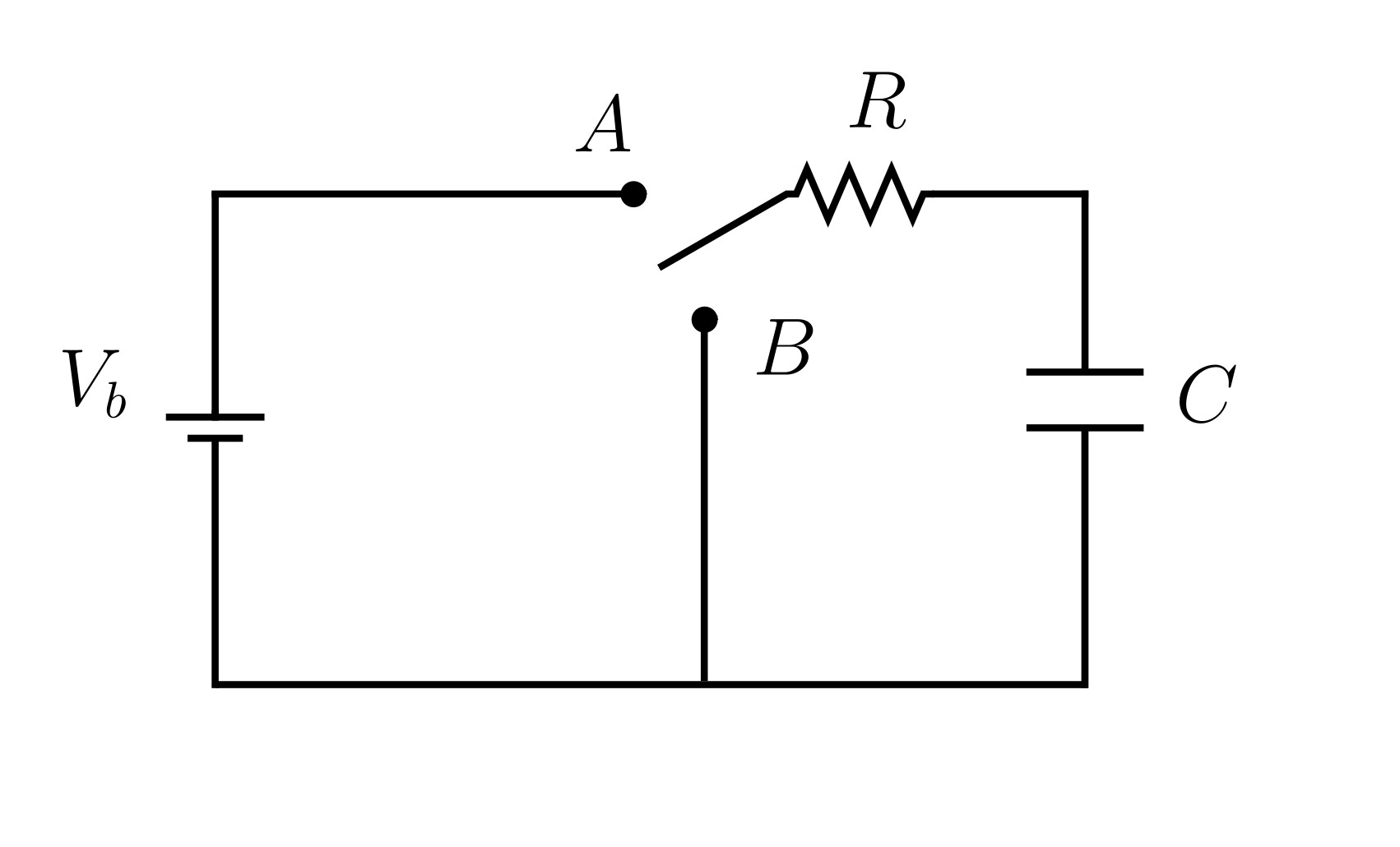
A. Immediately after the switch is moved to B, the voltage across the resistor is zero.
B. If the switch has been at A for a while and we then switch it to B, the current through the resistor as a function of time will look like an exponential decay.
C. The current through the resistor and the current 'through' the capacitor are always the same.
D. If the switch has been at B for a while, and we then move it to A, the charge on the capacitor as a function of time will look like an exponential decay.
E. While the switch is at A (having been at a for a while), the current 'through' the capacitor is zero.
F. Immediately after the switch is moved to B, the voltage across the capacitor is not zero.
G. None of the above.
B,C,E,F
2E.1.2
What will be the voltage drop across the resistor at 𝑡 =2.2 ms?
Vresistor(t)=Vb⋅e−t/τ
2E.1.3
How much energy in total will eventually be dissipated by the resistor?
E=21CVb2
2E.1.4
Now suppose that the switch has been at position B for a long time and is switched to position A at t = 0 s. What will be the voltage drop across the capacitor after 2.2 ms
Vcapacitor(t)=Vb(1−e−t/τ)
2E.2
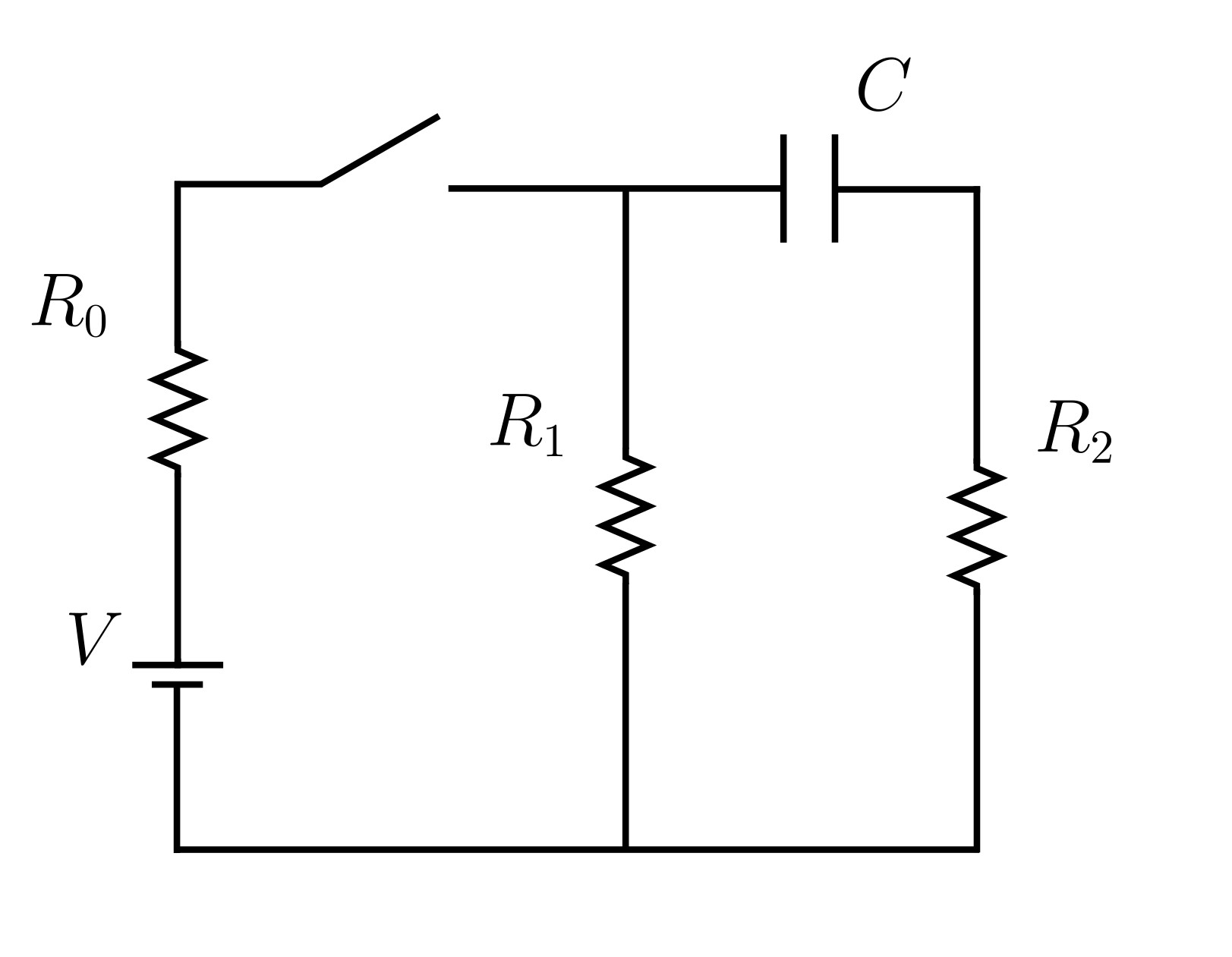
Itotal=Req,0V
2E.3
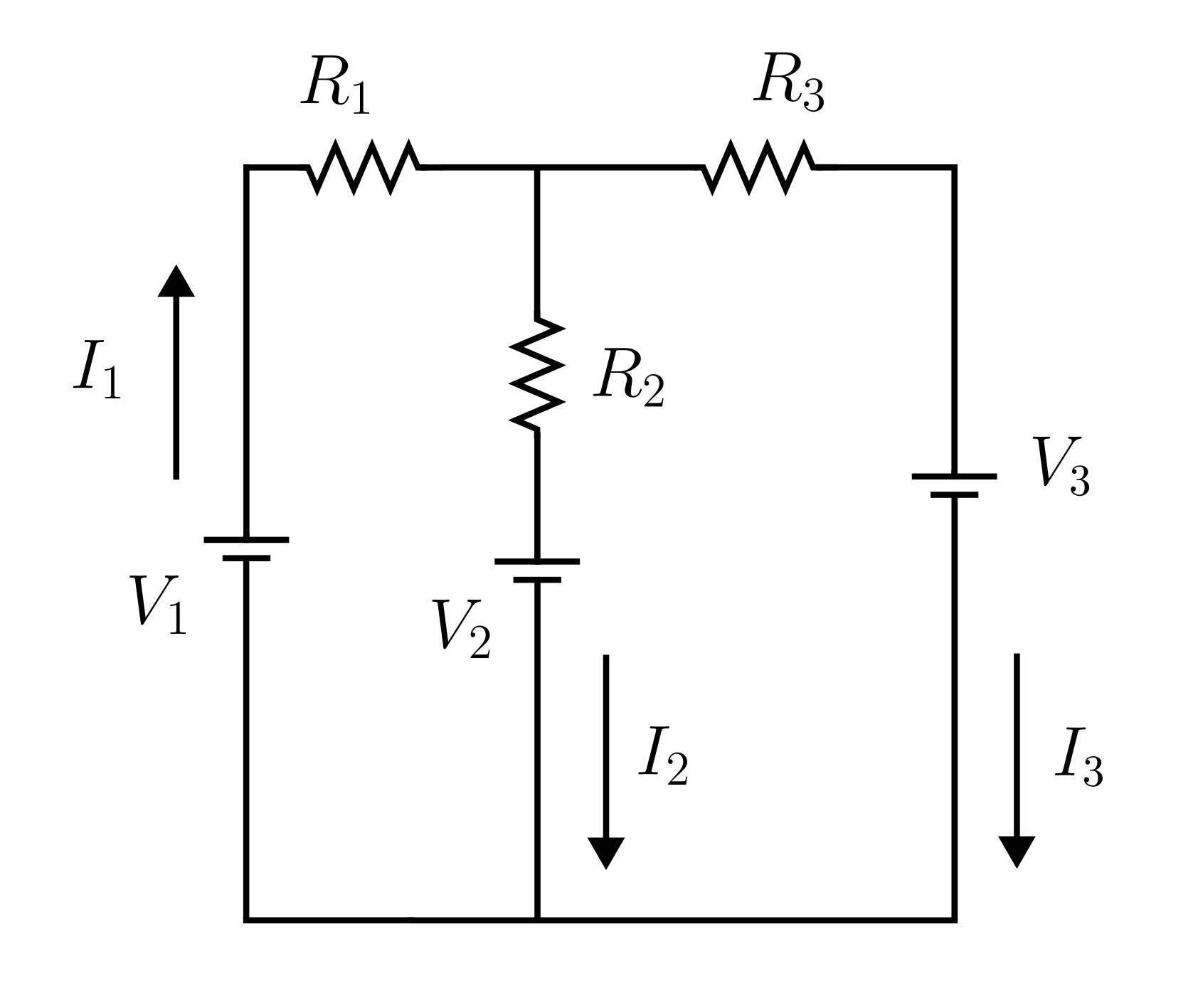
A. 𝑉3 −𝑖3𝑅3 −𝑖2𝑅2 −𝑉2 =0
B. −𝑉3 −𝑖3𝑅3 +𝑖2𝑅2 −𝑉2 =0
C. 𝑖1 −𝑖2 −𝑖3 =0
D. 𝑖1 +𝑖2 +𝑖3 =0
E. 𝑉1 −𝑖1𝑅1 −𝑖3𝑅3 −𝑉3 =0
F. 𝑉1 −𝑖1𝑅1 +𝑖2𝑅2 +𝑉2 =0
G. None of the above.
C,E
2E.4
What is the smallest capacitor needed in a computer power supply in order to produce at least 4.25 V for 0.32 s after the power goes off?
C=−R⋅ln(V0V(t))t
2F.1
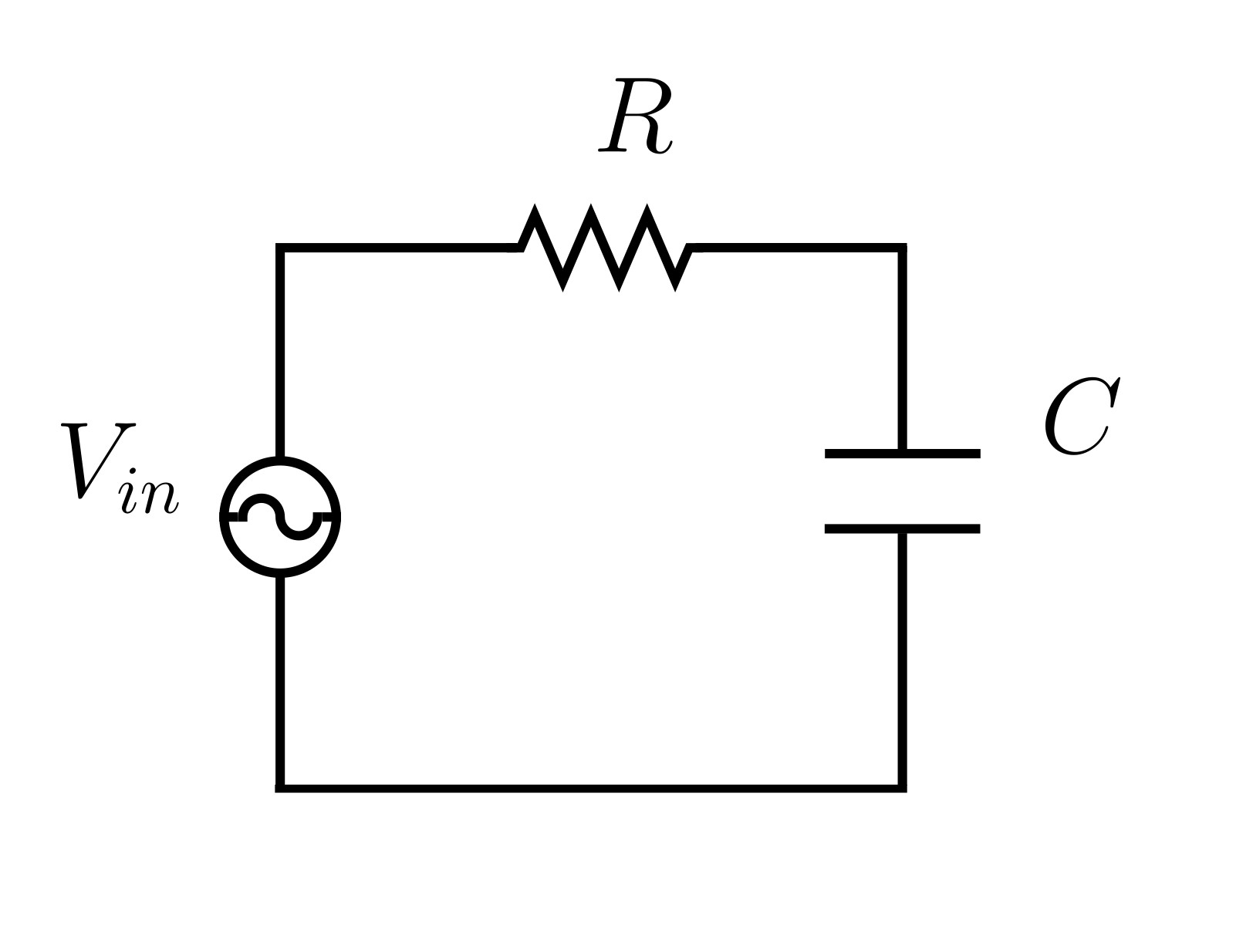
what is the capacitance of your capacitor?
C=2πfXC1
2F.2.1
Consider an AC power supply that provides a voltage of 10 𝑠𝑖𝑛(193𝑡) Volts, where t is in seconds. The power supply is hooked up to a 218 Ω resistor.
What is the mean current through the resistor?
0 A
2F.2.2
Consider an AC power supply that provides a voltage of 10 𝑠𝑖𝑛(193𝑡) Volts, where t is in seconds. The power supply is hooked up to a 218 Ω resistor.
What is the rms current through the resistor?
Irms=RVrms=2⋅RVpeak
2F.2.3
Consider an AC power supply that provides a voltage of 10 𝑠𝑖𝑛(193𝑡) Volts, where t is in seconds. The power supply is hooked up to a 218 Ω resistor.
What is the mean power being delivered to the resistor?
Pmean=2R(Vpeak)2
2F.3
Suppose you have two AC voltage sources that have the same amplitude and frequency, but are out of phase with one another. In mathematical terms, one of the voltage functions looks like 𝑉0 ⋅𝑠𝑖𝑛(𝜔𝑡) and the other looks like 𝑉0 ⋅𝑠𝑖𝑛(𝜔𝑡 +𝛿). 𝛿 is referred to as a phase offset and is in radians. If you add those sources together, what's the rms voltage of the resulting signal?
Vrms=22V0cos(2δ)=2V0cos(2δ)
2F.4
What is the reactance of a 10 𝜇 F capacitor at a frequency of 220 Hz?
XC1=2πf1C1
3A.1
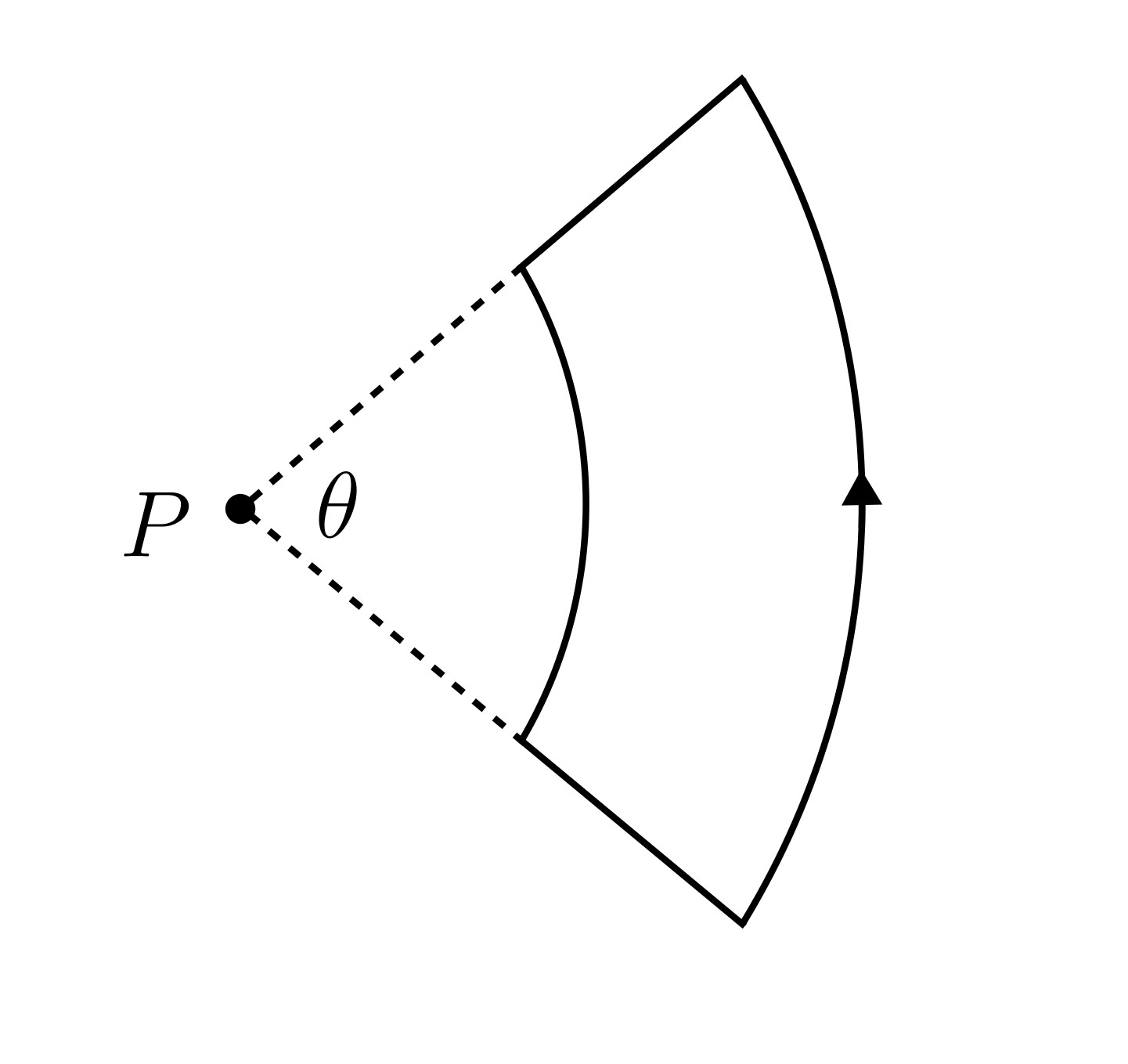
Find the magnitude of the magnetic field at point 𝑃 if 𝜃 =60∘.
Bfield=2μ0I(360∘θ)(Rinner1−Router1)
3A.2
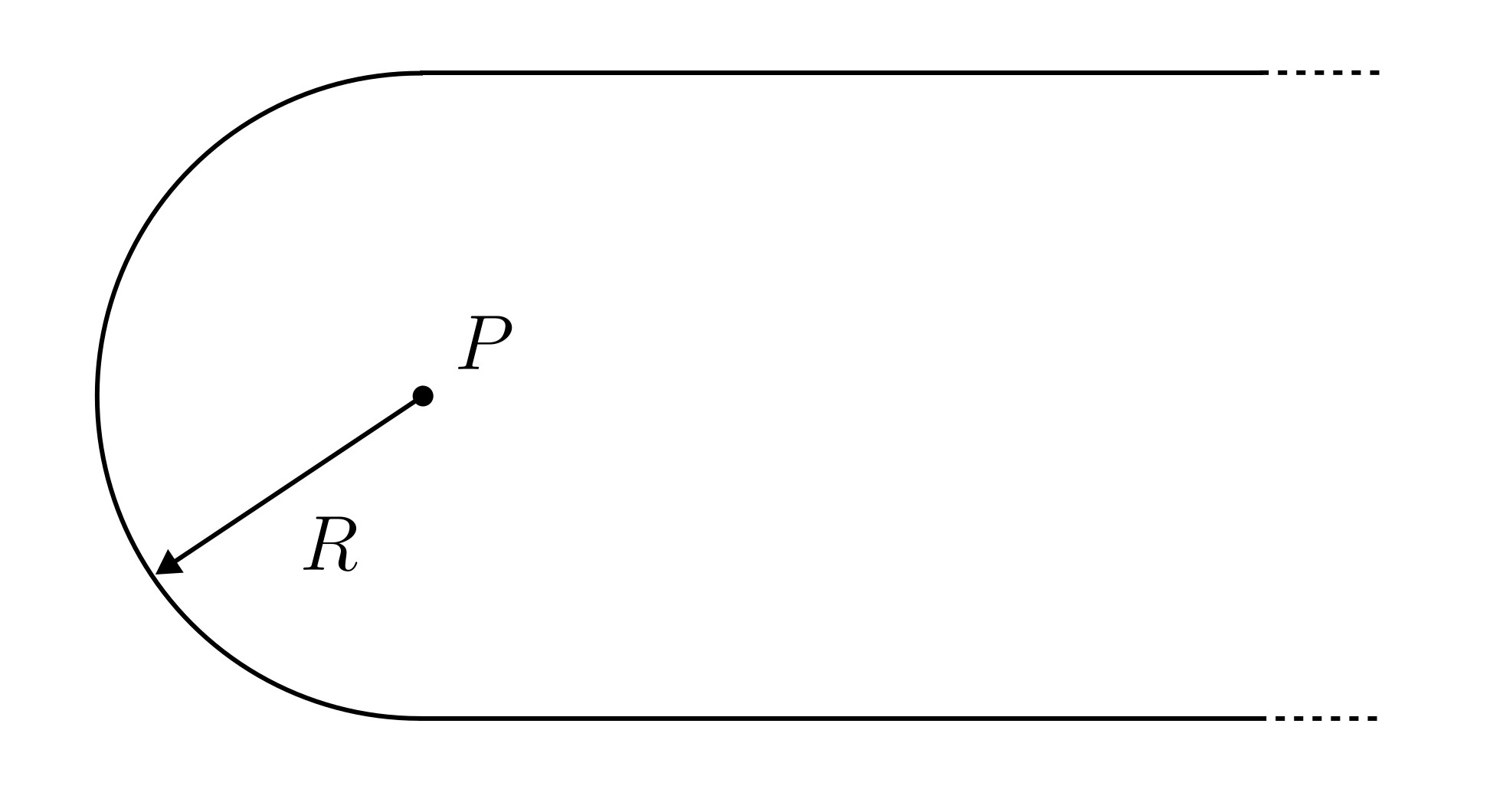
Find the magnitude of the magnetic field at the point 𝑃.
Btotal=4πRμ0I(2+π)
3A.3
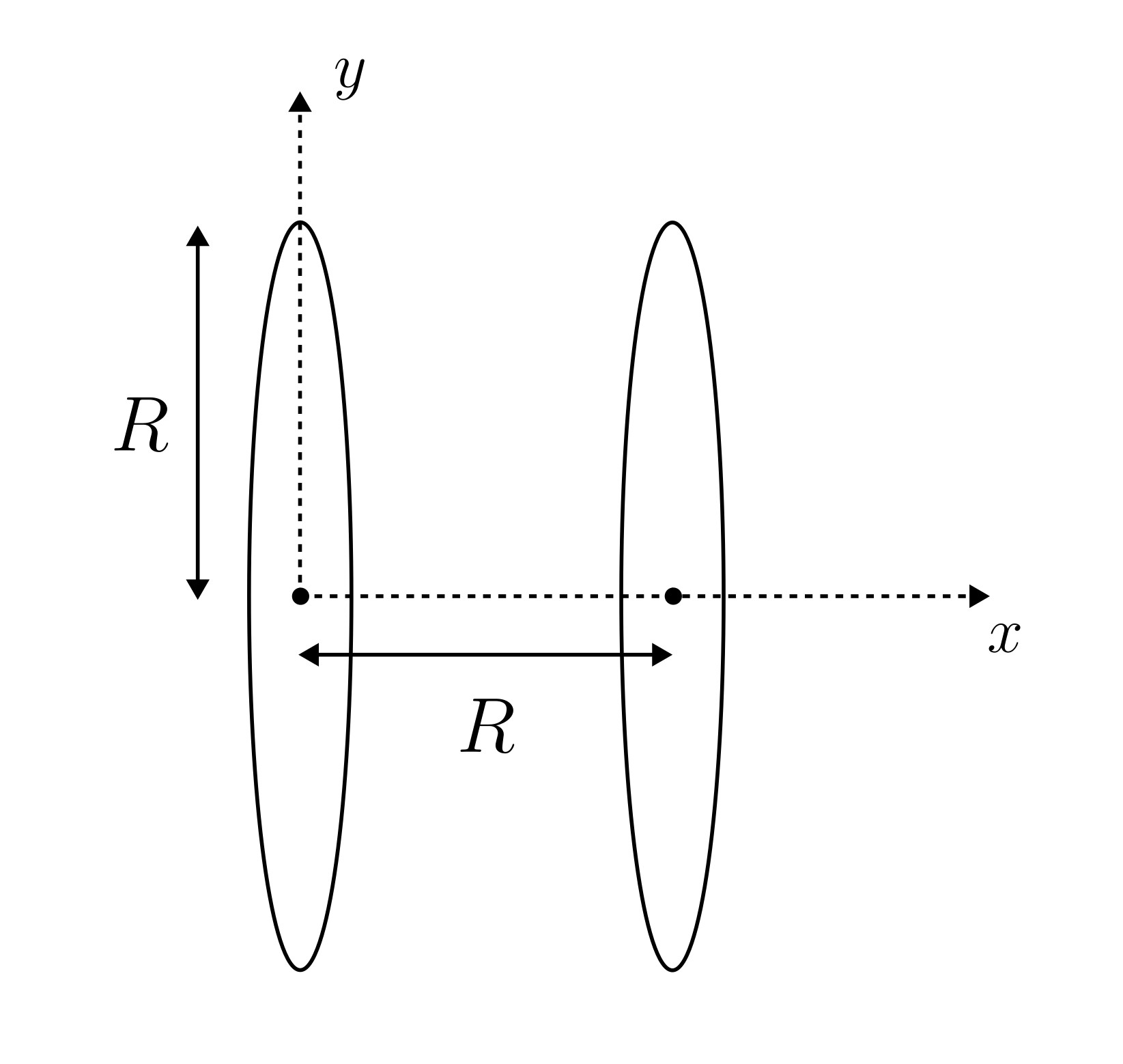
Calculate the total magnetic field field
Btotal(x)=2μ0NIR2(R2+x2)3/21+(R2+(R−x)2)3/21
3A.4
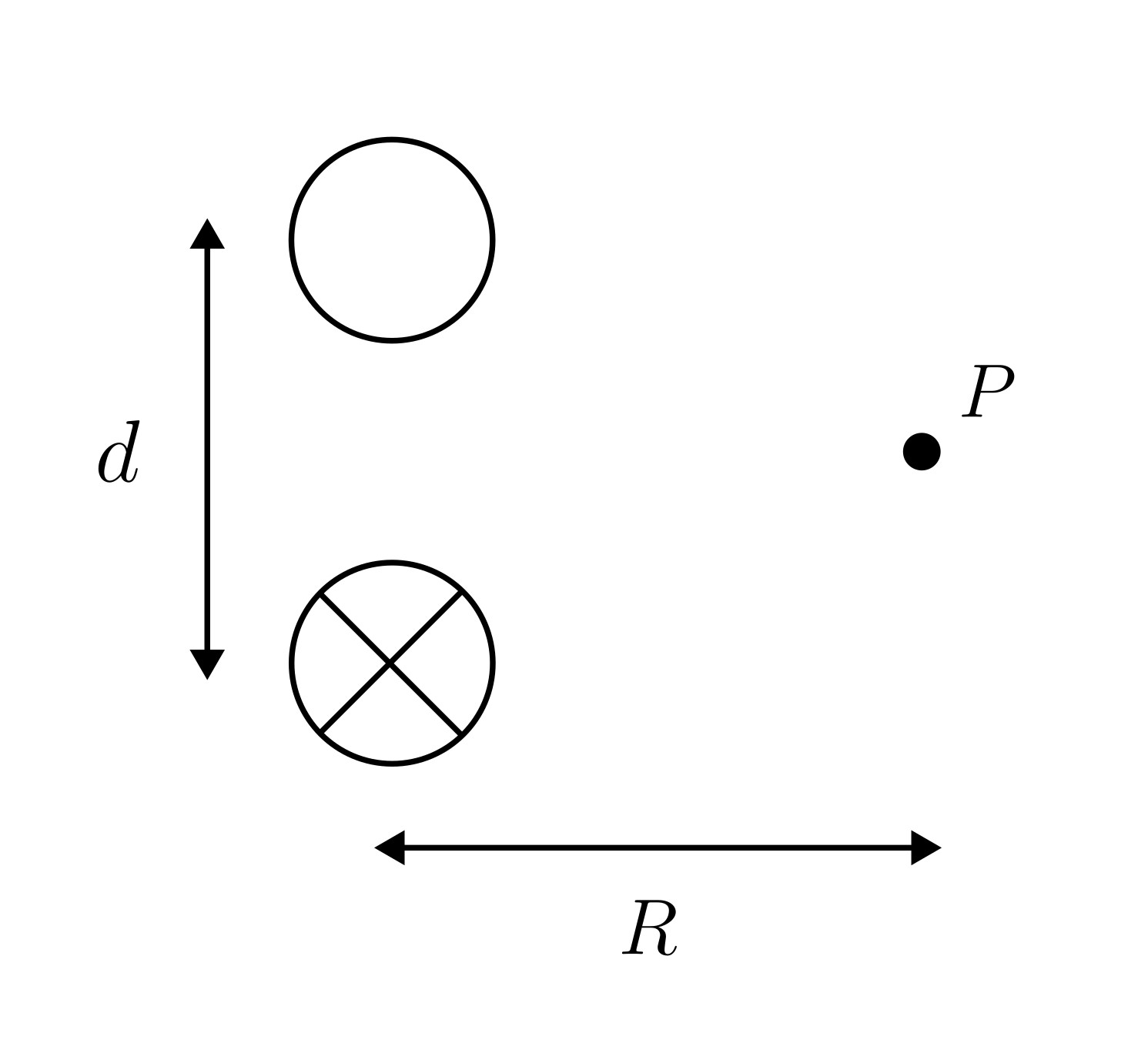
Find the magnitude of the magnetic field at the point 𝑃, which is equidistant from the wires. 𝑅 =8 cm.
Bnet=2π[(2d)2+R2]μ0Id
3B.1
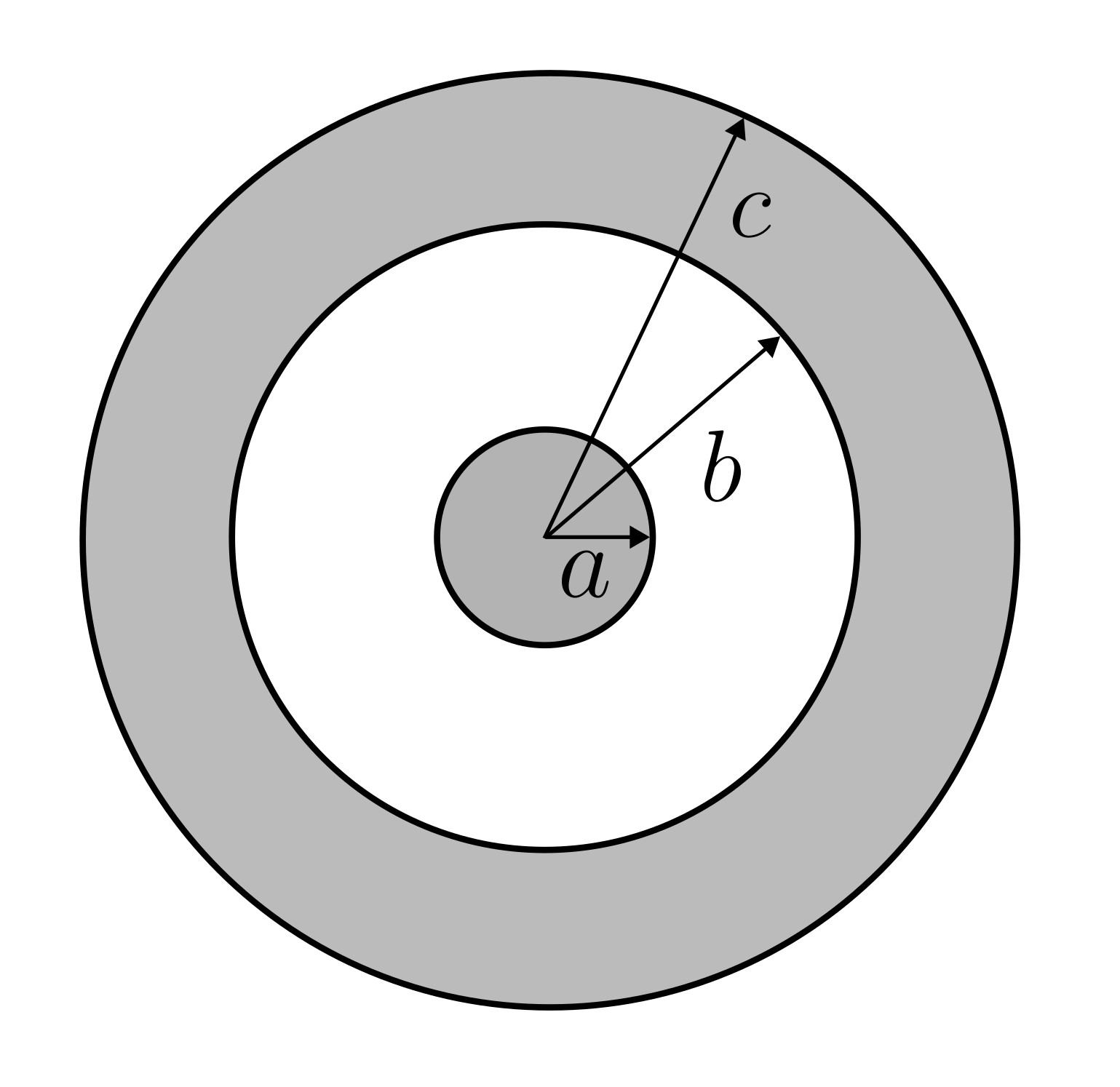
Find the magnitude of the magnetic field
B=2πrμ0Ienc
3B.2
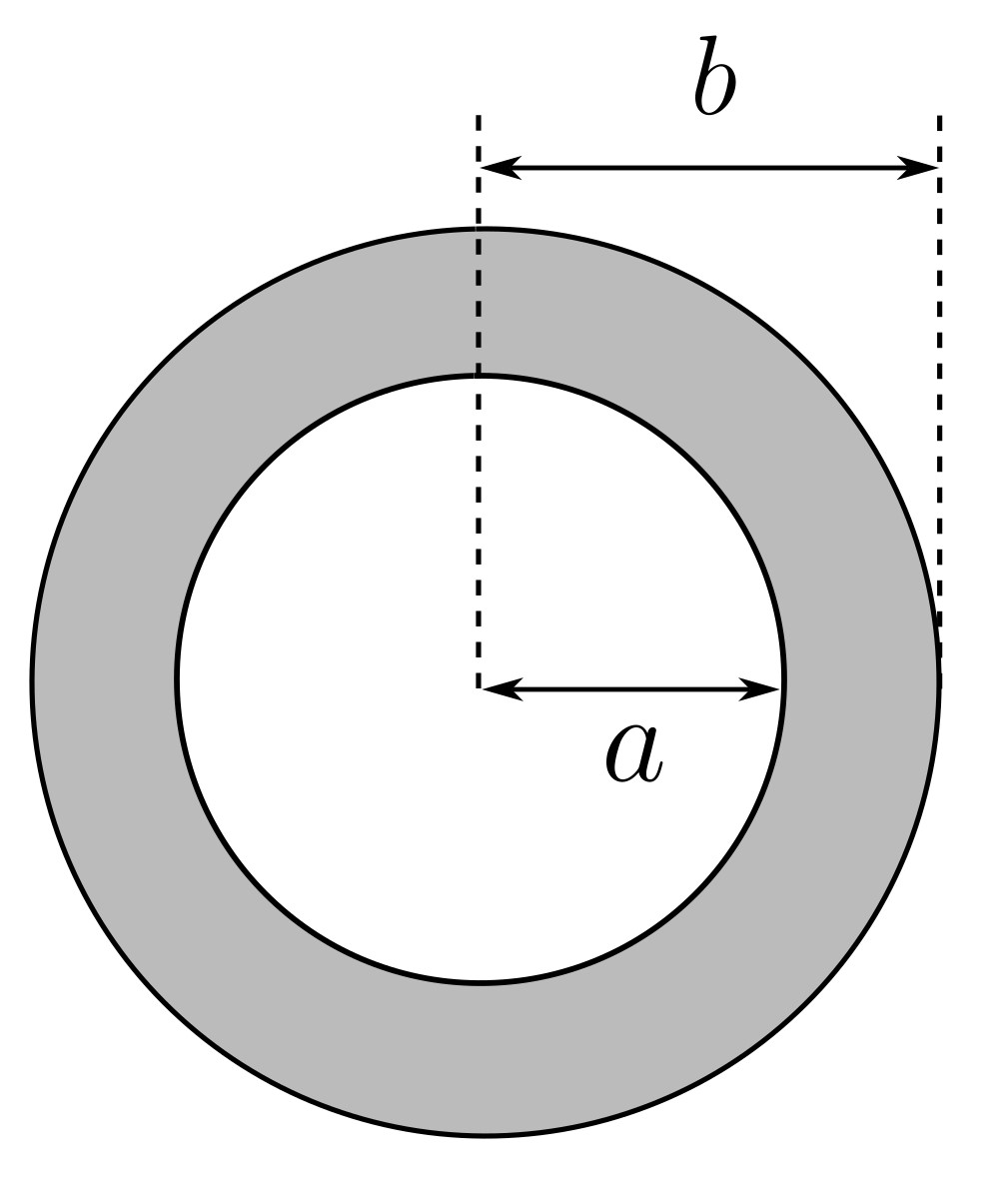
Find the magnitude of the magnetic field
Ienc=I⋅AtotalAenc=I(b2−a2r2−a2)
B=2πrμ0Ienc
3C.1
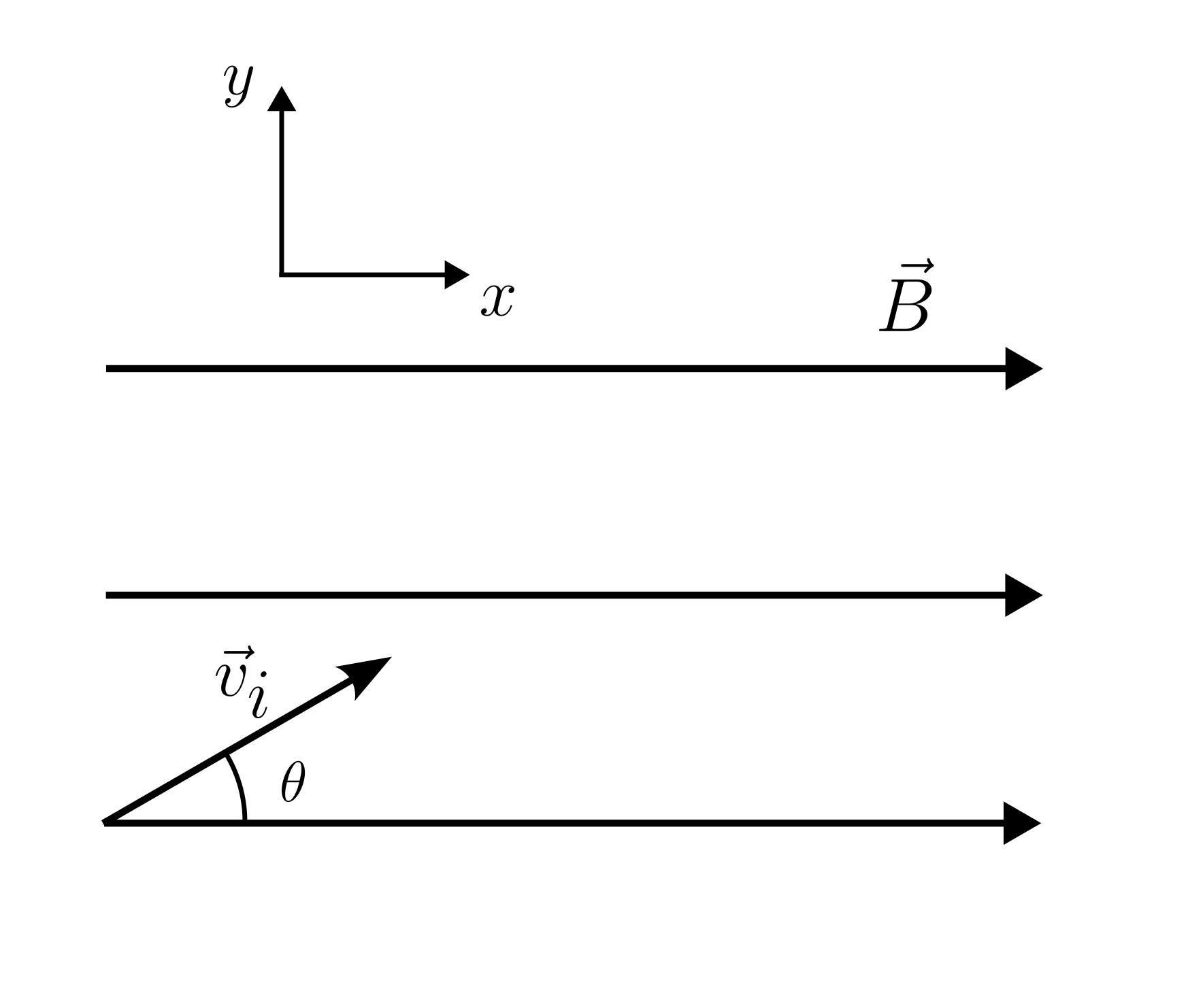
A. The particle's speed is unchanged as it passes through the magnetic field.
B. The particle follows a circular path since the force is perpendicular to the velocity.
C. The field does a finite, nonzero amount of work on the particle as the particle's trajectory is bent by the field.
D. The initial force on the particle is in the -𝑧 direction.
E. The y-component of the particle's velocity is unchanged as it passes through the magnetic field.
F. None of the above.
A,D
3C.2
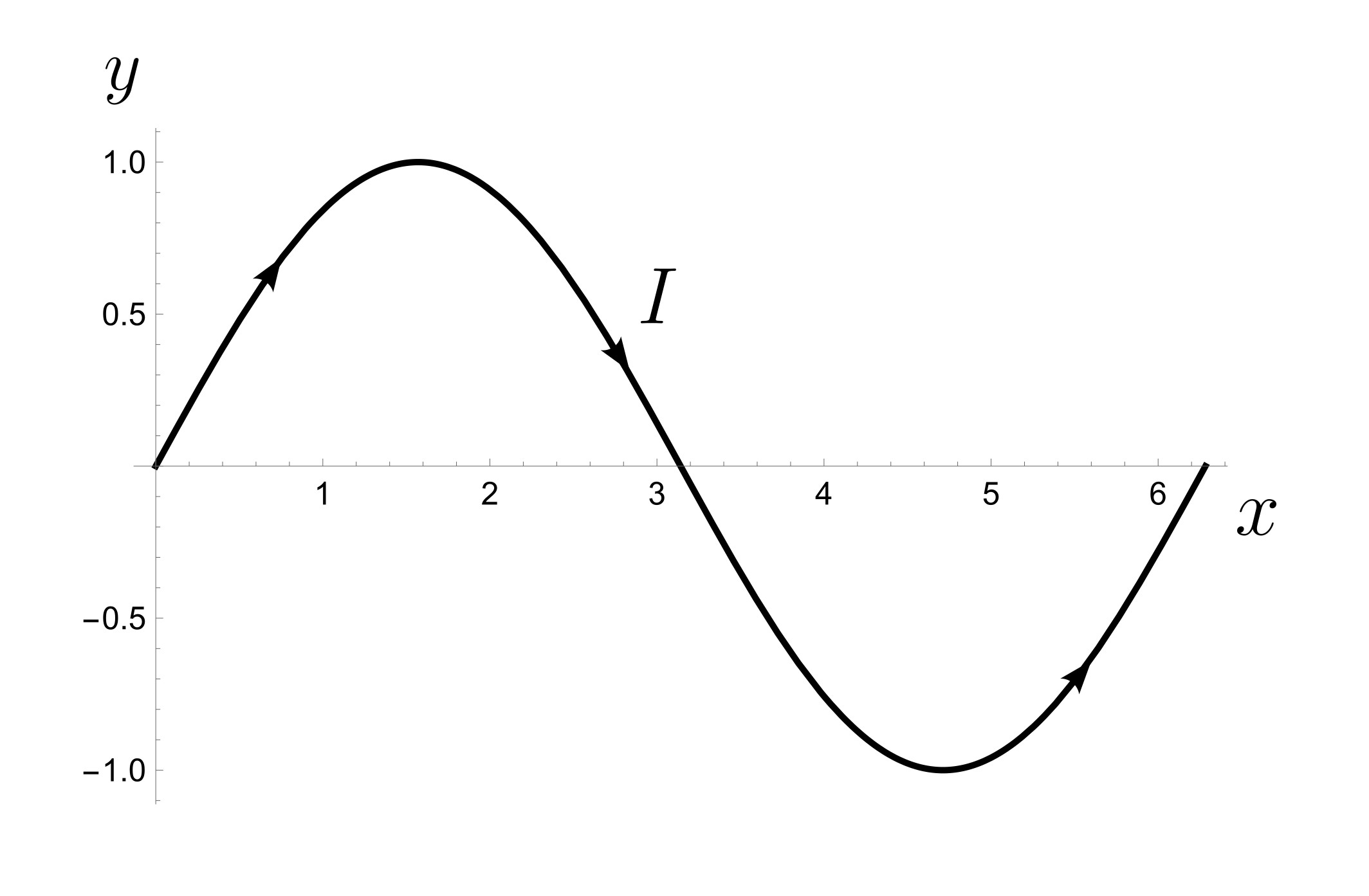
What is the 𝑦-component of the force on the wire segment?
F=∫I(dl×B)
Fy=−IB0∫02πxdx
3C.3
the vertical component of the Earth's magnetic field points down (towards the ground) with a magnitude of 59.9𝜇 T. What is the direction of the force on the electrons due to this component of the magnetic field?
South
3C.4
Suppose we have an electron moving perpendicular to a magnetic field along a circular path of radius 11.7 cm. If imposing an electric field of 19.7 kV/m makes the path straight, what is the magnitude of the magnetic field?
B=ermE
3C.5.1
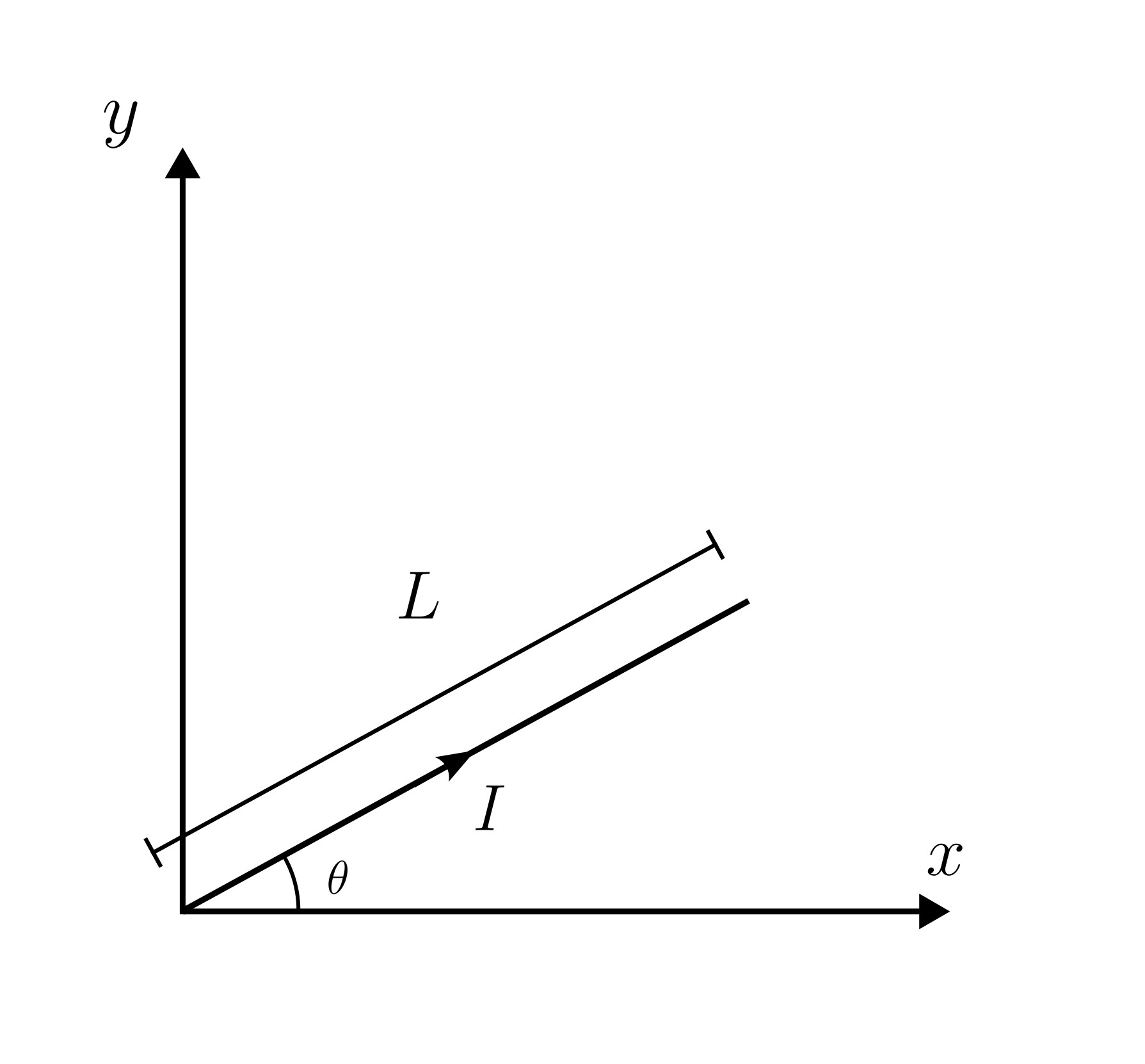
What is the 𝑥 component of the force on the wire segment?
Fx=−LIB0tanθ∫0Lcosθxdx=−2IB0Lcosθsinθ
3C.5.2
what is the magnitude of the torque on the wire segment?
τ=∫0LxdFy=LIB0sinθ∫0Lx2dx=31IB0L2sinθ
3D.1
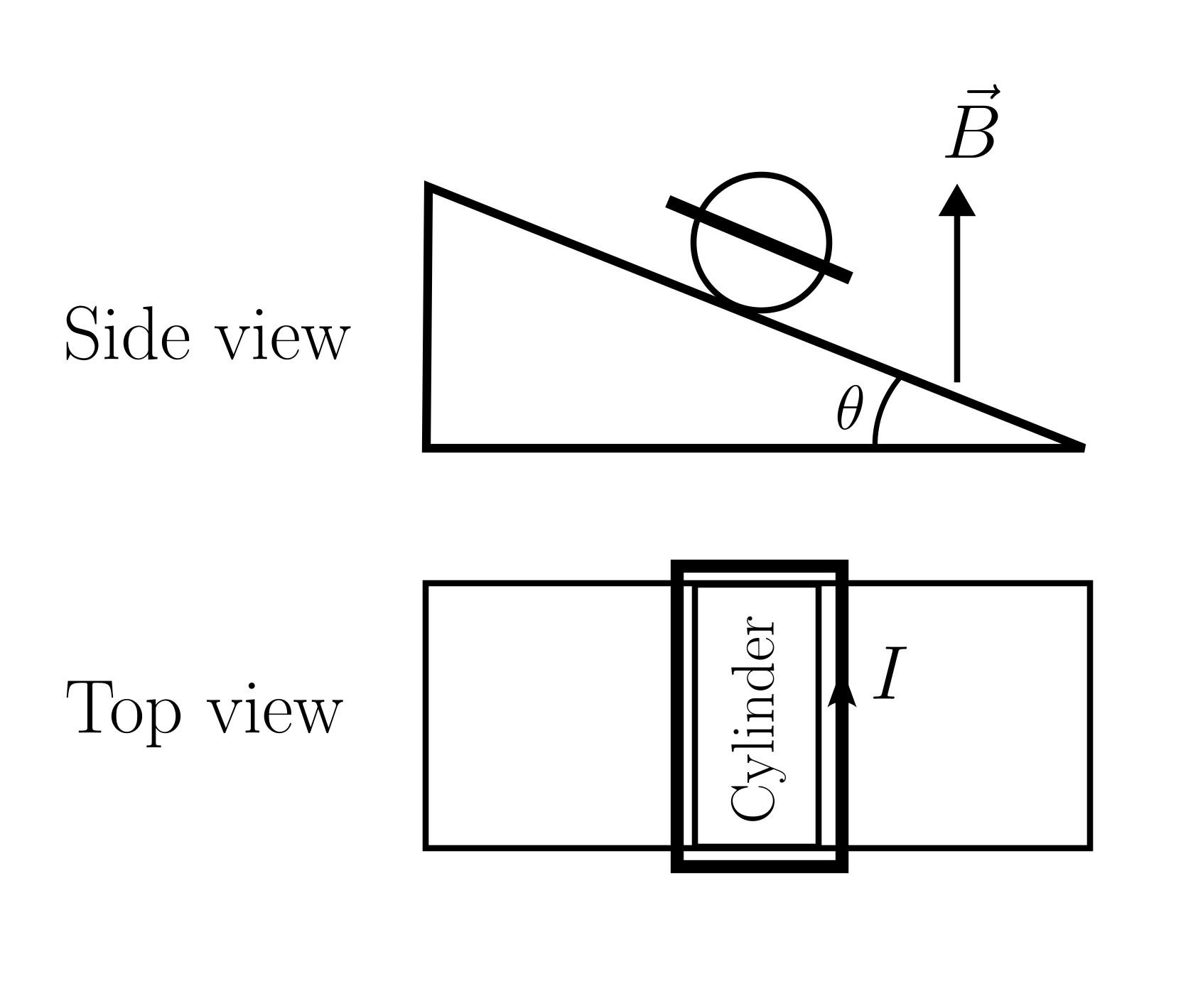
I=2NLBmg
3D.2
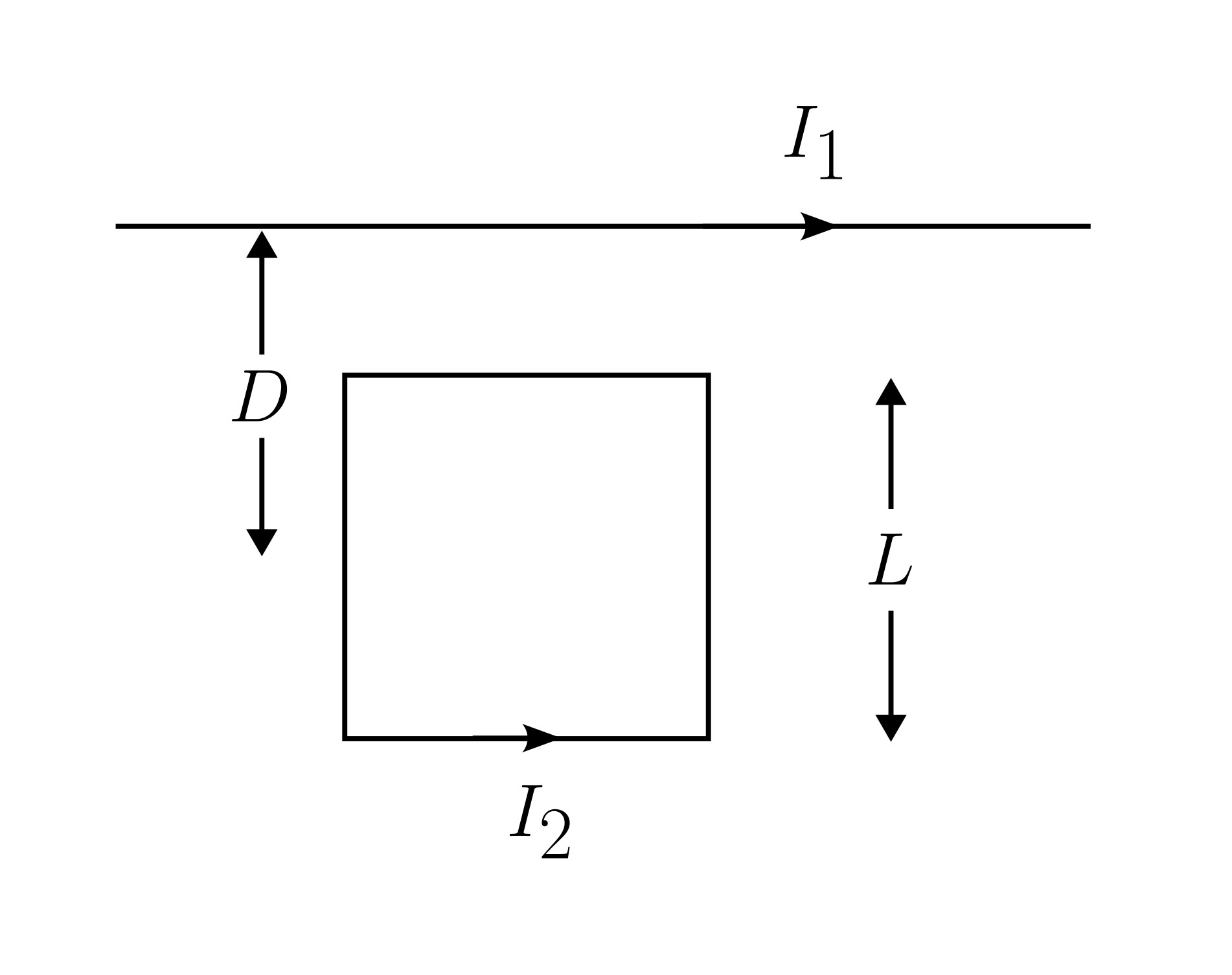
Find the magnitude of the net force on a rigid square loop of wire of side length
Fnet=Ftop−Fbot=2πμ0I1I2l(rtop1−rbot1)
3D.3
A 145 cm wire carries a current of 0.9 A. The wire is formed into a single circular loop and placed in a magnetic field of intensity 1.4 T. Find the maximum torque that can act on the loop.
τmax=NIAB
3D.4
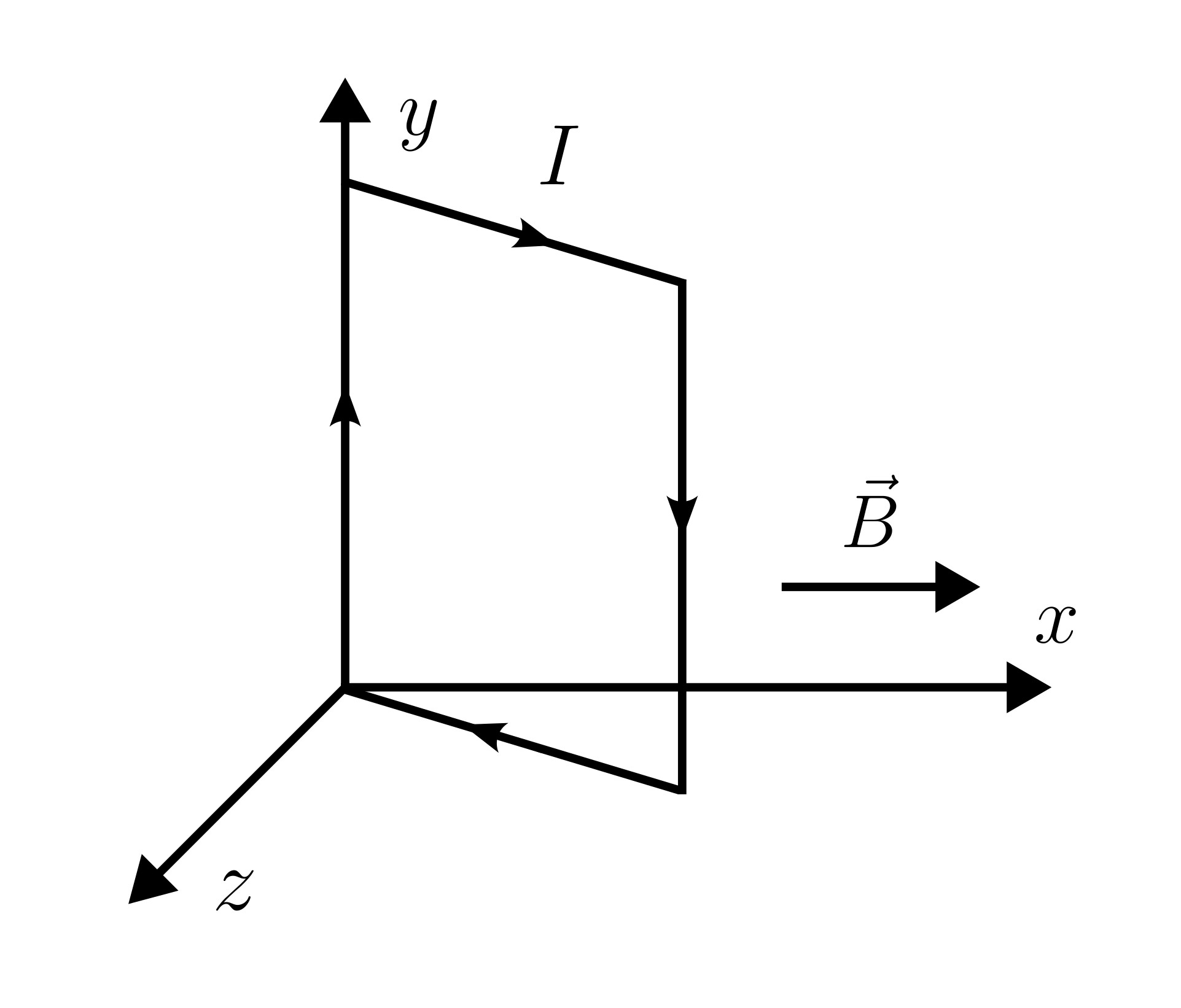
τ=NIABsin(θ)
3D.5
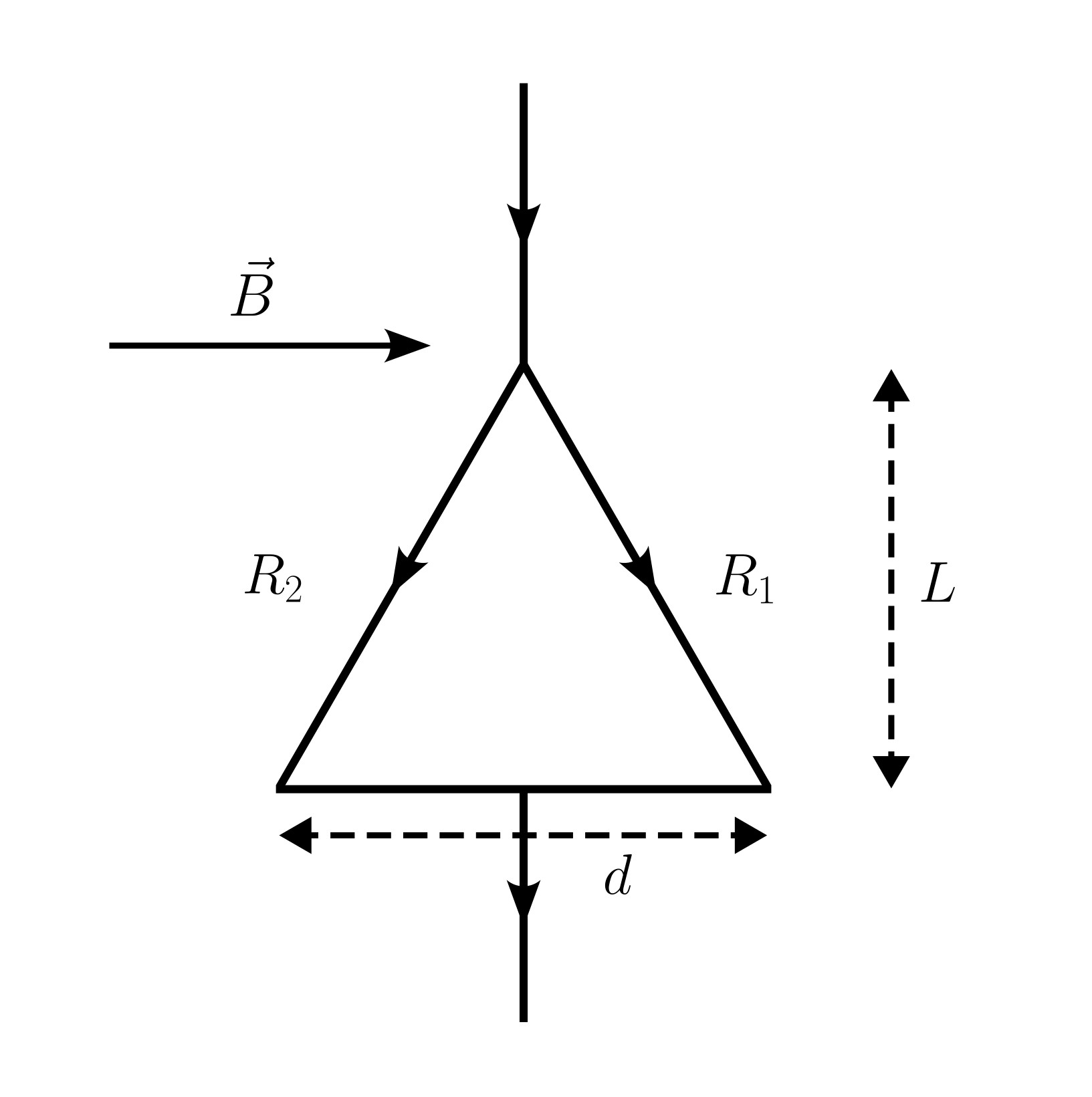
What is the magnitude of the torque on the circuit about the wire's vertical axis at the moment shown?
τ=B4dl∣I1−I2∣
3E.1
Calculate the magnitude of the induced voltage between the tips of the wings of a Boeing 767 flying at 640 km/h above Golden, Colorado. The downward component of the earth's magnetic field at this location is 0.7 ×10⁻⁴ T. The airplane's wingspan is 60 m.
ϵ=B⋅v⋅L
3E.2
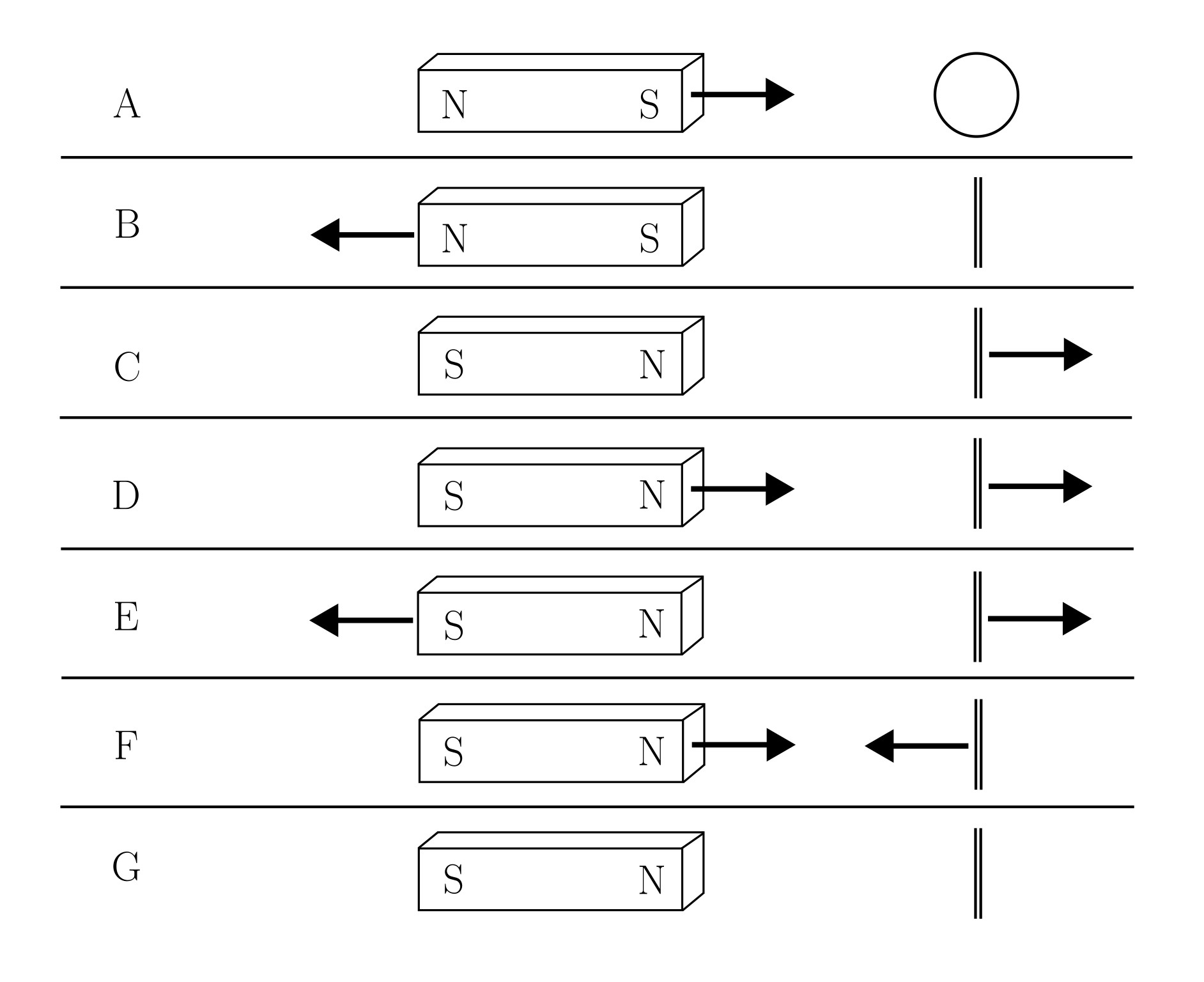
A. The induced voltage in D is zero.
B. The induced voltage in A is zero.
C. The induced voltage in B is zero.
D. The induced voltage in C is non-zero.
E. The induced voltage in E is zero.
F. The induced voltage in G is non-zero.
G. The induced voltage in F is non-zero.
H. None of the above.
A,B,D,G
3E.3
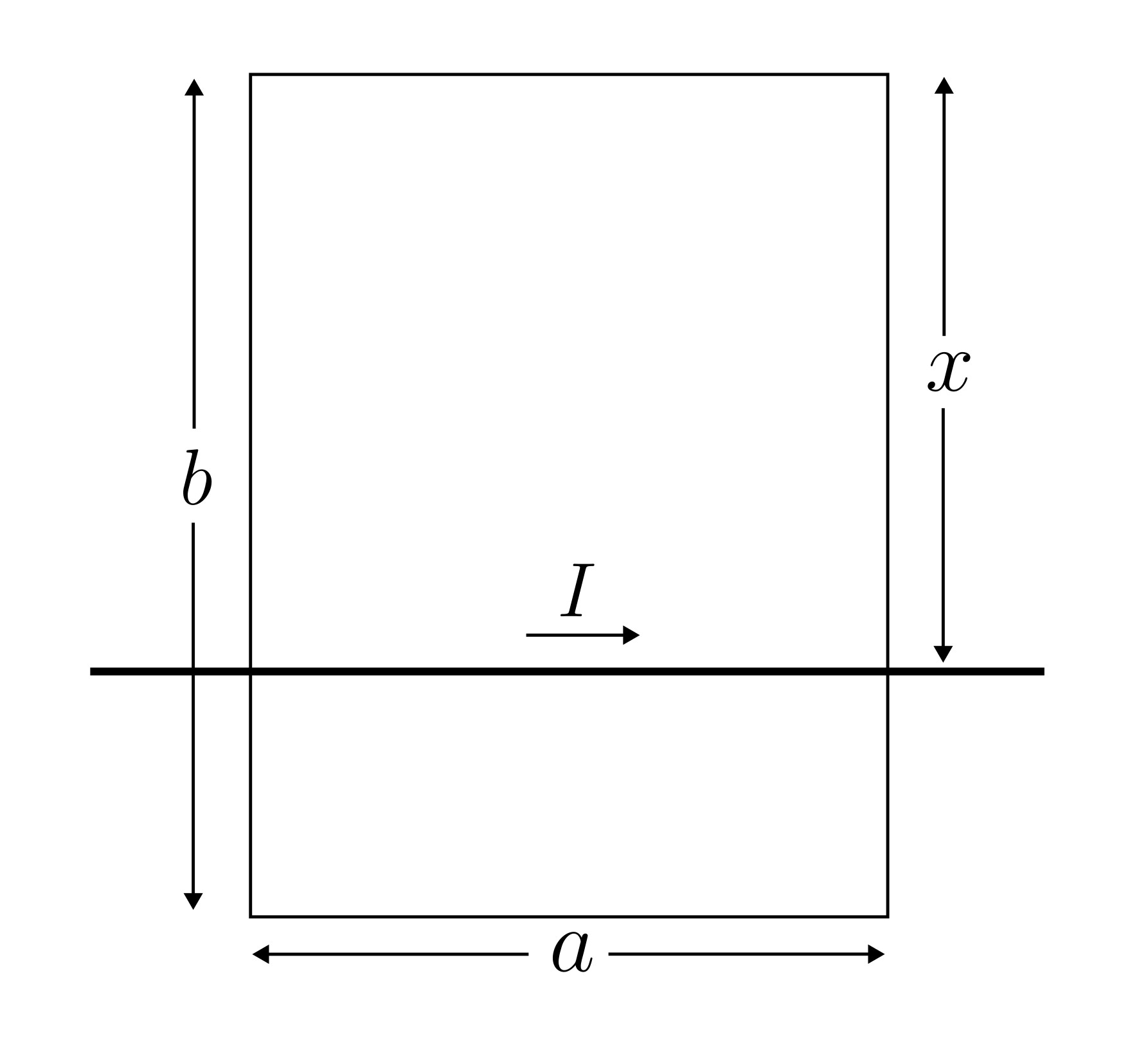
For what value of 𝑥 is the magnitude of the magnetic flux through the coil a minimum?
x=2b
3E.4.1
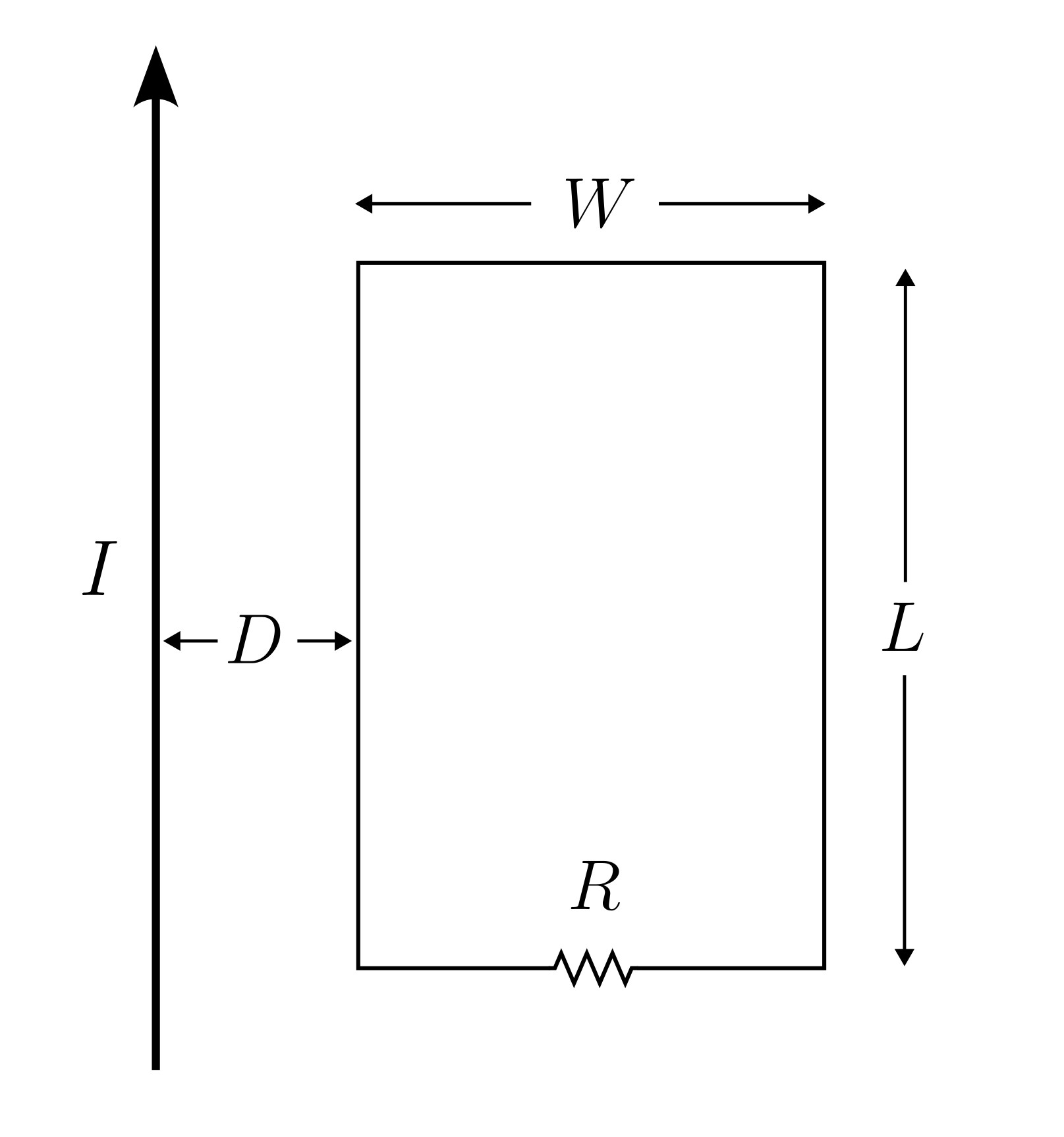
What is the magnetic flux through a single turn of the coil
ΦB(t)=2πμ0Lln(DW+D)
3E.4.2
What is the 𝑒𝑚𝑓 induced in the entire coil
E=−τNΦB(t) where ΦB(t)=2πμ0Lln(DW+D)
3E.4.3
What is the power dissipated in the entire coil
P(t)=RE2
3E.4.4
What is the total energy dissipated in the entire coil
E=P(t)⋅2τ(e2t/τ−1)
3F.1.1
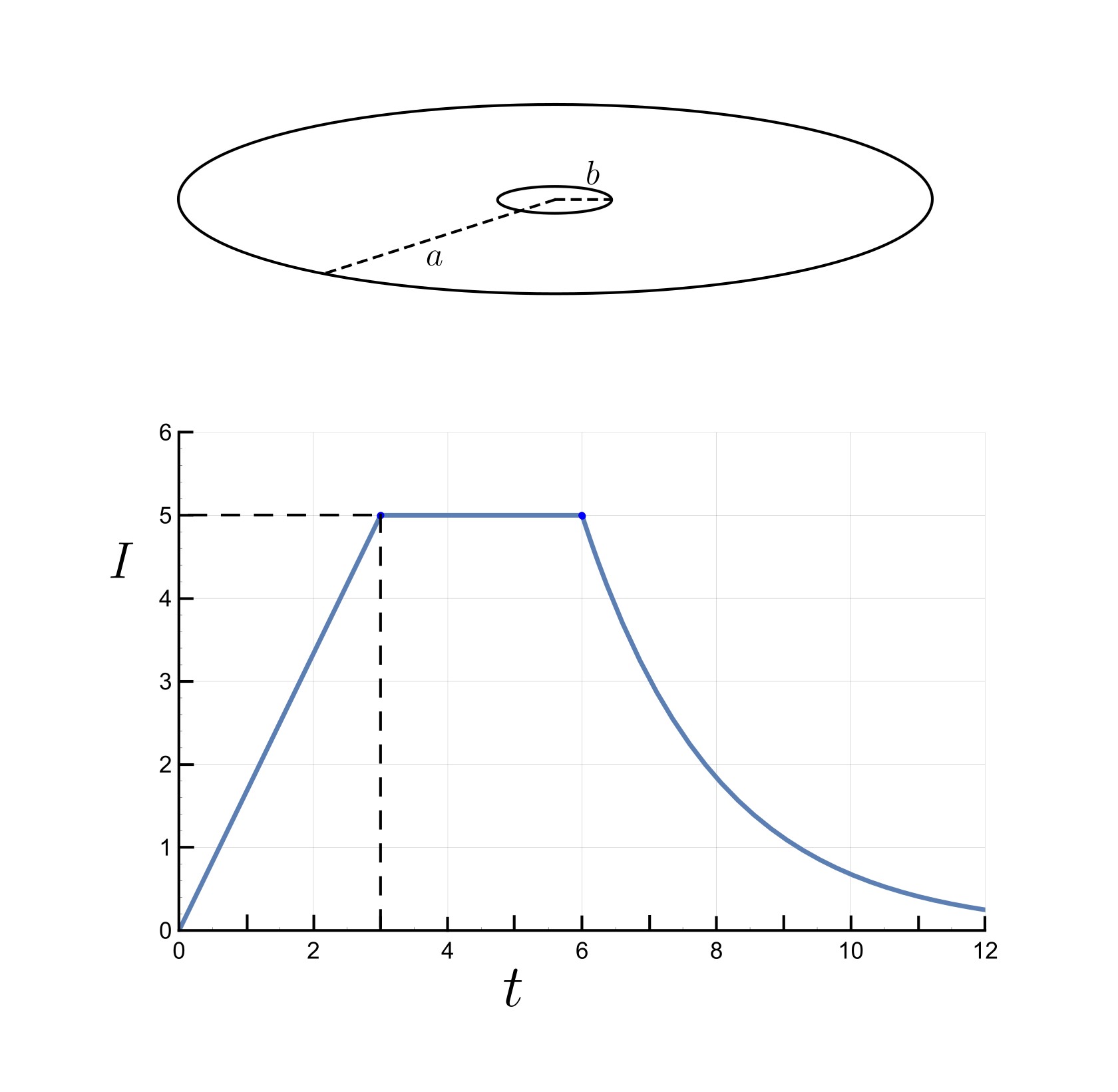
Approximately what is the magnitude of the EMF induced in the small coil at 𝑡 =2
E(t)=NsmalldtdΦB=2aμ0πNlargeNsmallb2dtdI