NMR spectroscopy
 Call Kai
 Learn
Learn Practice Test
 Spaced Repetition
 Match
Match Flashcards
 Knowt Play
1/53

There's no tags or description
Looks like no tags are added yet.
Name | Mastery | Learn | Test | Matching | Spaced | Call with Kai | Chat |
|---|
No analytics yet
Send a link to your students to track their progress
54 Terms
what does NMR stand for?
nuclear magnetic resonance
what has NMR spectroscopy revolutionised?
the analysis of organic compounds
what does the NMR spectroscopy technique use?
a combination of a very strong magnetic field and radio frequency radiation
what happens with the right combination of magnetic field strength and frequency?
the nuclei of some atoms absorb this radiation. the energy from this absorption can be measured and recorded as an NMR spectrum
what do electrons have a property called?
spin
why is the nucleus having a spin (nuclear spin) significant?
its significant if there is an odd number of nucleons (protons and neutrons)
what do almost all organic molecules contain?
carbon and hydrogen, mostly as 1H and 12C isotopes, with a small proportion (1.1%) of the 13C isotope
for organic chemists, where is NMR relevant?
for the 1H and 13C isotopes with an odd number of nucleons
what can NMR spectroscopy be used to detect?
isotopes of other elements with odd numbers of nucleons, like 19F and 31P
what is 1H NMR spectroscopy often referred to as?
proton NMR (just contains 1 proton)
how many spin states do electrons have?
2, and so does the nucleus, with different energies
what can happen with the right combination of a strong magnetic field and radio frequency radiation?
the nucleus can absorb energy and rapidly flip between the 2 spin states - resonance (gives the whole name NMR)
what has more energy: radio frequency radiation or the infrared radiation used in IR spectroscopy?
the infrared radiation in IR spectroscopy
what is the frequency required for resonance proportional to?
the magnetic field strength, and it is only in strong and uniform magnetic fields that this small quantity of energy can be detected
what is typically used?
a very strong super conducting electromagnet, cooled to 4K by liquid helium

what does this figure show?
a typical NMR spectrometer - you can see the large cylinder which houses the electromagnet, cooled by liquid helium
what do most routine spectrometers operate at for organic chemistry?
radio frequencies of 100, 200, or 400MHz
where are NMR spectrometers found?
in universities, and hospitals as MRI body scanners, a technique that uses the same technology
structure facts of an organic molecule:
every carbon and hydrogen atom is bonded to other atoms
all atoms have electrons surrounding the nucleus, which shifts the energy and radio frequency needed for NMR to take place
what is the frequency shift measured on a scale called?
chemical shift, in units of parts per million (ppm)
What is tetramethylsilane (TMS) (CH3)4Si used as?
the standard reference chemical against which all chemical shifts are measured
what is the chemical shift value of TMS?
0ppm
what is the amount of chemical shift determined by?
chemical environment, especially the presence of nearby electronegative atoms
diagram to show chemical shift:
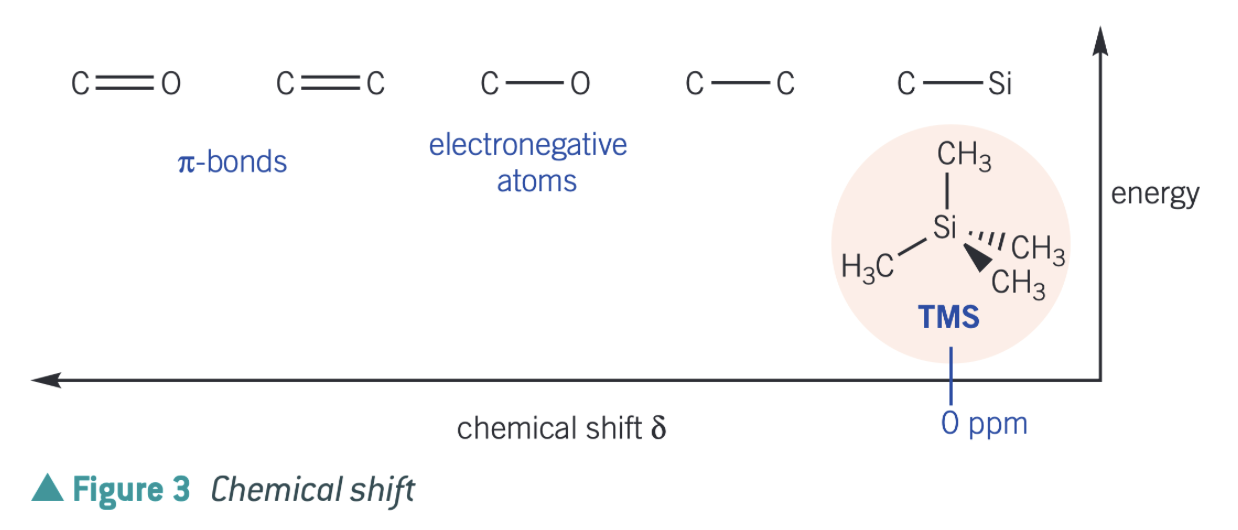
what does NMR require depending on the chemical environment?
a different energy and frequency, producing absorption peaks at chemical shifts
what does this mean?
the carbon and hydrogen arrangement in a molecule can be mapped out without needing to carry out conventional chemical tests and without destroying the organic compound under test
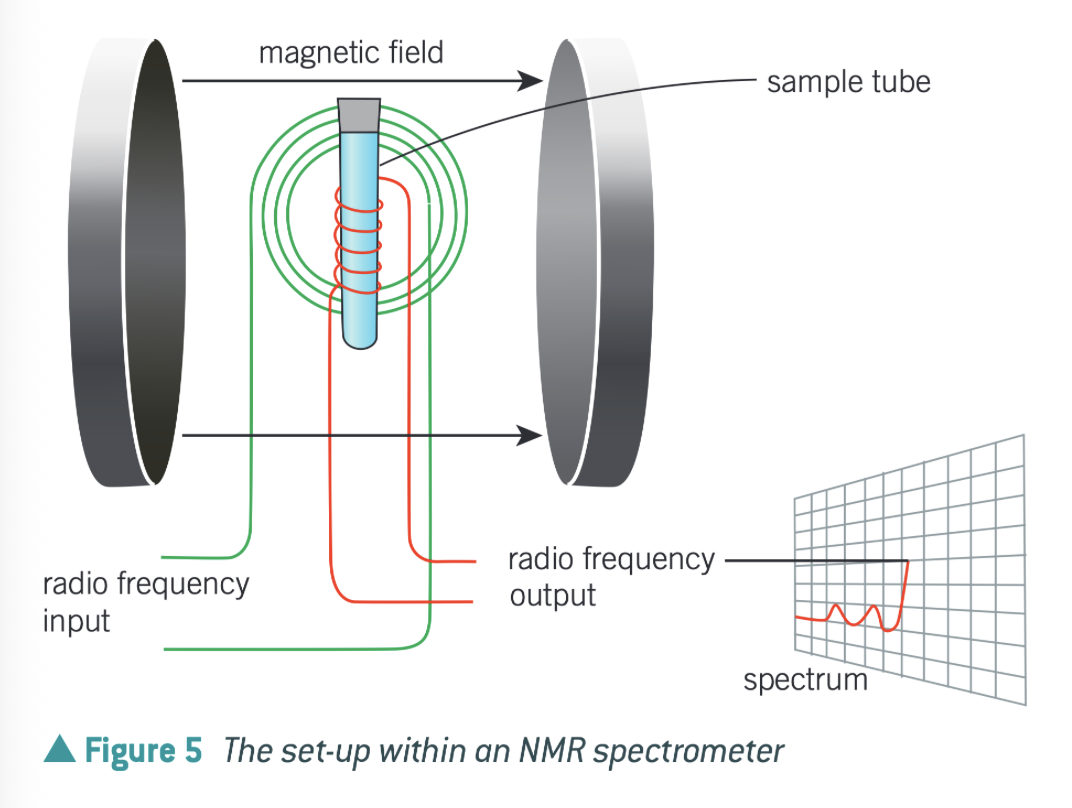
what happens in an NMR spectrometer?
the sample is dissolved in a solvent and placed in a narrow NMR sample tube, together with a small amount of TMS

where is the tube then placed?
inside the NMR spectrometer, where it is spun to even out any imperfections in the magnetic field within the sample . the spectrometer is then zeroed against the TMS standard and the sample is given a pulse of radiation containing a range of radio frequencies, whilst maintaining a constant magnetic field
what happens to any absorptions of energy resulting from resonance?
they are detected and displayed on a computer screen
what can happen after analysis?
the sample can be recovered by evaporation of the solvent
diagram to show the set up within an NMR spectrometer:
what do molecules of most common solvents contain?
carbon and hydrogen atoms, which will produce a signal in both 13C and 1H NMR spectra
what is usually used to counteract this?
a deuterated solvent in which the 1H atoms have been replaced by 2H atoms (deuterium, D)
why is deuterium good to use?
it produces no NMR signal in the frequency ranges used in 1H and 13C NMR spectroscopy
what solvent is commonly used as a solvent in NMR spectroscopy?
CDCl3, deuterated trichloromethane - it will still however produce a peak in a carbon 13 NMR spectrum
what does the computer usually do to this peak?
filters it out before displaying the spectrum
what information does a carbon-13 NMR spectrum provide about a molecule?
the number of different carbon environments - from the number of peaks
the types of carbon environment present - from the chemical shift
what is the chemical shift referenced against?
TMS at 0ppm
what is the chemical shift range of 220ppm wide enough to separate?
carbon atoms that only have slightly different environments
diagram to show carbon 13 NMR chemical shifts:

how many types of carbon atom are there that absorb over different chemical shift ranges?
4, as shown by the labels below the chemical shift axis
why may the chemical shifts be outside of the ranges?
dependant on the solvent, concentration and substituents
what is the chemical environment of a carbon atom determined by?
the position of the atom within the molecule
what will absorb at different shifts due to having different environments?
carbon atoms that are bonded to different atoms of groups of atoms
what happens if 2 carbon atoms are positioned symmetrically within a molecule?
they are equivalent and have the same chemical environment. they will then absorb radiation at the same chemical shift and contribute to the same peak
what are propanal and propanone?
structural isomers of C3H6O, but they produce a different 13C NMR spectra
propanal, CH3CH2CHO
there are 3 carbon atoms and these are clearly in 3 different environments as shown below
carbon-1 is part of the CHO functional group
carbon-2 is part of a CH2 group between a CH3 group and an aldehyde group
carbon-3 is part of a CH3 group bonded to CH2CHO

propanone, CH3COCH3
there are 3 carbon atoms but only 2 different environments as shown below
carbon-1 is part of the C=O group
the other 2 carbons, labelled 2, have the same environment. they are positioned symmetrically and can both be described in an identical way - each carbon atom is part of a CH3 group bonded to COCH3

carbon 13 NMR spectra for propanal and propanone:

what happened in the carbon13 NMR spectrum for propanal?
carbon 2 was assigned to the peak at 37ppm. although this carbon falls into the same broad C-C environment as carbon3, it is nearer to the oxygen atom connected to carbon 1 so it is likely to be shifted more than carbon3
worked example: isomers of alcohols:

worked example: aromatic isomers:

what does the worked example for aromatic isomers show?
just how useful carbon13 NMR spectroscopy can be. the structures are so similar that it would be very difficult to distinguish between them by other means- but from carbon13 NMR spectra, you just need to count the number of peaks
extra info: further analysis of a carbon13 NMR spectrum:
