oct 17th Lipids: Fatty Acid Synthesis, Breakdown, and Energetics
 Call Kai
 Learn
 Practice Test
 Spaced Repetition
 Match
 Flashcards
 Knowt Play
1/17

There's no tags or description
Looks like no tags are added yet.
18 Terms
When does the body make or break down fatty acids?

The body uses both glucose and fatty acids for energy throughout the day. Fatty acid oxidation does not wait until glycogen stores are depleted. After a meal, insulin favors glucose use and energy storage, so fatty acid oxidation generally decreases. Between meals and during fasting, fatty acid oxidation increases. The heart relies heavily on fatty acids under normal aerobic conditions.
During an overnight fast, the liver breaks down glycogen to maintain blood glucose while also oxidizing fatty acids for its own energy. As fasting continues, fatty acid oxidation becomes increasingly important, and the liver increases ketone body production.
Fatty acid synthesis occurs mainly in the cytosol, whereas β-oxidation occurs mainly in the mitochondrial matrix. Red blood cells cannot oxidize fatty acids because they lack mitochondria. The brain uses little circulating long-chain fatty acid for energy but can increasingly use ketone bodies during prolonged fasting.
Glucose remains necessary.
How are fatty acids released from stored fat?

Lipolysis is the breakdown of stored TAGs in adipose tissue, releasing fatty acids and glycerol.
Epinephrine and norepinephrine stimulate lipolysis, while insulin inhibits it. During fasting, lower insulin permits greater fatty acid release.
Fatty acids circulate mainly bound to albumin. Glycerol travels to the liver, where it can contribute to gluconeogenesis.
Lipolysis releases fatty acids from stored TAGs; β-oxidation breaks down their carbon chains inside cells.
Why must fatty acids be activated?

ATP is converted to AMP and pyrophosphate (PPi). Hydrolysis of PPi to two inorganic phosphates (Pi) strongly favors fatty acyl-CoA formation under cellular conditions.
Because ATP is converted to AMP rather than ADP, activation costs two ATP equivalents per fatty acid.
Why does fatty acid activation cost two ATP equivalents rather than one?
ATP is converted to AMP, and regenerating ATP from AMP requires two phosphorylation steps, equivalent to the energy supplied by two ATP-to-ADP conversions.
Fatty acyl-CoA consists of a fatty acyl group (the fatty acid-derived portion) attached to CoA. This distinction matters because the carnitine shuttle transports the fatty acyl group, not the entire fatty acyl-CoA molecule.
How do long-chain fatty acids enter mitochondria?


Fatty acids must be activated to fatty acyl-CoA before β-oxidation. Fatty acids are classified by chain length as short-chain (fewer than 6 carbons), medium-chain (6–12 carbons), long-chain (13–21 carbons), or verylong- chain (22 or more carbons). Palmitate (16:0) is an example of a long-chain fatty acid.
Long-chain fatty acyl-CoA cannot cross the inner mitochondrial membrane directly. The carnitine shuttle transfers its fatty acyl group into the mitochondrial matrix for β-oxidation. In contrast, short- and mediumchain fatty acids can enter mitochondria without the carnitine shuttle.
The sequence is:
CPT-I: Transfers the fatty acyl group from CoA to carnitine, forming acylcarnitine and releasing CoA.
Translocase: Carries acylcarnitine across the inner mitochondrial membrane into the matrix.
CPT-II: Transfers the fatty acyl group from carnitine to a mitochondrial CoA molecule, regenerating fatty acyl-CoA for β-oxidation.
Carnitine recycling: Free carnitine returns through the same translocase in exchange for incoming acylcarnitine. Carnitine is reused rather than consumed.
The fatty acyl group enters the mitochondrial matrix attached to carnitine, not CoA.
Short- and medium-chain fatty acids can enter mitochondria without the carnitine shuttle.
Malonyl-CoA, produced during fatty acid synthesis, inhibits CPT-I and reduces long-chain fatty acid entry into mitochondria for oxidation.
How does β-oxidation break down fatty acids?

β-Oxidation breaks down fatty acyl-CoA in the mitochondrial matrix through four recurring reactions:
Oxidation: Electrons are transferred through an enzyme-bound FAD-dependent pathway.; Hydration: Water is added.
Oxidation: NADH is produced.; Cleavage: Acetyl-CoA is released, leaving a fatty acyl-CoA shortened by two carbons.
Each cycle produces one NADH and reducing equivalents corresponding to one FADH₂. Most cycles release one acetyl-CoA, but the final cycle of a saturated even-chain fatty acid releases two.
As β-oxidation proceeds, long-chain fatty acyl-CoA molecules become progressively shorter, forming medium-chain intermediates that are oxidized by enzymes such as MCAD.
Acetyl-CoA enters the TCA cycle, and the reducing equivalents from both pathways support ATP production through oxidative phosphorylation.
Where does most of the ATP from complete fatty acid oxidation come from?
Oxidative phosphorylation, using reducing equivalents generated during β-oxidation and the TCA cycle
How much ATP does palmitate produce?

Palmitate (16:0) undergoes seven β-oxidation cycles, producing eight acetyl-CoA, seven NADH, and seven FADH₂ equivalents.
Oxidation of the eight acetyl-CoA yields approximately 80 ATP equivalents. Reducing equivalents from β-oxidation contribute another 28. Subtracting two ATP equivalents for fatty acid activation gives a net yield of approximately 106 ATP.
This estimate assumes complete aerobic oxidation and conventional ATP yields.
Fatty acids yield more ATP per carbon than glucose because their carbons are more reduced.
For comparison, complete aerobic oxidation of glucose typically yields approximately 30–32 ATP per molecule. Fatty acids yield more ATP per carbon because their carbons are more reduced.
Fat is also an efficient energy store because triacylglycerols (TAGs) are stored with very little associated water.
Which part of palmitate oxidation contributes the most ATP?
Oxidation of the eight acetyl-CoA molecules through the TCA cycle and oxidative phosphorylation, contributing approximately 80 ATP.
What happens when carnitine is deficient?

Carnitine deficiency impairs transport of long-chain fatty acyl groups into mitochondria, reducing fatty acid oxidation.
Severe deficiency may cause muscle weakness or cardiomyopathy. During fasting, impaired hepatic fatty acid oxidation can cause hypoglycemia and reduced ketone production.
Carnitine deficiency may be inherited or acquired. Valproate therapy can contribute to carnitine depletion, particularly in susceptible patients.
Levocarnitine treats certain forms of carnitine deficiency, but routine supplementation is not necessary for every patient taking valproate.
A patient has carnitine deficiency. Which process is most directly impaired?
A. Release of fatty acids from adipose tissue
B. Activation of fatty acids to fatty acyl-CoA
C. Transport of long-chain fatty acids into mitochondria
D. Synthesis of malonyl-CoA in the cytosol
C
During a cycle of β-oxidation before the final cycle of a saturated even-chain fatty acid, which products are formed?
A. One NADPH, one FADH₂ equivalent, and one acetyl-CoA
B. One FADH₂ equivalent, one NADH, and one acetyl-CoA
C. Two NADH and one malonyl-CoA
D. One ATP, one NADH, and one CO₂
B
Why is MCAD deficiency dangerous during fasting?

MCAD acts on medium-chain fatty acyl-CoA molecules, including intermediates formed as longer fatty acid chains are progressively shortened during β-oxidation.
MCAD deficiency is an inherited fatty acid oxidation disorder included in newborn screening. Affected children may appear healthy while feeding normally. During fasting or illness with poor food intake, liver glycogen stores can become depleted, increasing dependence on fatty acid oxidation.
Impaired β-oxidation reduces ATP availability for gluconeogenesis and acetyl-CoA availability for ketone body synthesis. Glucose use by other tissues also continues, increasing the risk of hypoglycemia.
The resulting combination of low blood glucose and inappropriately low ketone levels is called hypoketotic hypoglycemia.
Why can both blood glucose and ketone levels become low during fasting in MCAD deficiency?
Impaired hepatic β-oxidation reduces ATP availability for gluconeogenesis and acetyl-CoA availability for ketone body synthesis.
Why can’t most fatty acids synthesize glucose?

Most naturally occurring fatty acids have an even number of carbons and produce acetyl-CoA during β- oxidation.
Acetyl-CoA cannot be converted back into pyruvate because the pyruvate dehydrogenase reaction is irreversible. When acetyl-CoA enters the TCA cycle, oxaloacetate is regenerated rather than produced in net amounts. Therefore, acetyl-CoA from even-chain fatty acids cannot provide net glucose.
Glycerol from TAG breakdown can enter gluconeogenesis in the liver. Fatty acid oxidation also supplies ATP and reducing equivalents that support gluconeogenesis.
Odd-chain fatty acids can make a limited contribution to gluconeogenesis.
Fatty acid oxidation still supports gluconeogenesis by supplying ATP and reducing equivalents.
Why can’t a person rely entirely on stored fatty acids to maintain blood glucose during fasting?
Even-chain fatty acids produce acetyl-CoA, which cannot provide net glucose. The body therefore needs other gluconeogenic substrates, including glycerol and glucogenic amino acids.
How are fatty acids synthesized?

Fatty acid synthesis occurs mainly in the cytosol of tissues such as the liver.
Glucose undergoes glycolysis to produce pyruvate. Pyruvate enters mitochondria, where pyruvate dehydrogenase converts it into acetyl-CoA.
Acetyl-CoA cannot cross the inner mitochondrial membrane directly. Instead, it combines with oxaloacetate to form citrate, which is exported to the cytosol.
ATP-citrate lyase uses ATP and CoA to convert citrate into cytosolic acetyl-CoA and oxaloacetate. The acetyl-CoA supplies carbon for fatty acid synthesis.
Pharmacy connection: Bempedoic acid inhibits ATP-citrate lyase, reducing cholesterol synthesis and lowering LDL cholesterol.
Why are acetyl units exported from mitochondria as citrate during fatty acid synthesis?
Acetyl-CoA cannot cross the inner mitochondrial membrane directly. Citrate can be exported and then converted into acetyl-CoA in the cytosol.
What is the committed step in fatty acid synthesis?

Acetyl-CoA carboxylase (ACC) converts acetyl-CoA to malonyl-CoA. This is the committed and major regulated step of fatty acid synthesis.
ACC requires ATP and biotin. Biotin temporarily carries CO₂ derived from bicarbonate during the reaction.
Insulin and citrate promote ACC activity. During fasting or increased cellular energy demand, ACC activity generally decreases.
Malonyl-CoA supplies two-carbon units for fatty acid synthesis and inhibits CPT-I, reducing mitochondrial entry of long-chain fatty acyl groups for oxidation.
How does fatty acid synthase produce palmitate?

Fatty acid synthase builds palmitate, a saturated 16-carbon fatty acid, starting with a two-carbon acetyl group.
Each elongation cycle contributes two carbons from malonyl-CoA, releases CO₂, and consumes two NADPH. After seven elongation cycles, palmitate is released.
NADPH supplies reducing power for fatty acid synthesis. The pentose phosphate pathway is one source of NADPH.
Palmitate can subsequently be elongated, desaturated, or incorporated into TAGs for storage or transport.
Which electron carrier supplies reducing power directly to fatty acid synthase?
NADPH.
How does the body coordinate synthesis and oxidation?
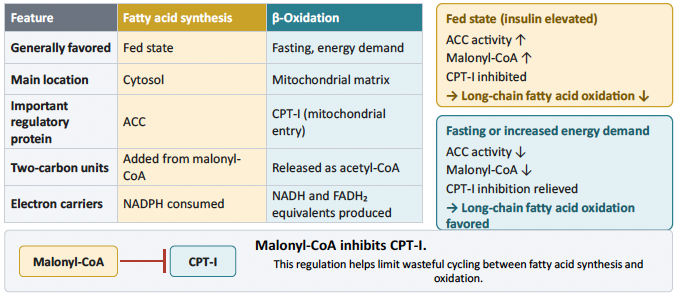
Malonyl-CoA helps coordinate fatty acid synthesis and oxidation by inhibiting CPT-I.
In the fed state, insulin promotes ACC activity, increasing malonyl-CoA production. This reduces mitochondrial entry of long-chain fatty acyl groups for oxidation.
During fasting or increased energy demand, ACC activity generally decreases, lowering malonyl-CoA and relieving CPT-I inhibition.
This regulation helps prevent simultaneous fatty acid synthesis and oxidation. The balance also depends on tissue type, fatty acid availability, and energy demand.
Why are newly synthesized fatty acids generally not immediately oxidized in the liver after carbohydrate-rich meal?
Increased ACC activity raises malonyl-CoA levels. Malonyl-CoA inhibits CPT-I, reducing transport of long-chain fatty acyl groups into mitochondria for oxidation.
A child with MCAD deficiency becomes lethargic after an illness with poor food intake. Blood glucose and ketone levels are both low. Why does MCAD deficiency cause reduced ketone production?
A. Insulin increases during fasting
B. The brain consumes ketone bodies faster than the liver produces them
C. Glycogen breakdown prevents ketone body formation
D. Impaired fatty acid β-oxidation reduces acetyl-CoA production in the liver
D
After a carbohydrate-rich meal, malonyl-CoA increases in the liver. What is its most direct effect on fatty acid oxidation?
A. Inhibition of CPT-I, reducing long-chain fatty acid entry into mitochondria
B. Stimulation of lipolysis in adipose tissue
C. Activation of mitochondrial β-oxidation
D. Conversion of acetyl-CoA into glucose
A
During fatty acid synthesis, which molecules does fatty acid synthase use to extend the growing fatty acid chain?
A. Acetyl-CoA and NAD⁺
B. Malonyl-CoA and NADPH
C. Fatty acylcarnitine and FADH₂
D. Glycerol and NADH
B