Cellular Respiration (HL Biology)
 Call Kai
 Learn
 Practice Test
 Spaced Repetition
 Match
 Flashcards
 Knowt Play
1/43

Earn XP
Description and Tags
Glycolysis, link reaction, anaerobic/aerobic respiration, Krebs cycle
44 Terms
Cellular respiration
Controlled release/production of energy from broken down organic compounds in cells
Structure of ATP
Ribose, adenine, 3 phosphates in sequence

ATP cycle
ATP hydrolyzes and releases energy + a phosphate
ADP forms
ADP phosphorylates and absorbs energy + a phosphate
ATP forms

When enzymes are present, ATP takes part in [blank] reactions
Energy requiring
Preferred respiratory substrate
Carbohydrates
Which has a higher energy yield, carbs, lipids, or proteins?
Lipids
Why are carbs the preferred respiratory substrate?
They oxidize easier and can directly enter glycolysis. Lipids need to become carbs first, creating more intermediate reactions. This reduces net ATP production, because some is used in those intermediate processes. Proteins are structural so they’re a last resort.
What happens in aerobic respiration
Sugar is completely oxidized to CO2, H2O, and ATP (free). This occurs in the mitochondria and makes lots of ATP, where each step has a specific enzyme.
C6H12O6 + 6O2 → 6CO2 + 6H2O + ATP
What happens in anaerobic respiration (fermentation)
This is a different (temporary) pathway used when no oxygen is present. It occurs in the cytoplasm and doesn’t make ATP. The sole waste product is lactate.
Variables affecting respiration rate
Metabolic rate of cell
Organism size
Oxygen supply
Substrate supply
Temperature
pH
How does the metabolic rate of the cell impact respiration rate
If more energy is needed, respiration will be faster
How does organism size impact respiration rate
Small organisms’ surface area is bigger compared to their size, so the higher rate allows for this heat loss
How does oxygen supply impact respiration rate
Constant oxygen supply is needed to release maximum ATP, without it, anaerobic respiration starts
How does substrate supply impact respiration rate
This dictates the rate of respiration and quantity of products (CO2, H2O, ATP)
How does temperature impact respiration rate
The process is controlled by enzymes, so the optimum temperature increases respiration rate and enzyme activity
How does pH impact respiration rate
The release of CO2 lowers pH (increases acidity) of the cell/body tissue. This affects enzyme function, decreasing their activity by moving out of the optimum pH range.
Respirometer
Measures oxygen consumption/CO2 production by trapping a respirating organism in a sealed container with enough O2 to be healthy. There is also a base (usually KOH) that absorbs CO2 and a capillary tube filled with a fluid that shifts with changes in pressure caused by O2 consumption. The movement of this fluid is divided by time to get the rate of respiration.

4 stages of cellular respiration
Glycolysis (glucose → pyruvate)
Link reaction (pyruvate → acetyl-CoA + CO2)
Krebs cycle (acetyl-CoA → CO2)
Electron transport chain (H’s removed in 1&3 form H2O, series of proteins transfer e- from NADH to make H+ gradient that drives the bulk of ATP synthesis)
Respiration redox reactions
Glucose is oxidized to CO2 and O2 is reduced to H2O at the same time. Dehydrogenation is oxidation (exergonic), and adding a hydrogen is reduction (endergonic). This only happens when an OA and/or RA are present.
Coenzymes
H acceptors/e- carriers (NAD & FAD)
Glycolysis stages
Phosphorylation
Lysis
Oxidation of Triose Phosphate
ATP formation

Phosphorylation
2 ATP give their phosphates to a glucose to form fructose diphosphate and 2 ADP
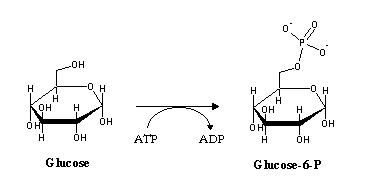
Lysis (splitting)
Fructose diphosphate splits into 2 triose phosphate (from here all processes are x2)
Oxidation of Triose Phosphate
The enzyme dehydrogenase oxidizes each triose phosphate, removing a phosphate and H, forming pyruvate. Each H is picked up by an NAD+ coenzyme, forming NADH + H+
ATP formation
The phosphates removed in the oxidation step combine with 2 ADP to form 2 ATP. Pyruvate then moves into the mitochondria for the rest of respiration.
NAD+ problem
NAD+ needs H to do its job, so the cell has to keep a supply of H. This is because glycolysis is the only ATP source when oxygen isn’t present, so the cell can’t afford to stop it.
Where does glycolysis take place?
Cytosol/cytoplasm
Where does the link reaction take place?
Mitochondrial matrix
Where are the enzymes for the link reaction and the Krebs cycle found?
Mitochondria
Anaerobic respiration
If oxygen isn’t present the pyruvate stays in the cytoplasm for fermentation. It accepts H from NADH (which then oxidizes back to NAD+) and forms lactate (in humans). In animals, the same thing happens but ethanol and CO2 are formed instead. This process regenerates NAD+ and lets glycolysis continue rather than making ATP directly.

Components and function of mitochondria
Outer membrane (selective barrier that lets small molecules like pyruvate pass through)
Inner membrane (electron transport chain proteins and ATP synthase enzymes are embedded here)
Circular DNA
70s ribosomes
Inter-membrane space (very small, allowing ion concentration to build up quickly and form a gradient)
Cristae (increase surface area)
Matrix

Link reaction
Pyruvate from glycolysis is actively transported through the mitochondrial membrane into the matrix (whole process x2).
Pyruvate decarboxylation (forms acetyl group and CO2 waste)
H from acetyl reduces NAD+ (NADH forms and CoA combines with acetyl to form acetyl-CoA)

Common entry point (acetyl-CoA)
Carbs → glycolysis → pyruvate → link rxn → acetyl-CoA (can do aerobic/anaerobic)
Lipids → fatty acids → acetyl groups → acetyl-CoA (can only do aerobic)
Acetyl-CoA → Krebs cycle
Electron transport chain (ETC)
Series of proteins in mitochondria membrane where NADH and FADH2 release electrons and H+ that gets pumped outside to generate a concentration gradient.

How do protons get pumped into the intermembrane space?
When NADH and FADH2 release electrons they also release energy, which is then used to actively pump the protons across the inner membrane where they accumulate and form a concentration gradient.
Enzyme that brings protons back in with the concentration gradient
ATP synthase
Function of ATP synthase
Brings protons back in with the concentration gradient, this is their only way to reenter the matrix because the inner membrane doesn’t let them through.
How does ATP form in the ETC
When protons reenter the matrix with the gradient, they release energy that is then used to combine ADP and phosphates to form lots of ATP
Where do electrons go at the end of the ETC
They combine with oxygen and H+ to form metabolic water, oxygen acts as a terminal electron acceptor
How many ATP per NADH
2.5
How many ATP per FADH2
1.5
Total yield of ATP per glucose molecule
32
Phosphorylation by chemiosmosis
Stored energy in a concentration gradient drives ATP synthesis
Why is oxygen needed in the ETC?
Electrons need a ‘final destination’ to be removed from the chain, this allows for the continuous flow of electrons through the system. Protons also need to be removed, and the formation of metabolic water fulfills both these purposes.