Parasitology LAB - Protista & Amoebae
 Call Kai
 Learn
 Practice Test
 Spaced Repetition
 Match
 Flashcards
 Knowt Play
1/107

There's no tags or description
Looks like no tags are added yet.
108 Terms
The protozoa studied in this lab are single-celled and ___?
eukaryotic
What does eukaryotic mean about the nucleus?
membrane-enclosed nucleus
Amoebae move and engulf food with false feet called ___?
pseudopodia
Which stage is the active feeding form inside the host?
trophozoite
In cyst-forming intestinal protozoa, which protected stage usually infects the next host?
cyst
Finding E. histolytica trophozoites in diarrheal stool makes them the usual infective stage: true or false?
false
Contaminated water, food, or hands transmit E. histolytica by which route?
fecal-oral ingestion of cysts
Give the simplified E. histolytica life-cycle sequence from ingestion to exit.
cyst → trophozoite → cyst
Which intestinal symptom is associated with E. histolytica?
severe bloody diarrhea
Severe diarrhea can rapidly become dangerous because of ___?
dehydration
Which amoeba was linked to mouth-to-mouth contact or kissing?
Entamoeba gingivalis
Which life-cycle stage is absent in E. gingivalis?
cyst
Why does E. gingivalis not need a prolonged external survival stage?
direct oral transfer can occur between mouths
Which oral condition did the instructor associate with E. gingivalis?
gingivitis
Where does N. fowleri normally live as a free-living organism?
warm freshwater and soil
Which amoeba covered in this lab has three possible life stages?
Naegleria fowleri
Name the three forms of N. fowleri.
cyst, amoeboid trophozoite, flagellate
Which temporary form of N. fowleri uses flagella for swimming and returns to an amoeba to feed?
flagellate
Which amoeba should come to mind after freshwater nasal exposure followed by severe headache and seizures?
Naegleria fowleri
Contaminated freshwater is dangerous for N. fowleri when it enters the ___?
nose
Does swallowing water containing N. fowleri cause its brain infection?
no
After nasal entry, N. fowleri travels along which nerves toward the brain?
olfactory nerves
Which fluid specimen is used to detect suspected N. fowleri infection?
cerebrospinal fluid (CSF)
Which amoeba was linked to a neti pot filled with contaminated water?
Naegleria fowleri
For a neti pot or nasal rinse, what water should be used?
distilled, sterile, or previously boiled and cooled water
Which portable chemical disinfectant was mentioned as a hiking backup?
iodine crystals or iodine tablets
FOUNDATIONS — The protozoa studied in this lab are single-celled and ___.
eukaryotic. Course shorthand: unicellular eukaryotes. This describes the protozoa studied here, rather than every organism historically placed in Protista. Memory: One cell + enclosed nucleus.
FOUNDATIONS — What does eukaryotic mean about the nucleus?
membrane-enclosed nucleus. The cell has a true nucleus surrounded by a nuclear envelope; eukaryotes also have membrane-bound organelles.
LOCOMOTION — Amoebae move and engulf food with false feet called ___.
pseudopodia. Temporary cell extensions let the amoeba move toward and surround food. Memory: Pseudo = false; podia = feet. Compare: Flagellates use flagella; ciliates use cilia. The instructor said the other groups will be covered later.

TWO-STAGE CYCLE — Which stage is the active feeding form inside the host?
trophozoite. This form feeds and may multiply. It is not literally an adult animal. Memory: Tropho = feeding.
TWO-STAGE CYCLE — In cyst-forming intestinal protozoa, which protected stage usually infects the next host?
cyst. A cyst survives outside the host and can be ingested by the next host. Memory: Cyst = carry to the next host. Note: This is a typical intestinal cycle, not a universal rule for all protists.
STOOL STAGE TRAP — Finding E. histolytica trophozoites in diarrheal stool makes them the usual infective stage: true or false?
false. Trophozoites can leave in stool but rapidly lose viability outside the body. In the usual fecal-oral cycle, mature cysts transmit infection. Note: Diagnostic stage found in stool does not automatically mean transmission stage.
E. HISTOLYTICA — Contaminated water, food, or hands transmit E. histolytica by which route?
fecal-oral ingestion of cysts. Fecal material containing mature cysts reaches another person's mouth. Memory: Histo: cyst in, cyst out.
E. HISTOLYTICA — Give the simplified life-cycle sequence from ingestion to exit.
cyst → trophozoite → cyst. Cysts are ingested; excystation releases trophozoites that feed and multiply; encystation produces cysts passed in feces. Note: The instructor excluded E. histolytica nuclei and excystation counts from the lab quiz.

E. HISTOLYTICA — Which intestinal symptom did the instructor emphasize?
severe bloody diarrhea. Cramping and rapid dehydration may accompany intestinal disease. Extraintestinal spread, including to lungs or brain, was mentioned as uncommon. Memory: Histolytica = tissue-damaging amoeba.
E. HISTOLYTICA — Severe diarrhea can rapidly become dangerous because of ___.
dehydration. Loss of fluid and electrolytes can be severe. The infection is treatable, but untreated invasive disease can be serious.
ORAL TRANSMISSION — Which amoeba was linked to mouth-to-mouth contact or kissing?
Entamoeba gingivalis. Its trophozoites inhabit the oral cavity. Direct oral contact can transmit the organism. Memory: Gingivalis = gingiva / gums.
E. GINGIVALIS — Which life-cycle stage is absent in E. gingivalis?
cyst. No cyst stage is known; its cycle involves trophozoites in the mouth. Note: Do not force every protozoan into a cyst-and-trophozoite cycle.

E. GINGIVALIS — Why does the course connect direct oral transfer with no cyst stage?
no prolonged external survival stage is needed. Transfer can occur directly between mouths, without a durable cyst waiting in the environment. Compare: E. histolytica normally uses an environmentally resistant cyst instead.
E. GINGIVALIS · COURSE ASSOCIATION — Which oral condition did the instructor associate with E. gingivalis?
gingivitis. The instructor also mentioned plaque, bad breath, and gum inflammation. Memorize this as the course association. Clarification: Source conflict: the course calls it pathogenic; CDC DPDx describes it as nonpathogenic and found in diseased periodontal tissue. Association does not establish that it causes gingivitis.
NAEGLERIA · HABITAT — Where does N. fowleri normally live as a free-living organism?
warm freshwater and soil. Freshwater lakes and their sediments were emphasized. Humans are accidental hosts, not a required part of its life cycle. Memory: Naegleria = warm freshwater, nasal exposure.

LIFE-CYCLE EXCEPTION — Which amoeba covered today has three possible life stages?
Naegleria fowleri. This was explicitly flagged as a likely quiz question. Note: The claim is scoped to the organisms discussed in this lab, not every protist in nature.
NAEGLERIA · STAGES — Name the three forms of N. fowleri.
cyst, amoeboid trophozoite, flagellate. The forms can change with environmental conditions; they are not a rigid one-way sequence. Memory: C-A-F: cyst, amoeba, flagellate.
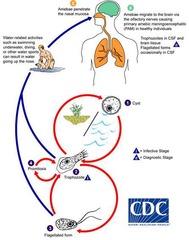
NAEGLERIA · MOVEMENT — Which temporary form uses flagella for swimming and returns to an amoeba to feed?
flagellate. The flagellated form is nonfeeding; the amoeboid trophozoite feeds. Compare: Do not confuse faster movement with the feeding form.

EXPOSURE + SYMPTOMS — Which amoeba should come to mind after freshwater nasal exposure followed by severe headache and seizures?
Naegleria fowleri. The instructor also mentioned stroke-like neurologic signs. It causes primary amebic meningoencephalitis (PAM), a rare but often fatal brain infection. Note: These findings are a study clue, not enough to diagnose an individual; appropriate clinical and laboratory assessment is needed.
NAEGLERIA · ENTRY — Contaminated freshwater is dangerous for N. fowleri when it enters the ___.
nose. Nasal exposure lets infective trophozoites reach the olfactory route toward the brain. Memory: Naegleria: Nose → Nerves → brain.
NAEGLERIA · ROUTE TRAP — Does swallowing water containing N. fowleri cause its brain infection?
no. The established route is water entering the nose. This does not make untreated lake water safe from other pathogens. Clarification: CDC distinguishes swallowing water from nasal exposure.
NAEGLERIA · BRAIN ROUTE — After nasal entry, N. fowleri travels along which nerves toward the brain?
olfactory nerves. The resulting disease is primary amebic meningoencephalitis (PAM), a rapidly progressive brain infection. Clarification: Anatomical route clarified by the supplied CDC figure and CDC DPDx.

NAEGLERIA · LAB TEST — Which fluid specimen was emphasized for detecting suspected N. fowleri infection?
cerebrospinal fluid (CSF). Amoebic trophozoites may be detected in CSF. The instructor discussed headache, seizures, and stroke-like neurologic signs; diagnosis requires appropriate laboratory testing. Memory: Brain infection → check fluid around brain/spinal cord.
NAEGLERIA · EXPOSURE SCENARIO — Which amoeba was linked to a neti pot filled with contaminated water?
Naegleria fowleri. The risk comes from introducing contaminated water into the nose. The instructor explicitly flagged this scenario for a question. Infection is rare but often fatal.
NAEGLERIA · PREVENTION — For a neti pot or nasal rinse, what water should be used?
distilled, sterile, or previously boiled and cooled water. Ordinary tap water is not necessarily appropriate for nasal irrigation. Do not assume a standard taste/odor pitcher filter makes water safe for this use. Memory: For the nose: distilled / sterile / boiled then cooled. Clarification: Water-safety wording follows CDC guidance.
CLASS DISCUSSION · WATER — Which portable chemical disinfectant did the instructor mention as a hiking backup?
iodine crystals or iodine tablets. This is chemical disinfection, not physical filtration. It is not reliably effective against all protozoa; do not memorize the unsupported "96%" claim. Clarification: CDC notes that practical iodine treatment does not reliably inactivate Cryptosporidium.
CLASSIFICATION — Why did the instructor call Kingdom Protista a grab bag?
it historically grouped diverse organisms that did not fit neatly elsewhere. This is the traditional classification language used in this lab, not a claim that Protista is one natural evolutionary group.
EUKARYOTIC CELL — Besides the enclosed nucleus, what else is characteristic of a eukaryotic cell?
membrane-bound organelles. The transcript supplied this as extra background. Organelles and the nucleus are enclosed by membranes.
LOCOMOTION — Which locomotive structure propels flagellates?
flagella. These are relatively long projections that help propel the organism. Memory: Flagellate → flagella.
LOCOMOTION — Which hair-like structures help ciliates move?
cilia. The transcript names ciliates and distinguishes their short, numerous projections from flagella. Memory: Ciliates → cilia.
CLASSIFICATION — The malaria parasites were placed in which protist group in the overview?
Apicomplexa. The instructor mentioned this group before focusing on amoebae. Do not interpret the transcript's "whip the body" wording as a universal motility definition.
LOCOMOTION — What does the term pseudopodia literally mean?
false feet. These are extensions of the cell, not separate legs. Memory: Pseudo = false; podia = feet.
AMOEBA CELL FUNCTION — After food is engulfed by pseudopodia, in which compartment can digestion occur?
food vacuole. The amoeba surrounds food and encloses it in a digestive vacuole.
BIG PICTURE — Are all protists harmful parasites?
no. The transcript emphasizes free-living and beneficial protists as well as pathogenic examples. Note: Being a protist does not automatically mean living as a human parasite.
TREATMENT DISTINCTION — For an amoebic parasitic infection, treatment should target which type of organism?
protozoa — use appropriate antiprotozoal therapy. Accuracy clarification: the transcript says antibiotics never work. That is too broad; some drugs used for amebiasis are also classified as antibiotics. This card is about choosing therapy active against the organism.
STAGE CHANGE — What is excystation in the cyst/trophozoite cycle?
emergence of trophozoites from a cyst. This follows ingestion in the typical intestinal cycle. Memory: EXcyst = EXit the cyst.
STAGE CHANGE — What is encystation in the intestinal cycle?
formation of a cyst from a trophozoite. This generates a resistant form that can leave the host and persist outside. Memory: ENcyst = ENclose in a cyst.
SURVIVAL — What feature helps a cyst survive outside the host?
its protective cyst wall. Resistance helps transmission; it does not make the cyst indestructible or immune to every treatment. Compare: Trophozoites are active feeding forms and are generally more fragile outside the host.
E. HISTOLYTICA · STAGE — Which stage of E. histolytica is normally ingested to establish intestinal infection?
mature cyst. This tests stage, whereas the original card tests the fecal-oral route. Note: Do not answer "trophozoite" merely because it is the active feeding form.
E. HISTOLYTICA · SITE — According to the life-cycle clarification, where does E. histolytica excystation occur?
small intestine. The released trophozoites then migrate to the large intestine. The precise site is clarified from CDC DPDx rather than the shorthand "stomach" in the transcript.
E. HISTOLYTICA · SITE — Where do E. histolytica trophozoites principally live and multiply after excystation?
large intestine. They can remain in the lumen or invade intestinal tissue.
E. HISTOLYTICA · DAMAGE — Which E. histolytica stage can invade intestinal tissue?
trophozoite. Cysts transmit infection; trophozoites are the active form associated with tissue invasion. Memory: Cyst carries; trophozoite attacks.
E. HISTOLYTICA · MULTIPLICATION — How do trophozoites multiply by splitting into two daughter cells?
binary fission. The instructor explained this process but said the name was not emphasized for the lab quiz. It is included here as background coverage. Memory: Binary = two; fission = splitting.
E. HISTOLYTICA · SPREAD — Besides the intestine, which two unusual sites were mentioned for E. histolytica spread?
lungs and brain. The transcript calls these uncommon. The supplied CDC diagram also shows extraintestinal disease involving the liver. Note: This does not make E. histolytica the same organism as the free-living "brain-eating amoeba."
E. HISTOLYTICA · STOOL — Which two forms may be detected in stool?
cysts and trophozoites. Cysts are commonly associated with formed stool; trophozoites with diarrheal stool. Usual environmental transmission relies on mature cysts. Compare: Detection in a specimen and the usual transmission stage are different questions.
E. HISTOLYTICA · SPREAD — Can a person with noninvasive infection still pass cysts?
yes. An asymptomatic carrier can continue shedding cysts, as illustrated in the noninvasive branch of the supplied diagram.
E. GINGIVALIS · LOCATION — Where do E. gingivalis trophozoites live?
oral cavity, especially gingival pockets. Gingiva means gums; the cleaned notes specify the mouth, and CDC clarifies gingival pockets near the teeth. Memory: Gingivalis → gingiva / gums.
E. GINGIVALIS · STAGE — Which E. gingivalis stage is transferred by direct oral contact?
trophozoite. There is no known cyst stage. This is an important exception to the typical intestinal "ingest a cyst" pattern. Compare: E. histolytica normally transmits by mature cysts.
E. GINGIVALIS · EXPOSURE — Besides kissing, what shared-item example was mentioned for oral transfer?
recently shared drinking or eating utensils. The instructor mentioned shared drinks/straws; CDC describes transmission through fomites such as eating utensils. The transcript's approximate seconds should not be memorized as a proven survival cutoff.
E. GINGIVALIS · COURSE FINDINGS — Besides gingivitis, which two oral findings did the instructor associate with E. gingivalis?
plaque buildup and bad breath. These are the course's stated associations. CDC does not regard a causal role in periodontal disease as established. Note: Do not turn an association into a scientifically proven cause.
NAEGLERIA · ECOLOGY — Does N. fowleri require a human host to complete its normal life cycle?
no. It is free-living in the environment; human infection is accidental. Note: An organism can be free-living normally and still cause opportunistic disease.
NAEGLERIA · STAGE FUNCTION — Which Naegleria form actively feeds?
amoeboid trophozoite. The temporary flagellated form is a nonfeeding swimmer. Memory: Tropho = feeding; flagellate = swimming.
NAEGLERIA · HUMAN ENTRY — Which N. fowleri form initiates infection by penetrating nasal mucosa?
trophozoite. Do not assume that the cyst is infective just because that is true for E. histolytica's usual intestinal cycle. Note: The infective stage is species-specific.
NAEGLERIA · STAGE REASONING — Must Naegleria pass through its three forms as a fixed one-way cycle?
no. The trophozoite can switch with environmental cyst and flagellated forms. These are alternative forms, not a required cyst → trophozoite → flagellate → human sequence.
NAEGLERIA · DISEASE — What brain infection can N. fowleri cause?
primary amebic meningoencephalitis (PAM). The name appears on the supplied CDC diagram; the instructor emphasized brain damage after nasal entry. Memory: PAM = primary amebic meningoencephalitis.
NAEGLERIA · SEVERITY — Is Naegleria brain infection generally mild or associated with very high fatality?
very high fatality. It is a rare infection that is nearly always fatal; "almost always" is more accurate than "always" or "there is no possible treatment." Note: Rare exposure outcome and severe disease once infected are different concepts.
NAEGLERIA · SPECIMEN STAGE — Which Naegleria stage is expected in CSF from an infected patient?
trophozoite. The supplied diagram marks trophozoites in CSF/brain tissue. Flagellated forms are occasionally detected in CSF, but cysts are not the expected finding.

NAEGLERIA · ENVIRONMENT VS HOST — Are N. fowleri cysts normally found in brain tissue?
no. Cysts are environmental forms. Trophozoites are associated with human tissue infection.
NAEGLERIA · PREVENTION — What precaution did the instructor recommend when jumping or diving into freshwater?
hold the nose or use a nose clip. The aim is to reduce water being forced into the nose. This reduces an exposure route; it is not a guarantee against all waterborne hazards. Memory: Protect the nose from forced water entry.

WATER · ENVIRONMENT — Why is clear mountain-stream water not automatically free of pathogens?
it can still be contaminated by feces. The instructor used animal feces as the example. Appearance alone does not establish microbiologic safety.
WATER · METHOD — Do iodine crystals chemically disinfect water or physically filter it?
chemically disinfect. The source calls this "filtering," but iodine acts chemically. It does not reliably inactivate every protozoan under practical conditions. Note: Disinfection and filtration are not synonyms.
WATER · NASAL SAFETY — Does an ordinary taste/odor pitcher filter automatically make water safe for nasal rinsing?
no. For nasal rinsing, use distilled, sterile, or previously boiled and cooled water. Do not substitute a general household-filter claim for the device's water-safety instructions.
COMPARE · MAIN SITES — Match E. histolytica, E. gingivalis, N. fowleri to their main sites in this lab.
intestine; mouth/gums; brain in human disease. The order follows the organisms in the question. Naegleria normally lives free in the environment. Memory: Histo: gut; gingivalis: gums; Naegleria: nose-to-brain.
COMPARE · ROUTES — Match E. histolytica, E. gingivalis, N. fowleri to their transmission routes.
fecal-oral cyst ingestion; direct oral trophozoite transfer; nasal water exposure. Do not treat all "waterborne amoeba" questions as an ingestion question.
COMPARE · INFECTIVE STAGE — Is "the cyst is always infective" a correct rule for all three organisms?
no. E. histolytica usually transmits through mature cysts; E. gingivalis has no cyst stage; N. fowleri infects human tissue as a trophozoite. Note: Always/only statements must be checked against species exceptions.
SOURCE CORRECTION · BACKGROUND — A verified E. histolytica trophozoite normally has how many nuclei?
one. The raw notes/transcript say two. CDC DPDx gives one. The instructor explicitly said these counts were not part of the lab quiz; this is a correction/background card.
SOURCE CORRECTION · BACKGROUND — A mature E. histolytica cyst usually has how many nuclei?
four. Immature cysts may have fewer visible nuclei. Do not infer the number of trophozoites produced by simply dividing nuclear counts. The instructor excluded this detail from the lab quiz.
Visual: Entamoeba histolytica Life Cycle
Mature cyst (ingested via fecal-oral route) -> Excystation in small intestine -> Trophozoite in large intestine (feeds/multiplies/invades tissue) -> Encystation -> Mature cyst passed in feces.
Visual: Naegleria fowleri Three Forms
1. Cyst: Environmental, resistant resting form.
2. Amoeboid Trophozoite: Active feeding form, infective stage entering via nose.
3. Flagellate: Temporary swimming form in water.
What features characterize protists?
Usually unicellular and eukaryotic.
What is a trophozoite?
The active feeding stage.

What is a cyst?
A transmission/environmental stage in organisms that form cysts.
What does pseudopodia mean?
"False feet."
How is Entamoeba histolytica acquired?
Through contaminated water.