ansc314 - mineral P
 Call Kai
 Learn
 Practice Test
 Spaced Repetition
 Match
 Flashcards
 Knowt Play
1/18

There's no tags or description
Looks like no tags are added yet.
19 Terms
phosphorus (P)
performs 14 vital functions
free P does NOT exist
P always chelated or bound as phosphate
P sources animal
cereal grains
↑ P, poorly available (20-60%) as it is bound as phytic acid

P sources human

P sources ruminants
microbial phytases breakdown phytic acid in cereal grains → release P that’s absorbed in s. intestine
ruminants have ↓ P requirement → don’t need phytase in diet

phytic acid
plant storage form of P
chelation
Mg, Zn, Cu, Ca, Mn , Fe & K (cations)
Occurs in plant & precipitates minerals in digestion cations)
↑ phytate prevents P release by animal enzymes
P functions
bone & teeth formation
↑ E bonds (ATP → ADP, creatine-P → creatine)
lipid transport (phospholipids)
nucleic acid synthesis (DNA, RNA)
milk secretion (casein micelle formation)
osmotic & acid-base balance (phosphate buffer system)
carbohydrate, fat & amino acid metabolism (phosphorylation, events, enzyme control)
enzyme system requirements
P blood & body distribution
P represents 1.1% of fat-free mass of body
80-85% of body P → bones & teeth
↑ skeletal P w/ ↑ maturity → ↑ ossification
soft tissue (14%)
blood (1%)
plasma lvls (60-90 mg phosphate/L)

P absorption sites
duodenum & upper jejunum
rapid absorption unless bound (phytate)
bound to phospholipid in intestinal epithelium (not free)
P absorption mechanisms
saturable (70% dietary P absorbed)
carrier-mediated ACTIVE transport against concentration gradient
some passive uptake
excess P intake depresses Ca absorption due to formation insoluble Ca phosphates in s. intestine
P absorption factors
excessive lvls of
Ca, Mg, Al → ties PO4 (precipitates) & ↓ absorption
diet acidity helps dissolve precipitates (↓ pH)
phosphate form
Dicalcium Phosphate – 85% available (more soluble)
Ca Phosphate – 45% available (less soluble)
Phytate-P – low and variable in monogastric species
phytic acid & animal/bacterial phytase
presence or absence
phytate complex (P availability)
monogastric
fed grain-based diets:
add more mineral P supplements
add phytase to the diet
ruminants
rumen microbial phytases release P from phytate complex in rumen
don’t need to add phytase
adding extra mineral P to diets problems
ends up in feces → water
finite supply of mineral phosphate mines
phytase sources
ruminal & intestinal bacteria
added to diet (from bacteria)
plant – low
animal phytase → very low levels of enzyme in intestine
except Enviro-pig
P excreted by broilers
excess P ends up in animal manures
↑ eutrophication of fresh water
most MD broiler producers feed phytase to ↓ impact on water
required by law in NC for swine

plant phytate-P sources
10-60% P availble from grains
corn, oats
wheat, barley, rice
soybeans
processing wheat flour makes phytate-P available (grinding & baking)
P requirements
0.3 to 1% of diet
Ca:P ratio very important
Ca:P < 1:1 or >2.5:1 metabolic problems
P deficiency
rickets & osteomalacia (same as Ca)
abnormal growth & bone structure
appetite loss (anorexia)
Pica - abnormal eating & chewing behavior
chew wood, bones, & other material, & eat soil
↓ blood P - hypophosphatemia
excess P
common deficiency in humans
low Ca:P ratio
feeding meat meal or cereals (↓ Ca:P ratio)
symptoms
hyperparathyroidism
↑ PTH →
↑ PO4 = excretion
↑ Ca resorption from bone
↑ Ca intestinal absorption to offset ↑ plasma Ca
bone calcification failure
↑ P & Mg → minerals deposits in bladder ""urolithiasis”
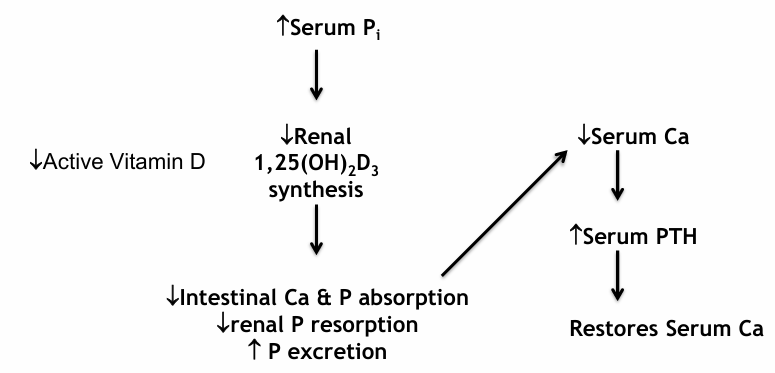
P homeostasis (↑ P)
response to ↑ P diet
↑ diet P → ↓ active D3, ↑ PTH, ↑ bone mobilization
P homeostasis (↓ P)
response to ↓ P diet
↓ P → active ↑ D3, ↓ PTH → restore serum Ca
can be caused by kidney dysfunction, alcoholism, diabetes, medications
