Alkanes
 Call Kai
 Learn
 Practice Test
 Spaced Repetition
 Match
 Flashcards
 Knowt Play
1/10

There's no tags or description
Looks like no tags are added yet.
11 Terms
what are single C-C and C-H bonds made of ?
sigma bonds allowing free rotation
general formula for alkanes
CnH2n+2
what is the trend in boiling points of alkanes ?
bp of straight-chain alkanes incs with chain length due to incd sa and so incd ldn forces between molecules.
why are alkanes non polar ?
bcs of their CH bonds also making them immiscible in water
why are alkanes so unreactive ?
they require a rlly high activation energy so are generally unreactive
what are the general products of complete combustion
water and CO2
products of incomplete combustion ?
CO and water - maybe soot
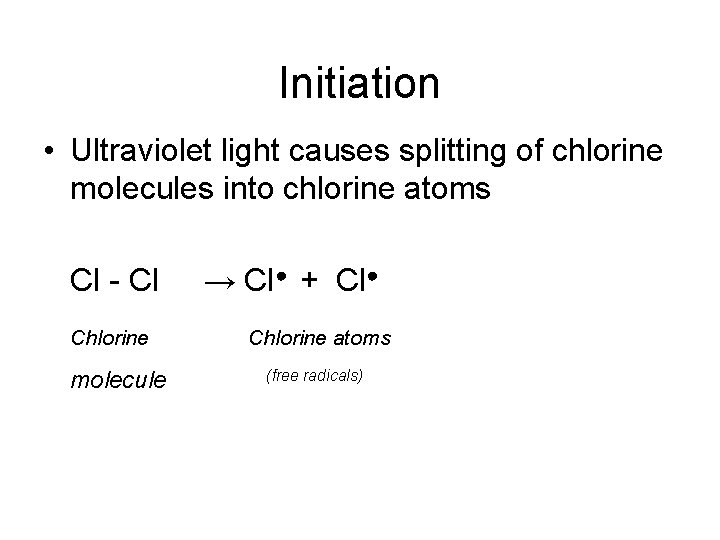
what is the first step in free radical substitution (using Cl2 as an example)
initiation: the weakest bond is broken
in this case the Cl-Cl bond is broken using UV light
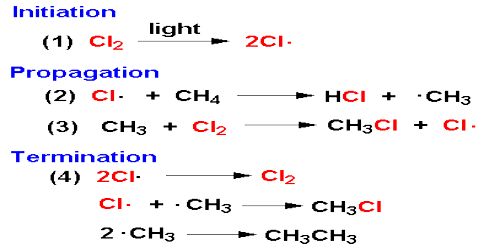
what is the second stage of free radical substitution? (reaction between Cl2 and CH4 as an example)
propagation :
the free radicals are vv reactive so the Cl free radical abstracts a hydrogen atom from methane forming a methyl radical
this methyl radical is also vv reactive so reacts w/ a chlorine molecule producing a chlorine radical and the whole process starts over again
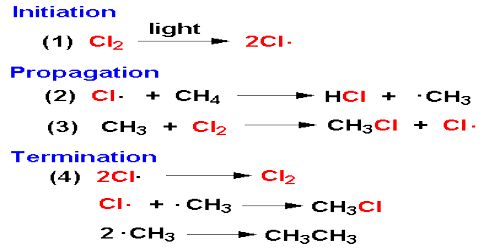
what is the third stage of free radical substitution? (reaction between Cl2 and CH4 as an example)
termination : the radicals are removed bringing an end to the reaction
limitations of free radical substitution?
a mixture of products bcs of the many possible reactions
substitutions at many diff positions along the chain