Frameworks, Paradigms, Puzzles + Interests, Interactions, Institutions
 Call Kai
 Learn
Learn Practice Test
 Spaced Repetition
 Match
Match Flashcards
 Knowt Play
1/20

There's no tags or description
Looks like no tags are added yet.
Name | Mastery | Learn | Test | Matching | Spaced | Call with Kai | Chat |
|---|
No analytics yet
Send a link to your students to track their progress
21 Terms
Realism
framework in IR
power & security, key actors are states, dominate other states to be very powerful and gain security from other states, no centralized authority
Liberalism
framework in IR
globalization (interdependence between groups in societies), individuals/groups are basic actors, believes cooperation is possible, value of multilateral institutions for regulation and cooperation
Constructivism
framework in IR
social construct (money) influences actions, identities of actors and social practices affects IR, identities change, goes beyond material interests, socially constructed, ket actors are states and other actors, ideas, norms
Feminism
gender roles, gendered power relations, key actors are beyond states and elites to individuals and everyday life, masculine experiences treated as universal in IR
Marxism
class and economic relations, key actors are states and international institutions reflecting the interests of dominant economic classes, capitalism, produces inequality, exploitation, conflict between/within states
Polarity
the number of power centers in the international system at a given time
multipolarity (before WWII), bipolarity (cold war), unipolarity (U.S.?)
Rationalism
Actors are engaging in purposive behavior - they have a goal and will work toward it
states and other political actors as unitary, goal-oriented agents who make logical, cost-benefit decisions to maximize their expected utility (such as security, power, or wealth)
Faults with Paradigms (broad set of assumptions)
Aren’t always useful in advancing our understanding of the world
Focus on narrow areas can encourage extreme positions
Aren’t really theories
Tend to focus on the things they care about
Makes them difficult to evaluate and fit into social scientific framework
Levels of analysis
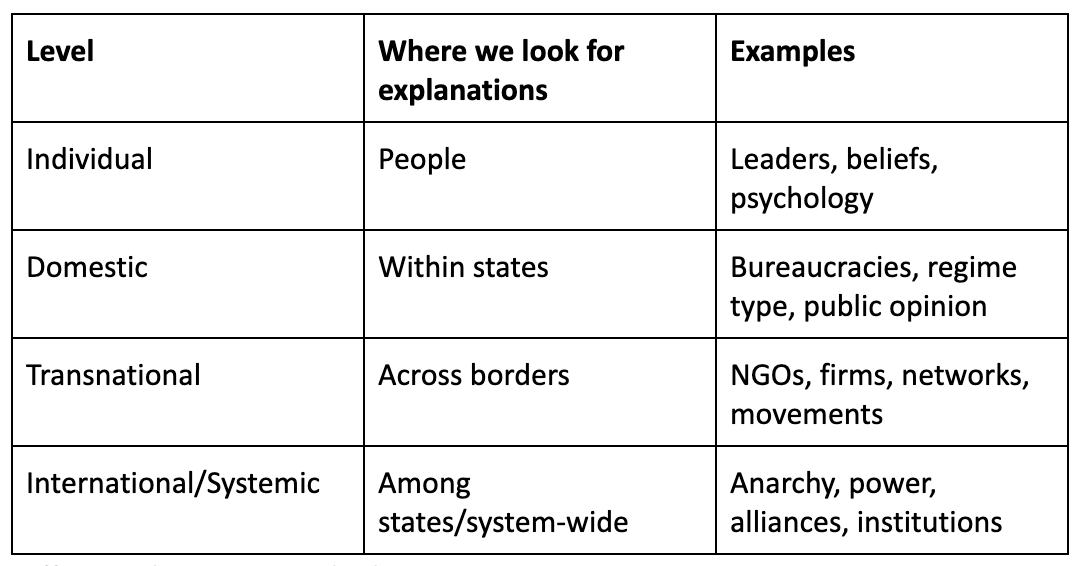
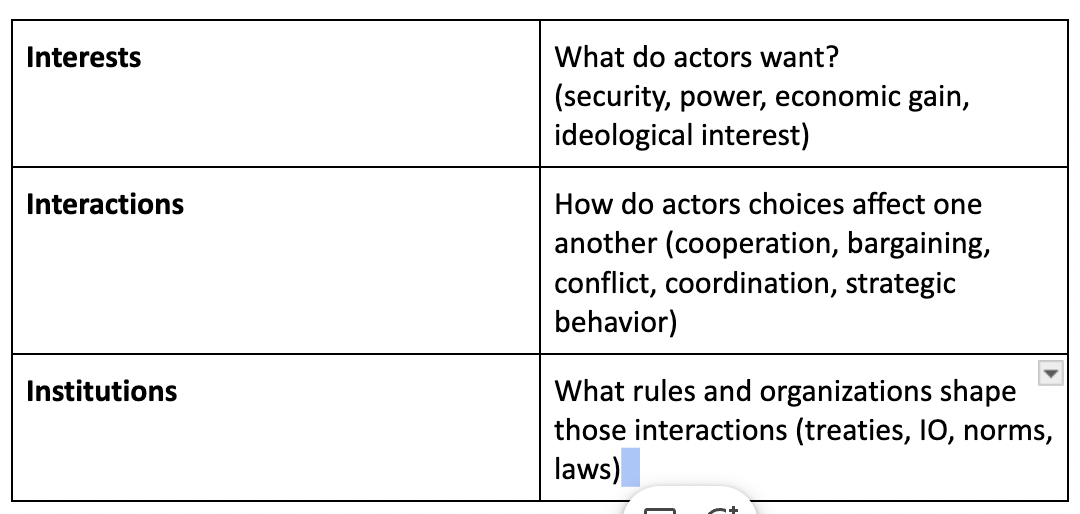
Interests, Interactions, Institutions
Puzzles and Mid-Level Theory

IR as a Social Science process? Hypothesis? Theory?
Theory → Hypothesis → Empirical test → test → repeat
Hypothesis – relationship between 2 phenomena
Theory – takes hypothesis and adds an explanation (answers y)
IV - change, DV - measured, thing being caused
Models
Theoretical and empirical
Designed to leave something out
Requires we make assumption
Aren’t right/wrong just more/less useful
What makes a good theory?
Are falsifiable (can be proven wrong)
Explain more (wider range)
Explain something important
Are parsimonious/simple
Are satisfying
Game Theory
Modeling strategic interactions (one party’s decision may be based on what another party does)
SImplify interactions to highlight an important dynamic
Equilibrium outcome - no player can do better by switching moves
Is the thing left out important enough to realize the model isn’t significant to an explanation
Prisoner’s Dilemma Game
Both stay silent - light sentence
One talks one stay silent - talker goes free, silent prisoner gets harsh sentence
Both talk - both receive substantial sentence
Dominant strategy (defect) makes both worse off but both would be better off cooperating
Tit for tat - cooperate on first move, if the other players defect you defect - if you interact more in the future you are more likely to cooperate
Chicken Game
Chicken – explains escalation behavior in IR
Mutual concession (Swerve, Swerve): A tied, moderate compromise.
Unilateral concession (Straight, Swerve): The firm player wins and gains the highest payoff, while the swerving player is humiliated.
Mutual firmness (Straight, Straight): The worst possible outcome for both sides—a catastrophic "crash" or war.
Unlike the Prisoner's Dilemma, there is no single best move; your optimal choice depends entirely on what you expect the other player to do.
Brinkmanship and Signaling: States deliberately push a situation to the edge of active conflict to signal resolve and force the adversary to back down first
Credibility
Stag Hunt Game
Stag hunt – dominant strategy is to cooperate and get the stag but if you don’t trust your fellow partner then it creates conflict
The Scenario: Two (or more) players decide independently and simultaneously whether to hunt a stag (cooperate) or a hare (defend/play safe).
Stag: Catching a stag requires full cooperation; if both choose stag, they get a large, high-value reward (payoff-dominant / Pareto optimal).
Hare: Catching a hare can be done alone for a smaller, guaranteed reward (risk-dominant).
The Catch (The Risk): If one player chooses the stag and the other defects to hunt a hare, the stag hunter gets nothing, while the hare hunter gets a hare.
Stag / Stag: Both cooperate; the best possible outcome for everyone.
Hare / Hare: Both defect; a safe outcome with a lower payoff
The Security Dilemma: In international politics, states want mutual disarmament or global climate agreements (the stag), but fear that trusting an adversary or partner will leave them vulnerable if the other cheats (the hare).
Trust and assurance
Bach or Stravinsky Game
Bach or Stravinsky - pure coordination don’t want to go alone but want to see different concerts (agreeing on international standards)
Choices: Two players must simultaneously choose between attending a Bach concert or a Stravinsky concert.
Preferences: Both players want to go to the same concert together more than anything else. However, Player 1 prefers Bach, while Player 2 prefers Stravinsky.
Dominant strategy
A single move that yields a higher payoff than any other strategy, completely independent of the opponent's actions
Nash equilibrium
A combination of strategies where no participant can improve their outcome by changing their own strategy while everyone else keeps theirs the same