BIOL 251
 Call Kai
 Learn
 Practice Test
 Spaced Repetition
 Match
 Flashcards
 Knowt Play
1/54

There's no tags or description
Looks like no tags are added yet.
55 Terms
What is Ecology?
The scientific study of the relationship b/w organisms and their environment
Environment: the abiotic and biological conditions that affect an organism
The 4 Laws of Ecology
Everything is connected to everything else
Everything must go somewhere — energy, waste products, etc.
Nature knows best — systems typically find their own equilibrium
There is no such things as a free lunch — trade-offs
Physiology and Biomes
Physiology is a key determinant of how orgs cope w/ their env and hence where they can survive. In terrestrial orgs, temp, and moisture availability are “master variables”.
Biome — area across which the climate is relatively consistent and hence is characterized by distinctive plants and animals
depicted by climate diagrams and whittaker biome diagrams
Whittaker’s Biome Diagrams
The general type of veg in a location. It will depend on its average annual temp and precipitation level.
There is nothing in top left b/c this is outside he boundary of where life can persist as it is too cold and too dry. Also, high precipitation and low temp does not exist on Earth

Physiological Tolerance & Niche
Physiological Tolerance limits the range of env conditions under which a species can survive. Temperature influences all manner of rate in plant and animals. But you could replace temp w/ any resource/condition.
Niche — set of env conditions that describe the tolerance range of a species. Outside this range, the species cannot survive.
Climate Diagrams
Temps and moisture availability are linked b/c plants must obtain enough water to offset their losses through evaporation (turning liquid water to vapor) and transpiration (evap of water from leaf into atmosphere) and still carry out photosynthesis.
Temp influences evapotranspiration (total amount of water leaving ground and into atmosphere) rate
Climate diagrams are useful to assess whether plants will be water stressed or not.
Percipitation vs AET vs PET
Precipitation determines how much water is available for evapotranspiration
PET: potential rate of evapotranspiration if there is abundant water
drive primarily by temp
PET (mm/month) = 2 x temp (C)
AET: actual rate of evapotranspiration by evaporation + transpiration, given moisture availability
Precipitation >= PET —> lots of water and AET = PET
Precipitation < PET —> water is scarce and AET = Precipitation
Note: no AET or PET if below freezing
Limiting Resource
Leibig’s Law of the Minimum — the distribution of a species will be limited by whichever resource is the most scarce. Doesn’t have to be nutrients. Which resource is limiting can diff b/w env. It is specific to each species in an env at any particular time.
Each species has min req that can limit where it can live. performance will be maxed when in it’s optimal env — set of conditions for which growth and reproduction are greatest.
Adaptation
Adaptations are when a species evolves through a natural selection such that the pop becomes better suited to survive and reproduce in its env.
There is a change at the genetic level that occurs among gens based on the selective survival and reproduction of individuals w/ particular trait values that grant them greater fitness
Acclimation
Acclimation is a change in physiology or morphology at the individual level in response to env conditions, not at the pop level.
Some types are reversible while others are irreversible.
How can an individual change its enzymes?
An individual cannot change their DNA but
diff genes for multiple versions of the enzyme: up-regulation or down-regulation of the expression of these genes can be temp dependents
temp affects a protein behavior by altering its structure
change the cellular env in which enzyme operate e.g. via HSP that stabilize the shape of other proteins
Limits to Acclimation
An org can only survive temp change (or any other env change) within the limits of acclimation for each critical function.
It has to be a gradual change of env but even too much can cause individual to die.
But the capacity to acclimate can be the target of natural selection and can expand the limits of acclimation.
note: acclimation and adaptation can occur simultaneously
Homeostasis
Maintaining relatively constant internal conditions that remain within an orgs physiological tolerance range despite changing external conditions. Has master variables: temp (homeothermy) and water
Water Balance Equation
Wnet = Wing + Wmet +- Wosm - Wsec - Wevap
Wing : water gained by ingestion → drinking or eating moist foods
Wmet : water gained by metabolism → breaking down sugars, proteins, fats
ex. water is a byproduct of aerobic respiration
Wosm : water gained or lost by osmotic exchange → passage of water across semi-permeable membrane following a gradient of low to high solution [ ]
impacts mostly aquatic orgs
Wsec : water lost by secretion → urine/feces
Wevap : water lost by evaporation or transpiration → sweating, transpiration
Want Wnet = 0 to maintain homeostasis. Positive = gain water. negative = lose water
note: water and heat are interconnected through evaporation and evapotranspiration
Heat Balance Chart
Endothermy relies on internal heat production
Ectothermy relies on external heat production
Poikilothermy has variable body temp
Homeothermy has constant body temp
Aquatic animals are poikilothermy and ectothermy as there is not much change in water temp so it would be a waste of energy to constantly regulate internal temp.
Heat Balance Equation
Hnet = Hsr + Hmet +- Hcond +- Hconv - Htr - Hevap
Hsr : heat gained from solar radiation
have behavioral & physiological adaptations to control how much solar energy is absorbed
Hmet : heat gained by metabolism and activity
varies w/ animal size & activity
metabolic rate: endo > ecto
Hcond : heat gained or lost by conduction through surface
movement from heat from hot to cool)
Hconv : heat gained or lost by convection through air movement
heat transferred by moving fluids like air and water
Htr : heat lost or gained by net thermal radiation
rate depends on temp & SA & it’s emissivity (how readily an object emits heat)
constant for homeothermic
Hevap : heat lost through evaporation
lots of energy to drive it
Units are W
Evaporation of water in Plants
Water is pulled up from soil and into leaves via transpiration. The stomata is what releases water and pulls in CO2.
[CO2] outside > [CO2] in leaf which drives diffusion, opposite for [O2]
Tradeoff: stomata opens to pull in water for transpiration and pulls in CO2 for C fixation. But it closes which means no CO2 in or water out as it prevents water loss especially when it is dry.
Transpiration in Plants
Evaporation cooling during hot weather to maintain heat balance
Creates a conveyor belt that draws nutrients from the roots to the leaves via vascular tissues
Supplies water that is needed for photosynthesis
Providing water that can be lost to air as CO2 is acquired
Rate increases as relative humidity is low but only to a point. If too low, the pull of water column is so great that cavitation occurs. If too high, then water outside equals water inside so no diffusiona nd no transpiration
Water Polarity
Water molecules are polar which mean they stick to themselves or polar surfaces.
Liquid water cohesion explains how transpiration pulls water up through plant as continuous column of water from root to leaf, water escaping from open stomata will create tension that pulls entire water column up against gravity.
Water Potential
ψW = ψp + ψg + ψpi + ψm
p → +- pressure
g → gravity which can be affected by height of plant
pi → osmosis
m → matrix (i.e. soil particle size, clay)
Goes from high to low potential and net should always be small for good water flow.
Cavitation Risk
cavitation → creation of a bubble in xylem tube that blocks transpiration and occurs when water potential becomes too negative
if water tension is too high, it risks forming bubbles of air in xylem which stop transpiration
stops the flow of sap and harms the tree — all plant’s functions that are reliant on the continual flow of water are disrupted
Aird (dry) conditions increase cavitation risk b/w lower the water potential of air
creates tradeoff: risk of cavitation vs lack of access to CO2 for photosynthesis
Risks increase as plant height increases
Photorespiration
Rubisco mistakenly affixes O2 instead of CO2. This occurs when CO2 becomes scarce and is wasteful for plants.
Plant
Plants have evolved diff strategies for balancing CO2 intake and H2O loss in hot/dry env
C3 — light $ dark rxns take place in the same cells, most effective at lower temps and abundant moisture
high temps = less CO2 = use CO2 faster = photorespiration
C4 — light & dark rxns in separate cells, w/ malate (4-C) moving C b/w the 2 systems, helps boost CO2 and limit photorespiration
adaptation for higher temp and wasteful at lower temps (TRADE OFF)
CAM — crassulacean acid metabolism; partition/separate light and dark rxns in time to limit cavitation under very low water potential, in hot and dry env
Comparing C3, C4, & CAM

What is Behavior?
A response to a stimulus that alters the relationship b/w organism and its env. The stimuli can be either originating outside (external) or inside the organism (internal).
external ex. monkey’s vocalizing predators based on specific alarm calls
internal ex. pain
Types of Behavior
Innate/ inborn vs Learned
Innate: inherited and inflexible (i.e. not affected by learning or env condition) & a stimulus triggers a response automatically
e.g. baby’s cry when uncomfortable
Learned: change in behavior that results from a specific experience in the life of an individual
e.g. bears learning how to catch salmon
Condition dependent/ flexible vs inflexible
Instinctual/ Inflexible (more complex) → independent of env conditions
Condition dependent → flexible in response to env conditions
Cost-benefit analysis in behavior: engertic cost, risk cost, opportunity cost
Fruit Flies
A type of foraging behavior as fruit fly larvae has a genetic predisposition to foraging patterns. 2 genes w/ diff phenotypes: rover and sitter allele
Foraging trail longer in rovers when food is available.
High pop density: roving is adaptive - higher probability of encountering unexploited food (flexible behavior)
Low pop density: sitting is adaptive - waste energy moving around (inflexible behavior)
Frequency Dependent Selection
When a behavioral phenotype has a fitness advantage depending on how common or rare it is.
For example, high pop of fruit flies = rovers while low pop of fruit flies = sitters
Condition Dependent Behaviors
Often the outcome of a cost-benefit analysis that reflects a trade-off in fitness or performance for individuals.
Cost-benefit models assess the value of a particular behavior or choice by comparing associated costs and benefits.
Linked to optimality theory.
Models in Beahvioral Ecology
Uses models to predict or explain behavior in light of optimality theory—states that evolution has favored behaviors that are, in some way, optima.
These decisions should balance costs and benefits to the individual’s fitness in the env.
Ecology of Fear
Foragers respond to the perception of predation risk. Perception can also be influenced by a variety of factors. An increase in predator abundance (direct) or from changes to the env that make foraging riskier (indirect).
This increases the COSTS of foraging behaviors and increases the giving up density (GUD)—the amount of food left uneaten at a specific location
Central Place Foraging Predicament
Describes a foraging strategy typical of animals that repeatedly venture out from a central place/nest to forage and then return to consume or cache their food.
Ex. birds that travel farther from their nest should carry bigger prey back and eat smaller pry when closer to nest
Foraging Strategies by Natural Selection
For foraging strategy to be acted on by natural selection, these things need to be true:
Variation among individuals
The strategy has to have some degree of genetic control
Some strategies have to improve survival and reproduction relative to others
Critical Search Time
Critical search time is the right part of the inequality
S1 = search effort
E1 = energy content of prey 1
E2 / h1 = ratio of the energy content of prey 2 to prey 1’s handling time
h2 = handling time
Predator should pick up new prey when S1 > CST but stick to most profitable prey when S1 < CST
more profitable to just eat it rather than search for prey 1

Optimal Foraging Theory & Profitability
Optimal foraging theory: evolution has favored behaviors that maximize an individual's rate of food harvest and/or intake & food choice depends on the balance of costs and benefits
Profitability is a measure of the amount of energy that can be harvested from a given food item per unit time, or a measure of harvesting efficiency. Calculated by energy of prey/harvesting time
Marginal Value Theorem
A model to predict what the optimal behavior should be for an individual facing diminishing returns on an investment. We can use this for example, to know the mass of prey we should get when traveling a certain amount of distance.
A better model than central place foraging strategy to predict how animals show forage
Harvest rate (H) is food load (L) divided by total foraging bout time (Tt + Tf)
H = L / (Tt + Tf)

Imperfect Predications of Foraging Models
Deviation from prediction can include
Imperfect food item identification
Forager sampling to identify quality of prey options
Risk of predator strike
Broader nutritional requirements
Communication
A social process in which a signal from one individual modifies the behavior of another individual. The stimulus is a signal and it evokes a response in another individual.
no response = no communication
The type of signal an organism uses correlates w/ its habitat
TRADEOFF: communication systems have been honed by natural selection to max benefit and min cost
Liars
Individuals can increase their fitness by providing inaccurate/ misleading info to others
Lying works only when it is relatively rare: negative frequency dependent selection.
negative b/c if behavior increased, the fitness advantage would decrease
positive frequency dependent is when the more common a phenotype is, the greater fitness advantage there is
If it were common, natural selection favors individuals that can detect and avoid or punish lairs
Game Theory & Payoff Matrix
Game theory: the study of strategic decision-making in contests with two or more players. Researchers use this to predict when animals will fight, flee, or put on a scary display.
Payoff matrix - fitness outcomes of the challenger depending on the combo of strategy - depend on the costs, benefits, and probabilities of each outcome
Summarizes the expected fitness payoff a player can expect from each possible contest in a game
Hawk-Dove Game
Players either fight (Hawk) or compete through displays (Dove)
E = (Pwin x V) - (Plose x I) - D
Expected payoff (E)
Pwin + Plose =1
Benefits of loss (L)
Benefits of vitory (V)
Cost of Injury (I)
Cost of Display (D)
Evolutionarily Stable Strategy (ESS)
A strategy that, when adopted by all members of a pop, cannot be invaded by an individual w/ a diff strategy. It can be:
Pure: not composed of other strategies a player could adopt
Mixed: mix of strategies, each of which is played w/ some probability
Individuals are consistent and at eq. there is a certain frequency of each type of individual
Each individual in the pop plays both strategies, each w/ a certain frequency
Conditional: player adopts a strategy according to a set of conditions
e.g. Hawk-Dove-Bourgeois conditional strategy: play hawk in your own territory but dove in others
Prisoner’s Dilemma
The best strategy isn’t actually the one that gives the greatest fitness b/c the behavior of other individuals is unpredictable.
Trade-offs of Mating
Fitness requires reproduction, not just survival. Due to sexual selection, traits can become advantageous that actually decrease your survival, as long as it increases your “attractiveness” to the opposite sex. This has benefits and costs.
Runaway sexual selection is when you mate w/ someone more “attractive” such that your sons have a better chance of getting a mate
Sexual Selection Types
Intrasexual selection: within-sex competition for mates
promotes sex traits like aggression and weapons like antlers
Intersexual selection: b/w the sexes (attractiveness)
courtship and ornamentation
Results in assortative mating: mate choice based on phenotypic traits
Often the female’s choice
Diff Selection Pressures on Sex
Males - Competition
fitness enhanced by mating w/ as many females as possible (fertilize more eggs)
little investment in each baby
Female - Choice
eggs and rearing offpring is energetically expensive
multiple mating is risky (parasitic disease)
best genes, best territory or most shared parental care
Why natural selection leads to competition for mates among males and resistance to mating among females in many but not all species
Mating Systems in Animals
Anisogamy (form of sexual reproduction in which the zygote is formed from 2 gametes) gives rise to the battle of the sexes
Collection of behavior describing how males and females’ pair in sexually reproducing species
parental care, territory heterogeneity, sex ratio
Monogamy, Polygyny (male > female), polyandry (male < female), polygynandry
Mating Systems in Plants
Unisexual: separate male and female individuals
Hermaphroditic: individuals possess both male and female organs, rapid expansion following colonization
Plants can be perfect or imperfect (dioecious - 2 houses or monoecious - 1 house)
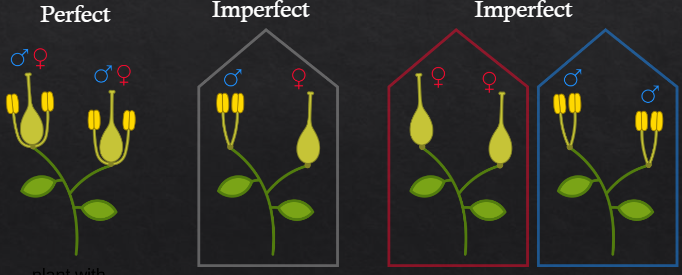
Plant fertilization
Outcrossing - reproductive fertilization,
Autogamy - self-fertilized seeds
Apomixis - unfertilized seeds
Combo of them are common
Autogamy and apomixis when no suitable mates
Allows rapid expansion of newly colonized habitat
Mechanisms to avoid self-pollination
asynchronous maturation of male and female flowers
Self-incompatibility (either in flower shape or genetics)
Types of Social Interaction
Selfishness → when the actor benefits and the recipient of the behavior bears a cost, clear winner and loser
Spite → both actor and recipient of the behavior lose
Mutual Benefit → both actor and recipient benefit
Altruism → engage in behavior that seems to benefit the recipient of the behavior but has obvious cost to actor
Altruism Paradox
Altruism: behavior w/ a direct fitness to cost to the individual carrying out the behavior and a direct fitness benefit to the recipient (i.e. self-sacrifice)
Flexible, condition-dependent behavior
No mutation that reduces an individual’s fitness should persist in the gene pool so it becomes a paradox as to why this occurs
Kin Selection
Kin Selection: fitness is increased if the survival and reproduction of your offspring (direct) and close relatives increase (indirect fitness)
If benefits of altruisitc behavior are high, benefits are dispersed to close relatively who likely possess the trait for alturism
If costs are low, alleles associated w/ altruistic behavior will be favor by NS
ex. Hamilton Rule
Hamilton’s Rule
Direct fitness is derived from your own offspring.
Indirect fitness is derived from helping relatives have more offspring than they could otherwise - affected by kin selection
Direct + Indirect fitness = Inclusive fitness
If rB > C, then altruism is faved by NS
B - fitness benefit to the beneficiary
r = coefficient of relatedness
C = fitness cost to the actor
Reciprocal Altruism
An exchange of fitness benefits that are separated in time. Not necessarily due to relatedness.
Altruistic behavior among unrelated individuals increases likelihood of receiving help in the future from non-kin.
Tit-for-tat: players repeated face off rather than playing just once, the strategy is one where the player initially cooperates but thereafter simply adopts whatever strategy the opponent used in the previous iteration.
Rationales for a behavior
3 hypotheses for why a particular behavior may persist or become more common within a pop across gens
Behavior benefits the actor
Behavior benefits a relative (kin selection)
Behavior is reciprocated
think about these 3 hypotheses to explain a behavior and then imagine an experiment to test which hypothesis is supported and predict what the data from that experiment would probably look like if your hypothesis were supported.
Also, what would your data look like if they supported your hypothesis