International Management Midterm - Unit Two
 Call Kai
 Learn
Learn Practice Test
 Spaced Repetition
 Match
Match Flashcards
 Knowt Play
1/47

There's no tags or description
Looks like no tags are added yet.
Name | Mastery | Learn | Test | Matching | Spaced | Call with Kai | Chat |
|---|
No analytics yet
Send a link to your students to track their progress
48 Terms
What are the four features of culture?
Shared = a group thing. Pervasive = at every level. Enduring = lasts a long time. Implicit = a 'silent language.'
What are Schein's three levels of culture, from most visible to deepest?
Artifacts → Espoused values → Underlying assumptions
In Schein's model, which level is easy to see but hard to interpret?
Artifacts (office layout, buildings, technology… you can see the open office but you might not know WHY it is set up that way)
What's the difference between cultural intelligence (CQ) and cultural sensitivity?
CQ = skill at managing people and processes across cultures; sensitivity = being aware of and honestly caring about another's culture
In the Environmental Variables model, which are the sociocultural variables?
Religion, education, and language
What is the 'self-reference criterion'?
Judging other cultures unconsciously by your own cultural values
What's the difference between parochialism and ethnocentrism?
Parochialism is not looking beyond your own world. Ethnocentrism is thinking your way is the right way
What is convergence?
Becoming alike
What is diffusion?
Ideas spreading between cultures
What is creolization?
Blending into something new
What are the eight cultural subsystems?
Kinship, education, economic system, system of government, social associations, healthcare, recreation/leisure, and spiritual beliefs
US culture says 'the individual controls their own future.' What's the alternative view, and what does it affect?
Life is preordained; affects planning and scheduling
Match the US view to its alternative: 'Hard work leads to success.'
Wisdom and luck are also needed as it affects motivation and rewards
Why are cultural values useful to managers?
They help managers anticipate likely cultural effects and adjust (contingency management)
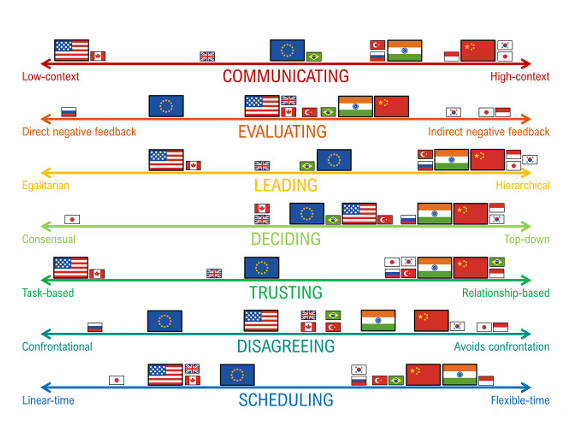
What scales appear on Erin Meyer’s Culture map?
Communicating, evaluating, leading, deciding, trusting, disagreeing, and scheduling
On Meyer's Culture Map, how does Japan stand out on leading vs. deciding?
Respect for the boss doesn't mean the boss decides alone. Japan builds group consensus, which ties to 'wa' (harmony). So hierarchical in leading and consensual in deciding
What are the four rules in which Erin Meyer implies?
Don’t underestimate the challenge, apply multiple perspectives, find the positive in other approaches, and adjust/readjust your position
(Hofstede) What is power distance?
How much people in society accept that power is unequally distributed
(Hofstede) What is uncertainty avoidance?
How threatened people feel by unclear or uncertain situations
(Hofstede) What is individualism?
The tendency of people to look after themselves and their immediate families only and to neglect the needs of society
(Hofstede) What is collectivism?
The desire for tight social frameworks, emotional dependence on belonging to “the organization,” and a strong belief in group decisions
(Hofstede) What is masculinity?
The degree to which traditionally masculine values - assertiveness, materialism, and lack of concern for others - prevail
(Hofstede) What is long-term/short-term orientation?
Long-term cultures save and plan for the future; short-term cultures focus on quick results
Which of these GLOBE dimensions is NOT in Hofstede's model?
Humane orientation (fairness, generosity, kindness)
GLOBE splits collectivism into two types. What are they?
Institutional collectivism (society rewards group action) and in-group collectivism (pride and loyalty to family or organization)
Trompenaars' universalism vs. particularism: what's the difference?
Universalism = rules and standards apply to everyone; particularism = relationships and trust come first
Trompenaars' neutral vs. affective: which country is the MOST neutral (hides emotions) on the chart?
Japan, as neutral = keeping emotions in check and affective = express emotions openly
Trompenaars' specific vs. diffuse: what does it measure, and where do the US and China fall?
Whether work and private life are kept separate (specific: UK, US) or closely linked (diffuse: Spain, China)
Trompenaars' achievement vs. ascription: what's the difference?
Achievement = status comes from performance; ascription = status comes from age, status, or gender (the US is more achievement-based)
Comparative Management: Japan vs. Germany?
Japan = Harmony, consensus and duty, and a mix of authority and humanism (open conflict is discouraged)
Germany = Prefers rules and order and privacy, dislikes inefficiencies and being late, assertive but no aggressive
Comparative Management: Latin America?
Work and private lives are closely integrated and it is very important to maintain harmony and save face
What are labor laws like in South Korean culture?
Has the longest working hours and highest suicide rate (notorious for workaholic culture)
What did the TRVL channel video in class show us about communicating across cultures?
Shouldn’t assume you know how to greet someone from a different country/culture
True/False: Does communication automatically mean agreement?
No, it is a transfer and understanding of meaning
The example of the German and the Indian worker show us?
Because of our cultures we can deter the true meaning of what someone is trying to say or tell us
What are the five stages of the negotiation process?
Preparation → relationship building → exchange of task-related information → persuasion → concessions and agreement
What are some traits of a successful negotiator?
They consider a wider range of options, tend to make twice as many comments regarding long-term issues, makes fewer irritating comments, and actively listens
What was Carlos Ghosn's cultural background?
Born in Brazil, raised in Lebanon, educated in France. He spoke English, French, Portuguese, Spanish, Arabic, and some Japanese
What did Ghosn ask Michelin's French headquarters for when he took over Michelin Brazil?
More autonomy, in exchange for taking full responsibility
How did Ghosn earn the nickname 'le cost killer' at Renault?
With the 20 Billion Plan (cut 20 billion francs in 3 years), including closing a Belgian factory of about 3,200 workers
What was Ghosn's favorite management tool at Michelin, Renault, and Nissan?
Cross-functional teams that break down silos (at Nissan he set up 9 cross-functional teams, each with two leaders from different areas plus a senior manager)
What is a keiretsu, and why did it hurt Nissan?
A Japanese network of companies tied together by business relationships and cross-holdings; Nissan stayed tied to suppliers and dealers even when it no longer made sense
Which problems did Ghosn find at Nissan?
No clear vision, no focus on profit, 39 of 43 models losing money, and boring designs
Which Japanese work practices did Ghosn keep and which did he get rid of?
Kept lifetime employment (as loyalty to workers), but ended promotion by seniority, which he blamed for complacency
Why did Ghosn switch Nissan's boardroom language to English?
It was a third language for both the French and Japanese, so neither side was favored and both had to be precise
What controversy started to build around Ghosn later in the case?
His motto was 'the highest achievers get the highest rewards.' The French government questioned his pay for 5 years. Ghosn has earned 4x Toyota’s president though Nissan made only 1/5 of Toyota’s profit
What is China’s current relationship with the US?
In 2025 they had a trade war with very high tariffs, then agreed to a truce. In 2026, Trump visited China and Xi visited the White House, and China agreed to buy US planes and farm goods. But they still disagree on rare earth minerals, technology, Taiwan, and Iran. The truce ends in November unless they renew it
What is China’s current relationship with Kenya?
China is the country Kenya owes the most money to. It built Kenya's big railway (Mombasa to Nairobi) and the Nairobi Expressway. In 2026, China agreed to let almost all Kenyan goods in tax-free. The downside: Kenya has a lot of debt to China