CHEM 111 - Exam one
 Note
Note Call Kai
 Learn
Learn Practice Test
 Spaced Repetition
 Match
Match Flashcards
 Knowt Play
1/32

There's no tags or description
Looks like no tags are added yet.
Name | Mastery | Learn | Test | Matching | Spaced | Call with Kai | Chat |
|---|
No analytics yet
Send a link to your students to track their progress
33 Terms
What is an atom?
The smallest particle of an element that retains its properties.Example: A hydrogen atom (H) is the simplest type of atom.
What is a molecule?
Two or more atoms joined together. Example: N₂, H₂O, NaCl.
What is a mixture?
A combination of two or more substances that can be physically separated.
What are the two types of mixtures?
Homogeneous (solution): Uniform throughout (e.g., wine) and Heterogeneous: Different composition in different regions (e.g., beef stew).
What are physical properties?
Properties that can be observed without changing the substance (e.g., boiling point, density).
What are chemical properties?
Properties that involve changing the chemical composition (e.g., iron rusting).
What is a physical change?
A change in form but not composition (e.g., ice melting).
What is a chemical change?
A change that alters the chemical composition (e.g., burning sugar).
What is an intensive property?
A property independent of amount (e.g., density, boiling point, temp,).
What is an extensive property?
A property dependent on the amount (e.g., mass, volume).
What are the standard SI units?
Length (m), mass (g, kg), time (s), temperature (°C, K).
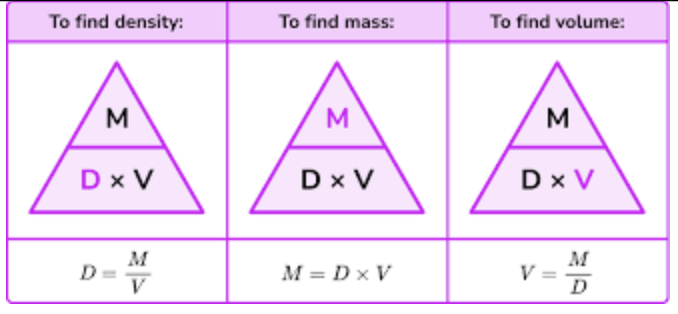
What is the formula for density?
Density = mass/volume (g/mL).
What are examples of exact numbers?
Counted objects (10 hats) or defined relationships (1 ft = 12 in).
What are five common conversion factors?
1 L = 1000 mL, 1 kg = 1000 g, 1 in = 2.54 cm, 1 mile = 1.609 km, 1 lb = 453.6 g.
What are the key points of Dalton’s atomic theory?
Elements are composed of atoms. 2. Atoms of one element are identical but differ from other elements. 3. Atoms combine in whole number ratios. 4. Atoms cannot be created or destroyed in a chemical reaction.
What is the Law of Definite Proportions?
A compound always has the same proportion of elements.
What is the Law of Multiple Proportions?
Different compounds with the same elements exist in different whole-number ratios.
What are the three subatomic particles?
Proton (+ charge), Neutron (neutral), Electron (- charge).
Which Rutherford nuclear theory statements are false?
Volume of hydrogen is due to proton? False; most of the volume is empty space. 2. Fluorine’s mass comes from electrons? False; mass is mostly from protons and neutrons.
Do protons and electrons have opposite charges?
True.
Do protons and neutrons have similar mass?
True.
Some atoms have no protons?
False.
Do neutrons have opposite charge to protons?
False (they are neutral).
What is an isotope?
Atoms of the same element with different numbers of neutrons.
Write the nuclear symbols for Copper with 34 neutrons.
⁶³₂₉Cu.
Write the nuclear symbols for Potassium with 21 neutrons.
⁴⁰₁₉K.
Determine protons, neutrons, and electrons for ⁴⁰₁₉K.
19 p+, 21 n, 19 e-.
Determine protons, neutrons, and electrons for ²²⁶₈₈Ra.
88 p+, 138 n, 88 e-.
Determine protons and electrons for Al³⁺.
13 p+, 10 e-.
Determine protons and electrons for Se²⁻.
34 p+, 36 e-.
What is a pure substance?
A substance composed of a single type of particle with a fixed composition. Example: Distilled water (H₂O) is a pure substance because it consists only of water molecules.
What are the two types of pure substances?
Elements (cannot be broken down, example: Oxygen - O) and compounds (two or more elements in fixed proportions, example: Water - H₂O).
Know these
Thomson’s cathode ray tube experiment determined that electrons are negatively
charged subatomic particle approximately one thousand-times smaller than an atom.
o Millikan’s oil drop experiment determined the charge and mass of an electron.
o Rutherford’s gold foil experiment determined the nuclear structure of an atom and he
further determined the presence of protons.
o Soddy determined that atoms of the same element could have different masses and
these atoms are called isotopes.
o Chadwick determined the presence of neutrons that are neutral and contribute to
different mass of isotopes