Unit 3, Chapter 4C-4F: PCR, Gel Electrophoresis, Recombination and Transformation, and GMOs
 Call Kai
 Learn
 Practice Test
 Spaced Repetition
 Match
 Flashcards
 Knowt Play
1/71

Earn XP
Description and Tags
Based on the information provided by and the structure of the Edrolo VCE Biology 3-4 Textbook (AI was not used to present any of the information)
72 Terms
Outline the Purpose of the Polymerase Chain Reaction Technique
The polymerase chain reaction is a DNA manipulation technique used in laboratories to amplify DNA by making multiple identical copies from a small initial sample.
List 3 Reasons why Scientists might want to Amplify DNA
Paternity testing
Forensic testing samples of bodily fluids
Analysing gene fragments for genetic diseases
Identify the Formula for the Amount of DNA per Cycle of PCR (x)
HINT:
let x = the amount of double-stranded DNA molecules
let n = number of PCR cycles
x = 2n
(exponential increase)
Outline the Function of the Taq Polymerase
The Taq polymerase is a heat-resistant DNA polymerase enzyme isolated from a bacteria (Thermus aquaticus), which amplifies a single-stranded DNA molecule by attaching complementary nucleotides.
List and Briefly Explain the 5 Primary Materials needed for PCR
Thermal cycler (alters temperature in pre-programmed steps for temperature-sensitive reactions)
DNA sample (to be denatured and amplified)
Nucleotide bases (to create the complementary DNA strand)
Taq polymerase (for elongation)
Sequence specific DNA primers (for the Taq polymerase to attach to)
Explain the 1st Step of PCR (denaturation)
DNA is heated to 90-95oC
Hydrogen bonds break and the DNA strands separate
This results in single-stranded DNA
Explain the 2nd Step of PCR (annealing)
The single-stranded DNA is cooled to 50-55oC
Primers are added
Primers bind to the complementary sequences on the DNA strands
Explain the 3rd Step of PCR (elongation)
The DNA is heated to 72oC, the optimal temperature for the Taq polymerase enzyme
Taq polymerase is added
Taq polymerase binds to the primers
Taq polymerase begins synthesising a complementary strand of DNA using the available nucleotides
The DNA molecules are now double-stranded
Explain the 4th Step of PCR (repeat)
The cycle is repeated multiple times until enough DNA copies have been obtained.
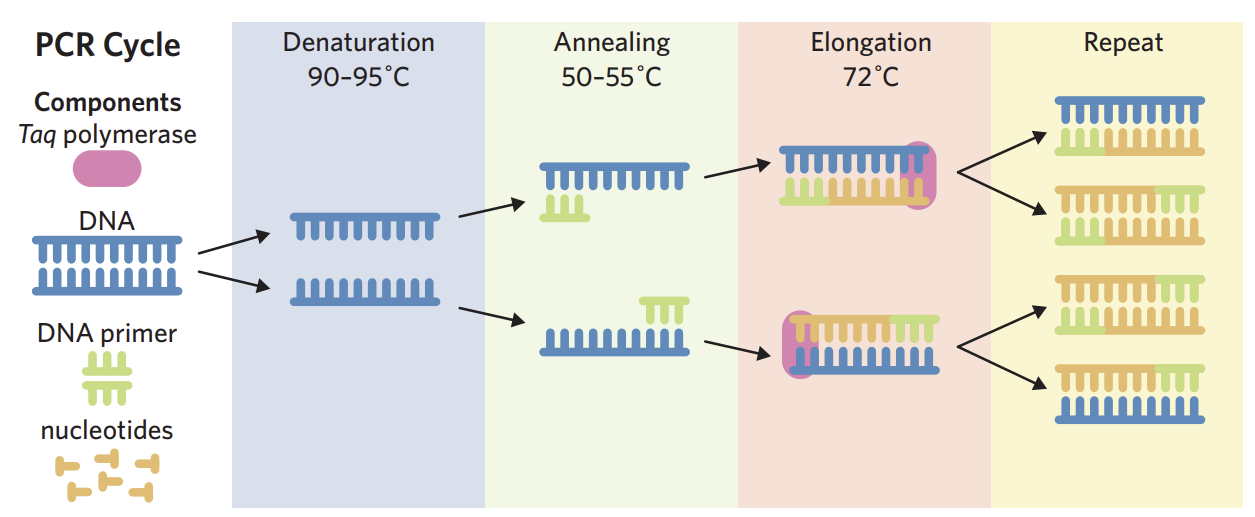
Explain why 2 Different Primers are Needed for PCR
Forward and reverse primers are needed as the Taq polymerase has to synthesise both strands (the coding and template strands). Since the Taq polymerase only operates in a 5’ to 3’ direction, the different primers are need to accomodate this.

Outline the Purpose of Gel Electrophoresis
Gel electrophoresis is a laboratory technique used by scientists to separate DNA fragments based on their molecular size (or number of base pairs).
Identify 8 Components in the Set Up for Gel Electrophoresis
HINT: this is not a question about what they are for or what they do, just recall of key terms and materials
Agarose gel
A buffer solution added to the gel
Wells for DNA fragments
A negative electrode next to the wells
A positive electrode on the far side from the wells
A well with fragments for a standard ladder (often)
A flourescent dye (eg. ethidium bromide)
UV lamp to visualise bands
Define Agarose Gel
Agarose gel is a sponge-like gel used in gel electrophoresis that contains pores for DNA fragments to move through.
Explain How the Agarose Gel Separates DNA Fragments
Given the small size of the pores, small fragments can slip through the pores in the agarose gel with comparitive ease, while the large fragments are hindered, so travel less distance in the same amount of time.
Define Wells
Wells are the indents in the gel into which a DNA sample is loaded.
Define and Describe the Purpose of a Standard Ladder
A standard ladder is a mixture of DNA fragments of known length that are used to infer the size of the fragments of unknown length in a sample.
Briefly Define Electrodes
Conductors of electricity that are attached to both ends of a gel allowing an electrical current to pass through it.
Explain the Positioning of the Electrodes for Gel Electrophoresis
The electrodes are positioned so that the DNA moves from the wells through the gel. Since DNA is negatively charged, the negative electrode is positioned near the wells and the positive electrode is at the opposite end of the gel. Thus, the DNA is attracted to the electrode on the other side of the agarose gel and will move towards it through the pores.
Define Buffer Solution
The buffer solution is an ion-rich solution that carries electrical current through the agarose gel.
Explain the Bands Formed after Gel Electrophoresis
The bands are the lines seen in the gel after running gel electrophoresis that indicate a collection of DNA fragments that share a specific size. Thicker bands indicate more DNA fragments of a similar length.
Outline the purpose of a flourescent dye such as Ethidium Bromide in Gel Electrophoresis
Ethidium bromide is a flourescent dye that binds to DNA fragments in a gel and allows them to be easily visualised under UV light.
Explain the 1st Step of Gel Electrophoresis
(setting up)
DNA samples are placed in wells and in the agarose gel which has been immersed in a buffer solution.
A standard ladder is also often loaded

Explain the 2nd Step of Gel Electrophoresis
(electrical current)
An electric current is passed through the gel using two electrodes; a negative one near the wells and a positive one on the other side of the gel
The negatively charged DNA is attracted to the positive electrode, causing the fragments to move from wells to the other end of the gel

Explain the 3rd Step of Gel Electrophoresis
(DNA moves through the gel)
Smaller DNA fragments move faster through the gel and thus travel further from the wells than the larger fragments
After a few hours the current is switched off
The DNA fragments stop moving and settle into bands, now separated based on size

Explain the 4th Step of Gel Electrophoresis
(results are visualised)
The gel is stained with a flourescent dye such as ethidium bromide
The bands can now be visualised under a UV lamp

Identify the Unit of Measurement of DNA Fragments
kb or kbp (kilobase pairs) is a standard unit of measurement indicating 1000 base pairs.
Briefly Explain what 1 Band in a Lane Indicates
Only one band in a lane indicated that all the fragments in that well were the same size.
Identify and Briefly Explain 4 Factors that Influence the Distance that DNA Fragments Travel through the Gel
Voltage: stronger electric forces generated by the electrodes cause DNA to travels further
Gel composition: greater density and agarose concentration increase the difficulty for larger fragments to move through
Buffer concentration: greater concentration of ions in the buffer results in higher conductivity, causing DNA to move further
Time: the longer the electric current is applied, the further the DNA will travel
Explain how PCR and Gel Electrophoresis can be used to Test for Genetic Disorders
DNA samples are obtained from an individual
PCR can be used to amplify the DNA at a possible mutation site
Gel electrophoresis can be used to compare the sample to 3 other samples
a standard ladder to indicate sizes
a known mutated gene
a known healthy gene
Describe the Possible Results from Comparing an Individuals DNA Fragment to 3 Other Samples of the Same Gene
(a standard ladder, a mutated gene, and a healthy gene)
Since humans have two alleles for every gene, an individual could have:
2 mutated alleles (one thicker band aligning with the known mutated gene)
1 mutated and 1 healthy allele (a bands that aligns with the known mutated gene and a band that aligns with the known healthy gene bands)
2 healthy alleles (a thicker band aligning with the known healthy gene)
Define Short Tandem Repeats (STRs)
STRs are short, repeated sequences of nucleotides that vary in length between people and are found in the non-coding areas of autosomal chromosomes.
NOTE: many hundreds of variants can be found in individuals due to their higher mutation rate than other areas of DNA
Explain the Application of STRs in DNA Profiling
Gel electrophoresis can be used to construct DNA profiles, as each STR variant will separate by size, which in comparison to other samples, indicate DNA as belonging to certain individuals.
For example, the samples below are unlikely to belong to the same person.

Interpret 3 Pieces of Information from this Table

The table depicts the DNA profiles of a victim, DNA found at a crime scene, and four other individuals using STR analysis. Numbers indicate the number of repeats.
DNA from the victim and individual 2 were found at the crime scene
1 and 3 match, so they are likely from the same person or genetically identical twins
3 and 4 share at least one STR for every locus, so they would likely be related by a parent-child or sibling relationship
Define a Plasmid
A plasmid is a small circular loop of DNA separate from the circular chromosomes typically found in bacteria.
Identify 3-4 reasons why Plasmids are Excellent Cloning Vectors
Plasmids are replicated independently from circular chromosomes in bacteria
They are small
They can be taken up by bacteria
It is comparitively easy to include antibiotic resistance genes, recognition sites and expression signals
Define a Recombinant Plasmid
Recombinant plasmids are circular DNA vectors (DNA molecules used to deliver foreign genetic material to another cell) that are ligated to incorporate a gene of interest.
Briefly Outline Bacterial Transformation
The process by which bacteria take up foreign DNA from their environment. It is the process used to introduces recombinant plasmids to bacterial hosts.
Define what is meant by Gene of Interest/Target Gene
(in the context of recombination and transformation)
A gene of interest or target gene is a genetic information that scientists want to be expressed in recombinant bacteria, often encoding a protein to be produced in commercial quantities.
Explain How Genes of Interest for Recombinant Plasmids are Typically Obtained
The DNA sequence encoding a human protein is isolated and implified using PCR before it can be inserted into a vector (eg. a bacterial plasmid).
Identify why Genes of Interest Must have Introns Removed
The gene of interest must not have introns prior to being inserted within a plasmid, as prokaryotic gene expression does not involve post-transcriptional modifications.
Outline the Relevance of the Universality of the Genetic Code here
Due to the universal nature of the genetic code, bacteria can use foreign genes to produce identical proteins.
Identify 4 Key Sequences of Most Plasmid Vectors
Restriction endonuclease sites (eg. EcoRI or BamHI)
Antibiotic resistance genes
Origin of replication (ORI)
Reporter genes

Define the Restriction Endonuclease Site
The recognisable sites on the plasmid that will be cut by a certain restriction endonuclease, where the gene of interest can be inserted.
Define Antibiotic Resistance Genes
Genes that confer resistance to specific antibiotics (eg. tetracyclin or ampicillin resistance genes).
Define the Origin of Replication sequence
A prokaryotic sequence that signals the starting point for DNA replication.
Define the Reporter Gene
A gene sequence with an easily identifiable phenotype. They often contain the resitriction endonuclease site to identify whether a plasmid is recombinant (eg. if it the reporter gene is cleaved and the target gene is inserted, the reporter gene is interrupted and successful recombination is indicated).
Explain Why a Plasmid Must Encode for 2 Observable Traits
For a plasmid to be selected, it must contain two genes encoding for observable traits. One gene will indicate which bacteria are transformed and one gene typically contains the restriction site to indicate which transformed bacteria are recombinant.
Explain the Use of Restriction Endonucleases in Making a Recombinant Plasmid
The gene of interest and plasmid are both cut with the same restriction endonuclease to create identical, complementary sticky ends. Blunt ends are less precise as any two blunt ends can bond. The restriction site can be within the reporter gene to indicate uptake of target genes.
Explain the Use of DNA Ligases in Making a Recombinant Plasmid
DNA ligase is used to join the ends of the gene of interest to the plasmid vector by forming phosphodiester bonds in the sugar-phosphate backbone. This creates a recombinant plasmid.
Identify a Common Issue with Ligases and Cleaved Plasmids
Instead of joining the gene of interest with the plasmid vector, most plasmids will just ligate back together with themselves, creating a mix of recombinant and non-recombinant plasmids.
Identify 2 Methods for the Uptake of Recombinant Plasmids in Bacteria
The heat shock method
The electroporation method
Outline the Heat Shock Method
The heat shock method involves rapidly increasing and decreasing the temperature the bacteria are exposed to to increase membrane permeability.
Outline the Electroporation Method
Electroporation involves passing an electric current through a solution containing the bacteria and plasmids, making the bacteria’s membranes more permeable.
Describe the Aim of Antibiotic Selection
The aim is to distinguish transformed and untransformed bacteria and to determine which transformed bacteria have taken up the recombinant plasmids.
Describe the Process of Antibiotic Selection
NOTE: assume the introduced plasmids contain a specific antibiotic resistance gene
Killed by antibiotic: untransformed bacteria (no plasmids with the antibiotic resistance)
Create Colonies: transformed bacteria (plasmids with the antibiotic resistance)
Express reporter gene: non-recombinant (not interrupted by target gene)
Do not express reporter gene: recombinant (interrupted by target gene)
Define Insulin and Link it to Diabetes
Insulin is a hormone secreted by the pancreas to control blood glucose levels. People with diabetes do not naturally produce or respons to insulin sufficiently and require it to be artificially administered.
Identify 3 Issues with Past Methods of Insulin Extraction
Animal welfare (porcine and bovine insulin necessitated slaughterhouses for insulin extraction)
Lower efficacy (side effects, worse uptake)
Comparitively more expensive and less efficient
Briefly Outline what the Process of Insulin Production Involves
HINT: refer to the alpha and beta subunits
The insertion of genes for two different insulin polypeptides - alpha and beta subunits - into two different plasmids in separate bacteria. These bacteria then produce the insulin and β-galactosidase fusion proteins to be eventually extracted and used to create human insulin.
Describe the Creation of Recombinant Plasmids for Insulin
NOTE: these flashcards consider the production of insulin with E. coli bacteria
Plasmid vectors containing the ampR gene (antibiotic resistance to ampicillin) and the tetR gene (antibiotic resistance to tetracycline) are prepared.
The tetR gene acts as the reporter gene, and contains a restriction site
Restriction endonucleases EcoRI and BamHI are used to cut the plasmid samples and the insulin subunit A and B genes of interest, creating complementary sticky ends
Describe the Creation of Transformed Bacteria for Insulin
The plasmids are added to a solution with E. coli bacteria and some of the plasmids are taken up by bacteria
Describe the Antibiotic Selection of Transformed Bacteria for Insulin
Bacteria colonies are placed on an agar plate containing ampicillin. Only transformed bacteria survive, as they have the ampR gene from the modified plasmids.
The transformed bactiera are placed on an agar plate containing tetracycline. As the tetR gene is interrupted in recombinant plasmids, the colony that dies back contains the transforemed bacteria with the recombinant plasmids.
These plasmids are then collected
Describe the Addition of the lacZ Gene
HINT: refer to the role of the ß-galactosidase enzyme
EcoRI is used to insert another gene called lacZ (minus its stop codon), which produces ß-galactosidase.
These recombinant plasmids will produce an insulin subunit protein attached to the large ß-galactosidase enzyme, in a fusion protein (protecting the insulin subunit protein from digestive enzymes within E. coli)
The recombinant plasmids containing lacZ are added to a new solution of E. coli bacteria and some of them are taken up by the bacteria.
Describe the Final Selection of the Transformed Bacteria for Insulin
HINT: we know they have the recombinant plasmids for an insulin subunit, but they must also have lacZ
ß-galactosidase can be detected enzyme is known to convert a compound called X-gal, resulting in a compound changing from colourless to blue.
The E. coli are plated on agar plates containing ampicillin and X-gal.
Colonies that grew and were blue contain the recombinant plasmids due to the presence of ß-galactosidase.
Describe the Process of Protein Production and Extraction for Insulin
Transformed bacteria are encouraged to exponentially reproduce
After a time, their membranes are broken down, are broken down and the insulin subunit and ß-galactosidase fusion proteins are extracted
The fusion proteins are separated and the insulin subunits are purified
The alpha and beta subunits are combined to create functional human insulin
Identify 4 Ways an Organism’s Genome may be Altered
Silencing genes (preventing expression)
Removing genes (preventing expression)
Inserting genes (introducing traits)
Altering genes by replacing nucleotides
Define the term GMO (Genetically Modified Organism)
A GMO is an organism that has had genetic material altered using genetic engineering technologies.
Define Cisgenic Organisms
Cisgenic organisms are GMOs that contain foreign genetic material from the same species (a sexually compatible donor organism) inserted in their genomes.
Define Transgenic Organisms
Transgenic organisms are GMOs that contain foreign genetic material from a different species (not sexually compatible donor organism) inserted in their genomes.
Describe the General Process of Producing Transgenic Plants
Gene identification: a gene of interest from a different species that produces a desired trait is identified and isolated
Gene delivery: the gene is delivered into the host organism’s cells, typically externally through direct DNA insertion or bacterial plasmids
Gene expression: The tranformed cells are regenerated using plant tissue cultures and can then be applied for agricultural use.
Identify 3 Pros and 3 Cons for the Biological Implications of GMO Crops
Pros:
Higher crop productivity (more food with less land)
Can lower the use of pesticides, water and fertilisers
Can have improved nutritional content
Cons:
Weeds and pests may evolve resistance
Potential loss of genetic diversity in crops
Cross-pollination between wild and GM species
Identify 3 Pros and 3 Cons for the Social Implications of GMO Crops
Pros:
Improve food security through improved crop productivity and resilience
Can reduce labour demands
Improved nutritional content, reducing nutrient deficiencies
Cons:
Expensive seeds for farmers
Complex legal issues
Strict packaging and marketing regulations
Identify 1 Pro and 3 Cons for the Ethical Implications of GMO Crops
Pros:
Potential for widespread benefits for nutrition, wealth, health, food security, and land care, particularly in developing nations
Cons:
Some people believe…
GMOs are unnatural (playing god)
GMOs are unsafe due to lack of long-term evidence of healthy use
Modifying organisms for human benefit is inhumane
Owned rights to GM crops may create power divides