Anatomy and Phys Test 1
 Note
 Call Kai
 Learn
 Practice Test
 Spaced Repetition
 Match
 Flashcards
 Knowt Play
1/231

Earn XP
Description and Tags
ANSC
232 Terms
What organs are associated with the immune system?
Spleen and Lymph Nodes.
True or False: Skin, hair, and sebaceous glands make up the integumentary system.
True
What organs are associated with the respiratory system?
Lungs, Larynx, Bronchi.
True or False: Histology is also known as microscopic anatomy.
True
Define Vivisection
The subject is alive while the dissection occurs.
True or False: The placenta functions as endocrine tissue.
False
True or False: The spinal cavity and cranial cavity do not connect.
False
List four tissue types.
Epithelial, connective, muscle, nervous.
What are the three types of muscle?
Smooth muscle, Striated/Skeletal muscle, Cardiac muscle.
What system exchanges oxygen and carbon dioxide with the blood?
Respiratory System.
What does the prefix 'myo' reference?
The muscle.
True or False: The terms dorsal and posterior reference the same area, but it depends on the animal for which the term is used.
True
True or False: Pharmacology is the study of diseases of the body.
False
What does the suffix 'genic' imply when understanding the term carcinogenic?
A cancer producing agent.
What does the suffix 'osis' reference?
Abnormal condition.
What does the suffix 'ectomy' reference?
Removal of a specific part of the body.
Define Anatomy.
The science which deals with the form and structure of all organisms.
What system drains tissue of excess fluids?
Lymphatic system.
True or False: Organs are a collection of systems that function as a unit.
False
Define Physiology.
The study of integrated functions of the body and the functions of all its parts.
Where is extracellular fluid found relative to the cell?
Outside of the cell.
List two products of cellular respiration.
Carbon Dioxide and ATP (Adenine Triphosphate).
True or False: Water is the most abundant substance in cells.
True
Who used an early microscope to examine cork and coined the term ‘cell’?
Robert Hook.
True or False: Lysosomes are the suicide agents for old or weak cells.
True
True or False: Cell membranes contain receptors.
True
True or False: Eukaryotic cells contain a nucleus.
True
True or False: Carbon dioxide is a nutrient product of cellular respiration.
False
True or False: Lysosomes are the control center of the cell.
False
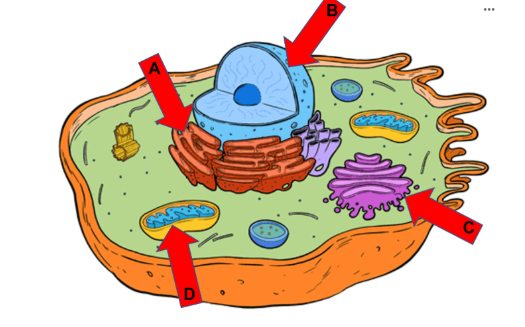
Identify the organelle: A: ? B: ?, C: Golgi Apparatus, D: Mitochondria.
A: Endoplasmic Reticulum; B: Nucleus.
True or False: Ribosomes are the respiratory center of the cell.
False
True or False: Organelles in the cytoplasm carry out diffusion.
False
True or False: The majority of the 'middle area' of the cell membrane is made up of proteins.
False
True or False: The nucleolus contains a nucleus.
False
True or False: The number of ribosomes is the same for every cell.
False
True or False: Tissue is the basic unit of biological organization.
False
Which mineral salts are required for muscle contractions?
Ca, Na, Cl, K.
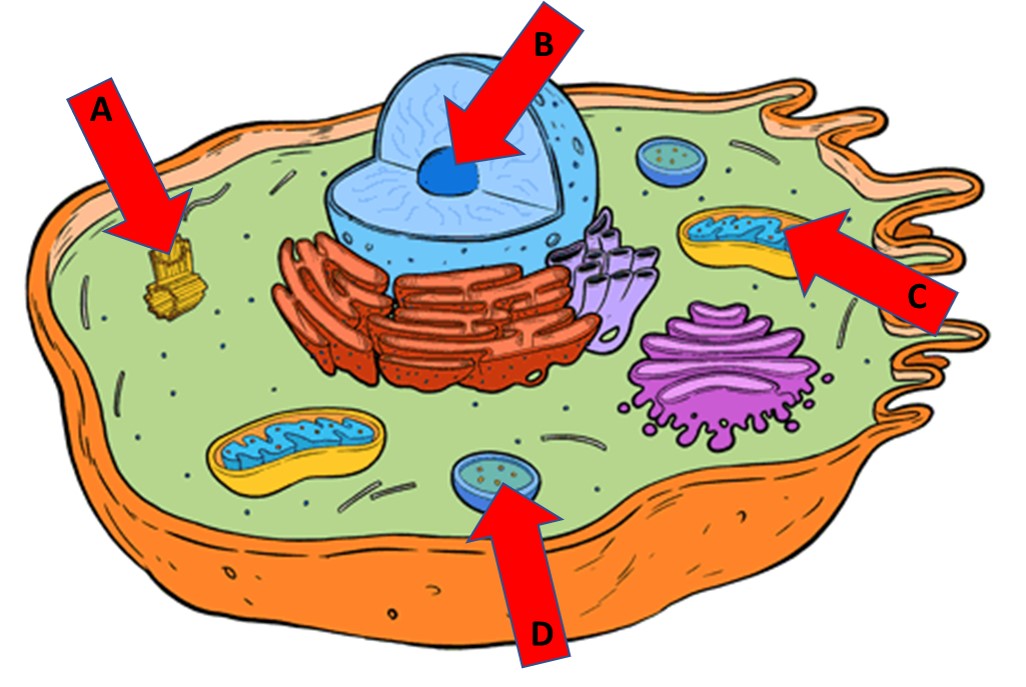
What is the function of the organelle labeled 'C'?
The powerhouse of the cell.
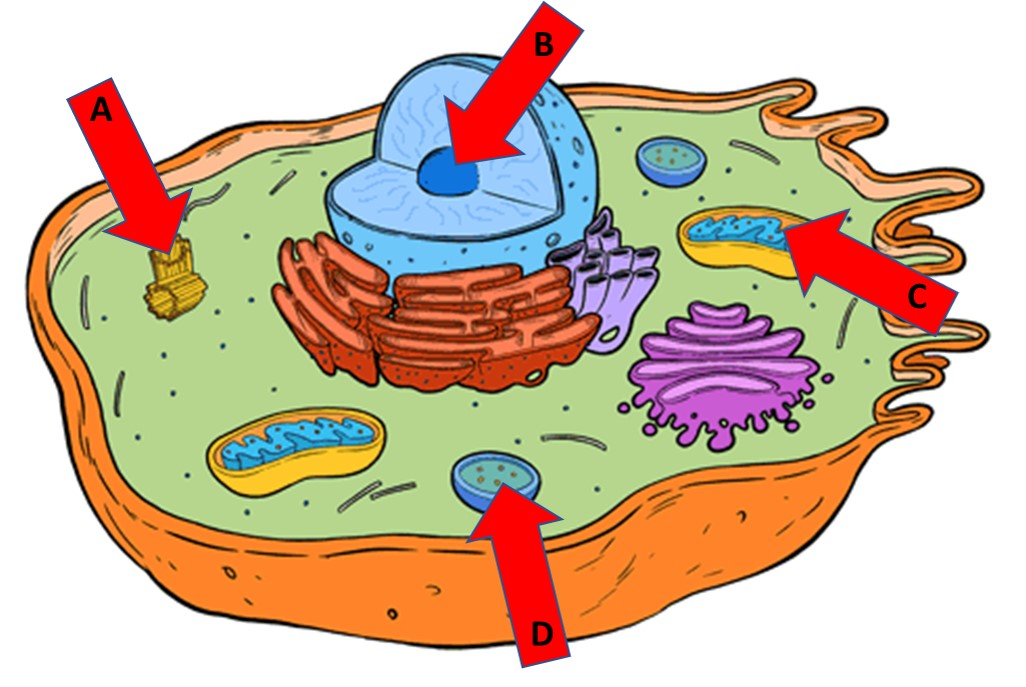
From the picture, which letter identifies the organelle known as the 'Control Center of the Cell'?
B.
True or False: Golgi apparatus are flat, disc-like and look similar to a stack of pancakes.
True
True or False: Cancers result from a single change in the amino acid sequence.
True
True or False: DNA contains the code for a particular protein.
True
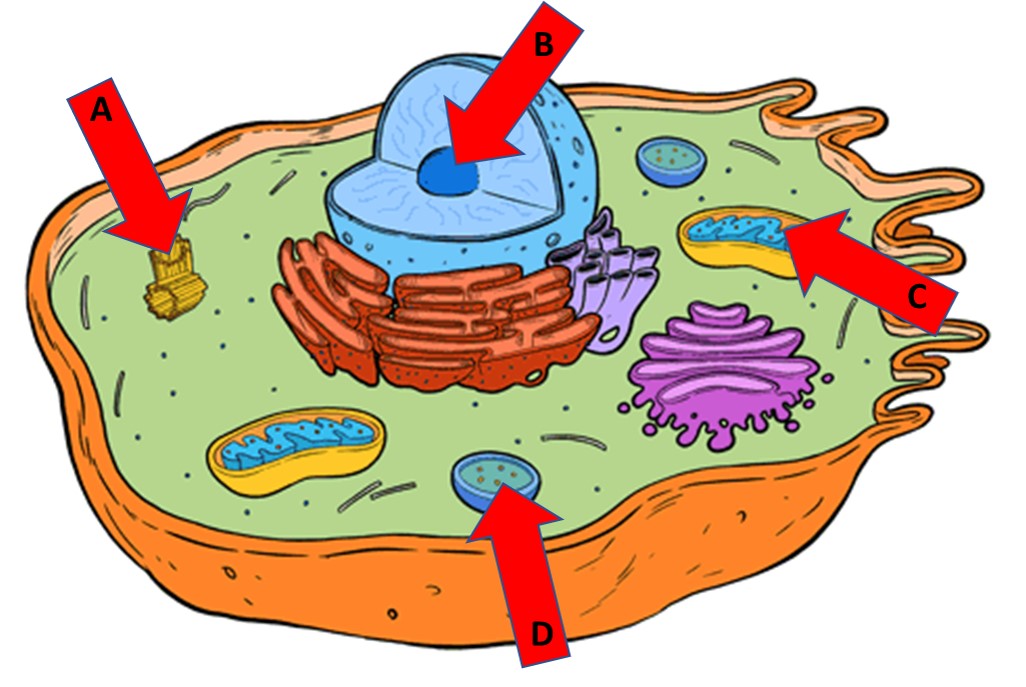
From the picture, which letter represents the organelle that contains digestive enzymes?
D: Lysosome.
List two routes the body will rid itself of urea.
Urine and Sweat.
True or False: Carbohydrates make up 5% of body weight.
False
True or False: Smooth endoplasmic reticulum is for protein synthesis.
False
Regarding the cell membrane, the phospholipid head is __________?
Hydrophilic. Loves water.
Define Anatomy.
Refers to the science which deals with the form and structure of all organisms.
Define Physiology.
The study of the integrated functions of the body and the functions of all its parts.
What is Pathology?
The study of the disease of the body.
What is Pharmacology?
The science of drugs.
What is Gross (macroscopic anatomy)?
The study of the form and relations of the structures of the body that can be seen with the unaided eyes.
What is Comparative anatomy?
Study of the structures of various species of animals.
What is Microscopic anatomy (histology)?
Study of those cells and tissues that can only be seen with a microscope.
Define Directional terms.
Frames of reference in relation to the animal itself and applies regardless of the position or direction of the animal.
What does Cranial mean?
Toward the head.
What does Caudal mean?
Toward the tail.
What does Rostral mean?
Toward the nose (rostral) or toward the tail (caudal) within the head.
What does Dorsal/Posterior mean?
Toward or beyond the backbone or vertebral column.
What does Ventral/Anterior refer to?
Toward the front or underside.
What does Medial mean?
Close to or toward the median plane.
What does Lateral mean?
Away from the median plane.
What is found in the Cranial cavity?
Contains the brain.
What does the Spinal cavity consist of?
The spinal column connection to the cranial cavity.
What does the Thoracic Cavity contain?
Contains the esophagus, trachea, lungs, heart, and aorta.
What is the Plural cavity?
Area surrounding the lungs.
What is Mediastinum cavity?
Area between the lungs.
What is the Abdominal cavity?
Contains the stomach, intestines, liver, spleen, gallbladder, pancreas, ureters, kidneys.
What does Cyto- refer to?
Cells.
What does Histo- refer to?
Tissue.
What does Myo- refer to?
Muscle.
What does Neur- refer to?
Nerves.
What does -gen mean?
Agent that causes something.
What does -genic mean?
Agent that produces something.
Who is -ologist?
One who studies practices.
What does -pathy refer to?
Disease.
What does -ectomy mean?
Removal of a specific part of the body.
What does -osis mean?
Abnormal condition.
Define Cells.
Smallest unit of life.
Define Tissues.
Made up of a group of cells that have similar structure that function together as a unit.
What is Epithelial tissue?
Barrier between underlying tissue and the environment.
What is Connective tissue?
Binds/supports/storage/protection of other tissues, including ligaments, tendons, bones, adipose tissue, cartilage, collagen.
What is Muscle tissue?
Supports movement; includes cardiac, smooth, striated.
What does Nervous tissue do?
Connects sensory structures to motor structures.
What are Organs?
A collection of tissues that structurally form a functional unit.
What is a System?
A group of organs organized for a common purpose.
What makes up the Integumentary system?
The largest organ that forms a physical barrier between environment and the internal environment (skin, hair, nails, sweat glands, sebaceous glands).
What is the Skeletal system?
The body’s central framework, also called the musculoskeletal system.
What are the functions of the Skeletal system?
Structural support, locomotion, blood pressure, fat and mineral storage, protection.
What is the Muscular system?
Composed of muscle cells and tissues that brings about movement of an organ or body part.
What is Smooth Muscle?
Involuntary, smooth contraction, responds to hormones/stimuli.
What is Striated/Skeletal muscle?
Each fiber has its own nerve fiber; force of contraction is dependent on muscle fiber condition.
What is Cardiac muscle?
Striated, contains Purkinje fibers that cause a wave of contraction.
What is the Nervous system?
The body’s command center originating from the brain.
What are the functions of the Nervous system?
Control and regulation, interpreting stimuli, movement, thoughts, automatic responses.
What is the Endocrine system?
Glands and organs that make hormones and release them directly into the blood.
What is the function of the Endocrine system?
Works with the nervous system to regulate chemical aspects of the body.
What does the Cardiovascular system (the circulatory system) involve?
Heart, arteries, veins, capillaries.
What is the purpose of the Cardiovascular system?
Transport substances to and from cells.
What is the Lymphatic/immune system?
The tissues and organs that carry white blood cells that fight infections/diseases.