cell bio 3
 Call Kai
 Learn
 Practice Test
 Spaced Repetition
 Match
 Flashcards
 Knowt Play
1/120

There's no tags or description
Looks like no tags are added yet.
Name | Mastery | Learn | Test | Matching | Spaced | Call with Kai | Chat |
|---|
No analytics yet
Send a link to your students to track their progress
121 Terms
fluid-mosaic model
membrane is a flexible phospholipid bilayer containing proteins and other molecules
lipid bilayer
two layers of lipids with water-attracting heads facing outward and water-repelling tails facing inward.
gorter and grendel experiment
found that extracted membrane lipids covered about twice the cell's surface area, supporting the bilayer model
scientists extracted lipids from red blood cells (RBCs), spread them into a monolayer on a Langmuir trough, and measured the area
the lipid monolayer had twice the surface area of the cells, supporting the idea that membranes contain a lipid bilayer
Amphipathic
Has both hydrophilic and hydrophobic regions
Hydrophilic
Attracted to water; usually polar or charged
Hydrophobic
Repelled by water; usually nonpolar.
Phosphoglycerides
membrane lipids with glycerol, two fatty acid tails, and a phosphate-containing head group
Phospholipid head groups
choline and ethanolamine are neutral; serine is negative; inositol is neutral and can be phosphorylated to form PIP₂
Sphingolipids
Lipids with a sphingosine backbone and a fatty acid
Sphingomyelin
A sphingolipid especially common in neurons
Glycolipids
lipids with attached sugars, mainly in the outer membrane layer; can be part of lipid rafts
Cholesterol
an amphipathic lipid with a hydroxyl head and a steroid-based region; helps regulate membrane fluidity and stability
Liposomes
artificial lipid vesicles made by dissolving lipids in organic solvent, evaporating the solvent, adding buffer, and agitating
Membrane fluidity
affected by temperature, fatty acid chain length, saturation, head groups, and cholesterol
lateral diffusion
lipids move sideways rapidly within the same membrane layer; flip-flop between layers is much slower
FRAP
fluorescence recovery after photobleaching; measures how quickly fluorescent membrane molecules move into a bleached area
lipid asymmetry
inner and outer membrane layers have different lipid compositions
lipid rafts
specialized membrane regions enriched in certain lipids, including cholesterol and some glycolipids
cholesterol experiment
removing cholesterol or inhibiting its synthesis makes membranes more likely to break under shear or hypotonic stress

peripheral proteins
attach to the inner or outer membrane surface; can be removed using salt, pH changes, or chelating agents
integral proteins
embedded in the bilayer; usually require detergent for extraction
non-ionic detergent
Breaks apart the fatty membrane so the proteins can be removed.
helps extract integral membrane proteins while better preserving their function
transmembrane domain
the part of a protein that passes through the cell membrane
alpha helix
the most common membrane-spanning structure; its hydrophobic amino acids interact with the membrane's fatty acid tails
glycophorin
a single-spanning membrane protein with 23 hydrophobic amino acids in its transmembrane helix; forms a homodimer
beta barrel
a membrane-spanning structure made from folded beta sheets; some form pores
glycosylation
addition of sugars to proteins, often on extracellular or organelle-lumen-facing regions
disulfide bonds (S–S)
bonds that help stabilize protein structure
freeze-fracture TEM
freezes and splits membranes to reveal membrane organization and integral proteins
heavy-metal shadowing
coats specimens with metals such as platinum and/or carbon for electron microscopy; rotating the specimen can improve resolution
lectins — Proteins that bind specific sugars
-patching and capping — Antibody- or lectin-bound membrane proteins cluster together
FRAP and FLIP
fluorescence techniques used to study membrane protein mobility
cytoskeleton attachment
can limit movement of proteins inside cell membrane
also provides structure, shape and support for the cell
passive diffusion
small nonpolar molecules, such as O₂ and CO₂, move down their concentration gradient without energy; movement depends on the gradient and hydrophobicity
protein-assisted transport
transport proteins help ions, sugars, amino acids, and some water cross membranes
active transport
uses energy, often from ATP, to move substances against their concentration gradient
ATP-powered pumps
use ATP hydrolysis to move substances; examples include sodium-potassium pumps and hydrogen-ion pumps
osmosis
passive movement of water down its concentration gradient
channel proteins
form tunnels for specific ions or water; some are gated. They can transport molecules very quickly, around 100 million per second in the lecture notes
carriers/transporters
bind one or a few molecules and change shape to move them across; approximately 100–10,000 molecules per second in the notes
facilitated diffusion
carrier-mediated movement down a concentration gradient without direct energy input
uniporter
moves one type of molecule in one direction down its gradient
symporter
moves two substances in the same direction
antiporter
moves substances in opposite directions
cotransporter
uses one substance moving down its gradient to drive another substance against its gradient
glucose absorption in the gut
a sodium-glucose symporter brings glucose into intestinal cells; the sodium-potassium pump moves sodium out and potassium in to keep sodium low inside the cell, and the glucose uniporter lets glucose leave the cell and enter the blood.
Robert K. Crane
proposed sodium-glucose cotransport
ernest m. wright
reconstituted the transport mechanism into liposomes
How do you extract peripheral proteins?
use salt, pH changes, or chelating agents
How do you extract integral proteins?
use a suitable detergent, preferably mild and non-ionic to preserve function
how can you study purified membrane proteins?
reconstitute them into liposomes
blobin experiment: how can you identify a peripheral protein?
treat ghost membranes with salt, pH changes, or EDTA; if blobin is released into the supernatant, it is peripheral.
blobin experiment: How can you identify an integral protein?
it stays with the membrane pellet after peripheral protein extraction and is released after detergent treatment.
blobin experiment: How can you determine which side blobin faces?
compare treatment of intact cells with treatment of open ghost membranes; release only from ghosts supports a cytoplasmic location
which detergent should be used to test blobin's interaction with an integral membrane protein?
a non-ionic detergent, to better preserve protein function.
metabolism
all chemical reactions that break down food, release energy, and build needed molecules
metabolic enzymes
catalyze reactions that break down nutrients or make amino acids, lipids, carbohydrates, and nucleotides
storage molecules
extra energy is stored mainly as triglycerides and glycogen; these can be broken down when needed
vitamins
small molecules obtained from food that help enzymes work
metabolic disease examples
diabetes affects glucose metabolism; phenylketonuria (PKU) prevents normal breakdown of phenylalanine and can damage the brain without dietary management
glycolysis
occurs in the cytoplasm and breaks one 6-carbon glucose into two 3-carbon pyruvates
what is glycolysis's net output?
2 ATP and 2 NADH per glucose. It uses 2 ATP and produces 4 ATP
aerobic pathway
uses oxygen and mitochondria to produce much more ATP
anaerobic pathway
occurs without oxygen and produces much less ATP
aerobic cellular respiration equation
overall equation — C₆H₁₂O₆ + 6O₂ → 6CO₂ + 6H₂O + energy
four stages of aerobic respiration
glycolysis → pyruvate oxidation → citric acid cycle → electron transport chain and oxidative phosphorylation
pyruvate oxidation
each pyruvate becomes acetyl-CoA, releasing CO₂ and producing NADH
citric acid cycle
breaks down acetyl-CoA, releasing CO₂ and producing NADH, FADH₂, and GTP/ATP
mitochondria
organelles with two membranes; the endosymbiotic hypothesis proposes they evolved from bacteria
MPC (mitochondrial pyruvate carrier)
transports pyruvate into mitochondria; its proteins were identified in 2012. MPC1 mutations can cause disease
why are mitochondria important?
training can increase mitochondrial capacity; mitochondria support cancer-cell energy and building needs; mitochondrial quality control is linked to aging and neurodegeneration
products per glucose in the lecture notes
10 NADH, 2 FADH₂, 4 ATP/GTP by substrate-level phosphorylation, and 6 CO₂
substrate-level phosphorylation
direct production of ATP or GTP during a metabolic reaction
electron transport chain
4 protein complexes that pass electrons along and use their energy to pump H⁺ (protons) into the space between the mitochondrial membranes
four large protein complexes in the inner mitochondrial membrane transfer electrons and help pump H⁺ into the intermembrane space
Complex I
Accepts electrons from NADH and pumps H⁺.
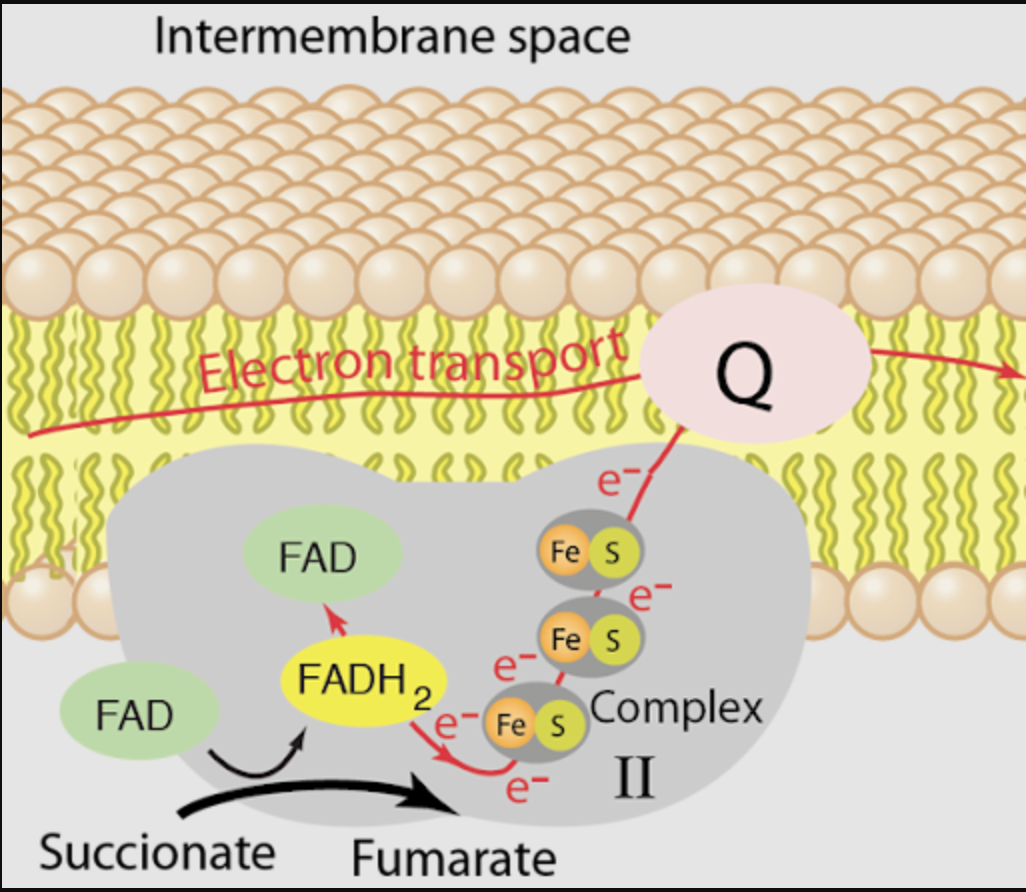
Complex II
Accepts electrons from FADH₂-linked reactions and passes them to CoQ; does not pump H⁺.
CoQ (ubiquinone)
fat-soluble mobile carrier that transfers electrons through the membrane

complex III
transfers electrons from Q to cytochrome c onward and pumps H⁺
cytochrome c
small, water-soluble mobile electron carrier
Complex IV
transfers electrons to oxygen, the final electron acceptor, forming water; pumps H⁺
other ETC components in cellular respiration
flavoproteins contain FAD/FMN; cytochromes contain iron in heme; iron-sulfur proteins contain iron and sulfur; some proteins contain copper
proton gradient
H⁺ becomes more concentrated in the intermembrane space than in the matrix
chemiosmosis
H⁺ flows back down its gradient through ATP synthase, providing energy to make ATP from ADP + Pi
ATP synthase
enzyme that makes ATP using energy from the proton gradient
oxidative phosphorylation
ATP production powered by electron transport and the proton gradient
how was the proton-gradient idea tested?
vesicles containing ATP synthase and bacteriorhodopsin made ATP when light caused H⁺ to be pumped across the membrane
ATP yield in the lecture notes
approximately 32–34 ATP from oxidative phosphorylation and 36–38 ATP total per glucose
fermentation
regenerates NAD⁺ so glycolysis can continue when oxygen is not available; yields only 2 ATP per glucose.
lactic acid fermentation
produces lactate; used in making yogurt, sauerkraut, and some cheeses.
alcohol fermentation
produces ethanol and CO₂; used in beer, wine, and bread production
anaerobic respiration
some bacteria use nitrate, carbonate, or sulfate instead of oxygen as the final electron acceptor; it produces more ATP than fermentation but less than aerobic respiration
how do fats enter respiration?
glycerol can enter glycolysis; fatty acids are converted to acetyl-CoA.
how do proteins enter respiration?
amino acids are broken down into metabolic intermediates, such as pyruvate
photosynthesis overall equation
6CO₂ + 6H₂O + light → C₆H₁₂O₆ + 6O₂
purpose of photosynthesis
uses light energy to make reduced carbon compounds and releases oxygen into the atmosphere
chloroplast
organelle where photosynthesis occurs
thylakoid
membrane system where light reactions occur
stroma
fluid-filled region where the Calvin cycle occurs
Two stages of photosynthesis
light-dependent reactions: produce ATP and NADPH in thylakoid membrane in chloroplast, uses light and water
Calvin cycle: stroma of chloroplast, uses them to help make sugars from CO₂
chlorophyll
absorbs light for photosynthesis and becomes excited, allowing electrons to be transferred
In the thylakoid membranes of chloroplasts.