Unit 8: Plant Response
 Call Kai
 Learn
 Practice Test
 Spaced Repetition
 Match
 Flashcards
 Knowt Play
1/48

There's no tags or description
Looks like no tags are added yet.
49 Terms
Xylem
dead cells in the extracellular fluid (apoplast)

phloem
live cells (symplast-continuous network of living cytoplasm inside plant tissues)
cell walls
cellulose fibers (stiff) causes constraints on movements
modular
no central control networked integration through up/down regulation of transcription
phytomer
one plant unit: stem, leaf, branch
Proton pump
ATPase
Plant sensitivity
Plants are sensitive to Na+ since there are no Na/K pumps
Sessile
cannot run from threats: strong chemical and structural defenses, forage (light, water, nutrients) by changing tissue position
Plant vision
¼ genes modulated by light
Hear and touch
pressure sensitive
Sense and taste
chemoreceptor
Constitutive (innate)
traits, defenses, or chemical compounds that are continuously present and expressed at all times, rather than being created only when an attack happens
Induced (acquired)
temporary physical or chemical deterrents that a plant activates only after detecting an attack by herbivores, pathogens, or mechanical damage, rather than keeping them constantly active
Elicitor Role
triggers physiological, defense, or stress-response mechanisms in plants
Herbivore Associated Molecular Patterns (HAMPs)
chemicals produced by heribvores
Damage Associated Molecular Patterns (DAMPs)
molecules released from stressed, damaged, or dying cells that serve as danger signals to alert the immune system in plant cell
Herbivore Induced Plant Volatiles
specific volatile organic compounds (VOCs) that plants release into the air, soil, or surrounding environment when damaged by feeding insects or other herbivores gaseous
metabolite 1 degree enzyme
Growth and development primary (1°) metabolites are essential for an organism's basic survival, growth, and reproduction
metabolite 2 degree enzyme
defense (2°) metabolites serve specialized ecological roles like defense and communication
Transcription of anti-herbivore genes and production of anti-herbivore secondary metabolites
plants molecular and chemical defense system triggered when an insect or animal tries to eat it
How do plants sense and respond to leaf-chewing herbivores at a local level?
Through a local stimulus-response pathway in the leaf that was eaten (Stimulus → Receptor → Input → Integrator → Output → Target → Response)
Local herbivore response: Stimulus - Elicitor (chemical cues from the herbivore/wounding)
Local herbivore response: Receptor - Plant cell with membrane receptors
Local herbivore response: Input - Signal cascade
Local herbivore response: Integrator - Nucleus (change in transcription / Δ transcription)
Local herbivore response: Output - New compounds (change in plant chemistry / Δ in plant chemistry)
Local herbivore response: Target - For defense in the animal (targets the herbivore)
Local herbivore response: Response - Protection against the herbivore
JA (jasmonate) is a defense hormone
“tagging”- ubiquitin attached to molecule which is then recognized by proteasome then degrades tagged compound
JA+JA Receptor becomes bound
tags TF repressor then removes repressor which allows transcription to proceed
JA synthesis
Available to bind to its receptor in cytoplasm and nucleus
Derepression
transcription protease which inhibits an animals ability to inhibitor (protein) breaks down protein
Tannin (secondary metabolite) in acacia leaves increases within minutes following feeding by giraffes
Giraffe feeding activated transcription of an enzyme involved in tannins biosynthesis enzyme needed to make a protein
Targets of JA
Unrepress transcription factor
•Genes transcribed
•Translated to defensive proteins
(e.g. protease inhibitors)
•Deter herbivores
•Unrepress transcription factor
•Genes transcribed
•Translated to enzyme in
biosynthetic pathway
•Secondary metabolites
biosynthesized
• Deter herbivores
• Released as volatiles (HIPVs)
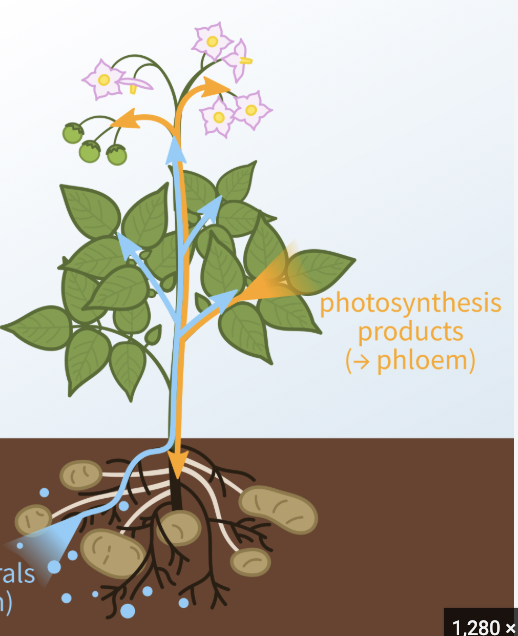
Phloem
live cells through the plasmodesmata always in the symplast
Source cells generate sugar (osmolytes) by
Moving in the phloem, which increases the gradient for water to move into the phloem, increasing pressure in the phloem near the source cells, creating a pressure gradient for bulk flow in the sap of phloem
How does a leaf that was not attacked induce a defense
increase in osmolyte an increase in h2o in the phloem having a high pressure
elicitor (saliva)+e-r = bound
Increased JA in symplast, moves JA into phloem down CG, bulk flow of sap moves JA to other parts of plant pressure because DF for BF is pressue
JA+JA-R= bound
into nucleus and bind JAZ (TF repressor) and tag with ubiquitin, proteasome degrades tagged molecule reducing TF repressor causing transcription
Plasmodesmata
Signal travels from leaf to leaf where cell membrane attaches between two cells
Elicitors
Molecules that trigger plant defense responses by being recognized by plant receptors.
Elicitor receptors
Proteins on or in plant cells that recognize HAMPs and DAMPs and initiate intracellular signaling. |
Jasmonic acid (JA / Jasmonate)
A plant hormone involved in regulating defense responses against herbivores and other environmental stresses.
JAZ
Jasmonate ZIM-domain proteins that act as repressors. They bind to defense gene transcription factors and prevent defense genes from being activated.
Ubiquitin
A small protein that attaches to other proteins and marks them for degradation.
Proteasome
A protein complex that breaks down proteins tagged with ubiquitin.
Defense gene transcription factors
Proteins that bind DNA and regulate the expression of defense genes.
pathway
Herbivore feeding introduces HAMPs and causes tissue damage, releasing DAMPs.
Elicitor receptors recognize these molecules and activate signaling pathways.
Jasmonic acid signaling increases.
JA signaling promotes the removal of JAZ repressor proteins.
JAZ proteins are tagged with ubiquitin.
The proteasome recognizes ubiquitin and degrades JAZ.
Defense gene transcription factors are no longer repressed.
Transcription factors activate defense gene expression. JAZ proteins normally prevent plants from activating defenses unnecessarily. When JAZ is degraded, the plant can activate its defense response.
GRL (Glutamate-Receptor-Like) receptor
A receptor that functions as a calcium-permeable ion channel. It helps initiate calcium signaling when activated by glutamate-related signals.
H+ ions
Electrically charged particles that move across cell membranes and contribute to electrical signaling.
Cl⁻
Chloride ions that contribute to membrane potential and electrical signaling.
Ca²⁺-gated Cl⁻ channel
A chloride channel activated by increased intracellular calcium. Allows Cl⁻ to move across the membrane.
K⁺
Potassium ions that contribute to membrane potential and electrical signaling.
Ca²⁺-gated Cl⁻ channel
A chloride channel activated by increased intracellular calcium. Allows Cl⁻ to move across the membrane
Voltage-gated Ca²⁺ channel (V-Ca²⁺)
A calcium channel that opens in response to changes in membrane voltage, allowing Ca²⁺ to enter the cell.