Physics Lesson: Work Energy and simple machine
 Call Kai
 Learn
 Practice Test
 Spaced Repetition
 Match
 Flashcards
 Knowt Play
1/39

There's no tags or description
Looks like no tags are added yet.
40 Terms
Work (W) 🛠️
Product of the component of force applied on an object and the displacement produced in the direction of the force. Formula: W=Fscos(θ). SI Unit: Joule (J) or Nm. CGS Unit: Erg (1J=107erg). Example: Pushing a trolley forward horizontally along a smooth aisle.
Energy (E) ⚡
The capacity or internal capability of a physical body to perform mechanical work. Formula: Equivalent to total work done (E=W). SI Unit: Joule (J). CGS Unit: Erg. Example: Chemical energy stored in a dry battery powering an electric motor.
Power (P) ⏱️
The time rate at which mechanical work is performed or electrical energy is transferred. Formula: P=tW. Symbols: W=work done, t=time taken. SI Unit: Watt (W=1Js−1). CGS Unit: ergs−1. Example: A winch lifting a crate in 2s delivers twice the power of one taking 4s.
Kinetic Energy (KE) 🏃
Form of mechanical energy possessed by a physical body by virtue of its state of motion. Formula: KE=21mv2. Symbols: m=mass, v=speed. SI Unit: Joule (J). CGS Unit: Erg. Example: A speeding train running on horizontal tracks.
Gravitational Potential Energy (PE) ⛰️
Energy stored in a body due to change in its vertical position relative to the ground. Formula: PE=mgh. Symbols: m=mass, g=acceleration due to gravity, h=vertical height. SI Unit: Joule (J). CGS Unit: Erg. Example: Water retained at the top of a mountain reservoir.
Mechanical Advantage (MA) ⚙️
Ratio of the resistance force overcome to the effort applied to operate a machine. Formula: MA=EffortLoad=EL. Units: Dimensionless pure number. Example: Raising a 400N engine block using a crowbar with only 80N of downward force (MA=5).
Velocity Ratio (VR) 🚀
Ratio of the displacement of the point of application of effort to the displacement of the load in the same time interval. Formula: VR=dLdE. Units: Dimensionless pure number. Example: Moving a lever handle by 60cm to lift a weight by 20cm yields VR=3.
Efficiency (η) 📊
Fractional or percentage ratio of useful work output produced by a machine to total work input supplied. Formula: η=WinputWoutput×100%=VRMA×100%. Units: Dimensionless (percentage). Example: A pulley taking in 200J of work and delivering 160J of useful work has η=80%.
Ideal Machine 🌟
A theoretical loss-free machine containing frictionless and weightless components where work output strictly equals work input. Formula: η=100% and MA=VR. Units: None. Example: An ideal frictionless lever with zero bar mass.

Lever 🥢
A rigid straight or bent bar free to turn about a fixed pivot or axis called the fulcrum. Formula: Principle of Moments: Load×Load Arm=Effort×Effort Arm. Units: None (machine). Example: A pair of wire-cutting pliers.

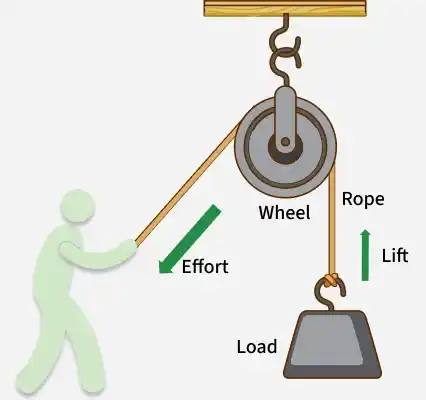
Pulley 🛞
A grooved rim wheel capable of turning around an axle fixed inside a frame called a block, driven by a cord. Formula for n movable pulleys: MA=2n (in ideal conditions). Units: None. Example: A fixed overhead wheel used to draw water from a well.


Inclined Plane 📐
A flat rigid surface tilted at an acute angle to the horizontal used to roll or push loads upwards. Formula: MA=hl=sin(θ)1 where l=slope length and h=vertical height. Units: None. Example: A sloping wooden loading ramp attached to the rear of a delivery truck.
Formula: General Work Done (W=Fscos(θ)) 📐
Formula: W=Fscos(θ). Symbols: F=applied force, s=displacement, θ=angle between force and displacement. When to use this formula: When the acting force is directed at an inclined angle to the actual path of motion. Example: Dragging a sled with a rope inclined at 45∘.
Formula: Parallel Work Done (W=Fs) ➡️
Formula: W=Fs. Symbols: F=magnitude of force, s=displacement. When to use this formula: When force and displacement are collinear and act in the exact same direction (θ=0∘, cos(0∘)=1). Example: Pushing a supermarket cart straight ahead along a flat floor.
Formula: Kinetic Energy (KE=21mv2) 🏎️
Formula: KE=21mv2. Symbols: m=mass of object, v=translational speed. When to use this formula: When calculating the dynamic energy possessed by any moving body whose mass and velocity are known. Example: Determining the energy of a 0.15kg cricket ball traveling at 30m/s.
Formula: Gravitational Potential Energy (PE=mgh) 🏗️
Formula: PE=mgh. Symbols: m=mass, g=acceleration due to gravity, h=vertical height raised. When to use this formula: When finding the energy stored in an object lifted against Earth's gravitational pull. Example: Calculating energy stored in a 10kg stone resting on a 5m wall.
Formula: Mechanical Power (P=tW) 💡
Formula: P=tW=Fv. Symbols: W=work done, t=time duration, F=force, v=constant velocity. When to use this formula: When evaluating the rate at which work is being completed or power output of an engine. Example: An elevator motor doing 60000J of work over 20s.
Law of Conservation of Energy 🔄
Fundamental principle stating that energy cannot be created or annihilated, only transformed from one variety into another. Formula: Total Mechanical Energy E=KE+PE=constant. When to use this formula: For closed, conservative systems without frictional energy losses. Example: A swinging grandfather clock pendulum.
Formula: Mechanical Advantage (MA=EffortLoad) 🏋️
Formula: MA=EL. Symbols: L=load resistance overcome, E=effort force applied. When to use this formula: When calculating the force multiplication factor of any simple machine. Example: Finding how much a jack multiplies force to lift a car.
Formula: Velocity Ratio (VR=dLdE) 📏
Formula: VR=dLdE. Symbols: dE=distance moved by effort, dL=distance moved by load. When to use this formula: When determining geometric displacement ratios of machine parts, independent of friction. Example: Comparing the stroke travel of a hydraulic piston to that of the lifting ram.
Formula: Machine Efficiency ($$\eta = \frac{MA}{VR} \times 100\%$) 📈
Formula: η=VRMA×100%. Symbols: MA=mechanical advantage, VR=velocity ratio. When to use this formula: When determining energy losses or real performance quality of a mechanical system. Example: Evaluating a gear system where VR=5 and MA=4.
Conditions for Mechanical Work Done to Be Zero (W=0) 🛑
Mechanical work equals zero when: (1) Displacement is zero (s=0), (2) Net force applied is zero (F=0), or (3) Force is perpendicular to displacement (θ=90∘, cos(90∘)=0). Example: A railway porter carrying luggage horizontally on his head (θ=90∘ between weight and motion).
Positive, Negative, and Zero Work ⚖️
• Positive Work (0∘≤θ<90∘): Force assists displacement (e.g., gravity on a freely falling stone). • Negative Work (90∘<θ≤180∘): Force opposes displacement (e.g., brake pads stopping a bicycle wheel). • Zero Work (θ=90∘ or s=0): Displacement is perpendicular to force (e.g., Earth orbiting the Sun under centripetal gravity).
Energy Transformation: Pendulum, Falling Body, and Hydro Plant 🌊
• Simple Pendulum: Maximum PE at extremes converts entirely into maximum KE at lowest mean point. • Freely Falling Body: Initial PE progressively transforms into KE while keeping PE+KE constant. • Hydroelectric Plant: Gravitational PE of stored dam water transforms into KE of falling water, then into turbine mechanical energy, and finally into electrical energy.
Reason Why Real Machines Are Never 100% Efficient 🚫
A practical machine cannot reach η=100% because part of the work input is unavoidably spent: (1) Overcoming friction between sliding or turning mechanical contacts, (2) Overcoming air drag, and (3) Lifting the heavy moving parts of the machine itself, dissipating energy as waste heat and sound.
Mathematical Relationship Between MA, VR, and Efficiency 🔗
Work output equals Load×dL and Work input equals Effort×dE. Therefore, η=Effort×dELoad×dL=(EffortLoad)×(dEdL)−1=VRMA. Hence, MA=η×VR. Since η<1 in real machines, MA is always strictly less than VR.
Class I Lever (Fulcrum in Middle) ⚖️
Fulcrum (F) is located between Effort (E) and Load (L) (Relative order: E−F−L). Can have MA>1, MA=1, or MA<1. Examples: (1) Pliers (MA>1, effort arm longer than load arm to multiply force), (2) Seesaw (MA=1, equal arms designed to balance two weights).
Class II Lever (Load in Middle) 🛒
Load (L) is located between Fulcrum (F) and Effort (E) (Relative order: F−L−E). Effort arm is always longer than the load arm; thus MA>1 and VR>1 (always functions as a force multiplier). Examples: (1) Nutcracker (crushes hard shells near pivot with small hand effort), (2) Wheelbarrow (heavy soil carried close to the front wheel axle).
Class III Lever (Effort in Middle) 🎣
Effort (E) is located between Fulcrum (F) and Load (L) (Relative order: F−E−L). Load arm is always longer than the effort arm; thus MA<1 and VR<1 (always acts as a speed or displacement multiplier, never a force multiplier). Examples: (1) Sugar tongs (fine tips move through larger distance), (2) Human forearm flexing a dumbbell (biceps tendon pulls between elbow joint and hand load).
Pulley Systems: Single Fixed, Movable, and Block & Tackle 🏗️
• Single Fixed Pulley: MA=1, VR=1, does not multiply force; simply changes the effort direction to a convenient downward vector. • Single Movable Pulley: Ideal MA=2, VR=2, acts as a force multiplier. • Block and Tackle (n pulleys): VR=n, ideal MA=n, designed to hoist massive cargo with small manual effort.
Inclined Plane: Mechanism and Advantages 🏔️
A continuous ramp allowing a load to be lifted with reduced force applied over a longer distance. VR=hl=sin(θ)1. Ideal MA=sin(θ)1. As the inclination angle θ decreases, MA increases, making it easier to roll the object upward.
Numerical Trigger: Power of a Climbing Person 🏃♂️
Question: A 50kg boy ascends a vertical height of 10m in 10s (g=9.8m/s2). Calculate his power output. Formula & Solution: W=mgh=50×9.8×10=4900J. P=tW=104900=490W.
Numerical Trigger: Kinetic Energy Scaling With Velocity 🚗
Question: If the velocity of an automobile is doubled while mass is held constant, by what factor does its kinetic energy increase? Formula & Solution: KE=21mv2. Since KE∝v2, when v′=2v, KE′=21m(2v)2=4(21mv2)=4KE. Kinetic energy increases by a factor of 4.
Numerical Trigger: Work Done in Vertical Lifting 📦
Question: Find the work done by a worker lifting a 25kg sack vertically through a displacement of 4m (g=10m/s2). Formula & Solution: W=Fscos(0∘)=mgh. W=25×10×4=1000J.
Numerical Trigger: Commercial Unit of Energy Conversion (1kWh) ⚡
Derivation: 1kWh=1kW×1h=1000W×3600s=1000J/s×3600s=3.6×106J. Meaning: Represents the electrical energy used by a 1000W load operating continuously for one full hour.
Numerical Trigger: Machine Mechanical Advantage & Efficiency 🚜
Question: A pulley system with VR=5 raises a 1500N cargo using an effort force of 375N. Compute efficiency. Formula & Solution: MA=EffortLoad=3751500=4. η=VRMA×100%=54×100%=80%.
Exam Trap: Work vs. Energy 🔍
• Work: A dynamic process of energy transfer occurring exclusively during the application of an external force that produces displacement; cannot be stored. • Energy: A scalar state property representing the total reservoir capacity of a system to perform work; can be stored indefinitely.
Exam Trap: Power vs. Energy ⏱️
• Energy: Total quantity of work performed, measured in Joules (J); completely independent of the time interval taken. • Power: The rate at which that work is delivered or consumed, measured in Watts (W=J/s); strongly dependent on the time taken.
Exam Trap: Mechanical Advantage (MA) vs. Velocity Ratio (VR) ⚠️
• Velocity Ratio (VR): Purely kinematic ratio fixed by the machine dimensions and cord paths; never changes with friction. • Mechanical Advantage (MA): Ratio of forces; always drops when friction increases. In real machines, MA<VR.
Top 3 Common Grade 9 Physics Exam Mistakes ❌
Assuming work is done when carrying loads horizontally (θ=90∘⟹W=0). 2. Treating VR as dependent on friction or lubrication (it depends purely on geometry). 3. Omitting SI units or confusing Joules (J) with Watts (W).