Mycology: Introduction
 Call Kai
 Learn
Learn Practice Test
 Spaced Repetition
 Match
Match Flashcards
 Knowt Play
1/62

Earn XP
Description and Tags
Name | Mastery | Learn | Test | Matching | Spaced | Call with Kai | Chat |
|---|
No analytics yet
Send a link to your students to track their progress
63 Terms
What is Mycology?
The scientific discipline dealing with fungi
Who are Mycologists?
They are scientists who study fungi
What are Mycoses?
The diseases that are caused by fungi
What does Myco stand for?
Fungus
What is studied in Mycology?
Structure
Taxonomy
Reproduction methods
Economical importance
What are the most important branches in Mycology?
Ecology
Physiology
Genetics
Industrial uses
Medical uses
Why do we study mycology?
Because its the most diverse organisms on earth.
Second to Insects.
How do you estimate the number of fungal species?
Find the number of flowering plants in the area
most plant species are believed to be described
Fund the number of fungi in the same area
Find the ration of 6 fungi to each plant
Is a Fungus a eukaryote or prokaryote? Why?
Eukaryote, it contains a true nucleus and a nuclear membrane bound organelles
What are the characteristics of Fungi?
Eukaryotes
Lack chlorophyll
Heterotrophs
Glycogen is the primary carbohydrate storage product
Chitin cell wall
Single-cell or multi-cellular
Can be Molds
Form hyphae
Form Mycelium
What are Molds?
Filamentous fungi that produce mycelium
What are Hyphae?
Long, branched, thread-like filaments
They can be
Septate
Hyphae that have cell walls between septa
Aseptate
Hyphae that do not have septa
Have a continuous cytoplasm mass
What is a Mycelium?
The total hyphal mass
A network formed by hyphae
How are Algae and Fungi similar?
Both have simple bodies called thallus
Which are not differentiated into
Roots
Stems
Leaves
How are Algae and Fungi different?
Chlorophyll
Algae contain chlorophyll
Fungi do not contain chlorophyll
Mode of nutrition
Algae are Autotrophic
Fungi are Heterotrophic
Reserved food material
Algae use Starch
Fungi use Glycogen and Oil-Globules
Starch content
Algae have starch
Fungi starch is absent
What is a Haustoria? What is its perpose/function?
Root-like structure that grows INTO or AROUND another structure
Function: to absorb the water and nutrients from the structure.
What are the hyphal structure?
Mycelium is usually highly developed as white growth
Rhizomorphs
Hypha may grow very close and wound around one another
Plectenchyma
The tissues formed by the closely associated hyphae
What are the 2 commonly seen fungal tissues?
Prosenchyma
Loose associated hyphae
Hyphal structure may be clearly seen
Pseudoparanchyma
Closely woven hyphae
NO intercellular spaces
Hyphae can NOT be seen
Ex. Sclerotium
What is the ultrastructure of fungal cells?
Cell wall
Plasma membrane
Cytoplasm and organelles

What is the Ultrastructure of fungal cells (Cell wall)?
Composition is variable among different groups or same group but different species
Lack cellulose
Chitin as elongated variously oriented microfibrillar units
Laid down in layers
Basic of structural rigidity
What are the organelles found in the cytoplasm?
Mitochondria
Endoplasmic reticulum
Vacuoles
Golgi apparatus
Nucleus
How do fungi obtain its nutrients? Explain.
By absorption
The nucleus sits at the back of the hyphae and directs it to the organic source
Hyphal tip releases enzymes
The released enzymes breakdown the substance
The products are diffused into the hyphae
Only some fungi are heterotrophic. (T/F)
False, ALL are heterotrophic
What are the 3 main ways fungi obtain nutrition?
Parasitic
Saprophytic
Symbiotic
What are Parasitic fungi?
Obligate or facultative
Obligate: Live on live host & does NOT kill the host
Facultative: Are Saprophytes. Kill host and feeds on it
Food obtained from LIVING host
What are Saprophytic fungi?
Nutrition obtained from Dead or decaying organic matter
Obligate or facultative
Obligate: Remains saprophytic entire life
Facultative: Primarily parasite that has secondarily adopted saprophytic means
What are Symbiotic fungi?
Mutualistic
Form lichens
Enter mycorrhizal relationships
Enter relationships with algae
What are Mycorrhiza?
Fungi that infect the plants roots and forming a
non-disease-producing association with the plant
About 90 percent of land plants rely on mycorrhizal fungi. (T/F)
True
Why do fungi have a great potential for quick adaptation?
The majority of the terrestrial forms are SAPROPHYTIC
They are also present all the time in air.
What are the 3 types of reproduction?
Vegetative
Asexual (Anamorph)
Sexual (Teleomorph)
In vegetative reproduction, the nuclei are united. (T/F)
False, There is no union of
nuclei
sex cells (gametes)
sex organs.
Vegetative reproduction helps to increase the number of individuals in the population (T/F)
True
How does Vegetative reproduction in fungi occur?
Fragmentation
Fission
Budding
Sclerotia
Rhizomorphs
How does Fragmentation happen in Vegetative reproduction?
The Mycelium breaks up into small fragments/pieces
Not all the fragmented pieces of the mycelium are able to develop into new individuals. (T/F)
False, all are able to develop into new individuals
How does Fission happen in Vegetative reproduction?
Common method of reproduction fission of yeast
Mature cell elongates
The nucleus divides into 2 daughter nuclei
The daughter nuclei separate
cytoplasm cleaves dividing the parent protoplasm into two daughter protoplasts.
A double cross wall is deposited in the middle
Septum
The middle layer of the double cross wall degenerates and the daughter cells are separated.
How does budding happen in Vegetative reproduction?
Common method in budding yeast
small outgrowth or bud emerges from the parent cell
nucleus of the parent cell divides into two
One of the nuclei is incorporated into the bud
may or may not be separated from the parent cell
When it is not a separated cell, it produces another bud.
resulting in the formation of a chain of buds called a pseudo-mycelium
What is Sclerotia and how is it formed in Vegetative reproduction?
They are compact masses of mycelium that survive for many years
They give rise to NEW mycelia when favorable conditions are met
Ex. Claviceps purpurae , Rhizoctonia solani
What is Rhizomorph and how is it formed in Vegetative reproduction?
A modified mycelium, rope-like
Resistant to unfavorable conditions
Give rise to NEW mycelia
Asexual reproduction is more common than Sexual reproduction. (T/F)
True
What are Sprors?
Specialized reproductive cells formed in Asexual reproduction
What is sporalation?
The formation of spores in fungi
Each spore develops into a new thallus. (T/F)
False, develops into a hyphae
Why are they called Mito-spores?
Because spores are produces as a result of mitosis in parent cells
Where are spores born from?
Sporophores
What do you call a fungi that produces more than 1 type of spore?
Multi-spored fun-guy!!
Pleomorphic or Polymorphic
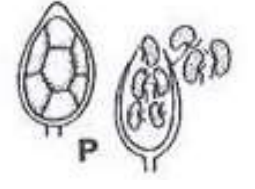
What are Endogenous spores?
Spores produced INSIDE the Sporangium
What is a Sporangiophore?
Sporophores that bare the sporangia on their apices
The Sporangium can be branched or unbranched. (T/F)
True
What are the2 types of Endogenous spores?
Aplanospores
Zoospores
What are Zoospores?
They are produced inside the zoosporangia
They are motile
Uni/Bi-flagella
No cell wall
Uninucleate
Vacuolate
Kidney-shaped
Flagella are inserted in 2 places
Posteriorly
Laterally
FOUND IN LOWER FUNGI
Ex. Albugo , Phytophthora

What are Exogenous spores (Conidia)?
Spores produced on the terminal ends of Conidiophores
They are diverse in their
Shape
Size
Color
If they are unicellular or multicellular
If they are uninucleate or multinucleate
What is a Conidiophore?
The part that produces conidia externally
Can be branched or unbranched
Why are spores important?
Allow fungi to move to a new food source
To survive periods of adversity
to introduce new genetic combinations
Why are Aspergillus and Penicillium called blue green molds?
Their conidia are smoky green colored
What the specialized structures of Conidia?
Pycnidium
Flask-shaped
Produce: Pycniospores
Acervule
Saucer-shaped
Widely open body
Develop conidia in/on small conidiophores
Sporodochium
Small compact stroma
Stroma bears conidiophores on which asexual spores or conidia
Synnemata
Large erect reproductive structures
Bearing compact conidiophores that fuse together to form a strand with conidia at the end
How does Sexual reproduction in fungi occur?
Spores form from the fusion of 2 opposite mating strains OF THE SAME FUNGUS SPECIES
Consists of 3 phases
Plasmogamy
Karyogamy
Meiosis
What happens in Plasmogamy?
The plasma of the gametes fuse together
That happens in Karyogamy?
The nuclei of the gametes fuse together
What happens in Meiosis?
Reduction division
What are the 3 methods of sexual reproduction?
Isogamy
Motile
Morphologically similar✅
Physiologically different❌
Heterogamy
Morphologically different
Physiologically different
Gametangial copulation
The fusion of the entire content of the gametangia
Form a Zygote/Zygospore
Slide 40