D2.1
 Call Kai
 Learn
Learn Practice Test
 Spaced Repetition
 Match
Match Flashcards
 Knowt Play
1/44

There's no tags or description
Looks like no tags are added yet.
Name | Mastery | Learn | Test | Matching | Spaced | Call with Kai | Chat |
|---|
No analytics yet
Send a link to your students to track their progress
45 Terms
What is the fundamental mechanism by which new cells are produced in living organisms?
Cell division, where a single parent cell divides to produce two daughter cells.
Describe the outcome of a single cell division event in terms of parent and daughter cells.
One parent cell divides to form two daughter cells.
What is cytokinesis?
The division of a parent cell between two daughter cells following mitosis or meiosis.
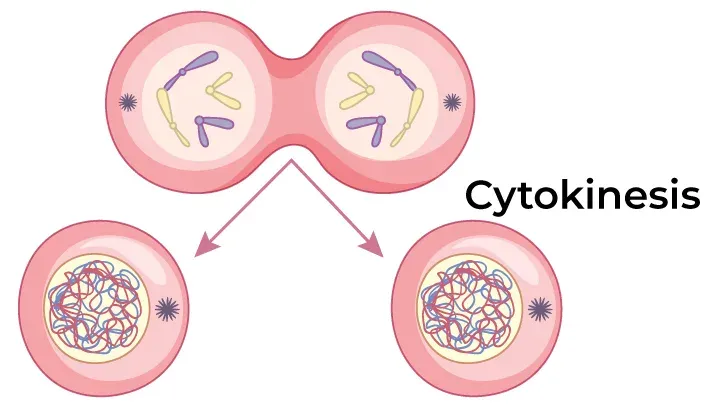
How does cytokinesis occur in animal cells?
Uses actin to pinches the cell membrane inward (forming a cleavage furrow) to split the cytoplasm.
How does cytokinesis occur in plant cells?
Vesicles merge at the center to construct new sections of cell membrane and cell wall (forming a cell plate) to divide the cell.
Compare the mechanism of cytokinesis in animal vs. plant cells.
Plant cells:
build cell wall in the middle to create two new cells
Animal cells:
split by pinching inward via actin

Is cytokinesis always equal? Explain.
No. Cytokinesis usually divides cytoplasm equally, but unequal cytokinesis occurs in specific cases like human oogenesis and yeast budding.
What minimum requirement must both daughter cells receive during cytokinesis for essential organelles?
Both daughter cells must receive at least one mitochondrion (and any other organelle that can only arise from dividing a pre-existing structure).
Why must certain organelles be distributed to both daughter cells during cytokinesis?
Because organelles like mitochondria contain their own DNA and cannot be synthesized from scratch; they must divide from pre-existing structures.
Give two specific biological examples of unequal cytokinesis.
Oogenesis in humans: Produces one large egg cell (retaining most cytoplasm) and small polar bodies.
Budding in yeast: Produces a small daughter cell that pinches off from a larger parent cell.
Why must nuclear division (mitosis/meiosis) occur before cell division (cytokinesis)?
To ensure each daughter cell receives a nucleus containing genetic material, avoiding the production of anucleate cells (cells without a nucleus).
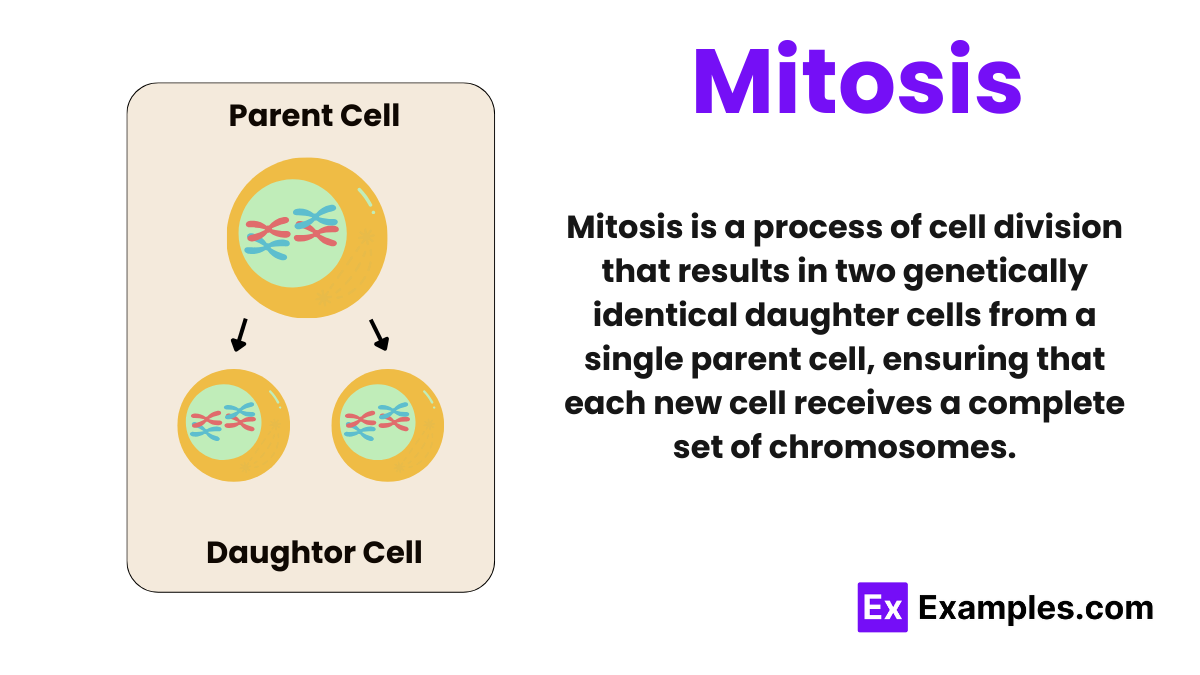
What is the primary role of mitosis in terms of chromosome number and genetic composition?
Maintains the chromosome number and produces genetically identical daughter cells (preserves the genome).
What are the primary roles of meiosis in eukaryotes?
Reduces the chromosome number by half to produce four genetically distinct haploid sex cells

Compare the genetic outcome and chromosome number of mitosis versus meiosis.
Mitosis: Diploid (2n), genetically identical daughter cells.
Meiosis: Haploid (n), genetically diverse daughter cells
Why is DNA replication a prerequisite before both mitosis and meiosis?
So that every new cell gets a full, complete set of genetic instructions to survive and function
What is the structure of a chromosome immediately following DNA replication?
Each chromosome consists of two identical sister chromatids (elongated DNA molecules) held together at the centromere.
Until what specific stage of nuclear division are sister chromatids held together?
Until anaphase (Anaphase in mitosis / Anaphase II in meiosis), when they are pulled apart to opposite poles.
What are two shared features of chromosome behavior in both mitosis and meiosis?
Condensation (supercoiling) of chromosomes during prophase and movement of chromosomes during metaphase and anaphase.
What is the role of histones in chromosome condensation?
DNA wraps around histone proteins to enable supercoiling, which tightly packages long DNA molecules into compact, visible chromosomes.
Why must DNA undergo condensation/supercoiling before nuclear division?
To make chromosomes compact enough to be moved and separated without tangling or breaking DNA strands.
What structures and proteins are responsible for moving chromosomes during nuclear division?
Spindle fibers pull chromosomes toward opposite poles.
What are the four phases of mitosis in sequential order?
Prophase, Metaphase, Anaphase, Telophase (PMAT).
Outline the main event that occurs during Prophase of mitosis.
Chromosomes condense (supercoil), nuclear membrane breaks down, and spindle microtubules form.

Outline the main event that occurs during Metaphase of mitosis.
Chromosomes align along the equator of the cell attached to spindle microtubules at their centromeres.

Outline the main event that occurs during Anaphase of mitosis.
Centromeres divide and sister chromatids separate, pulled to opposite poles by spindle fibres.

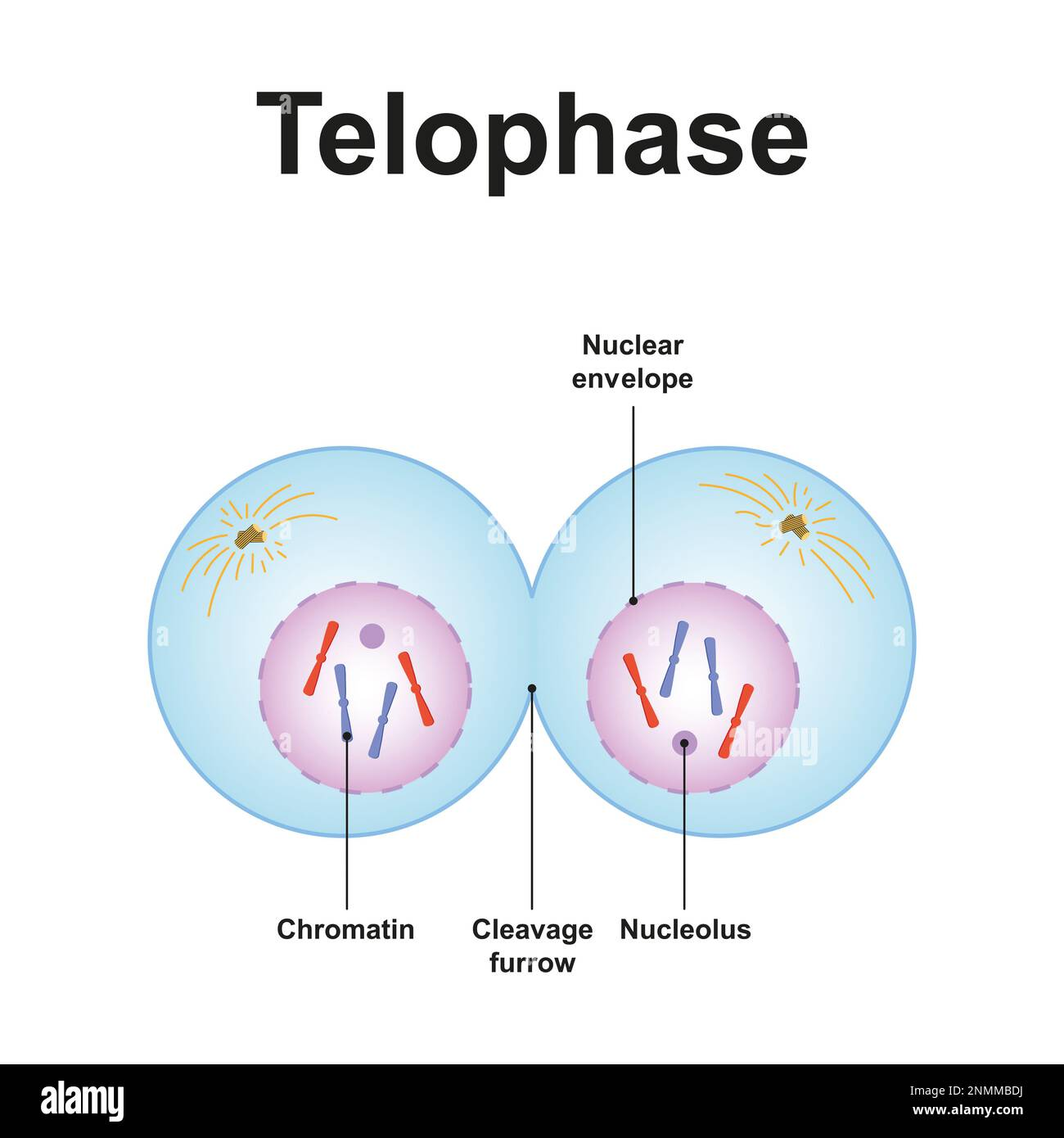
Outline the main event that occurs during Telophase of mitosis.
Chromosomes decondense, nuclear membranes reform around each set of chromosomes at opposite poles.
How does the process of mitosis as a whole guarantee genetically identical daughter cells?
DNA is replicated accurately during Interphase (forming identical sister chromatids).
Sister chromatids align individually in Metaphase and separate equally in Anaphase.
Each new nucleus receives an exact identical copy of every chromosome.
Define diploid (2n) and haploid (n).
Diploid (2n): A cell containing two full sets of chromosomes (homologous pairs).
Haploid (n): A cell containing one single set of chromosomes (unpaired).
Why is meiosis referred to as a reduction division?
Because it reduces the chromosome number by half, converting one diploid (2n) nucleus into four haploid (n) nuclei.
Why is meiosis essential in a sexual life cycle?
It prevents the chromosome number from doubling in every generation when fertilization (fusion of gametes) occurs.
Outline the first round of segregation in meiosis (Meiosis I).
Homologous chromosome pairs separate and move to opposite poles, halving the chromosome number (2n —> n).
Outline the second round of segregation in meiosis (Meiosis II).
Sister chromatids separate and move to opposite poles, producing four genetically distinct haploid cells (n).
Distinguish between what separates in Anaphase I vs. Anaphase II.
Anaphase I: Separation of homologous chromosomes (sister chromatids remain attached).
Anaphase II: Separation of sister chromatids.
What is non-disjunction during meiosis?
The failure of homologous chromosomes (in Anaphase I) or sister chromatids (in Anaphase II) to separate properly during meiotic division.
How does non-disjunction cause a gamete to have an abnormal chromosome number?
It produces gametes with either one extra chromosome (n + 1) or one missing chromosome (n - 1).
Describe the specific chromosomal error that results in Down syndrome.
two copies of chromosome 21
What factor correlates strongly with an increased rate of non-disjunction leading to Down syndrome?
Increased maternal age (older mothers have a higher probability of non-disjunction events occurring during oogenesis).
What is crossing over and when does it occur during meiosis?
Occurs in Prophase I.
Non-sister chromatids of a homologous pair exchange segments of DNA, creating new combinations of maternal and paternal alleles
What is random orientation of bivalents and when does it occur?
Paired matching chromosomes (homologous pairs) line up by chance along the center of a cell during cell division, facing either pole independently of the other pairs
Occurs in Metaphase I.
State two processes during meiosis that generate genetic variation in haploid gametes.
Crossing over in Prophase I (exchanges alleles between non-sister chromatids).
Random orientation of bivalents in Metaphase I (randomizes combination of maternal and paternal chromosomes sent to each pole).
Interphase

Prophase

Metaphase

Anaphase

Telophase