SUS. TAINABILUTIY: planetary boundaries & social sust #1
 Call Kai
 Learn
 Practice Test
 Spaced Repetition
 Match
 Flashcards
 Knowt Play
1/10

Earn XP
Description and Tags
sustain your mental health bitch
11 Terms
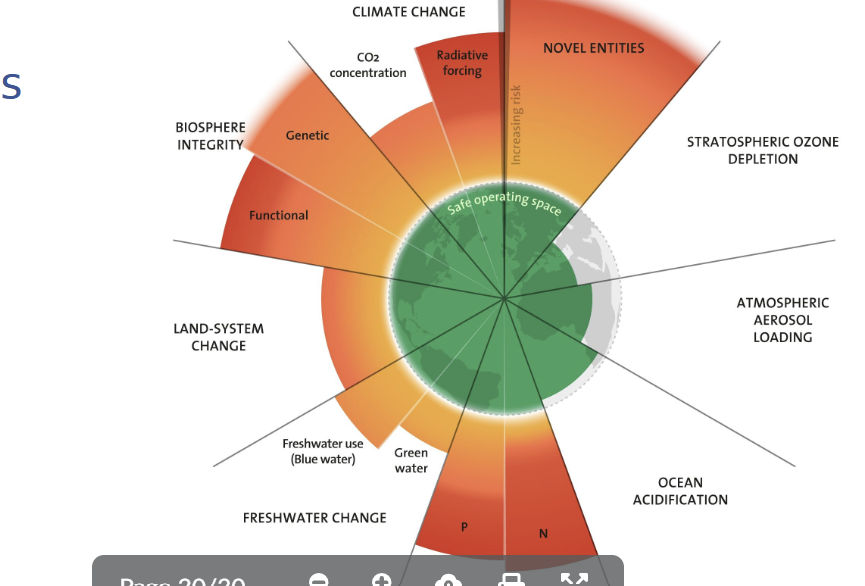
What are planetary boundaries?
A precautionary threshold, set below the point where a dangerous
change is thought to become likely
Always being changed/updated, recent one highlights 7 of 9 crossed (only aerosols and ozone not)
Safe operating space → zone of increasing risk → high risk zone
The 9:
1. Climate change
2. Ocean acidification
3. Biosphere integrity
4. Land-system change
5. Freshwater change
6. Biogeochemical flows (N, P)
7. Atmospheric aerosol loading
8. Stratospheric ozone depletion
9. Novel entities
Control variable?
A specific, measurable proxy used to track a boundary process.
Choosing one is a methodological decision, not a neutral given
What is the value of a framework like the Planetary Boundaries? What are its strengths/possible weaknesses? What could / should be included in this framework?
Very vague, offers no solutions
Ways of determining boundaries is constantly changing, and since there are no clear hard values to hit/avoid, its complicated to even put anything in place to combat it or change or anything.
Quantitative?
Doesn’t explain why, how, or what we could do to thus change it.
What is the Great Acceleration? Why is it happening?
Great Accerlation = Many global indicators have grown exponentially, at the
same time, especially since the mid-20th century (Industrial Revolution).
Demographic change = population growth
Technology = people stay alive longer, improved economy, yield, etc.
Development aspirations
Inequality!

What is the IPAT equation? What does it tell us?
I = PxAxT
with
I (Impact): Environmental degradation or resource depletion.
P (Population): Total number of people.
A (Affluence): Consumption per capita, often measured by GDP per
person.
T (Technology): Environmental impact per unit of consumption (e.g.,
carbon intensity)
Basically highlights one way we can “calculate” impact on environment caused by specific things/countries, etc.

Consumption vs. Overconsumption vs. Hyperconsumerism. What drives them? Hidden costs?
Consumption: the necessary, functional act of using goods and services to
meet basic need
Consumerism: cultural and institutional patterns that encourage
acquisition of goods for status and pleasure and promote consumption
beyond needs.
Hyperconsumption: excessive or non-functional consumption
What are the costs of hyperconsumption?
Unsustainable use of natural resources, environmental pollution
Loss of global biodiversity and habitats for non-human species
Increasing emissions of greenhouse gases driving global warming
Rising production, transportation and waste disposal costs
Loss of social connectedness and sense of community
Work-related stress and loss of quality-of-life
Hyperconsumption: excessive or non-functional consumption.
Consumption: the necessary, functional act of using goods and services to meet basic needs;
Ways to visualize social sustainability

An example of social UNsustainability
In attempts to be sustainable: Green sacrifice zones
Mining for solar panels, for example
Extreme ecological and natural damage
marginalized regions, ecosystems, and
Indigenous areas that suffer severe environmental degradation, pollution,
and displacement to extract the critical raw materials needed for global
decarbonization and green technology
practice where wealthy, affluent nations in the
Global North export toxic, hazardous, electronic, and plastic waste to
developing countries in the Global South under the guise of recycling or
trad
What is green growth?
Green growth = the idea that we should transition to a sustainable society
and keep growing GDP
Some issues:
Need global decoupling of carbon + growth, not just specific countries
Narrow view of sustainability as only reducing emissions
GDP is very narrow view of success → hides inequality
Doesn’t address root cause = Jevon’s paradox
Jevon’s paradox = As long as growth remains a central policy goal, any efficiency gains will be reinvested into new forms of production and consumption.
More efficiency = more consumption, basically
Compare and contrast green growth and degrowth?
Degrowth = the idea that infinite GDP growth is not possible and not desirable.
A sustainable society only becomes possible if we transform our economic system
Issues are centered around actually implementing this
Social inequality, colonial past → unfair to choose that less developed countries may now not have GDP growth as a goal
Priviledged take and hard to implement politically as well..