drug dissolution bioavailability & bioequivalence
 Call Kai
 Learn
 Practice Test
 Spaced Repetition
 Match
 Flashcards
 Knowt Play
1/57

There's no tags or description
Looks like no tags are added yet.
58 Terms
dissolution and drug absorption
the process by which drug (particles) dissolves is termed dissolution
for drug absorption, drug must be first dissolved in the fluid at the absorption site
factors that affect drug dissolution:
physico-chemical factors
a) drug
b) dosage form
physiological factors
what are the two factors that affect dissolution and drug absorption?
physico-chemical factors (drug and dosage form) and physiological factors
drug dissolution from an oral tablet or capsule

disintegration of the capsule/tablet starts at the surface. as more and more water penetrates inside, the entire capsule/tablet will break apart. what you would get are granules (big chunks). with further disintegration (deaggregation), those chunks will turn into fine particles.
drug dissolution can take place from any form of the capsule/tablet. if dissolution comes straight from the capsule/tablet as is, the dissolution is slow. if the dissolution comes from the granules, the dissolution rate is intermediate. while the dissolution from fine particles would be considered a rapid rate.
the reason as to why the dissolution rate is different based on the form it takes it from is because of surface area. the smaller the drug (particles), the larger the surface area, so higher the drug dissolution.
dissolution: Noyes-Whitney equation
dc/dt = k*S*(Cs-Ct)

dc/dt = rate of dissolution
k = dissolution rate constant
S = surface area of the dissolving solid
this is of the dosage form itself
Cs = saturation concentration of drug in the diffusion layer
Ct = concentration of the drug in the dissolution medium at time t
can Cs and Ct ever be 0?
no, you will always have really high concentration Cs and very low concentration Ct. this is because the moment that the drug is dissolved, it will be absorbed.
what factors are going to increase drug dissolution (dc/dt)?
higher dissolution rate constant
higher surface area
higher difference between Cs - Ct
physico-chemical factors affecting drug dissolution
crystalline vs amorphous drug form
general rule - amorphous form of a compound has more solubility than its crystalline form
sometimes, crystalline form of drugs may be used because of greater stability than the corresponding amorphous forms, e.g. the crystalline forms of penicillin G
prompt insulin zinc suspension, USP vs. extended insulin zinc suspension, USP
prompt: released immediately
extended: released over a period of time, not immediately
which form do you think is more suitable for prompt insulin zinc suspension, and which form do you think is more suitable for extended insulin zinc suspension? (form as in amorphous vs crystalline)
prompt insulin zinc suspension is more suitable with amorphous form because of higher solubility
extended insulin zinc suspension is more suitable with crystalline form because it is going to dissolve slowly
physico-chemical factors affecting drug dissolution
surface area of drug particle

when a drug particle is reduced to a large number of smaller particles, the total surface area created is increased
for drug substances that are poorly or slowly soluble, decreasing particle size generally results in an increase in the rate of dissolution
physico-chemical factors affecting drug dissolution
salt forms
dissolution rate of a salt form of a drug is generally quite different than that of the parent compound
sodium and potassium salts of weak organic acids and hydrochloride salts of weak organic bases dissolve much more readily than do their respective free acids or bases
e.g. theophylline
initially formulated as a hydroalcoholic mixture
problem for kids (alcohol in it)
includes water and alcohol (hydroalcoholic)
alcohol being a co-solvent
ethylenediamine salt of theophylline formulated as oral aq solution
physico-chemical factors affecting drug dissolution
other factors
state of hydration of a drug molecule
usually, anhydrous form is more readily soluble than the hydrated form
e.g. anhydrous ampicillin has greater solubility than ampicillin trihydrate
anhydrous = no water molecules (dehydrated)
formation of less soluble complexes resulting in reduced absorption
e.g. tetracycline analogues form complexes with calcium, magnesium and aluminum
decreased absorption of the tetracycline complexes
adsorption (attach) - to the insoluble material in the GI tract
reduced for absorption
physico-chemical factors affecting drug dissolution
dosage form and absorption

which of these three (tablet/capsule/solution) will show you the fastest drug absorption?
solution
drug is already dissolved, no dissolution process required
for capsules/tablets, disintegration needs to be taken place
explain the effect of particle size on surface area, solubility, dissolution rate and absorption rate of a poorly water soluble drug
if particle size is lower, what is surface area?
higher
explain the effect of particle size on surface area, solubility, dissolution rate and absorption rate of a poorly water soluble drug
if particle size is lower, what is the solubility?
higher
explain the effect of particle size on surface area, solubility, dissolution rate and absorption rate of a poorly water soluble drug
if particle size is lower, what is the dissolution rate?
higher
explain the effect of particle size on surface area, solubility, dissolution rate and absorption rate of a poorly water soluble drug
if particle size is lower, what is the absorption rate?
higher
explain the effect of particle size on surface area, solubility, dissolution rate and absorption rate of a poorly water soluble drug
if particle size is higher, what is the surface area?
lower
explain the effect of particle size on surface area, solubility, dissolution rate and absorption rate of a poorly water soluble drug
if particle size is higher, what is the solubility?
lower
explain the effect of particle size on surface area, solubility, dissolution rate and absorption rate of a poorly water soluble drug
if particle size is higher, what is the dissolution rate?
lower
explain the effect of particle size on surface area, solubility, dissolution rate and absorption rate of a poorly water soluble drug
if particle size is higher, what is the absorption rate?
lower
which of the following will increase the dissolution of a poorly water soluble drug from a tablet dosage form?
a) increasing the size of the tablet
b) faster disintegration of the tablet
c) decreasing dissolution rate constant
d) decreasing the surface area of the drug
e) decreasing the saturation concentration of drug in the diffusion layer
b
dc/dt = k*S (Cs-Ct)
for a poorly water soluble drug, which of the following approach will result in faster dissolution?
a) using the crystalline form of the drug
b) using the amorphous form of the drug
c) using the pentahydrate form of the drug
d) using the free acid form of the drug
e) using the tablet dosage form for the drug
b
more water soluble → faster dissolution rate
for a poorly water soluble drug, I want drug dissolution to be faster and absorption to be quick. which is a better approach, reducing the particle size or converting it into a salt form?
reducing the particle size
helps with getting a larger surface area → quicker drug dissolution → absorption quicker
if we had chosen salt form → increase water solubility, but it’s ionized → drug dissolution decrease → slower absorption
physiological factors affecting drug absorption
gastric emptying rate
rapid with fasting stomach
GI tract transit time
stomach 2-4 hours, small intestine 4-10 hours
co-administration of other drugs
age of the patient
most physiological functions are decreased
food taken by the patient
most drugs absorbed well with food
disease state of the patient
why is gastric emptying rate important for physiological factors affecting drug absorption?
most of the drug absorption takes place in the small intestine. so the faster the drug material enters into the small intestine, the faster the absorption can take place.
if you have an empty stomach, and you take a drug with the empty stomach, the drug will enter into the small intestine quicker.
why is GI tract transit time important for physiological factors affecting drug absorption?
what is the total time for the food to move throughout the entire GI tract (from mouth to where it needs to be).
it takes 2-4 hours for contents to pass through stomach.
for the small intestine, it takes about 4-10 hours.
transit time is variable because of the food you eat. if you were to have eaten red meat, it will stay longer in the GI tract. versus if you wat vegetables, it will not stay as long as red meat.
why is the co-administration of other drugs important for physiological factors affecting drug absorption?
some patients may be taking more than one drug, so those other drugs may affect absorption of each other.
why is the age of the patient important for physiological factors affecting drug absorption?
with age, most physiological functions decrease
why is food taken by the patient important for physiological factors affecting drug absorption?
most drugs go well with food
some of the lipids or fatty acids in the food will help with absorption of the drug
why is disease state of the patient important for physiological factors affecting drug absorption?
contractions where the disease state is, this causes a hindrance, so the drug is absorbed slowly
for a drug that is primarily absorbed in the stomach, which of the following will increase the absorption of the drug?
a) high gastric emptying rate
b) low gastric emptying rate
c) drug administered in fasted state
d) drug administered with NaCl
b
if absorbed in stomach, you want it to stay in stomach.
if absorbed in intestine, you want high gastric emptying so it can leave stomach quicker
rate-limiting steps for oral absorption
dosage form → drug in solution (GI tract) → GI membrane → systemic circulation
for a dosage form to get to the drug in solution (GI tract), what needs to happen?
dissolution
the drug’s aqueous solubility relative to the dose of the drug

for a drug in solution (GI tract) to get to the GI membrane, what needs to happen?
permeability
intrinsic membrane permeable to the drug

what is the biopharmaceutics classification system (BCS)?
highly soluble: the highest dose strength is soluble in 250mL aq solution (pH 1.0-7.5)
highly permeable: >90% oral bioavailability

what is under class I biopharmaceutics classification system?
high solubility
high permeability
the best
what is under class II biopharmaceutics classification system?
low solubility
high permeability
intermediate
what is under class III biopharmaceutics classification system?
high solubility
low permeability
intermediate
what is under class IV biopharmaceutics classification system?
low solubility
low permeability
the worst
what is bioavailability?
the rate and extent to which an active drug ingredient or therapeutic moiety is absorbed from a drug product and becomes available at the site of drug action
what is bioequivalence?
the comparison of bioavailabilities of different formulations, drug products, or batches of the same drug product
bioavailability and bioequivalence

Cmax = peak height concentration
tmax = time at which the peak height concentration was
we are measuring for the area under the curve (AUC)
AUC tells us the extent of the drug
you measure rate by Cmax and tmax
plasma drug concentration vs time curve

any drug below MEC (minimum effective concentration) won’t do anything
any drug in between MEC (minimum effective concentration) and MTC (minimum toxic concentration) is great for patients and most beneficial
any drug above MTC (minimum toxic concentration) is lethal
ideally you want to maintain levels at the therapeutic window
if the therapeutic window is very narrow, those are very potent drugs
bioavailability vs bioequivalence cont.
CONT
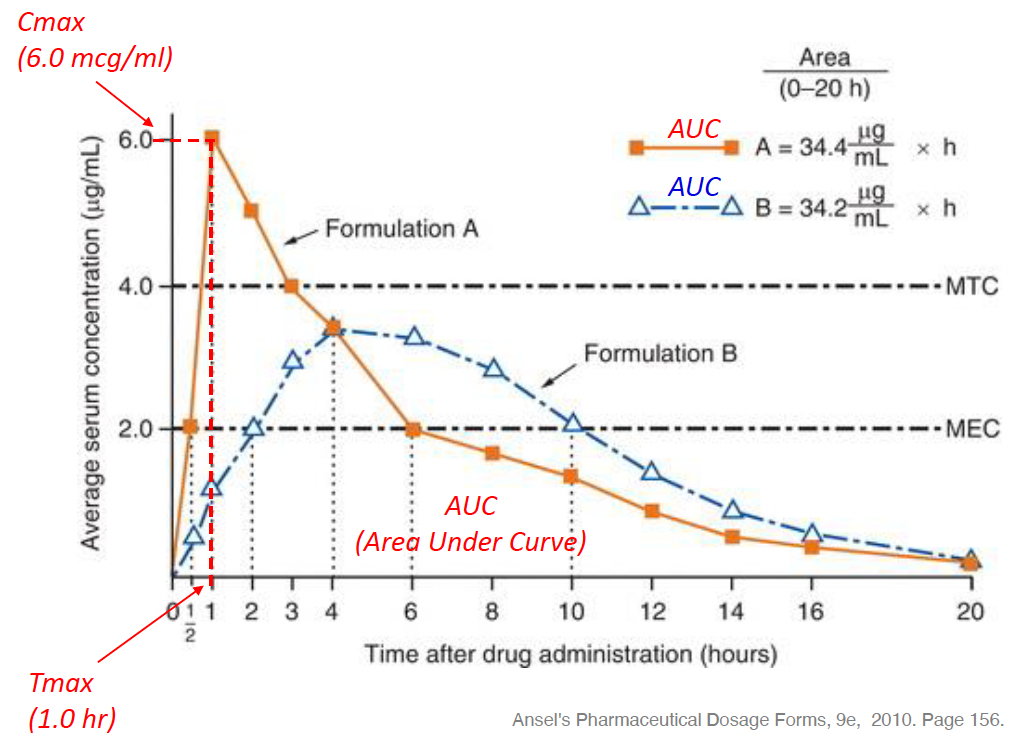
A = 34.4 mcg/mL x h
B = 34.2 mcg/mL x h
if the bioavailabilities are similar, then they are bioequivalent
what are the two types of drug products?
proprietary drug products aka brand drugs
non-propriety drug products aka generic drugs
types of drug products
what are propriety drug products aka brand drugs?
a trademark officially registered by a company
e.g. Lipitor from Pfizer, inc.
the original product

types of drug products
what are non-propriety drug products aka generic drugs?
the generally recognized or common name for a drug in the drug product
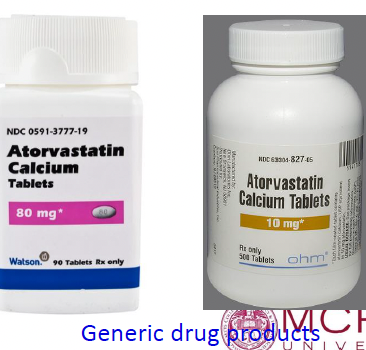
Atorvastatin calcium is the generic name for Lipitor
“copycats” → don’t cost as much to make because no clinical trials are needed and they use other excipients
types of drug products
who are the standardized nomenclatures of drugs established by?
USAN (United States Adopted Names) council
WHO (World Health Organization)
generic drug product
a pharmaceutical product that can substitute a brand product
must show similar drug profile in plasma as its brand product (bioequivalent)
besides, the following items should be the same for brand and generic products
the active ingredient (drug) & strength
the dosage form
ex:
Azithromycin tablets prepared by another company other than Pfizer
Rosuvastatin tablets prepared by another company other than AstraZeneca
generic vs brand drugs
the following equivalences play an important role in establishing a generic drug
pharmaceutical equivalent
pharmaceutical alternative
bioequivalent
therapeutic equivalent
what is pharmaceutical equivalents?
drug products that:
contain identical active ingredients (same salt, or ester of parent drug)
are identical in strength or concentration (of the drug)
contain identical dosage forms
have identical route of administration
meet the identical compendial or other applicable standard of identity, strength, quality, and purity including potency and, where applicable, content uniformity, disintegration times, and/or dissolution rates
may differ in:
shape, drug release mechanism, labeling, excipients (including colors, flavors, etc.)
what is pharmaceutical alternatives?
are drug products that contain the identical therapeutic moiety (same parent drug), or its precursor, but not necessarily in the same amount (100mg vs 125mg) or dosage form (capsule vs tablet) or as the same salt or ester
each such product individually meets either the identical or its own respective compendial or other applicable standard of identity, strength, quality, and purity, including potency and, where applicable, content uniformity, disintegration times, and/or dissolution rates
e.g. tetracycline phosphate or tetracycline hydrochloride equivalent to 250 mg tetracycline base are considered pharmaceutical alternatives
a patient is wanting to replace a pharmaceutical medication called Phenytoin sodium, 20mg, by Pfizer with Phenytoin potassium, 20mg, by Pfizer. can the pharmacist substitute the medication Phenytoin sodium with Phenytoin potassium? Yes or no?
no
you cannot substitute alternative products, they are not bioequivalent → may not have the same effect
you can only substitute bioequivalent products
bioequivalent drug products
are pharmaceutical equivalents or pharmaceutical alternatives whose rate and extent of absorption do not show a significant difference when administered at the same molar dose of the therapeutic moiety under similar experimental conditions, either single dose or multiple dose
therapeutic equivalents
used to indicate pharmaceutical equivalents which, when administered to the same individuals in the same dosage regimens, will provide essentially the same therapeutic effect
therapeutic equivalents
FDA classifies therapeutically equivalent products as those that meet the following general criteria:
they are approved as safe and effective
they are pharmaceutically equivalent
they are bioequivalent
they are manufactured in compliance with Current Good Manufacturing Practice (cGMP) regulations (follow guidelines)
they are adequately labeled (if one is labeled for pain, the other must also be labeled for pain)

which of the following is TRUE about the above drug products?
a) they are pharmaceutical alternatives
b) they are pharmaceutical equivalents
c) they are therapeutic equivalents
d) none of the above
b
they are exactly identical
the differences in colors and excipients and weight are okay for pharmaceutical equivalents
the drugs are bioequivalent. they are safe and effective. they were manufactured in compliance with Current Good Manufacturing Practice (cGMP) regulations. they are adequately labeled. which of the following is TRUE about the above drug products?
a) they are pharmaceutical alternatives
b) they are pharmaceutical equivalents
c) they are therapeutic equivalents
d) none of the above
c
has the additional info needed to know that it is a therapeutic equivalent

which of the following is TRUE about the above drug products?
a) they are pharmaceutical alternatives
b) they are pharmaceutical equivalents
c) they are therapeutic equivalents
d) none of the above
a
there was a change in drug strength
the same could be said if they changed up the dosage form