ARTH 2213 Islamic Art First Exam Image List Flashcards
 Call Kai
 Learn
 Practice Test
 Spaced Repetition
 Match
 Flashcards
 Knowt Play
1/13

Earn XP
Description and Tags
Vocabulary flashcards covering the artwork, architecture, ceramic types, patrons, dates, and calligraphic works for ARTH 2213 Islamic Art First Exam.
Name | Mastery | Learn | Test | Matching | Spaced | Call with Kai | Chat |
|---|
No analytics yet
Send a link to your students to track their progress
14 Terms

Dome of the Rock
Umayyad architectural monument created in 691-92 under the patronage of Abd al-Malik — Jersualem
Byzantine influence in columns and mosaics — top half is mosaics of glass while the bottom half is marble
Byzantine crowns and jewels in mosaics — Sasanian wings instead of angels for closer connection with earthly leadership and power
Figure of the caliph as a connection to God — importance of rain and water which is a power he has
Built on the platform where the temple of Solomon once stood — Muslims associate it with where Muhammad ascended to the 7 heavens in the course of his night journeys
Located at the Rock where Abraham attempted to sacrifice his son Issac before the angel intervened
Domed octagonal shape — similar encircling design as Roman Mausolea
Possibly meant to outshine the Christian Holy Sepulcher also located in Jersusalem
Dome itself points to heaven — goes with the connotation of it being a point of apocalypse/judgement
Octagonal shapes are typically used to commemorate important events or people
Roman columns, taken from buildings — mosaics refer to Byzantine influences with marble
Contains the earliest band of inscription — almost all Qur’anic in nature with exception of patron’s
240 meters long inviting the “People of the Book” or jews and christians to convert to Islam
Maybe the Dome was a motivation to convert
Band and circle shape encourages people to explore the entire area in directions
Similar to Ka’ba in sense of movement
Contextual literacy — people would recognize the phrases from the Qur’an
Mosaics inside the Dome — known as tesserae or pieces of mosaic — made of marble and glass designs
Originally covered the Dome externally too before it was replaced by the Ottomans in 16th century
Sasanian wings, referring to their crowns and power and wealth as an empire recently taking over the territory of the Sasanians
Holy Sepulcher and Dome compete with each other visually across the Jersualem sky line
Also potentially seen as an alternative to Mecca during period of turmoil for Umayyads
Original gold dome with Sasanian motifs referring to the arrival of Islam in the area
Iconography of the trees referring to the Temple of Solomon

The Great Mosque of Damascus
Umayyad architectural structure constructed in 705-15 under the patronage of al Walid — Damascus, Syria
Byzantine influence in columns and mosaics — top half is mosaics of glass while the bottom half is marble
Prior to Muslims, dedicated to Semitic god of Rain, then to Zeus, then to Jupiter, then a site for Christians under the Romans, then to the Muslims after conquering
Damascus was a predominantly Greek/Christian society — allowed Christians to continue praying there
Tore down parts of the church to build the Mosque, yet the wall of the temple of Jupiter remains
Christian temple in middle holds a head relic dedicated to John the Baptist
Mosque is located amongst markets in densely populated area — formerly connected to a palace/royal residence
Mihrab and Minarets became commonplace from the projects done by al-Walid I
Two minarets — show of wealth and power as only one is needed to conduct the call to prayer
Hypostyle hall, similar to the Great Mosque of Kufa — roof supported by columns, yet not evenly spaced as compared to Kufa
Wider than it is deep — opposite to the Aqsa Mosque which he did as well which is deeper than it is wide
Triangular pyramid at the main entrance, reminiscent of Roman architecture — large arches similar to triumphal arches — royal association
Resistance to the building — al-Walid did a speech saying that he wanted to add a fifth thing that gives marked superiority
Treasury located inside as a sign of power
Built by Persians, Egyptians, etc.
Mosaics are reminiscent of those found in the Dome of the Rock
Vine imagery, trees, elaborate and illustrious designs — no figural representation
Interpreted as depicting paradise or as depicting Umayyad magnificence in their Empire and the diversity in their land holdings
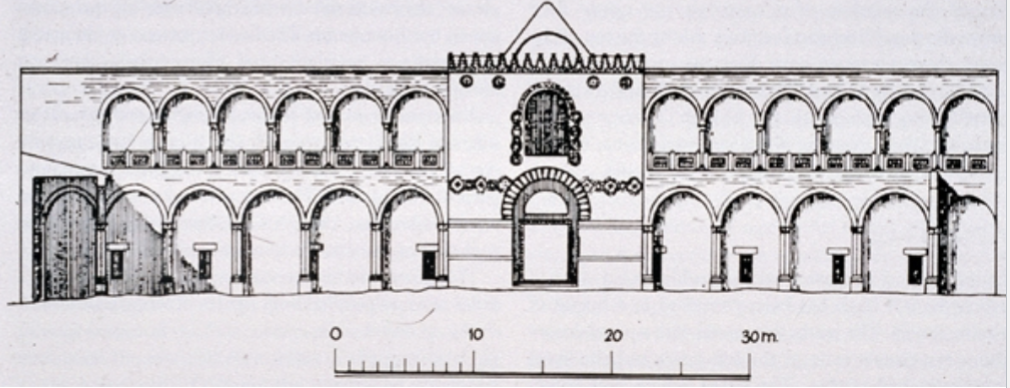
Khirbat al-Mafjar
8th-century Umayyad architectural site, with patronage attributed possibly to Prince Walid ibn Yazid (later Walid II, r. 743-44) or Hisham ibn Abd al-Malik (r. 724-743) — located in Palestine
In the Lion Gazelle there is roman stone mosaics, not glass mosaics
Also shows abundance and power thru the Lion
Contains a castle component, a Mosque, courtyard, and a bathtub structure, accompanied by an external courtyard
Typical roman bathhouse is social, communal, hot/cold, public
Umayyad ones where cold rooms are larger and the more social space
Bathhouse functioned like a throne room/audience hall — floor built with mosaic art
Lion-Gazelle mosaic — originally had a political interpretation, yet this is mostly debunked by the private nature of the room it sits in
Interpretation of it as erotic is more accepted — Gazelle represents female imagery, surrounding curtains, tree as symbol of fertility
ROMAN mosaic as it is made with stone
Statue of Caliph — positionally sits at top of the entrance, standing on lions (dominance), holding traditional royal weapons (swords, etc.) and wearing royal garb
Stucco is used, representing Sasanian influence on their art

Qusayr Amra
Umayyad architectural site built in 723-43 under patron Prince Walid ibn Yazid (later Walid II, r. 743-44), featuring the Six Kings fresco listing Roman, Persian, Ethiopian, Visigoth, Turks, and Chinese — located in Jordan
Palace of Ctesiphon — empty throne is inspiration for the six kings frescoe
Two buildings: one for water, the other is a bathhouse itself
Murals depict the ruler, bathing women, and royal hunting
Others have him depicted on an arched throne — similar to Roman traditions
Murals also depict musicians, dancers, acrobats, etc. and Umayyad residences
6 kings — depict Roman, Persian, Ethiopian, Visigoth, Turks, Chinese, all alongside himself, putting himself into a context with them

Baghdad (Abbasid Capital)
Abbasid capital begun in 762 featuring four gates named Khorasan, Syria, Basra, and Kufah.
Founded by caliph al-Mansur — called the city the Madinat al-Salam (city of peace) and was referred to as Dar al-Khilafah (the house of the caliphate)
Eastward shift in the empire from Damascus and the Arabian peninsula to Baghdad and Iraq
Established Baghdad as a perfectly round city with outer and inner rings, a large palace, and a Mosque at the center
Baghdad was thought of as being the center of the world due to its location as the center of the “best” climate in the area at the time
Inner rings: shops, Outer rings: homes
Diameter of the city becomes a unit of measure
People from different parts of the empire were invited to live there to make the city representative of the parts ruled by the Umayyads
Four gates: named after/pointed to important places in the Empire
Used columns and seashell designs from Umayyads in the entrances to the city
Ceremonial hall in the palace while the doors have associations with Pharaohs and Solomon adding further legitimacy to them

Samarra
Abbasid capital city begun in 836 and built by Caliph al-Mutasim.
Samarran bevelled walls — roughly 9th century — comparable to the Mosque of Ibn Tulun
Founded Samarra as a capital to house the soldiers from Baghdad after the Turks had harassed residents
Bought area of a monestary — ruins of Samarra stretch for 35 miles
Told generals to build/develop different parts of the city

Luster Glazed Bowl - 9th-century Abbasid ceramic piece originating from Iraq
Lustreware paint retains its shiny metallic quality as opposed to glass ware which retains a quality closer to a matte finish
Developed the white glaze as a way to imitate the porcelain styles found in China
Much of the innovation in lustreware was done by the middle to lower classes
As the bowl is moved, its colors change in the light, providing iridescence and the sense of abu qalamun: sense of instability or changeability
Visual stimulation and challenge for the viewer of a piece
Bevelled sense — abstract, vegetal motifs which confound a viewer
Less delineation between foreground and background
Scientific fascination with optics and the way light changes color
Is it a bird shape? Sense of abstract representation figurally
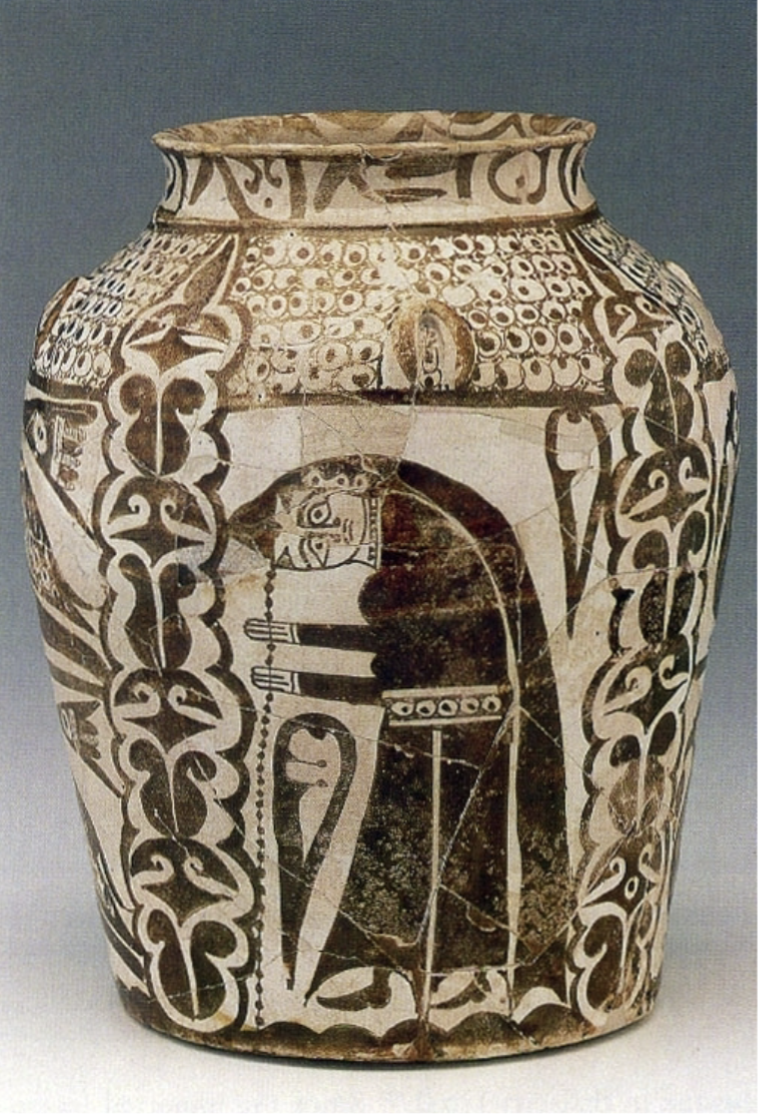
9th-century Abbasid ceramic jar from Iraq — Luster Glazed Jar with Peacock "Eye" Designs
Peacock eyes, the design on their tail feathers, were seen as being iridescent and possessing the sense of abu qalamun
Many designs evoke this natural abu qalamun found in animals, etc.
Sense of ajab— wonder which is desirable originating from something difficult to understand
This feeling was sought after in art and other parts of life

9th-century Abbasid — Blue and White Ceramic Bowls
Artists in Basra and other places used blue paint originating from Cobalt and put this over the thin white luster glaze in efforts to imitate Chinese porcelain styles
Many of these bowls had practical uses, being used in homes and restaurants
Blue and white were specifically a taste of Abbasid and Iraqi culture at the time
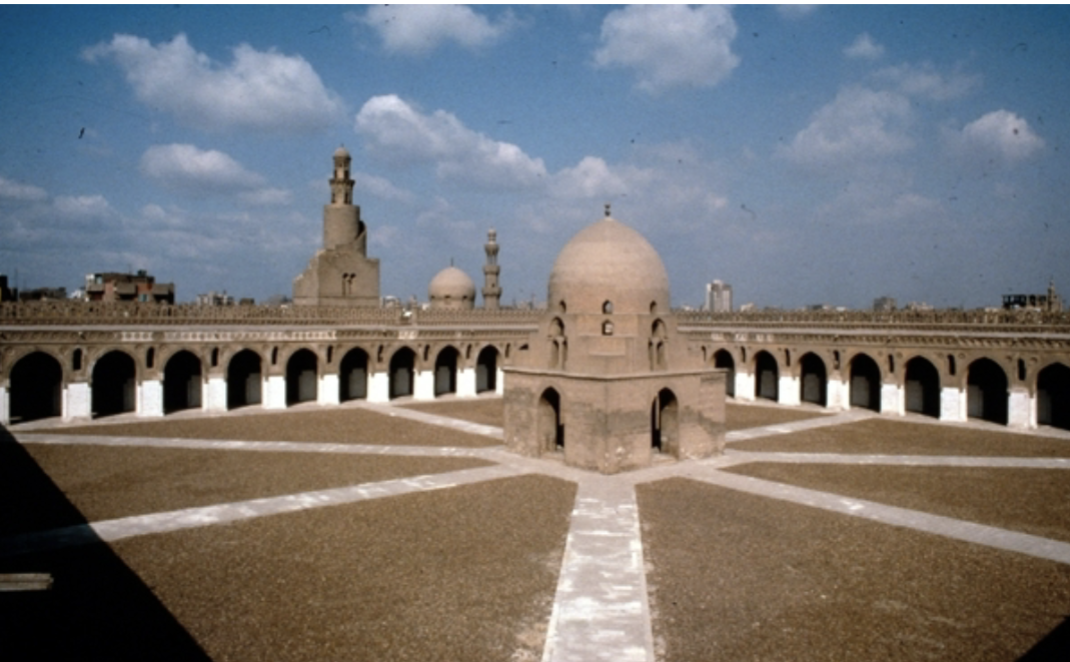
Mosque of Ibn Tulun
Tulunid mosque located in Cairo, built in 879 under the patronage of Ahmad Ibn Tulun (r. 868-84).
Spiral minaret is across from the mihrab, which is distinctly Abbasaid
Cairo at the time was ruled by “governors” appointed to rule under the name/power of the Abbasid empire
Ibn Tulun was a general, then became governor, before declaring the Tulunid dynasty’s independence from the Abbasids
Two layers of walls — religious charitable complex with the Mosque in the middle
The outer walls were not for protection, bur rather separated the secular parts of the city and the religious complex within — residences surrounded the complex
Hypostyle hall in brick and stucco which is atypical in Egypt (usually used stone in projects like the pyramids)
Stucco is inherently a Sasanian/Iraqi/Abbasid technique, displaying how this is still an Abbasid style mosque
Bevelled stucco designs on the walls and molding
Spiral minaret with 14th century reconstruction
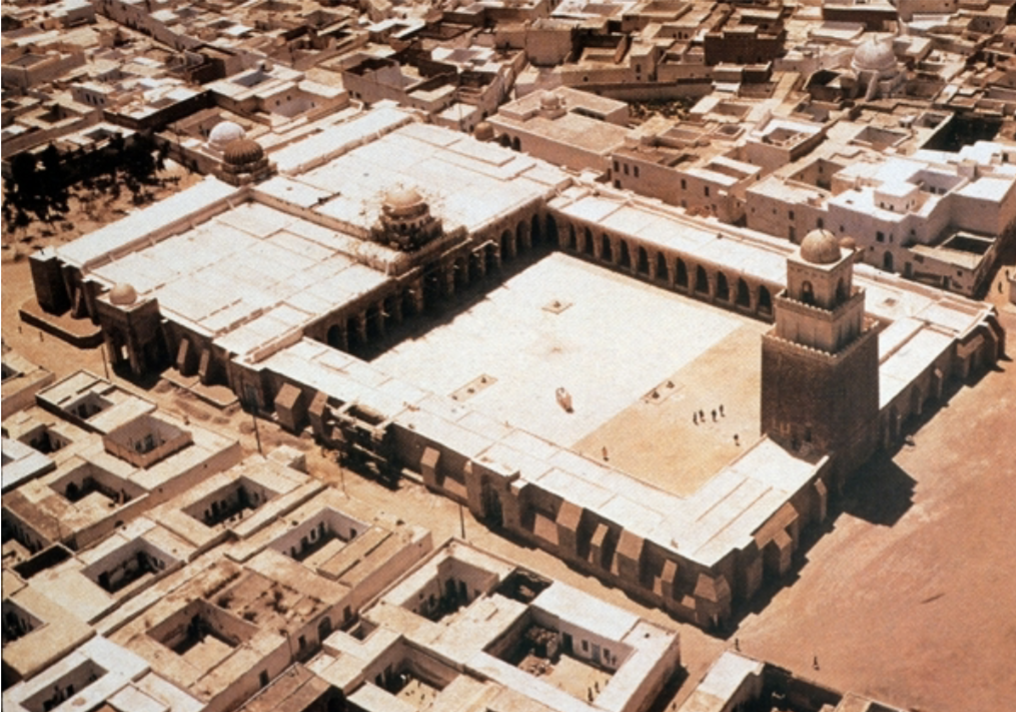
Great Mosque of Qayrawan
Aghlabid mosque in Qayrawan dated 836, 856-63, 875, commissioned by patron Ziyadat Allah I (r. 817-38) — Located in Tunisia
Hypostyle hall with brick and stucco, columns, and minaret facing the Mihrab
Growing professionalization of leading Mosques as the Caliph becomes less involved in religious affairs
Samarran designs in the Mihrab — lustre glazed ceramic tiles of which are attributed to Baghdad

Quran Page with Kufic Script (before 875)
Abbasid Quran page created before 875 under the patronage of Amajur, Governor of Damascus. — given to a Mosque, which is how we know it is from before 875
Qur’an was revealed in Arabic, making the two intertwined in the early oral tradition and into the first written collections of the Qur’an
Originally used parchment paper made from animal skin (like in this one) — moved to paper in 7-8th c.
Sign of wealth and elegance when used especially in this gifted Qur’an
Kufic script is thicker, more horizontal, less slanted compared to Hijazi script
This instance also has more curved lines and sharp edges
Red dots were used for reading, not to mark consonants
Kufic Qur’ans like these were much more difficult for people to understand and read — given prominently to royalty and religious figures, meaning they had the most access to it

Pages from a Quran with Cursive Script (dated 1000-1001)
Abbasid manuscript dated 1000-1001, written in Baghdad and attributed to Ibn al Bawwab.
Court cases in 940, between these scripts
Medallions — verse markers — got fancier as they could spend more due to lower costs with paper
Two theories at the time regarding the Qur’an
Qur’an is eternal like god, meaning it is not created by him and is similarly complex and difficult to understand like him
Means that the words in the Qur’an do not need to be understood by most people
Qur’an is a creation of God, meaning humans may observe it and rationalize it like nature
Supports making the Qur’an easier to understand for more people and making the text itself more legible
Ibn Muqla creates his system of proportions in 940 making proportions of each letter standardized
Leads to adapting the secular scripts into a standardized style, which then leads to the 6 canonical scripts
This style is more vertical, curvier, and more standardized with dots and lines to help people recognize vowels and other consonants
If you know the alphabet, then you can read the Qur’an after this standardization
Also with the wider use of paper, it became far more accessible for muslims
Attributed to Ibn al Bawwab — 60 years after the trials — works in Baghdad
Son of a doorkeeper, making this a less elitist profession and also reflecting a democratization of the Qur’an and the holy word of God
Chapter titles are highlighted in gold colors while Medallions decorate the different chapters and parts to the side of each section
More words to each page, making it more of a functional Qur’an rather than one to display wealth
Mosque components
mihrab - semicircular niche in the qibla wall where Muhammad used to lead prayer
minbar - high chair used by the Imam on friday prayers
Also meant to recognize Muhammad on the top seat, which remains empty
qibla wall - back wall which faces Mecca — “qibla” is a directional term referring to Mecca
minaret - tall towers —> only need one, but it is a sign of power if a person has more
Used in the call to prayer
maqsura - VIP area — more decorated area reserved for the ruler and his officials
hypostyle - stylus columns with the roof supported by these columns