ORGO 234 EXAM 1 MATERIAL
 Call Kai
 Learn
 Practice Test
 Spaced Repetition
 Match
 Flashcards
 Knowt Play
1/167

There's no tags or description
Looks like no tags are added yet.
168 Terms
aldehydes are more/less reactive than ketones? Why
more
Ketones are sterically hindered and have electron donating groups. They usually have two alkyl groups that donate e density into the carbonyl carbon, reducing it’s partial positive charge and making the molecule less reactive (weaker electrophile). Additionally, the steric hindrance limits the access to the already weak electrophilic site.
Why does the nucleophile attack the carbonyl carbon?
Due to dipole moment, a partial positive charge is place on the c
What kinds of forces do both ketones and aldehydes experience?
Van der Waals and dipole-dipole
In IR spect, how does a carbonyl present
a sharp strong stretch in the 1700 cm area
In IR spec, how does the aldehyde present
sharp+weak/moderate in the 2700-2800cm area
In IR spec, greater ring strain forces the carbonyl to present:
forces the stretching frequency to shift to higher wavelength
What is the typical IR spec observed in each of these:
Acyclic ketones
Cyclohexanone (6-membered ring)
Cyclopentanone (5-membered ring)
Cyclobutanone (4-membered ring)
Typically absorb around 1715 cm⁻¹.
Low ring strain; C=O stretch appears near 1715 cm⁻¹.
Moderate ring strain; C=O stretch shifts higher to about 1740-1750 cm⁻¹.
High ring strain; C=O stretch shifts further to about 1775-1780 cm⁻¹.
Conjugation ____ carbonyl IR stretching. Why? and to what is it lowered to?
lowers
Conjugation lowers infrared (IR) frequency because electron delocalization weakens the bond, reducing its strength and making it require less energy to vibrate.
The regular carbonyl stretching frequency decreases to around 1685 cm
In proton NMR, what are the chemical shifts for carbonyl alpha hydrogens and aldehyde protons
2-2.5 ppm adjacent to carbonyl
9-10 ppm directly attached to carbonyl
Where does the carbonyl carbon appear on the CNMR spectrum
190-215 ppm
Nomenclature for Aldehydes + cyclic aldehyde rules
replace parent chain with ‘-al’
name the ring, follow it with ‘carbaldehyde’
Aldehydes take priority over ketones if they’re both present
Also take priority over alcohols
Nomenclature for Ketones + cyclic ketones rules
Name parent chain or ring, replace ending with ‘-one’
give carbon bearing double bond oxygen lowest # possible
Carbonyl group of ketone is changed to ‘oxo’ if in the presence of an aldehyde
What does DBALH look like


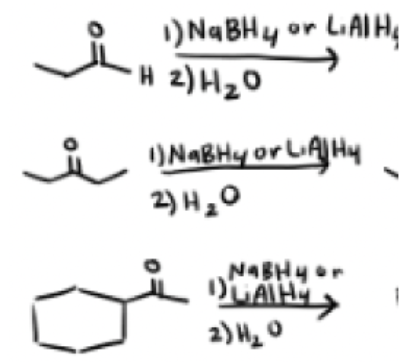


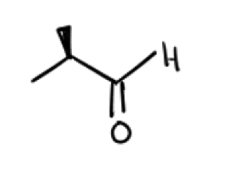


Why do alkyl halides behave as electrophiles while grignards and organocuprates behave as nucleophiles?
Alkyl Halide — halide is more electronegative than carbon, placing a partial negative charge on the halide
organometallic compounds — carbon is more electronegative, placing a partial positive charge on the element attached
Organocuprates are soft or hard nucleophiles?
Grignards are soft or hard nucleophiles?
Organocuprates are soft
Grignards are hard
What are the qualities of soft and hard nucleophiles
Soft Nucleophiles have low charge densities and behave like carbon-carbon/covalent bonds + they usually add once in a rxn (weak bases). More polarizable.
Hard Nucleophiles have high charge densities, behave like ionic bonds + add twice in a rxn (strong bases). Less polarizable.
What is the functional group range in a IR spec?
1500 - 4000 cm
Signals appearing in the 3000 cm area in IR spec indicate the presence of?
Sp3 hybridized carbons (carbons bonded to H), alkyl chains
Signals appearing in the 27-2800 cm area in IR spec indicate the presence of?
CH stretch, signals the carbon attached to the carbonyl
What is the rule for splitting patterns? Whats something to watch out in aldehydes?
n + 1 rule, where n is the # of hydrogens in the neighboring carbon
Sometimes the H in the aldehyde can appear as a singlet, however sometimes it is counted as a ‘neighbor’ to the alpha carbon and the signal for the alpha carbon might be different than expected
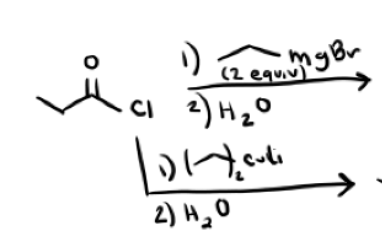


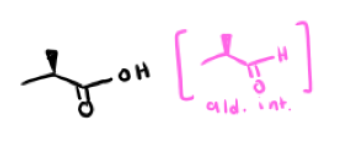
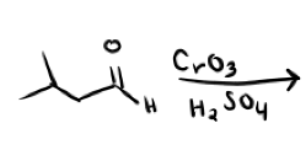


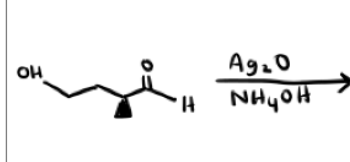

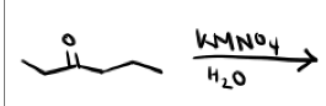


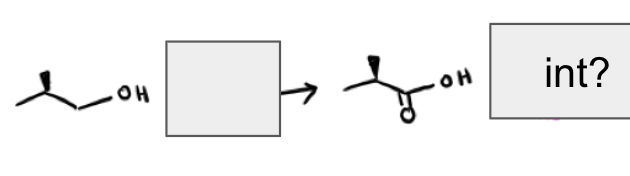
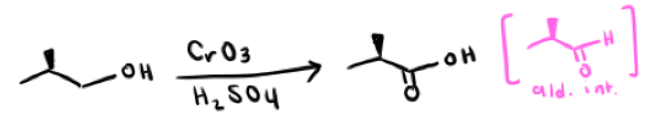
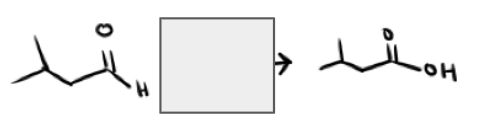


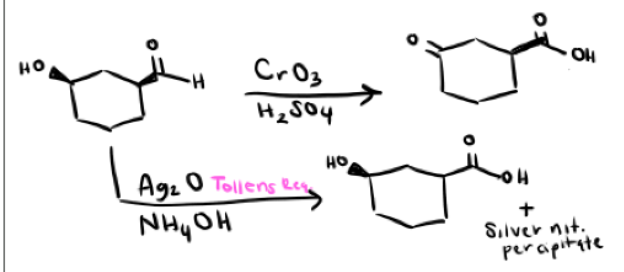


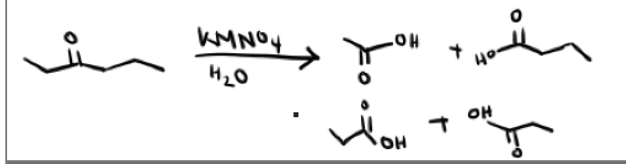


In the presence of acid, what will protonate first?
The carbonyl
What factors influence the yield of hydrate formation?
The sterics of the starting material —- produced more stable product
The EWG of the starting material — EWG pull electron density from the carbonyl, making the electrophilic site more reactive via the inductive effect.
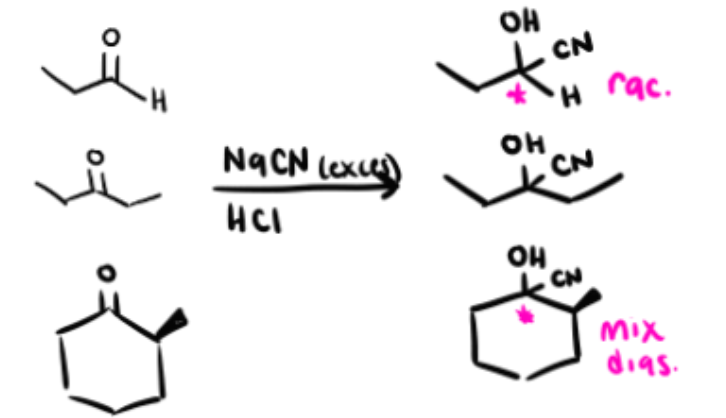
Why do we need excess NaCN and HCl?
Since CN is a good leaving group, no exess material would result in the collapse of the forming molecule and revertion back to the starting material.
____ add faster to carbonyls than weak nu (neutral)
Strong Nu
Electron Withdrawing Groups (EWG)
groups that withdraw electron density, they also make benzene rings less reactive/nucleophilic
Nitro (NO), carbonyl, cyano groups (CN), halogens
Electron Donating Groups (EDG)
atom that has a lone pair directly connected to a molecule, they activate benzene rings, making them more reactive/nucleophilic
Amino (NH2), hydroxyl (OH), Alkoxy (OCH3), and alkyl grorups
ignore





ignore
ignore








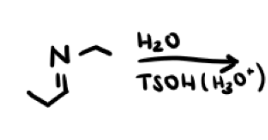

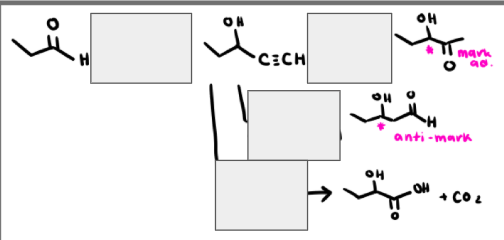


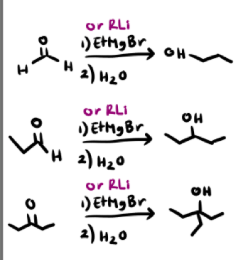


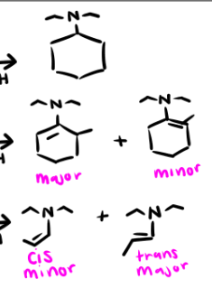


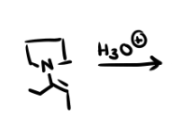
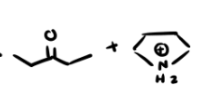

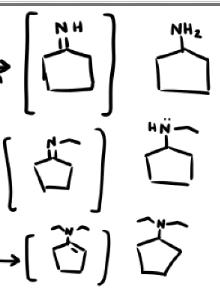
Why no reaction?
The amine needs to have at least one N-H bond to allow for the loss of a proton and dehydration + too much going on steric wise
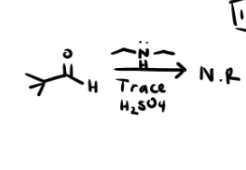
Why no reaction?
The mechanism requires the elimination of a hydrogen from the alpha carbon to create a double bond

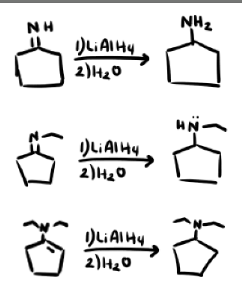
Imine or amine?
Imine

Imine or amine?
amine


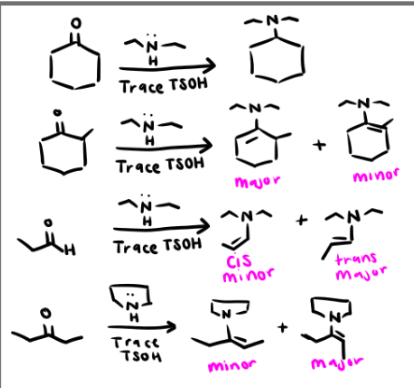

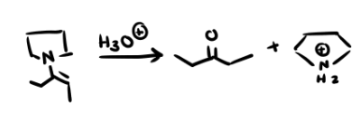


including intermediates