Oncogenes
 Call Kai
 Learn
 Practice Test
 Spaced Repetition
 Match
 Flashcards
 Knowt Play
1/24

There's no tags or description
Looks like no tags are added yet.
25 Terms
Transfection and tumors importance

injection of morphologically transformed cells into mouse hosts causes tumors
Proto-oncogenes traits
normal genes that can be mutational targets (activation)
targets of chemical carcinogens
highly conserved and expression tightly regulated
Proto-oncogenes in charge of
cell proliferation, differentiation or apoptosis
Nobel Prize 1989
awarded for discovery of cellular origin of retroviral oncogenes
discovery of oncogenes
1900s researchers linked cancers to nonbiological agents
1980s genome found to be rich source of genes that drive cancer cell proliferation
Nonbiological agents can induce cancer through their ability to transform cells
what proto-oncogene mutations are involved with cancer?
Gain of function mutations that produce dominant transforming oncogene
what happens when proto-oncogenes are mutated?
They become oncogenes

3 ways proto-oncogenes become activated to an oncogene
Point mutations
Chromosome rearrangements

Gene amplifications
Oncogene functions
regulate cell growth and differentiation
cell surface receptors
involved in signal transduction
DNA binding nuclear proteins
execution of mitogenic signals
Ras function
off when bound to GDP but when stimulated by growth factor it exchanges GDP for GTP, when mutated it is always on
Ras proto-oncogene to oncogene mutation
Point mutation inactivates intrinsic GTPase of RAS and prevents its interactions w/ GAPs (GAPS turn it off so it’s always on)
Ras mutated in 20-30% of cancer
Which codons are mutated in ras?
12, 13th, or 61st
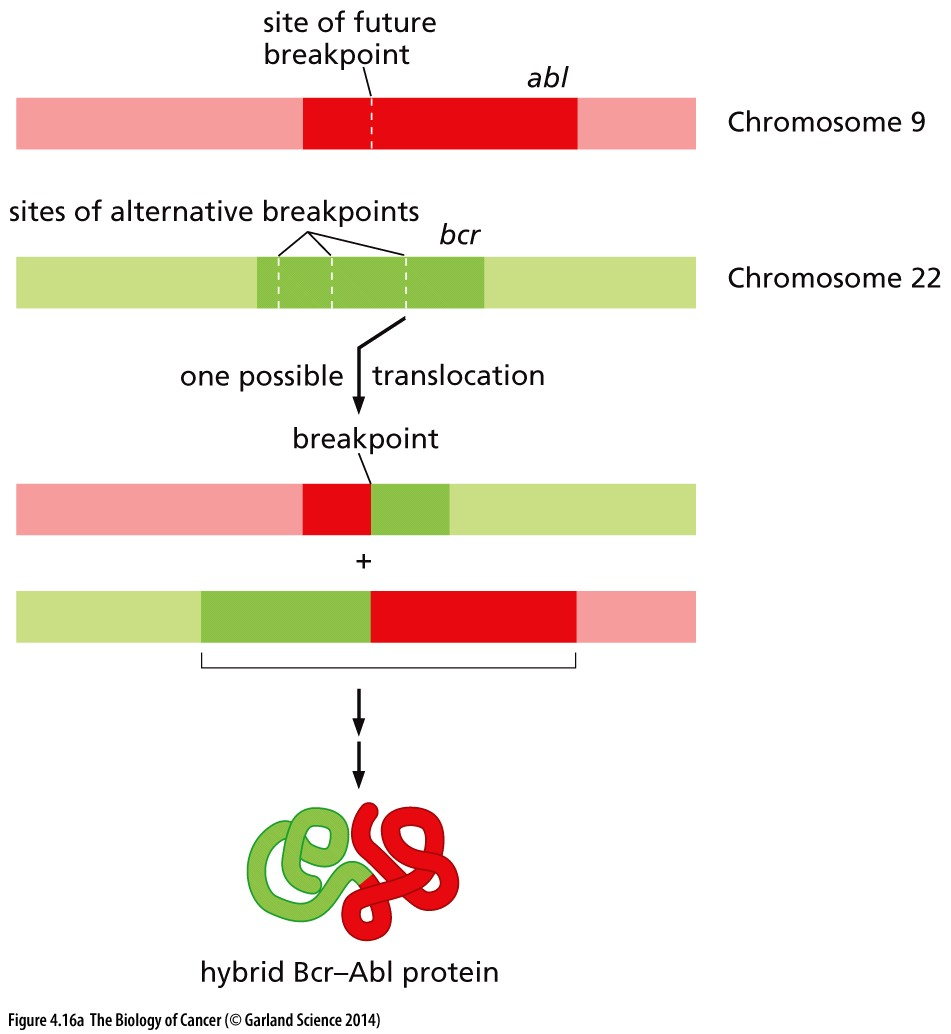
Chromosomal rearrangement myelogenous leukemia
translocation between 9 and 22 produces abnormal fusion protein that has part of proto-oncogene c-abl (tyrosine kinase) and bcr protein (serine/threonine kinase activity)
Chromosomal rearrangement Burkitt’s Lymphoma
overexpression of unaltered normal proto-oncogene
c-myc activated by chromosomal translocation where it is now under regulation of immunoglobulin promoter

Myc
oncogene initially discovered in genome of avian retrovirus
activated through 3 alternative mechanisms- provirus integration, gene amplification, chromosomal translocation
at high levels drives uncontrolled cell proliferation
CCND1/cyclin D1
oncogene amplification and overexpression involved in breast, lung, melanoma, oral squamos cell carcinomas
Cyclin D1 family
Cdks are catalytic subunits of heterodimeric serine threonine protein kinases involved in controlling cell cycle progression
ERBB2 gene
overexpression of it occurs in 15-30% of breast cancers
ERBB1 belongs to which family of oncogenes?
receptor tyrosine kinases
Important things
ERBB1/2
CDKs from CCND1
Myc
C-abl
bcr
DNA methylation
turns off gene
histone acetylation
acetylation activates
histone methylation
methyl group to arginines turns off
methyl group to lysines can turn off or on
histone phosphorylation
establishes other interactions w/ other histone modification
Achilles heal of cancer
•conditional expression of a Bcr-Abl fusion gene resulted in the development of leukemia that eventually killed all of the mice. Yet, when the expression of this gene was switched off, even at advanced stages of disease, the leukemic cells underwent rapid and extensive apoptosis and the mice survived