BIOL 220: CH. 27 - MALE REPRODUCTIVE SYSTEM
 Call Kai
 Learn
Learn Practice Test
 Spaced Repetition
 Match
Match Flashcards
 Knowt Play
1/134

There's no tags or description
Looks like no tags are added yet.
Name | Mastery | Learn | Test | Matching | Spaced | Call with Kai | Chat |
|---|
No analytics yet
Send a link to your students to track their progress
135 Terms
What is true about the development of sexes in the first 5-6 weeks of development?
During the first 5-6 weeks of development, the two sexes are indistinguishable, meaning that the external genitalia of both males and females appear very similar at this stage.
What role do androgens play in development?
Androgens are essential in the development and differentiation of male genitalia, influencing the formation of male-specific reproductive structures.
How is the development of external genitalia similar in males and females?
The external genitalia of both males and females develop similarly at first, but later diverge due to the influence of sex hormones.
What are homologs in terms of embryonic development?
Homologs are structures that develop from the same embryonic tissue, but differentiate into different organs based on sex and hormonal influence.
What is the homologous structure to the penis?
The penis is homologous to the clitoris, as both develop from the same embryonic structure but serve different functions.
What is the homologous structure to the scrotum?
The scrotum is homologous to the labia majora, as both originate from the same embryonic structure and later differentiate into different parts of the reproductive system.
What is Androgen Insensitivity Syndrome?
Androgen Insensitivity Syndrome (AIS) is a condition where an individual is genetically male (with XY chromosomes and male gonads) but has female-typical external genitalia due to a lack of response to testosterone.
What is the karyotype of a person with Androgen Insensitivity Syndrome?
A person with Androgen Insensitivity Syndrome has a karyotype of XY chromosomes, indicating a genetic male.
Where are the testes located in individuals with Androgen Insensitivity Syndrome?
In individuals with Androgen Insensitivity Syndrome, the testes are typically located in the abdomen, rather than in the scrotum.
Do individuals with Androgen Insensitivity Syndrome produce testosterone?
Yes, individuals with Androgen Insensitivity Syndrome produce normal male levels of testosterone, but their target cells lack the receptors to respond to it.
How does the lack of response to testosterone affect the development of external genitalia in Androgen Insensitivity Syndrome?
Due to the lack of receptors for testosterone, the external genitalia develop with female anatomy, as if no testosterone were present.
Do individuals with Androgen Insensitivity Syndrome have a uterus or menstruation?
No, individuals with Androgen Insensitivity Syndrome do not have a uterus, and they do not menstruate.
What is the scrotum made of?
The scrotum is made of skin, muscle, and connective tissue, and it houses the testes.
What is the function of the internal medial septum in the scrotum?
The internal medial septum divides the scrotum into two compartments and helps prevent the spread of infection between the testes.
What does the spermatic cord consist of?
The spermatic cord is a bundle of fibrous connective tissue that contains the vas deferens, blood vessels, and nerves, which support the testes.
What is the function of the vas deferens in the spermatic cord?
The vas deferens is a tube in the spermatic cord that carries sperm from the testes towards the urethra.
What role does the cremaster muscle play in the scrotum?
The cremaster muscle controls the position of the testicles by reflexively raising and lowering them in response to temperature changes or external stimuli.
Where does the spermatic cord pass?
The spermatic cord passes upwards towards the pelvic cavity, carrying important structures such as the vas deferens and blood vessels.
What is the inguinal canal?
The inguinal canal is a passage in the lower anterior abdominal wall through which the spermatic cord passes, connecting the scrotum to the pelvic cavity.
What are the testes?
The testes are reproductive organs that have both endocrine (hormone production) and exocrine (sperm production) functions.
What do the testes produce?
The testes produce hormones, such as testosterone, and sperm, which are essential for reproduction.
What is the function of connective tissue septa in the testes?
The connective tissue septa divide the testes into lobules, which are important for organizing the structures within the testes.
How many lobules are typically found in each testis?
Each testis contains around 250-300 lobules, which house the seminiferous tubules where sperm production occurs.
What are seminiferous tubules?
Seminiferous tubules are coiled structures within the lobules of the testes where sperm production (spermatogenesis) takes place.
What are nurse cells?
Nurse cells, also known as Sertoli cells, provide support, nourishment, and protection to the developing sperm cells.
What are spermatogonia cells?
Spermatogonia cells are the earliest germ cells in the testes that divide and give rise to sperm.
What is the blood-testis barrier?
The blood-testis barrier is formed by tight junctions of nurse cells, protecting the developing germ cells from the immune system and maintaining a favorable environment for sperm production.
What are interstitial cells (Leydig cells)?
Interstitial cells, or Leydig cells, are located between the seminiferous tubules and produce sex steroids, such as testosterone, which regulate male reproductive functions.
What is the role of the seminiferous tubules in the testes?
The seminiferous tubules are responsible for producing sperm, and they lead to the rete testis, where sperm begins its journey toward maturation.
What is the function of the rete testis?
The rete testis collects sperm from the seminiferous tubules and is involved in the partial maturation of sperm.
How do sperm travel through the male reproductive tract?
Sperm travel through a series of ducts, including the epididymis and vas deferens, after being collected in the rete testis.
What is the role of fluid from nurse cells in the testes?
The fluid produced by nurse cells supports sperm development and nourishes the sperm as they mature.
What is the function of cilia around the rete testis cells?
Cilia around the rete testis cells help move sperm through the rete testis and into the epididymis.
Do sperm swim in the male reproductive tract?
No, sperm do not swim in the male reproductive tract until they reach the epididymis, where they begin to gain motility.
What is the characteristic of the spermatic artery's blood pressure?
The spermatic artery has low blood pressure and no pulse, which helps maintain a stable environment for sperm production.
Why do sperm develop large mitochondria?
Sperm develop large mitochondria to combat hypoxia (low oxygen) in the testes and provide the energy needed for movement.
How does sperm move throughout the spermatic ducts?
Rete testis
Efferent ductules
Duct of epididymis
Vas deferens
Ejaculatory duct
What are the efferent ductules?
The efferent ductules are small tubes that carry sperm from the rete testis to the duct of the epididymis.
What is the duct of the epididymis responsible for?
The duct of the epididymis is responsible for storing and maturing sperm, allowing them to gain motility and the ability to fertilize an egg.
What happens to disintegrated non-ejaculated sperm?
Disintegrated non-ejaculated sperm are absorbed by the walls of the epididymis, which helps maintain the health of the sperm-producing system.
What is the vas deferens (ductus deferens)?
The vas deferens, also known as the ductus deferens, is a muscular tube that ascends in the spermatic cord, transporting mature sperm from the epididymis toward the urethra.
What is the role of the ejaculatory duct?
The ejaculatory duct passes through the prostate and empties sperm into the urethra, where it is mixed with seminal fluid during ejaculation.
What is the structure of the penis?
The penis is composed of both internal and external parts.
The internal part is the root, while the external part includes the shaft and glans.
What are the three tissue cylinders in the penis?
The three tissue cylinders in the penis are erectile tissues that fill with blood during an erection, causing the penis to become firm.
What are lacunae in the penis?
Lacunae are many small blood vessels within the erectile tissues of the penis that fill with blood during an erection.
What is the function of the corpus spongiosum in the penis?
The corpus spongiosum surrounds the urethra in the penis and forms the distal end, which becomes the glans penis.
What is the corpus cavernosum in the penis?
The corpus cavernosum consists of two columns of erectile tissue located on the left and right sides of the penis, above the corpus spongiosum and along the dorsal side.
What is the hypothalamo-pituitary-gonadal axis?
The hypothalamo-pituitary-gonadal axis is the system of hormonal control that regulates reproductive functions, involving the hypothalamus, pituitary gland, and gonads.
What is the role of GnRH in hormonal control?
GnRH (Gonadotropin-Releasing Hormone) stimulates the release of LH (Luteinizing Hormone) and FSH (Follicle-Stimulating Hormone) from the anterior pituitary gland.
What is the function of FSH in male reproductive physiology?
FSH stimulates nurse cells (Sertoli cells) in the testes to secrete androgen-binding protein (ABP), which is essential for spermatogenesis.
What is androgen-binding protein (ABP)?
ABP binds to and accumulates testosterone in the seminiferous tubules, which is important for maintaining high testosterone levels needed for sperm production.
What is the function of LH in male reproductive physiology?
LH stimulates Leydig cells in the testes to secrete testosterone, which plays a crucial role in promoting sperm production.
What is inhibin and what is its function?
Inhibin is a hormone secreted by nurse cells in the seminiferous tubules that suppresses the secretion of FSH from the pituitary gland, helping to regulate sperm production.
How does the feedback mechanism in hormonal control work?
The feedback mechanism regulates the secretion of hormones, where inhibin suppresses FSH release, and high testosterone levels suppress both GnRH and LH secretion, ensuring balanced reproductive function.
What is meiosis?
Meiosis is a type of cell division that reduces the chromosome number by half, producing four non-identical haploid cells, each with half the number of chromosomes as the original diploid cell.
What is the purpose of meiosis?
The purpose of meiosis is to produce gametes (sperm and eggs in animals) for sexual reproduction, ensuring genetic diversity and maintaining the stability of an organism's chromosome number across generations.
What are the two stages of meiosis?
Meiosis consists of two stages: meiosis I and meiosis II.
What happens during meiosis I?
During meiosis I, a diploid cell undergoes division to produce two haploid cells, each with a unique combination of chromosomes.
This stage includes processes like crossing over and independent assortment, which contribute to genetic diversity.
What occurs during meiosis II?
In meiosis II, the two haploid cells from meiosis I divide again, separating the sister chromatids of each chromosome, resulting in four haploid cells in total, which are genetically distinct.
What is spermatogenesis?
Spermatogenesis is the process of sperm formation, which occurs in the seminiferous tubules of the testes, producing about 400 million sperm per day.
Where are spermatogonia found?
Spermatogonia are located around the edges of the seminiferous tubules in the testes.
What happens during mitosis in spermatogenesis?
During mitosis in spermatogenesis, a spermatogonium divides into two cells, with one cell moving away from the edge of the tubule to begin the process of becoming a primary spermatocyte.
How does a spermatogonium develop into a primary spermatocyte?
A spermatogonium enlarges and moves toward the tubule lumen to become a primary spermatocyte.
What occurs during meiosis I in spermatogenesis?
During meiosis I, the primary spermatocyte divides into two haploid, genetically unique secondary spermatocytes.
What occurs during meiosis II in spermatogenesis?
During meiosis II, the secondary spermatocytes divide to form haploid spermatids.
What is spermiogenesis?
Spermiogenesis is the final stage of spermatogenesis, where spermatids mature into spermatozoa, developing a flagellum for mobility.
How long does it take for sperm to mature?
It takes about 70 days for sperm to mature through the process of spermatogenesis.
What is a spermatozoon?
A spermatozoon is a mature male reproductive cell, also known as a sperm cell, that is capable of fertilizing an egg.
What does the head of a spermatozoon contain?
The head of the spermatozoon contains the nucleus, which holds 23 chromosomes, making it haploid, and carries the genetic material to be passed on to the egg.
What is the function of the acrosome in a spermatozoon?
The acrosome is a lysosome that contains enzymes, which are crucial for the sperm to penetrate the egg during fertilization.
What is the role of the basal body of the flagellum in a spermatozoon?
The basal body of the flagellum anchors the flagellum to the sperm cell and helps in its movement, contributing to the sperm's motility.
What is the function of the tail of a spermatozoon?
The tail, also known as the flagellum, provides propulsion, allowing the spermatozoon to swim toward the egg.
What does the midpiece of the spermatozoon contain?
The midpiece of the spermatozoon is thick and contains many mitochondria, which produce ATP to fuel the sperm’s movement.
What is the principal piece of a spermatozoon?
The principal piece is the longest portion of the sperm's tail, contributing to its motility during its journey to the egg.
What is the function of the end piece of a spermatozoon?
The end piece is the final segment of the sperm's tail, helping it to maintain its movement as it reaches the egg.
What are the seminal vesicles and where are they located?
The seminal vesicles are accessory glands located behind the bladder.
They secrete fluid that contributes to semen formation, containing fructose, citrate, and calcium.
How does the secretion from the seminal vesicles affect semen?
The secretion from the seminal vesicles initiates semen formation and includes fructose and citrate for energy, calcium for sperm motility, and prostaglandins that cause uterine contractions.
What is the function of the prostate gland and where is it located?
The prostate gland surrounds the urethra and ejaculatory duct, located below the bladder.
It produces a milky secretion that activates sperm and helps buffer vaginal acidity.
What is the process involving proseminogelin and semenogelin in semen?
Proseminogelin is converted into semenogelin in the vaginal tract, which gives semen a sticky property that causes it to clot and stick.
This clotting is later broken down, liquefying the semen.
Where is the bulbourethral gland (Cowper’s gland) located?
The bulbourethral gland, or Cowper’s gland, is located below the prostate gland and before the urethra exits the body cavity.
What is the function of the pre-ejaculate produced by the bulbourethral gland?
The pre-ejaculate produced by the bulbourethral gland acts as a lubricant and an alkaline buffer, helping to neutralize the acidity of the urethra and providing lubrication during sexual activity.
The primary sex organs of the male are the _______.
testes
Anteriorly the perineum is bounded by which of the following?
Pubic symphysis
What is the pouch of skin, muscle, and fibrous connective tissue that contains the testes?
Scrotum
The perineal _______ is the external seam where the two halves of the scrotum are fused.
raphe
The complex of veins within the spermatic cord is the ______.
pampiniform plexus
Which organs produce gametes?
Primary sex organs
Maximal sperm production occurs when the testes are at what temperature?
35 degrees Celsius
What is the region between the thighs bordered by the coccyx, pubic symphysis, and ischial tuberosities called?
Perineum
Choose all that the testes produce.
Sperm
Testosterone
Which structure divides the scrotum into right and left compartments?
Median septum
Male germ cells receive nutrients and protection from the immune system from which cells?
Sustentocytes
The internal median septum is externally marked by a seam on the scrotum called what?
Perineal raphe
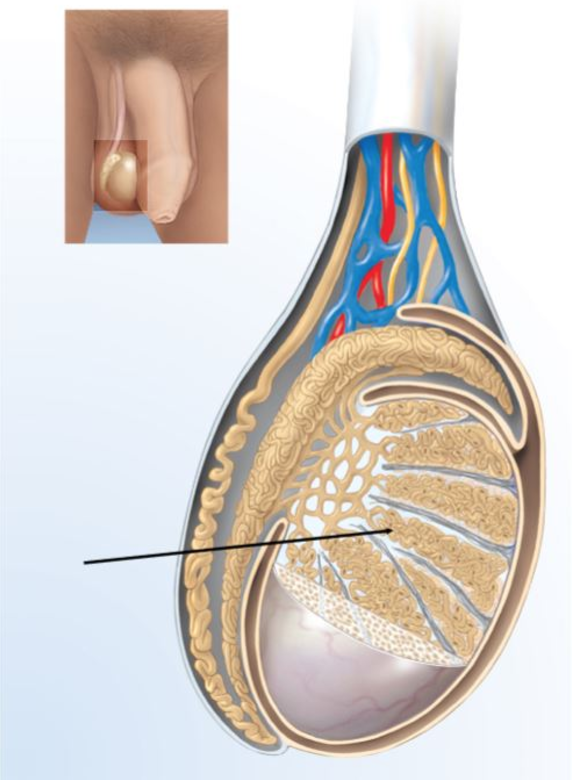
What is the tubular structure indicated in the figure?
Seminiferous tubule
The ductus deferens, cremaster muscle, pampiniform plexus, and testicular artery are located in the _____ cord.
spermatic
Which structures of some rete cells help to move sperm?
Cilia
True or False?
The maximal sperm production occurs when the testicular temperature is 37 degrees Celsius (98.6 degrees Fahrenheit).
False
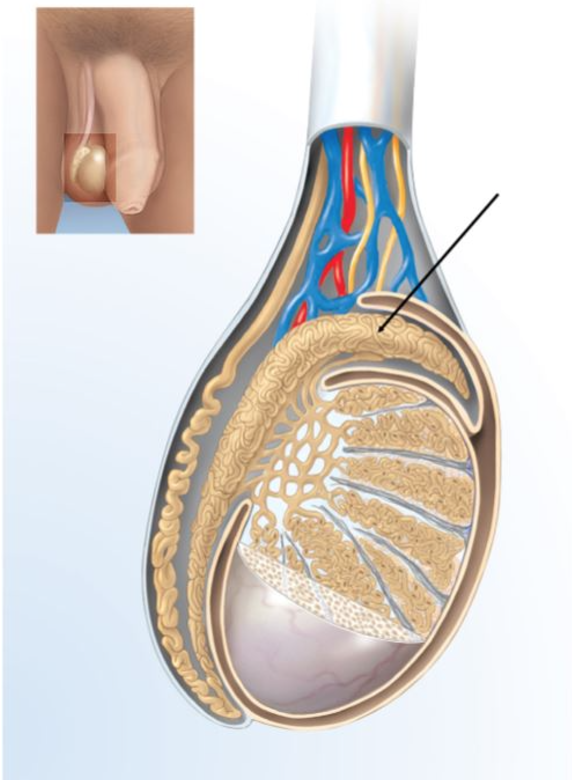
Which structure is indicated in the figure of a testis?
Epididymis
True or False?
Each testis is classified as both an endocrine and exocrine gland.
True
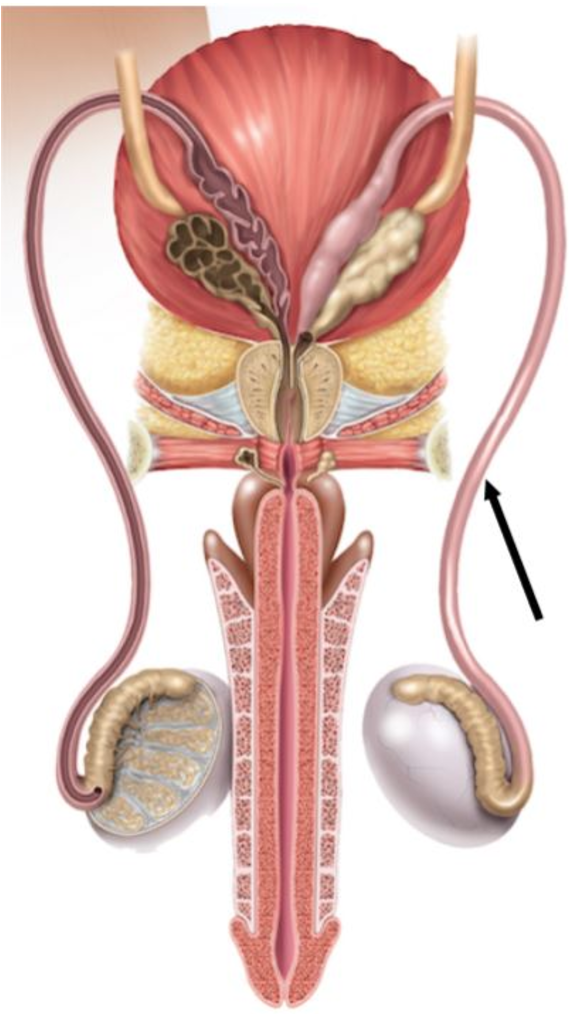
The ______ deferens is indicated in the figure.
ductus (vas)