Membrane Lipids
 Call Kai
 Learn
 Practice Test
 Spaced Repetition
 Match
 Flashcards
 Knowt Play
1/37

There's no tags or description
Looks like no tags are added yet.
38 Terms
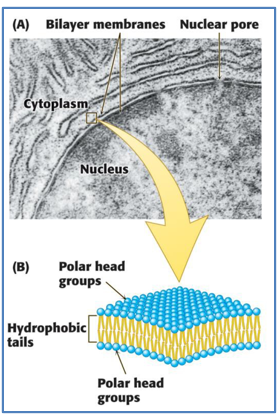
Which major biomolecule classes are found in biological cell membranes?
Phospholipids, proteins, and carbohydrates
Cholesterol is also a major membrane lipid in animal cells.
What does membrane compartmentalization mean?
What does selective transport mean as a membrane function?
How do membranes participate in cell signaling?
How do membranes support energy conversion?

What lipid shape tends to form a bilayer?
A roughly cylindrical amphipathic shape with two hydrophobic tails and a sizable polar head group
Amphipathic shape matters - bilayer-forming lipids have the correct head-to-tail balance

What is the structural difference between a micelle and a bilayer?
A micelle is a small aggregate with tails inward and no aqueous interior
A bilayer has two leaflets with tails facing each other and can close around an aqueous compartment
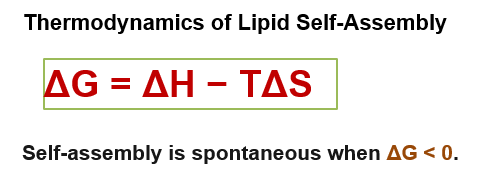
What determines spontenaiety in terms of lipid self-assembly?
Self-assembly is spontaneous when ΔG < 0
ΔH does not need to be negative - ΔG determines favorability
The entropy increase from releasing ordered water can make ΔG negative

Why do amphipathic lipids cluster?
Water drives the hydrophobic effect
Dispersed lipids expose their hydrophobic tails to water
Aggregation reduces nonpolar surface that’s in contact with water
Water gets release from ordered hydrates shells often increasing entropy

What are the two membrane-lipid backbones?
Glycerol and sphingosine
Glycerophospholipids use glycerol
Sphingomyelin uses sphingosine
Both are amphipathic, so they’re membrane-forming lipids

What key feature does sphingosine have that glycerol lacks?
Sphingosine contains a long hydrophobic hydrocarbon chain
Glycerol is a small three-carbon alcohol and contributes no hydrophobic chain by itself
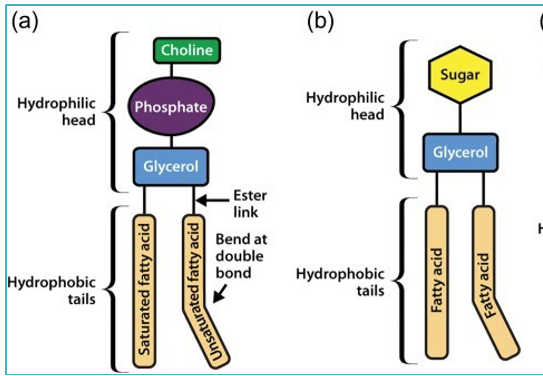
What determines the classification or identity of a glycerophospholipid?
Its glycerol backbone and phosphate are shared, but the alcohol or polar head group attached to the phosphate differs
Examples include ethanolamine, choline, serine, glycerol, and inositol-based groups.
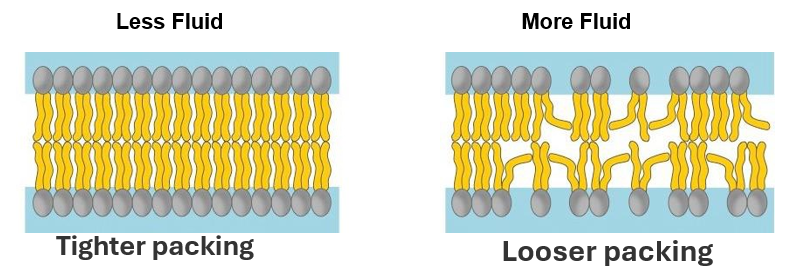
How does fatty-acid tail saturation affect membrane packing?
Saturated tails form extended zigzags that pack closely and strengthen dispersion interactions
Conversely, cis-unsaturated tails kink and disrupt close packing.

What does Tm describe?
The chain-melting transition temperature separates an ordered gel from a more fluid, liquid-crystalline bilayer
Below Tm: ordered gel
DPPC and DSPC
Above Tm: fluid bilayer
DOPC
Why do real cell membranes often lack one sharp melting point?

How does cholesterol affect a membrane at high temperature?
It restrains phospholipid movement, preventing the membrane from becoming excessively fluid
At low temperatures - it disrupts tight packing of tails, preventing crystallization/excessive rigidity
Why is cholesterol called a fluidity buffer?

What types of motion can membrane lipids make rapidly?
Lateral diffusion and rotation
Can exchange positions within the same leaflet quickly
Individual lipids can rotate about their long axis quickly

Why is spontaneous transverse diffusion (flip-flop) slow?
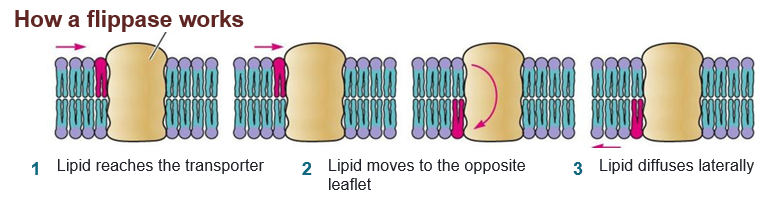
What does a flippase do?
It uses ATP-dependent transport to move selected lipids from the outer leaflet to the inner leaflet.
Lipid reaches the transporter → moves to the opposite leaflet → diffuses laterally

What does a floppase do?
It uses ATP-dependent transport to move selected lipids from the inner leaflet to the outer leaflet.
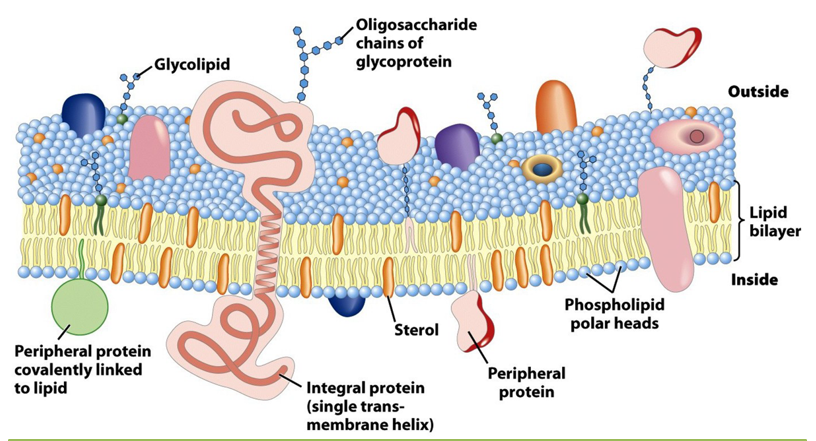
What is the fluid mosaic model of a cell membrane?
A dynamic lipid bilayer containing proteins and surface carbohydrates
Lipids and many proteins move laterally, making the membrane fluid rather than static.
What is membrane asymmetry?
The two leaflets have different lipid compositions, protein distributions, and exposed carbohydrate groups
A cell membrane as directionality
The two sides of a membrane are therefore not interchangeable.

Which side of the plasma membrane displays glycolipid and glycoprotein sugars?
The extracellular side

What is the usual direction of the membrane potential?
The cell interior is often negative relative to the outside.
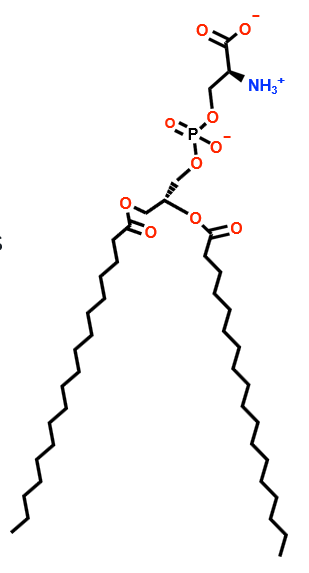
What happens to phosphatidylserine during apoptosis?
It transfers from the inner to the outer leaflet of the plasma membrane, changing the cell’s surface signal.

What is an integral membrane protein?
A protein embedded in the lipid bilayer
Many integral proteins span the entire membrane
Some associate strongly with only one leaflet.
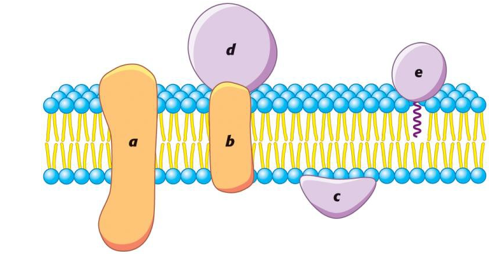
What is a peripheral membrane protein?
A protein that binds to the membrane surface through noncovalent interactions with lipids or other proteins
It does not enter the hydrophobic core
Give examples of membrane receptors.
Opsin detects light
Insulin receptor responds to hormones
Acetylcholine receptor responds to neurotransmitters
Taste/smell receptors can detect pheromones
Give examples of membrane proteins involved in transport.
Maltoporin facilitates nutrient uptake
K+ channels move ions
Serotonin reuptake proteins transport neurotransmitter
Give examples of membrane enzymes from the lecture.
Some acyltransferases participate in lipid biosynthesis
F0F1 ATPase/ATP synthase makes ATP

How can proteins associate with membrane surfaces without fully spanning the bilayer?
Noncovalent interactions with lipids or other proteins and partial insertion of hydrophobic regions can anchor them to the membrane.

What reaction does phospholipase C (PLC) catalyze?
PLC cleaves membrane PIP2 into two second messengers: IP3 and DAG
IP3: Triggers Ca2+ release from the ER
DAG: helps activate protein kinase C (PKC)

What does NADH oxidase do?
It catalyzes electron transfer from NADH to oxygen
Participates in cellular redox processes
Can generate reactive oxygen species

Why do transmembrane alpha helices contain many hydrophobic amino acids?
Their side chains contact the hydrophobic core of the lipid bilayer, so nonpolar residues are favorable there.
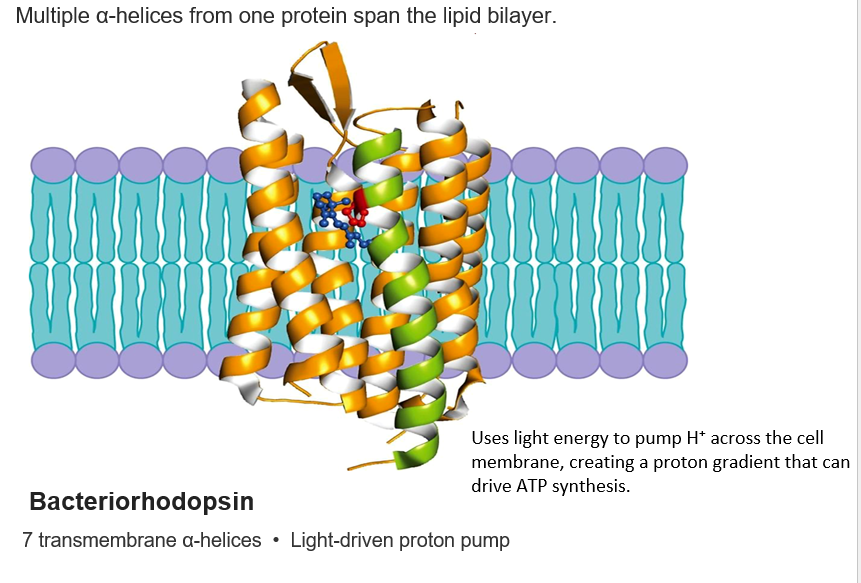
What is bacteriorhodopsin?
A protein with seven transmembrane alpha helices that uses light energy to pump H+ across the membrane
Creates a gradient that can drive ATP synthesis.
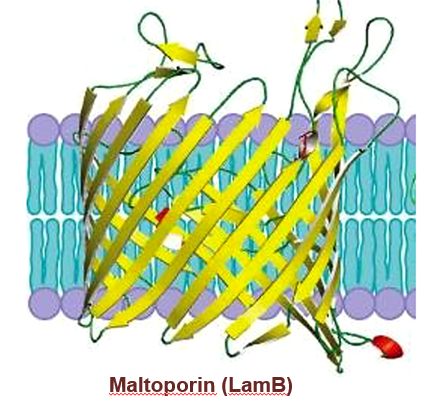
How can a beta barrel function as a membrane channel?
Beta strands form a cylindrical barrel with a selective pore through its center
The outer surface contacts membrane lipids, while the pore permits appropriate molecules to pass
What is maltoporin (LamB)?
A beta-barrel protein that forms a selective channel for maltose and maltodextrin uptake into the bacterial periplasm.