24.2 Competition
 Call Kai
 Learn
 Practice Test
 Spaced Repetition
 Match
 Flashcards
 Knowt Play
1/20

There's no tags or description
Looks like no tags are added yet.
21 Terms
What type of limiting factor is competition?
biotic factor
2 types of competition?
interspecific competition and intraspecific competition
Interspecific competition?
competition between different species
Intraspecific competition?
competition between members of the same species
What does interspecific competition - two or more different species competing for the same resource - result in?
a reduction of the resource available to both populations
Why will less food, due to interspecific competition, result in smaller populations than if only one of the species had been present?
less food means organisms will have less energy for growth and reproduction
When will a species be outcompeted?
if two species of organisms are competing for the same food source but one is better adapted, the less well adapted species is likely to be outcompeted
The competitive exclusion principle?
where two species are competing for limited resources, the one that uses the resources more effectively will ultimately eliminate the other
When was the grey squirrel, a native of North America, introduced into the wild in the UK?
1870s
What did the grey squirrels’ population quickly increasing in numbers in the UK result in?
the native red squirrel disappearing from many areas
Why did the introduction of the grey squirrel cause the population of red squirrels to decrease?
the grey squirrel can eat a wider range of food than the red squirrel and as it is larger it can store more fat (outcompetes)
Why does this cause the grey squirrels’ population to increase rapidly?
eat a wider range of food - increases its chances of survival and therefore its ability to reproduce thus increasing its population
Another impact of an increasing population of grey squirrels on the red squirrel population?
further reduces the food supply available to the red squirrels - reducing their ability to survive and reproduce
When does intraspecific competition occur?
when members of the same species compete for the same resource
Intraspecific competition: what does the availability of the resource determine?
the population size - the greater availability the larger the population that can be supported
Intraspecific competition: what does the availability of the resource determining the population size cause?
fluctuations in the number of organisms present in a particular population over time
A graph showing the effects of intraspecific competition over time?
…

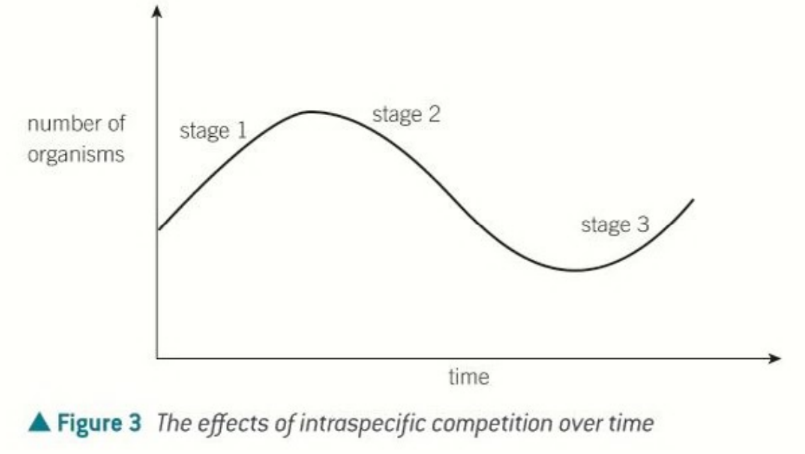
A graph showing the effects of intraspecific competition over time: stage 1 - what results in an increase in population size?
when a resource is plentiful in a habitat (such as food or space), all organisms have enough of the resource to survive and reproduce

A graph showing the effects of intraspecific competition over time: stage 2 - why does the population now decrease in size?
as a result of the increased population, there are many more individuals that share the food or space available, resources are now limited and there is not enough available for all organisms to survive

A graph showing the effects of intraspecific competition over time: stage 3 - what causes the population growth?
less competition exists as the smaller population means less organisms are competing for the same resources, this means more organisms survive and reproduce

A graph showing the effects of intraspecific competition over time: what then happens to this cycle of events?
it then repeats