International relations 121a
 Call Kai
 Learn
 Practice Test
 Spaced Repetition
 Match
 Flashcards
 Knowt Play
1/30

There's no tags or description
Looks like no tags are added yet.
31 Terms
Sovereignty: Define Sovereignty, with respect to internal and external.
Sovereignty is the ability of a country to make decision for it’s own country without external influence.
External: Refers to the international recognition (UN seat = soveignty, no UN = gray area)
Internal: Ability to make decisional, economical, political decison within their own border
Sovereignty: What are the grey areas?
Is an international union like the EU violating sovereignty?
(foreign aid, IMF bailouts, development assistance)
No. Because their autonomy resides in the ability to make independent decisions, and deciding the give away their decide
Yes. Following the definition of sovereignty, the loss of border control, of currency, of trade barriers, Common foreign and Security Policy, Acquis communautaire, Constitution for Europe, they are reducing their authority.
Is government assistance violating sovereignty?
(single currency, no border control, no trade barrier, common common policies)
No. Choice being at the core of the definition of sovereignty, making the decision to accept aid, is an action that can be defined as sovereign, and always holds to power to quit the assistance.\ (losing power = some benefits)
An increase in a ressources = increase stability = increase of legitimacy
From my perspective, sovereignty is the autonomy to make policies and control their country, receiving help does not affect their ability, yes it can put constraints but can also help them make choices now that they have more resources.
Sovereignty: What are some challenges in 2026, due to how interconnected we are (globalization) in defining sovereignty?
Global alliances
International groups like the EU give up independence = exchange, trade and security
Global problems
Climate change, pandemic, cybersecurity = rely on international cooperation
No control
Money, digital data, mass migration, global market, foreign tech companies, multinational corporation = can heavily impact local economy of government = no control
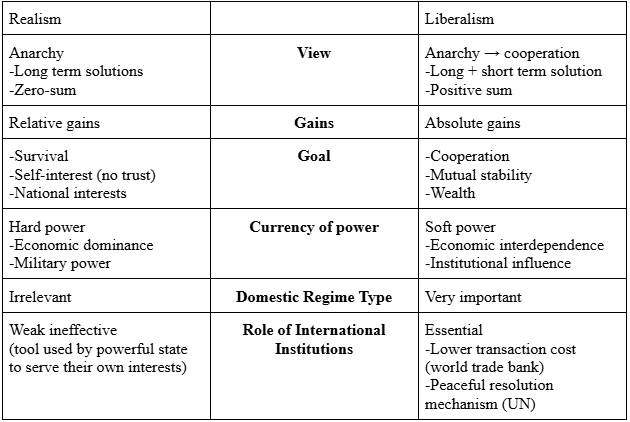
Grand Theories of IR: Define Realism and Liberalism
Realism is an international relations theory assuming that the global system is an anarchic, zero-sum arena where self-interested states must prioritize their own military power, security, and survival above all else.
Liberalism is an international relations theory assuming that global politics can be a positive-sum environment where democracy, economic interdependence, and international institutions foster lasting cooperation, trade, and peace.
Grand Theories of IR: What are the assumptions of Realism and Liberalism
Realism
Anarchy: No central world government exists to enforce rules.
State-Centric & Rational: Sovereign states are the main rational actors.
Survival & Power: Survival is the main goal, secured via military power.
Uncertainty & Self-Help: Trust is impossible, forcing states to rely on self-help.
Zero-Sum Dynamics: Relative gains matter most; one state's gain is another's loss.
Liberalism
Anarchy Managed: Anarchy exists, but institutions can regulate and mitigate it.
Diverse Actors: Non-state actors and international bodies shape global politics alongside states.
Positive-Sum Dynamics: Absolute gains matter most; states can achieve mutual win-win outcomes.
Economic Interdependence: Global trade raises conflict costs, making war highly inefficient.
Democracy & Institutions: Democracies and international organizations build trust to sustain lasting peace.
Grand Theories of IR: What are the similarities and differences of Realism and Liberalism?
Similarities:
-Anarchy
-Rational
-State as primary actor
Grand Theories of IR: Define security dilemma
The security dilemma is a structural paradox in an anarchic system where one state's defensive actions to increase its own security are perceived as threatful by other states, compelling them to respond in kind and ultimately leaving all participants less secure.
Grand Theories of IR: Define hegemony
Hegemony is the dominance of a single superpower that uses its overwhelming material capacity (military, economic, and institutional) to shape, enforce, and maintain the rules of the international system
Grand Theories of IR: Define zero-sum
A zero-sum dynamic assumes that international power and security are fixed resources, meaning any gain made by one state comes at the direct expense of another.
International Order: Define Hegemonic and Constitutional Order.
Hegemonic order is an international system organized and governed by a single dominant power that uses its supreme military, economic, and institutional strength to set, enforce, and maintain global rules.
Constitutional order is a system of global or regional governance based on agreed-upon, binding rules and institutions that limit the power of all states, including the most powerful, through mutual consent.
International Order: What are the similarities and differences of Hegemonic and Constitutional Order?
Similarities
-Both recognizes the presence of a hegemon
-Both want to maintain stability

International Order: What are the assumptions?
Hegemonic order:
-Hierarchical structure
-Power domination by the hegemon
-Self-interest (maintain power)
-Enforces though (coercion, carrots and sticks, ideological and appeal)
Constitutional order:
-Sovereign equality
-Legitimacy and reciprocity
International Order: In 2026, what is a relevant real life case of Hegemonic and Constitutional Order? Do we have a hegemon in the international system today?
Prisoner’s dilemma: Define Prisoner’s dilemma
Individually rational decisions produce a collectively sub-optimal outcome.
Prisoner’s dilemma: What is the outcome of a prisoner’s dilemma?
Mutual defection
Prisoner’s dilemma: Articulate why it is always defect, whatever the game is. Why countries reach this defection outcome?
Assumptions (trust issues, no communication)→ Influence Decision
Prisoner’s dilemma: What are the assumptions built into the game?
-2 players and 2 options (cooperate or defect)
-No communication
-Rationality (actors are rational = calculate cost and benefits maximize own self-interest)
-Defecting yields a higher payoff
-One-time decision (no past relationship and no future consequences = no trust)
Prisoner’s dilemma: What ways do states behave in that game?
Always defect: States choose to cheat or default to non-cooperation because it yields the safest or highest individual payoff regardless of the other's choice.
-Act rationally (selfish)
-Fall into a suboptimal outcome
Internal constitutions: What are the effects of international organizations?
IOs change who states are, not just what they do: IOs aren't just referees enforcing rules; they actually brainwash countries into changing their values and goals
Explain the socialization effect of IOs
-Promote democratization (become democracies)
-Promote economic liberalization ( trade (capitalism))
-Encourage members to adopt peaceful conflict management strategies
International constitutions: For international organizations how can they facilitate cooperation?
Alter the prisoner’s dilemma setup → Alter state behaviour
-Bringing diplomacy & mediation = allowing states to negotiate solutions
-Provide information (shared information and transparency = reduce uncertainty)
-Lower transaction costs
-Allowing enforcement = collective sanctions against defectors = cheating costly
-Reciprocity
-Create concerns for reputation
-Create issue linkages:connecting two or more distinct issues or policy areas into a single negotiation, agreement, or enforcement mechanism
Altering state behavior:
Reduced uncertainty = not hostile strategies → reliable long-term cooperation