Syringes & Needles -- Calculating Parenteral Medication Dosages (360)
 Call Kai
 Learn
Learn Practice Test
 Spaced Repetition
 Match
Match Flashcards
 Knowt Play
1/43

There's no tags or description
Looks like no tags are added yet.
Name | Mastery | Learn | Test | Matching | Spaced | Call with Kai | Chat |
|---|
No analytics yet
Send a link to your students to track their progress
44 Terms

Syringe parts and functions
Needle shaft — includes the bevel, a hollow cylinder of the needle, and the hub.
Barrel — is the body of the syringe. It holds the medication.
Calibration lines — these markings accurately measure medication doses.
Plunger — is a rubber-tipped cylinder that fills and empties the syringe.

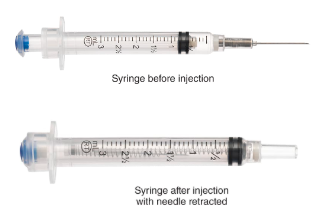
Retracting syringes
you push the plunger all the way in and the needle fully retracts into the syringe barrel
IM injection site for viscus medications
ventrolgluteal (dorsolguteal)
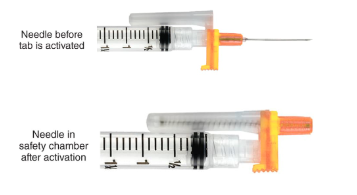
Retracting needle
the needle retracts into the safety chamber when pressed laterally
What are the increments of 20mL, 30 mL, 50 mL, 60 mL
DOUBLE CHECK INFORMATION ON CANVAS SLIDES OR BOOK
IVP (medications site)
Intravenous Push
Needles with shielding devices


What measurement do the longer lines denote? The shorter lines?
Longer lines are one tenths (0.1) and the smaller ones are one hundredths (0.01)
The lines in between are one five hundredths (0.05)

Small and large calibration lines on a 10 mL syringe represent…
large represent whole mL
small represent 0.2 mL

syringe cartridge
it is prefilled medication that needs a cartridge holder to administer to patient
(single dose)
Always double check is matches the correct ordered dose or administer only what has been ordered and you usually discard the rest

The dead space of a needle and syringe
The small amount of liquid or air that stays trapped in the needle hub, tip, and barrel after the plunger is fully pushed down
mL increments for 5 and 10 mL syringes
0.2 mL
pre-filled syringes
come from the manufacturer filled with medication
(single dose)
usually have 1 mL or 2 mL of extra space so that another compatible drug can be added to the medication in the syringe, if needed.
Parenteral routes
IM - Intradermal
IV - intravenous
ID - intradermal
SUBQ - subcutaneous
generally refers to injectable medications, although it also in includes inhalants, topical, eye drops, etc.

Needle gauge and length for Intradermal (ID) injections
Needle gauge: 26G−27G
Needle length: 21 in, 83 in
Needle gauge and length for standard Subcutaneous (SUBQ) injections
Needle gauge: 25G
Needle length: 85 in
Needle gauge and length for Subcutaneous (SUBQ) insulin injections
ORANGE CORED TOP ONLY
Needle gauge: 30G−31G
Needle length: 163 in, 165 in, 21 in
Needle gauge and length for Intramuscular (IM) injections
Needle gauge: 21G−23G
Needle length: 1 in, 121 in(2” in for deep IM) KP never uses 2” so it will be 1.5” or 1”
Needle gauge and length for IV medication preparation
Needle gauge: 18G−19G
Needle length: 1 in, 121 in
ISO standards for syringe manufacturing
Standards from the International Organization for Standardization establishing color-coding for needle hubs as well as syringe and needle packaging.
Safety rule regarding color-coded syringes and needles
Nurses should always double-check the syringe type, medication volume, and needle length and gauge rather than relying solely on packaging or hub colors.
Which syringes are calibrated in both milliliters and ounces.
20 mL
30 mL
40 mL
50 mL
Most commonly used for large volumes of IV medications
The nurse chooses needle length based on:
Route of administration
Injection site
Size of the patient
The nurse chooses the needle gauge based on:
Viscosity of the medication
Ease of withdrawing and administering the medication
Recommended needle gauge for the injection site
Recommended needle gauge for the route-
choose the smallest gauge for the comfort of the patient.
Ampule
glass container with a long narrow top that is snapped off to allow for withdrawal of medication.
(single dose)

A medication vile
a plastic or glass container that has a rubber stopper that is punctured for withdrawal of medication.
(single or multidose)

Measurement units for parenteral medication orders
Ordered by specific strength units to be administered, such as grams (gg), milligrams (mgmg), or micrograms (mcgmcg).
organization that accredits hospitals and healthcare organizations
The Joint Commission.
beyond-use date
last date a vile can be used after being opened
it is written on the drug label by the pharmacist or nurse who opens a multi-dose vial, once the vial cap is removed or the vial is punctured
The Joint Commission requirement for multi-dose vial discard after initial opening
Must be discarded within 28 days after first use, unless the manufacturer specifies a different timeframe.
Rationale for the 28-day discard timeframe on multi-dose vials
It is based on research regarding the length of time that the drug's sterility can be guaranteed.
Labeling requirements after opening a Multi-Dose Vial
Date and time
Nurse initials
beyond-use date
Organizations concerned with patient safety
Institute for Safe Medicine Practices (ISMP)
Centers for Disease Control and Prevention (CDC)
they recommend parenteral drugs be available in single dose containers in the recommended amounts
medication examples expressed in “UNITS” that pertains to the biological activity or potency of drugs
penicillin
heparin
Insulin
Standard unit of measurement for electrolytes such as potassium
Milliequivalents (mEq)
Conversion requirement for medication dosage calculations involving units or milliequivalents (mEq)
No conversion is needed because the ordered unit of measurement always matches the unit on the drug label.
Heparin
anticoagulant drug used to prevent blood clots. It is a high alert medication indicating an increased risk for patient harm
The National Patient Safety Goal, developed by the Joint Commission, addresses which standards regarding the administration of parental heparin
heparin is ONLY to be administered using prefilled syringes & premixed IV bags when available
Programmable infusion pumps are to be used when heparin is administered intravenously and continuously.
Baseline and ongoing laboratory tests are required for heparin and low molecular weight heparin therapies
(hospitals can have specific protocols such as having a second nurse double check doses and calculations
will you need to convert heparin doses?
No, All medication orders for heparin and all heparin labels measure heparin in units. No conversion of units will be needed.
ALWAYS VALIDATE THE CONCENTRATION OF HEPARIN
Class of anticoagulant drugs that must not be confused with standard heparin
Low molecular weight heparins (LMWHs)
Measurement unit used for ordering the LMWH drug dalteparin (Fragmin)
International units (IU)
Measurement unit used for ordering the LMWH drug enoxaparin (Lovenox)
Milligrams (mg)
How Low Molecular Weight Heparins (LMWHs) are commonly ordered
By their specific generic or trade name