Teas Cell Structure, Function, SE
 Call Kai
 Learn
 Practice Test
 Spaced Repetition
 Match
 Flashcards
 Knowt Play
1/61

There's no tags or description
Looks like no tags are added yet.
62 Terms

🧫 CELL THEORY
First: What is a cell?
Think of a cell as the smallest building block of life.
🏠 House → made of bricks
🧍 Living thing → made of cells
So:
CELL = basic building block of life
Cells are tiny, but they contain what they need to stay alive and do their jobs.

⭐ THE 3 RULES OF CELL THEORY
The easiest way to remember them is:
ALL → BASIC → FROM
1⃣ ALL living things are made of cells.
This means:
🌳 Plants → cells
🐶 Dogs → cells
🧑 Humans → cells
🦠 Bacteria → cells
Some living things have ONE cell, while others have TRILLIONS of cells.
🧠 Memory trick:
ALL = All living things have cells.
2⃣ CELLS are the basic unit of life.
This means the cell is the smallest unit that can be considered alive.
Think:
Cell = smallest piece of life
Your body has organs → organs have tissues → tissues have cells.
Cells are at the basic level of life.
🧠 Memory trick:
BASIC = Cell is the basic building block of life
3⃣ All cells come from pre-existing cells.
This means:
A cell comes from another cell.
It doesn't just randomly appear.
🧫 Cell → divides → 🧫 + 🧫
🧠 Memory trick:
FROM = Cells come FROM other cells.
🚨 THE TEAS MEMORY TRICK
Remember:
ALL → BASIC → FROM
Cell Theory | Super Easy Meaning |
|---|---|
ALL living things have cells | 🌱 Everything alive has cells |
Cells are the BASIC unit of life | 🧱 Cells = building blocks of life |
Cells come FROM other cells | ➗ Cell → new cells |
"ALL living things have cells. Cells are the BASIC unit of life. Cells come FROM other cells."
🔬 Robert Hooke
This part is usually easier:
Robert Hooke was looking at cork under a microscope.
He saw tiny little box-like spaces and called them "cells" because they reminded him of small rooms/cells.
🧠 Memory trick:
HOOKe → looked at cork → saw little "rooms" → called them CELLS.
You don't need to overcomplicate this.
🧠 FINAL 10-SECOND REVIEW
CELL = basic building block of life
Cell Theory = ALL → BASIC → FROM
ALL living things have cells.
BASIC = cells are the basic unit of life.
FROM = cells come from other cells.
"Which statement is part of cell theory?"
B. All living things are made of cells
🧫 PROKARYOTES vs EUKARYOTES
There are 2 major types of cells:
🦠 Prokaryotes🧑 Eukaryotes
The #1 thing to remember is:
PRO = NO nucleus
EU = HAS nucleus
That's your biggest TEAS memory trick.
🧠 THE BIG MEMORY TRICKPRO = NOEU = YOU
Think:
"PRO says NO nucleus." ❌
"EU = YOU have a nucleus." 🧑
If you remember PRO = NO, you'll already get a huge part of the question right.
🦠 1. PROKARYOTE =
NO NUCLEUS
Think:
PRO = "NO"
Prokaryotic cells DO NOT have a nucleus.
Their DNA is just sitting in the cell instead of being enclosed inside a nucleus.
Example:
🦠 Bacteria
Bacteria are prokaryotes.
🧑 2. EUKARYOTE =
HAS A NUCLEUS
Eukaryotic cells DO have a nucleus.
The nucleus is like a safe/office that holds the DNA.
Examples:
🧑 Humans
🐶 Animals
🌱 Plants
🍄 Fungi
All of these are eukaryotes.
🔬 NOW LET'S BREAK DOWN THE TABLE1⃣ SIZE
Prokaryotes = SMALL
About 0.2–2.0 µm
Eukaryotes = BIGGER
About 10–100 µm
So:
🦠 PRO = tiny
🧑 EU = bigger
🧠 Memory trick:
Pro = petite 🤏
Eukaryote = enormous-ish 😆
Don't worry about memorizing every number unless your TEAS prep specifically emphasizes them.
The important idea is:
Prokaryotes are smaller. Eukaryotes are larger.
2⃣ NUCLEUS ⭐⭐⭐
This is the MOST IMPORTANT difference.
🦠 Prokaryote
❌ No nucleus
DNA is in the cell, but not inside a nucleus.
🧑 Eukaryote
✅ Has a nucleus
DNA is protected inside the nucleus.
🧠 Remember:PRO = NOEU = HAS
3⃣ ORGANELLES
This one can sound confusing.
Prokaryotes:
They do NOT have membrane-bound organelles like:
❌ mitochondria
❌ nucleus
❌ ER
❌ Golgi apparatus
They DO have ribosomes, though.
⚠ So don't memorize "prokaryotes have zero organelles."
Instead:
Prokaryotes = no membrane-bound organelles.
Eukaryotes:
They have many organelles.
For example:
🧠 Nucleus
⚡ Mitochondria
📦 Golgi apparatus
🛤 Endoplasmic reticulum
4⃣ FLAGELLA
A flagellum is basically a structure that can help a cell move.
Think of it like a little tail. 🦠〰
Prokaryote flagella:
Simple
Eukaryote flagella:
More complex
For TEAS, the big idea is simply:
Prokaryote = simpler
Eukaryote = more complex
🧠 SUPER EASY COMPARISON
pro vs euk
🦠 PROKARYOTE | 🧑 EUKARYOTE | |
|---|---|---|
Nucleus | ❌ NO | ✅ YES |
Size | 🤏 Smaller | 📏 Larger |
Organelles | Few; no membrane-bound | Many |
Example | 🦠 Bacteria | 🧑 Humans, 🌱 plants |
Flagella | Simple | Complex |
🚨 THE TEAS TRICK
If you see:
"Which cell has NO nucleus?"
👉 PROKARYOTE
"Which cell has a true nucleus?"
👉 EUKARYOTE
"Which is usually smaller?"
👉 PROKARYOTE
"Which includes humans?"
👉 EUKARYOTE
"Which includes bacteria?"
👉 PROKARYOTE
Say this:
"PRO is small and has NO nucleus; EU is bigger and has a nucleus."
That's your TEAS cheat sentence. 🧠
Even shorter:PRO = NOEU = YOU HAVE ONE
And remember:
🦠 Bacteria = PROKARYOTE
🧑🌱🍄 Animals, plants, fungi = EUKARYOTE
🦠 Bacteria
are living organisms. ✅
That's actually a great TEAS connection:
🦠 Bacteria = living
🦠 Bacteria are made of cells
🦠 Bacteria are prokaryotes
🦠 Prokaryotes do NOT have a nucleus
🧠 Easy chain to remember:
BACTERIA → LIVING → CELL → PROKARYOTE → NO NUCLEUS
So if the TEAS asks, "Are bacteria living?" → ✅ YES!

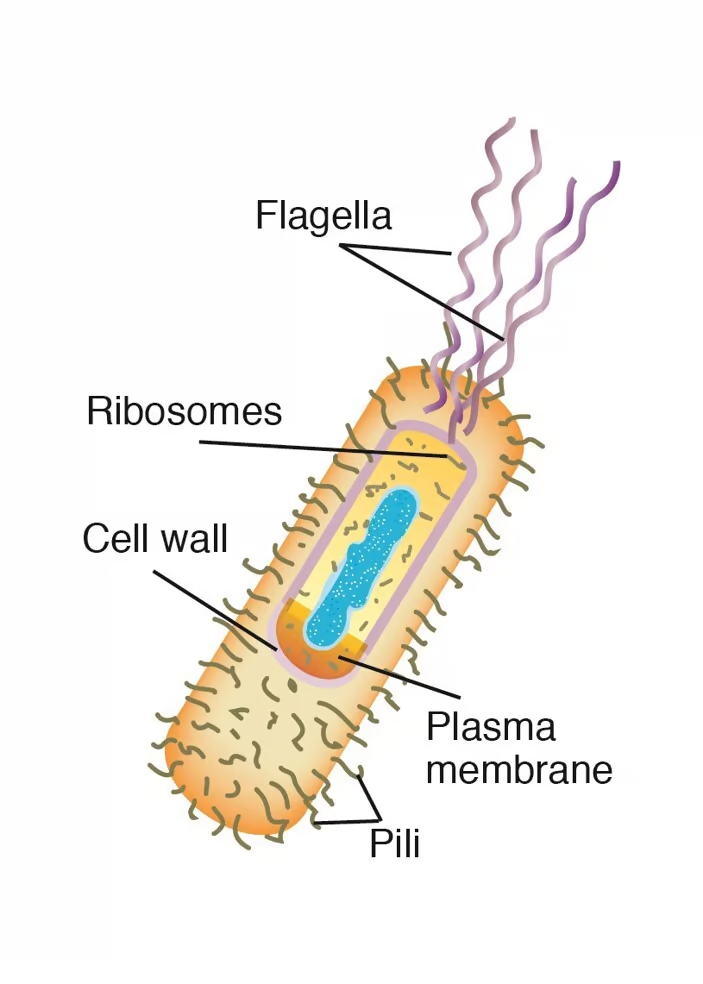
🦠 PROKARYOTIC CELL
small, simple cell + NO NUCLEUS
Its DNA is not inside a nucleus. The DNA is in the cytoplasm.
🧠 Imagine a BACTERIUM as a tiny little house
Each part has a simple job:
🟦 DNA = instructions
🟡 Plasma membrane = security door
🟧 Cell wall = strong outside protection
🟢 Ribosomes = protein makers
🟣 Flagella = tail → movement
🟤 Pili = little hairs → attachment
Let's break each one down.
🦠 PROKARYOTIC CELL
1-2
1⃣ DNA 🧬What is it?
DNA contains the instructions for the cell.
In a prokaryote:
❌ No nucleus
So the DNA is just located in the cytoplasm.
🧠 Memory trick:
PRO = NO nucleus → DNA has NO nuclear room.
2⃣ Plasma Membrane 🛡
The plasma membrane surrounds the inside of the cell.
Its main job is to control what enters and leaves the cell.
Think:
🚪 Plasma membrane = DOOR
It decides:
➡ what can come in
⬅ what can go out
🧠 Remember:
MEMBRANE = DOOR
🦠 PROKARYOTIC CELL
3-5
3⃣ Cell Wall 🧱
The cell wall gives the cell support and protection.
Think of it like a:
🧱 brick wall
🧠 Memory trick:
CELL WALL = WALL
Easy! 😂
4⃣ Ribosomes 🏭
Ribosomes make proteins.
Think of ribosomes as tiny:
🏭 PROTEIN FACTORIES
🧠 Memory trick:
RIBOSOME = protein maker
If the TEAS asks:
"What makes proteins?"
👉 Ribosomes ✅
5⃣ Flagellum 🏊
Look at the long tail-like structures in your picture.
Those are flagella.
Their job?
🏊 MOVEMENT!
They help the bacterium move/locomote.
🧠 Memory trick:FLAGELLA = FLY/MOVE
Think of the flagellum as a tail that helps the cell swim. 🦠💨
⚠ Flagellum = singular
⚠ Flagella = plural
🦠 PROKARYOTIC CELL
6-7
6⃣ Pili 🪢
Look at all the short hair-like structures around the outside.
Those are pili.
Their main job here:
🤝 HELP THE CELL ATTACH
They help bacteria stick/attach to surfaces or other cells.
🧠 Memory trick:PILI = PULL IN / PEEL?
Better one:
Pili = "PINS" the bacteria in place. 📌
Think:
🦠 → 📌
Pili = attachment
7⃣ Cytoplasm 🫧
The cytoplasm is the material inside the cell surrounding the DNA and ribosomes.
Think of it like:
🥣 the soup inside the cell
The DNA and ribosomes are sitting in it.
🧠 Remember:
CYTOPLASM = inside space

⭐ WHAT DOES THE WHOLE CELL LOOK LIKE?
prokaaryotic
🟣 Flagella
↓
~~~~~~~~~~~~~
/ \
| 🟢 Ribosomes |
| |
| 🧬 DNA |
| |
\______________/
🟤 Pili around
It's basically a tiny simple cell with:
🧬 DNA
🟢 Ribosomes
🫧 Cytoplasm
🚪 Plasma membrane
🧱 Cell wall
🟣 Flagella
🟤 Pili
🚨 ONE IMPORTANT CORRECTION
Your notes say:
"these cells lack organelles"
For TEAS, remember this more accurately as:
Prokaryotes lack membrane-bound organelles.
They DO have ribosomes.
So don't think:
❌ "Prokaryotes have absolutely zero structures."
Instead think:
✅ No nucleus
✅ No membrane-bound organelles
✅ DO have ribosomes
The two major groups of prokaryotes are:
🦠 BACTERIA + ARCHAEA
🦠 Bacteria🌋 Archaea
Both are prokaryotes.
And remember from your last question:
🦠 Bacteria = LIVING organisms
1⃣ UNICELLULAR
Uni = one
So:
UNICELLULAR = ONE CELL
Most prokaryotes are unicellular.
🦠 = one cell
🧠 Memory trick:
UNI = ONE
Like:
unicorn 🦄 → one horn
unicycle 🚲 → one wheel
unicellular → one cell
🔥 UNI = ONE
🎯 THE TEAS CHEAT SHEET
prokaryotic
Structure | Job | Memory Trick |
|---|---|---|
🧬 DNA | Instructions | 📝 Instructions |
🫧 Cytoplasm | Inside fluid/space | 🥣 Soup |
🚪 Plasma membrane | Controls entry/exit | 🚪 Door |
🧱 Cell wall | Support/protection | 🧱 Wall |
🟢 Ribosomes | Make proteins | 🏭 Factory |
🟣 Flagella | Movement | 🏊 Tail |
🟤 Pili | Attachment | 📌 Stick |
"DNA gives instructions, ribosomes make proteins, the membrane controls the door, the wall protects, flagella move, and pili stick."
That's basically the whole picture in one sentence.
And for the BIG TEAS idea:🦠 PROKARYOTE
NO NUCLEUS ❌
SMALL & SIMPLE
DNA in cytoplasm
NO membrane-bound organelles
RIBOSOMES ✅
Usually ONE CELL
🧠 Super-fast phrase:"PRO = NO nucleus, RIBOSOMES still GO!"
If you remember PRO = NO nucleus, flagella = move, pili = stick, and ribosomes = proteins, you're covering the most testable parts here.

🦠 NUCLEOID vs NUCLEUS
They are NOT the same thing.
🔵 NUCLEUS
A nucleus is a real structure surrounded by a membrane.
It holds the cell's DNA.
👉 Found in eukaryotes like:
🧑 Humans
🌱 Plants
🍄 Fungi
Think:
NUCLEUS = DNA has its own ROOM 🏠
🟡 NUCLEOID
A nucleoid is the area where a prokaryote's DNA is located.
But here's the important part:
❌ It does NOT have a membrane around it.
So bacteria have their DNA in a nucleoid, not a nucleus.
Think:
NUCLEOID = DNA has NO ROOM 🚫🏠
The DNA is just in a region of the cytoplasm.
🟡 Nucleoid | 🔵 Nucleus | |
|---|---|---|
Found in | 🦠 Prokaryotes | 🧑 Eukaryotes |
Contains DNA? | ✅ Yes | ✅ Yes |
Membrane around it? | ❌ NO | ✅ YES |
True nucleus? | ❌ No | ✅ Yes |
NUCLEOID = NO WALLNUCLEUS = HAS WALL
Or even easier:
🦠 Bacteria: DNA lives in the NUCLEOID.
🧑 Humans: DNA lives in the NUCLEUS.
"Here's the area where the DNA is located."
⭐ EUKARYOTE =
HAS A NUCLEUS
Remember our trick:
🦠 PRO = NO nucleus
🧑 EU = HAS nucleus
That's the biggest TEAS difference.
1⃣ NUCLEUS 🏠🧬
Eukaryotic cells have a membrane-bound nucleus.
That means the DNA is kept inside a protected structure called the nucleus.
Think:
🏠 Nucleus = DNA's private room
Inside the nucleus:
🧬 DNA
And the nucleus has a membrane around it.
🧠 Memory trick:
NUCLEUS = DNA HOUSE
2⃣ MEMBRANE-BOUND ORGANELLES 🏭
eukaryotic
Eukaryotic cells also have organelles surrounded by membranes.
Organelles are like tiny specialized departments inside the cell.
For example:
⚡ Mitochondria → make ATP/energy
🏭 Ribosomes → make proteins
📦 Golgi apparatus → modifies/packages materials
🛤 ER → helps make/transport materials
Think:
Eukaryotic cell = a big building with lots of little rooms, each doing a different job. 🏢
3⃣ THEY STILL HAVE THE BASIC CELL STUFF
Here's something important:
Eukaryotes also have:
✅ Cytoplasm
✅ Ribosomes
✅ Plasma membrane
So don't think these belong only to prokaryotes.
🧠 Easy way:
Both types have the basic stuff:
🫧 Cytoplasm
🟢 Ribosomes
🚪 Plasma membrane
But eukaryotes have the extra organized compartments.
4⃣ UNICELLULAR OR MULTICELLULAR
Eukaryotes can be:
🦠 UNICELLULAR
One cell
OR
🧑 MULTICELLULAR
Many cells
Examples:
🍞 Some fungi/yeasts → can be unicellular
🍄 Many fungi → multicellular
🧑 Humans → multicellular
🌱 Plants → multicellular
🧠 Memory trick:
UNI = ONE
MULTI = MANY
Easy! 🔥
5⃣ EUKARYOTES ARE BIGGER 📏
Compared with prokaryotes:
🦠 Prokaryotes = smaller
🧑 Eukaryotes = larger
Think:
PRO = tiny/simple
EU = bigger/organized
🧠 PRO vs EU — THE BIG TEAS COMPARISON
🦠 PROKARYOTE | 🧑 EUKARYOTE | |
|---|---|---|
Nucleus | ❌ NO | ✅ YES |
DNA location | Nucleoid | Nucleus |
Size | Smaller | Larger |
Membrane-bound organelles | ❌ NO | ✅ YES |
Ribosomes | ✅ YES | ✅ YES |
Cytoplasm | ✅ YES | ✅ YES |
Plasma membrane | ✅ YES | ✅ YES |
Usually | Unicellular | Uni or multicellular |
Examples | Bacteria, Archaea | Humans, plants, fungi |
🚨 THE #1 TEAS TRICK
If the question asks:
"Which cell has a membrane-bound nucleus?"
👉 EUKARYOTE ✅
"Which cell has membrane-bound organelles?"
👉 EUKARYOTE ✅
"Which cell does NOT have a nucleus?"
👉 PROKARYOTE ✅
"Which has a nucleoid?"
👉 PROKARYOTE ✅
"Which includes humans?"
👉 EUKARYOTE ✅
🔥 YOUR SUPER FAST MEMORY TRICK
pro vs euk
PRO = NO
🦠 No nucleus
Small
Simple
EU = YOU
🧑 You have a nucleus
Larger
More organized
Membrane-bound organelles
Say this:
"PRO has NO nucleus. EU has YOU's nucleus."
😂 It sounds silly, but that's exactly why it's easier to remember.
🎯 10-SECOND TEAS REVIEW🦠 PROKARYOTE
NO nucleus ❌
DNA = nucleoid
Small/simple
No membrane-bound organelles
Usually one cell
🧑 EUKARYOTE
HAS nucleus ✅
DNA = nucleus
Larger/more complex
Has membrane-bound organelles
Can be one cell OR many cells
⭐ The biggest thing to memorize:PRO = NOEU = HAS
🧫 What does "membrane-bound organelle" mean?
Membrane-bound = surrounded by a membraneOrganelle = a small structure inside a cell that has a specific job
So:
⭐ Membrane-bound organelle = a cell structure that has its own membrane around it.
Think of it like little rooms inside a house. 🏠
🏠 EUKARYOTIC CELL = BIG HOUSE
Inside the house are different rooms:
🚪 Nucleus → room that stores DNA
⚡ Mitochondria → makes energy
📦 Golgi apparatus → packages things
🛤 Endoplasmic reticulum → helps make/move things
Each room is separated from the rest by a membrane.
That's why they're called membrane-bound organelles.
Think:
MEMBRANE = WALL 🚧
So:
Membrane-bound organelle = organelle with a WALL around it.
Eukaryotes have separate "rooms" inside the cell. Those rooms are membrane-bound organelles.
And remember:
EU = ROOMS 🏠PRO = NO ROOMS 🚫🏠
That's really all "membrane-bound organelles" means.
🧫 What does "membrane-bound organelle" mean?
eukaryotic pt.2
📦 Golgi apparatus
✅ Membrane-bound organelle
It has a membrane surrounding it.
🟢 Ribosome
❌ NOT membrane-bound
Ribosomes do NOT have a membrane around them.
But ribosomes are still found in both prokaryotic and eukaryotic cells.
🧠 Easy way to remember:
"Golgi has a WALL, ribosome does NOT."
Structure | Membrane-bound? |
|---|---|
🏠 Nucleus | ✅ Yes |
📦 Golgi apparatus | ✅ Yes |
⚡ Mitochondria | ✅ Yes |
🛤 Endoplasmic reticulum | ✅ Yes |
🟢 Ribosome | ❌ No |
⭐ TEAS rule:
Eukaryotes have membrane-bound organelles, BUT not every structure in a eukaryotic cell is membrane-bound.


🧫 ANIMAL CELL =
A TINY CITY
Think of the cell like a little city where everyone has a job.
🚪 Cell membrane = SECURITY GATE
🏠 Nucleus = BRAIN / CONTROL CENTER⚡ Mitochondria = POWER PLANT
🏭 Ribosomes = PROTEIN FACTORIES
🚚 ER = HIGHWAY📦
Golgi = PACKAGING & SHIPPING CENTER🗑 Lysosomes = GARBAGE/RECYCLING💧
Vacuoles = STORAGE
If you memorize those 8 jobs, you're already in great shape. 🔥

1⃣ CELL MEMBRANE 🚪
animal cell picture
animal cell and human works
What is it?
The cell membrane is the outer boundary of the cell.
It separates:
INSIDE ↔ OUTSIDE
It controls what comes in and out.
🧠 Memory trick:MEMBRANE = SECURITY DOOR 🚪
It says:
"You can come in... you can't come in..." 😂
It's selectively permeable, meaning it allows some things through but not everything.
TEAS:
What controls what enters and leaves the cell?
👉 Cell membrane ✅
2⃣ NUCLEUS 🏠🧬
The nucleus contains the cell's:
🧬 DNA
It has a membrane around it, so it's a membrane-bound organelle.
Think of it as the cell's:
🧠 CONTROL CENTER
The DNA contains instructions for the cell.
Inside the nucleus is the:🔵 Nucleolus
The nucleolus helps make the parts needed to build ribosomes.
🧠 Memory:
NUCLEUS = DNA
NUCLEOLUS = helps make RIBOSOMES
Don't mix those two up!
3⃣ MITOCHONDRIA ⚡
animal cell and human
Mitochondria produce much of the cell's:
⚡ ATP
ATP is a major form of usable energy for cells.
Think:
⚡ MITOCHONDRIA = POWERHOUSE
🏭 → ⚡
🧠 Memory trick:
MITO = MOTOR
Think of mitochondria as the motor that powers the cell.
TEAS:
Which organelle produces ATP?
👉 Mitochondria ✅
4⃣ RIBOSOMES 🏭
Ribosomes make:
🧬➡🥩 PROTEINS
They're basically tiny protein factories.
They can be:
🟢 floating in the cytoplasm
OR
🟢 attached to the rough ER
🚨 Remember:
Ribosomes are NOT membrane-bound.
🧠 Memory:RIBOSOME = PROTEIN FACTORY 🏭
If you see:
"protein synthesis"
Think:
👉 RIBOSOME
animal cell and human
5⃣ VACUOLES 📦💧
Vacuoles are basically:
📦 STORAGE BAGS
They can store:
💧 Water
🍎 Food/materials
🗑 Waste
🧠 Memory:
VACUOLE = VACUUM BAG
It holds/stores stuff.
6⃣ ENDOPLASMIC RETICULUM (ER) 🚚🛣
This name looks terrifying. 😂
Just call it:
ER = CELL HIGHWAY
It helps move materials around the cell.
There are TWO types:
🟢 Rough ER
Has:
🟢 Ribosomes
So:
ROUGH = RIBOSOMES
🔵 Smooth ER
Has:
❌ No ribosomes
So:
SMOOTH = NO RIBOSOMES
🧠 SUPER EASY:ROUGH = BUMPSSMOOTH = NO BUMPS
The "bumps" are ribosomes.
7⃣ LYSOSOMES 🗑♻
animal and human cells
Lysosomes contain digestive enzymes.
Their job is to:
🗑 Break down waste
♻ Break down old/damaged cell parts
🍎 Help break down materials
Think:
LYSOSOME = CELL CLEANUP CREW🧠 Memory trick:
LYSOSOME = "LYSOS" → "LIQUIDATE THE JUNK"
Not a scientific definition — just a memory trick.
TEAS:
Which organelle breaks down waste and old organelles?
👉 Lysosome ✅
8⃣ GOLGI APPARATUS 📦📬
animal and human
The Golgi receives materials, especially proteins, from the ER.
Then it:
Modifies them
Packages them
Ships them where they need to go
Think:
📦 GOLGI = AMAZON SHIPPING CENTER 😂
ER 🚚 → GOLGI 📦 → 🚚 destination
🧠 Memory:GOLGI = MODIFY → PACKAGE → SHIP
🔥 THE WHOLE CELL IN ONE STORY
Imagine a protein being made:
eukarytoitc
Step 1:
🟢 Ribosome makes the protein.
Step 2:
🚚 Rough ER helps move it.
Step 3:
📦 Golgi apparatus modifies and packages it.
Step 4:
📬 The packaged material gets sent where it needs to go.
That's the basic pathway.
🧠 YOUR ANIMAL CELL CHEAT SHEET
Organelle | MAIN JOB | MEMORY |
|---|---|---|
🚪 Cell membrane | Controls what enters/leaves | DOOR |
🧬 Nucleus | Stores DNA | CONTROL CENTER |
⚡ Mitochondria | Makes ATP/energy | POWERHOUSE |
🏭 Ribosomes | Make proteins | FACTORY |
📦 Vacuoles | Store materials/waste | STORAGE |
🚚 ER | Transports materials | HIGHWAY |
🗑 Lysosomes | Break down waste/old parts | CLEANUP |
📦 Golgi | Modifies, packages, ships | SHIPPING |
🔥 FINAL MEMORY STORY
Picture a tiny city:
🚪 MEMBRANE = security gate
🧠 NUCLEUS = boss/control center
⚡ MITOCHONDRIA = power plant
🏭 RIBOSOMES = protein factories
🚚 ER = highways
📦 GOLGI = shipping center
🗑 LYSOSOMES = cleanup crew
📦 VACUOLES = storage
If you can remember the city, you can remember the organelles. 🧠🔥
Most important TEAS pairs:
Mitochondria → ATP ⚡
Ribosome → Protein 🏭
Nucleus → DNA 🧬
Lysosome → Break down 🗑
Golgi → Package/ship 📦
ER → Transport 🚚
Membrane → Controls entry/exit 🚪
"What controls what enters and leaves?"
👉 Cell membrane
"Where is DNA stored?"
euk
👉 Nucleus
"What produces ATP?"
👉 Mitochondria
"What makes proteins?"
👉 Ribosomes
"What stores materials?"
👉 Vacuole
"What transports materials?"
👉 Endoplasmic reticulum
"What breaks down waste and old organelles?"
👉 Lysosome
"What modifies, packages, and ships proteins?"
👉 Golgi apparatus
🌱 Example: Plant vs 🧑 Human
Both have:
🧬 Nucleus
⚡ Mitochondria
🏭 Ribosomes
🚚 ER
📦 Golgi
🫧 Cell membrane
But plants ALSO have:
🌞 Chloroplasts → photosynthesis
🧱 Cell wall → support
💧 Large central vacuole → storage
Humans don't have chloroplasts or cell walls.
UKARYOTE = nucleus + membrane-bound organelles
Then ask:
"What kind of eukaryote?"
🧑 Animal → animal-cell structures
🌱 Plant → plant-specific structures
🍄 Fungi → fungal-specific features
Human cells have a
cell membrane, but no cell wall.
🧠 Easy comparison:
🧑 Human/animal cells
🚪 Cell membrane ✅
🧱 Cell wall ❌
🌱 Plant cells
🚪 Cell membrane ✅
🧱 Cell wall ✅
🦠 Bacteria
🚪 Cell membrane ✅
🧱 Cell wall ✅
🔥 TEAS memory trick:
ANIMALS = NO WALL 🐶🧑
PLANTS = WALL 🌱🧱
So don't confuse the cell membrane with the cell wall:
Membrane = controls what enters/leaves 🚪
Wall = extra support/protection 🧱
Human cells do NOT have a cell wall. ✅
Which two organelles work together to facilitate protein synthesis?
Ribosome and endoplasmic reticulum
After a protein is synthesized by ribosomes, it is shuttled to the endoplasmic reticulum, where it is further modified and prepared to be transported by vesicles to other places in the cell.
🌱 PLANT CELLS
are EUKARYOTIC cells.
So they already have the basic eukaryotic machinery we've learned.
🧑 Animal vs 🌱 Plant
Both have the basic stuff:
🧬 Nucleus → stores DNA
⚡ Mitochondria → makes ATP/energy
🏭 Ribosomes → makes proteins
🚚 ER → helps transport/process materials
📦 Golgi → modifies/packages/ships
🚪 Cell membrane → controls what enters/leaves
🫧 Cytoplasm → inside material of the cell
But plants have some special extras.
-cell wall
🌱 PLANT CELLS
1⃣ CELL WALL 🧱
Its job is:
🛡 Protection
💪 Support
📐 Helps the plant cell keep its shape
The cell wall is outside the cell membrane.
🧠 MEMORY TRICK:🌱 PLANT = WALL 🧱
Think of a plant cell as having:
🧱 WALL → 🚪 DOOR
The wall is outside.
The membrane is underneath/inside the wall.
🚨 TEAS:
Which structure gives plant cells extra support and protection?
👉 Cell wall ✅
And remember:
🧑 Human = ❌ cell wall
🌱 Plant = ✅ cell wall
🌱 PLANT CELLS
2⃣ CHLOROPLAST 🌞🌱
This is the BIG plant-specific organelle you need to know.
Chloroplasts help plants perform:
☀ PHOTOSYNTHESIS
Photosynthesis allows plants to use sunlight energy to help make food.
🧠 MEMORY TRICK:CHLOROPLAST = CHLORO → GREEN 🌱
Think:
GREEN PLANT → SUN → CHLOROPLAST
So when you see:
Sunlight + plant + photosynthesis
👉 Think CHLOROPLAST immediately. ⚡
3⃣ WHERE ARE CHLOROPLASTS?
They're found in the:
🫧 CYTOPLASM
And they are surrounded by their own membrane.
So:
🌱 Plant cell
→ cytoplasm
→ chloroplast inside it
🔥 THE PLANT CELL CHEAT SHEET
🧑 ANIMAL CELL
🚪 Membrane
🧬 Nucleus
⚡ Mitochondria
🏭 Ribosomes
🚚 ER
📦 Golgi
🗑 Lysosomes
📦 Vacuoles
🌱 PLANT CELL
Has the basic eukaryotic parts PLUS:
🧱 CELL WALL
Support + protection
🌞 CHLOROPLAST
Photosynthesis
And plant cells also have a large central vacuole for storage and helping maintain the cell's structure.
🚨 THE 2 THINGS TO MEMORIZE FOR TEAS
plant cells
🌱 CELL WALL → SUPPORT + PROTECTION🌞 CHLOROPLAST → PHOTOSYNTHESIS
That's the big difference you want to know right now.
🧠 SUPER FAST MEMORY:
PLANT = WALL + SUN
🧱 Wall → support/protection
☀ Sun → chloroplast → photosynthesis
If you see "photosynthesis" → 🌞 CHLOROPLAST
If you see "support/protection of plant cell" → 🧱 CELL WALL
☀ So what is photosynthesis?
Photosynthesis is the PROCESS of making food using sunlight.
That's it.
Think:
PHOTO = LIGHT 📸☀SYNTHESIS = PUTTING/MAKING TOGETHER
So photosynthesis = using light to make food.
🌱 First: What is a chloroplast?
A chloroplast is a structure INSIDE a plant cell.
Think of it like a little solar-powered kitchen inside the plant cell. ☀🏭
Its main job is:
Use sunlight to help the plant make food.
So:
🌱 Plant cell
→ contains 🟢 chloroplasts
→ chloroplasts capture sunlight
→ this helps the plant make food
🟢 WHERE DOES THE CHLOROPLAST COME IN?
Here's the part that's probably confusing you:
Chloroplast = WHERE photosynthesis happensPhotosynthesis = WHAT happens
Think about a kitchen:
🏠 Kitchen = the place
🍳 Cooking = the process
Same idea:
🌱 Chloroplast = the place
☀ Photosynthesis = the process
🔥 THIS IS THE BIG MEMORY TRICK:
CHLOROPLAST = PLACE
PHOTOSYNTHESIS = PROCESS
🧠 Think about a plant like this:
A plant needs:
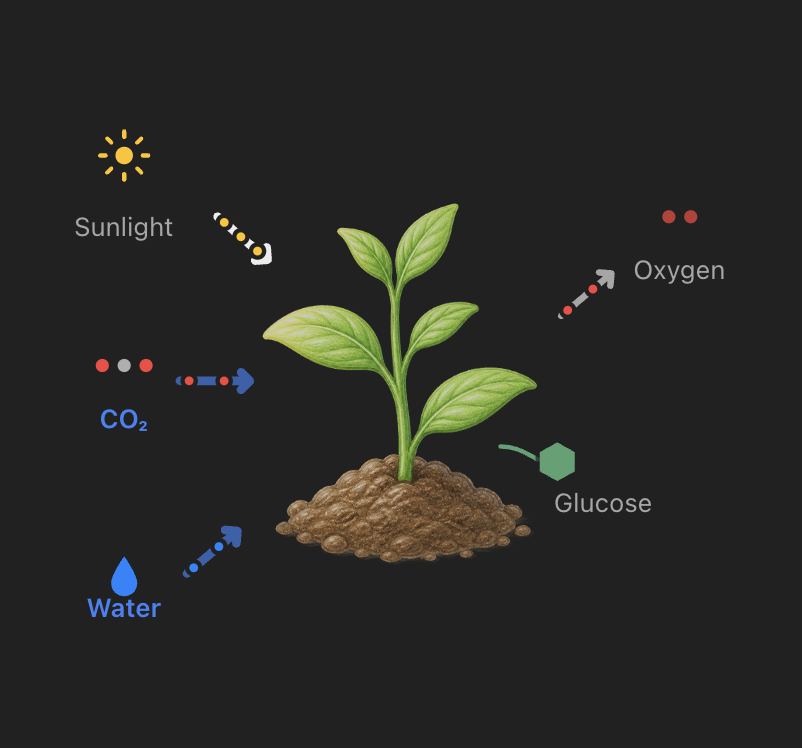
☀ Sunlight
💧 Water
🌬 Carbon dioxide (CO₂)
The plant uses these to make:
🍬 Glucose (sugar/food)
And it releases:
💨 Oxygen
So the basic idea is:
Sunlight + water + CO₂ → glucose + oxygen
🌱 Let's make it a story
plant cell
Imagine a plant cell is a house. 🏠
Inside the house is a chloroplast:
🟢 Chloroplast = little solar kitchen
The chloroplast receives:
☀ sunlight
💧 water
🌬 CO₂
Then it helps perform:
☀ PHOTOSYNTHESIS
And the result is:
🍬 GLUCOSE = food for the plant
plus
💨 OXYGEN
🚨 WHY DOES THE PLANT NEED FOOD?
Just like you need food for energy, plants need the glucose they make to support their growth and activities.
So:
Chloroplast → helps make food → plant gets energy/materials to live and grow.
📍 WHERE IS THE CHLOROPLAST?
You said:
"plant cell → cytoplasm → chloroplast"
YES. ✅
Think of it like:
🌱 PLANT CELL
⬇
🫧 CYTOPLASM
⬇
🟢 CHLOROPLAST
The cytoplasm is the inside area of the cell, and the chloroplast is one of the structures located there.
And remember:
🟢 Chloroplast has its own membrane because it is a membrane-bound organelle.
🧠 THE EASIEST WAY TO REMEMBER EVERYTHING🟢 CHLOROPLAST
"Solar kitchen" ☀🏭
Job: Helps make food.
☀ PHOTOSYNTHESIS
"Food-making process" 🍬
Job: Uses sunlight, water, and CO₂ to make glucose and releases oxygen.
"Which organelle is responsible for photosynthesis?"
👉 🟢 Chloroplast
"Where does photosynthesis occur?"
👉 🟢 Chloroplasts
"What does a plant use sunlight for?"
👉 To help make food (glucose) through photosynthesis.
"What is photosynthesis?"
👉 ☀ The process plants use to make food using light energy.
"The chloroplast is the place where photosynthesis happens, and photosynthesis is the process plants use to make food using sunlight."
That's the whole concept. 🌱☀
CHLOROPLAST = WHERE
PHOTOSYNTHESIS = WHAT

🌱 AUTOTROPH vs 🧑 HETEROTROPH
🌱 AUTOTROPH = MAKES ITS OWN FOOD🧑 HETEROTROPH = GETS FOOD FROM OTHER ORGANISMS
That's the whole foundation.
🌱 1. AUTOTROPHS = "I MAKE MY OWN"
Break down the word:
AUTO = SELF
So:
AUTOTROPH = feeds itself
Autotrophs can use things from the environment to make energy-rich food molecules.
For many plants, this happens through:
☀ Sunlight
💧 Water
🌬 Carbon dioxide
⬇
🟢 Photosynthesis
⬇
🍬 Glucose (food)
Example:
🌱 Plants = autotrophs
Plants don't need to eat a hamburger to get their food. 😂
They use sunlight and raw materials to make their own food.
Some bacteria are also autotrophs.
AUTO = AUTOMATIC / SELF
Think:
🌱 "AUTO = I make my OWN."
AUTOTROPH → OWN FOOD

🧑 2. HETEROTROPHS =
"I HAVE TO GET MY FOOD"
Now look at:
HETERO = OTHER
So:
HETEROTROPH = gets food from OTHER organisms
Humans cannot make their own food from sunlight.
Instead, we:
🍎 Eat food
⬇
🧪 Digest/metabolize it
⬇
⚡ Get usable energy/materials
So:
🧑 Humans = heterotrophs
🐶 Dogs = heterotrophs
🍄 Fungi = heterotrophs
And some bacteria are heterotrophs too.
🧠 HETEROTROPH MEMORY TRICK
HETERO = OTHER
Think:
🧑 "I need OTHER organisms for my food."
HETEROTROPH → OTHER'S FOOD
⚡ BUT WAIT — WHAT ABOUT MITOCHONDRIA?
🌱 Plants have:
🟢 Chloroplasts → help make food through photosynthesis
⚡ Mitochondria → use molecules from food to make ATP
🧑 Humans have:
❌ No chloroplasts
⚡ Mitochondria → make ATP from energy-rich molecules obtained from food
So don't think:
"Mitochondria make food."
❌ Not exactly.
Think:
🟢 CHLOROPLAST
Makes food using sunlight ☀🌱
⚡ MITOCHONDRIA
Makes ATP that the cell can use for energy ⚡
🧠 THE BIG CONNECTION
Here's the easiest way to see it:
🌱 PLANT
☀ Sunlight
↓
🟢 Chloroplast
↓
🍬 Makes glucose
↓
⚡ Mitochondria
↓
ATP ⚡
🧑 HUMAN
🍎 Eat food
↓
🧪 Digest it
↓
🍬 Nutrients/glucose
↓
⚡ Mitochondria
↓
ATP ⚡
🔥 AUTOTROPH vs HETEROTROPH
🌱 AUTOTROPH | 🧑 HETEROTROPH | |
|---|---|---|
Meaning | Makes its own food | Gets food from others |
Memory | AUTO = SELF | HETERO = OTHER |
Example | 🌱 Plants | 🧑 Humans |
Photosynthesis? | Many do | ❌ Humans don't |
Chloroplast? | Plants have them | Humans don't |
"An organism makes its own food using sunlight. What is it?"
👉 Autotroph ✅
"Which organelle allows plants to perform photosynthesis?"
👉 Chloroplast ✅
"Which organelle produces ATP?"
👉 Mitochondria ✅
"Humans are what type of organism?"
👉 Heterotroph ✅
"Which organism gets energy by consuming food?"
👉 Heterotroph ✅
🧠 THE 5-SECOND MEMORY TRICK
🌱 AUTO = OWN
Autotroph → makes its OWN food
🧑 HETERO = OTHER
Heterotroph → gets food from OTHERS
And:
☀ CHLOROPLAST = MAKES FOOD⚡ MITOCHONDRIA = MAKES ATP🔥 Say this 3 times:
"AUTO makes its own. HETERO gets from others. CHLOROPLAST makes food. MITOCHONDRIA make ATP."
Cell Wall
structure providing protection and support to plant cells