Multiple Sclerosis
 Call Kai
 Learn
Learn Practice Test
 Spaced Repetition
 Match
Match Flashcards
 Knowt Play
1/99

There's no tags or description
Looks like no tags are added yet.
Name | Mastery | Learn | Test | Matching | Spaced | Call with Kai | Chat |
|---|
No analytics yet
Send a link to your students to track their progress
100 Terms
- CP
- SCI
- Spina bifida
Name some examples of congenital, infancy, and childhood non-progressive disorders of CNS
- Infections
- Encephalopathic organisms
- COVID-19
- Neoplasms
what are conditions that may follow progressive or non-progressive course:
- Gullian Barré
- Peripheral vestibular disorders*
Lower Motor Neuron:
poly-neuropathies, motor endplate, muscle disorders that are non-progressive…..
- Muscular Dystrophy
- Post polio syndrome
- Myasthenia Gravis
- Charcot Marie Tooth
Lower Motor Neuron:
poly-neuropathies, motor endplate, muscle disorders that are progressive…..
Multiple Sclerosis (MS)
Auto-Inflammatory destruction of the myelin sheath and / or the oligodendrocyte
- Sclerotic plaques
- Axonal damage
- White and eventual grey matter disease
what can occur as a result of Auto-Inflammatory destruction of the myelin sheath and / or the oligodendrocyte
Oligodendrocyte
myelin-producing cells of the central nervous system
T cells release inflammatory mediators → inflammation and injury to neural tissue/myelin → demyelination
A patient with MS experiences an autoimmune attack in which T cells encounter CNS myelin. What is the immediate consequence of this immune response?
Loss of myelin disrupts efficient neural signal transmission, causing slowed or impaired nerve conduction
A patient with MS has an inflammatory reaction that damages myelin surrounding CNS axons. Why would this interfere with neurological function?
formation of glial scars (plaques)
what does gliosis eventually lead to
axonal neurodegeneration
What is believed to be the main cause of permanent neurological disability in MS
optic nerves
periventricular white matter
corticospinal tracts
posterior white columns
cerebellar peduncles
CNS areas most susceptible to MS
optic neuritis
Blurred vision , Decreased visual acuity, Pain with eye movement, Reduced color perception, and temporary visual loss
what condition can develop if MS affects the optic nerve
Motor deficits
Sensory changes
Cognitive problems
Coordination problems
because of MS, what can damage to the white matter contribute to
Weakness
Increased tone/spasticity
Abnormal movement patterns
Hyperreflexia
Difficulty walking
because of MS, what can damage to the corticospinal tracts lead to?
**connects the cerebellum to the other parts of the nervous system
ataxia
dysmetria
tremor
poor coordination
wide based gait
balance deficits
because of MS, what can damage to the cerebellar peduncles lead to?
women
who is more likely affected by MS
True
TRUE or FALSE: Among patients with MS, Men have worse prognosis (more progressive disease course and more rapid disability)
- Highly variable (dependent on symptom severity)
- Median survival time (newly diagnosed MS patients without severe disability): approximately 30-35 years
what is the life expectancy for patients with MS
- May be increased with environmental triggers (infections, low sun exposure, vitamin D deficiency, smoking, and possibly increased BMI)
- Genetics
what are the risk factors and risks of developing MS
Clinically Isolated Syndrome (CIS) MS
- First episode of inflammatory demyelination in the CNS
- Could become MS if additional activity occurs
- Characterized as: Not Active or Active
- Active = becomes relapsing-remitting MS (RRMS)
Relapsing/Remitting MS
- Clearly defined relapses (acute exacerbation)
- Followed by recovery and stability or recovery with residual deficits
relapsing/remitting MS
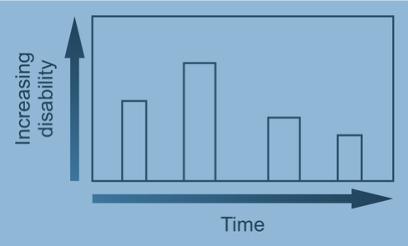
this type of MS has symptoms of onset that then go away
just the myelin damaged
surrounding neurons can pick up the slack of damaged neurons (larger neuronal reserve)
bad neuronal reserve= not really an onset/recovery period
describe this chart of relapsing/remitting MS (what is damaged)
Secondary progressive MS
- Relapsing/remitting followed by steady functional decline
- May still have periods of remission or plateaus
secondary progressive MS
what type of MS does this chart display

Secondary progressive (SPMS)
What is the second stage of MS after relapsing remit
Primary progressive MS
- Steady functional decline
- May have plateaus & temporary minor gains & acute relapses that may or may not resolve
- Typically older at diagnosis (late 30s - early 40s)
Progressive relapsing MS
- Progressive disease from onset with acute relapses that may or may not resolve
- Disease continues to progress after relapse
progressive relapsing MS
what MS is described in this chart

Neuronal Reserve
the brain's internal capacity and efficiency in its networks of nerve cells, which helps it keep working normally even when physical damage or aging occurs
- The inflammatory attack on the NS (decreases as a function of age)
- normal aging
What are causes for the decrease of Neuronal Reserve in cases of MS
- Genetics: How big the brain is and how many neurons you have
- Environmental factors: enriched environment and exercise
What factors determine the amount of Neuronal Reserve a person has
- Visual symptoms (80%)
- Sensory disturbances
- Pain (80%)
- Fatigue (65% - 97%)
- Fatigability
- Depression (26% - 50%)
- Cognitive impairment (up to 70%)
- Emotional Impairment
- Speech & Swallowing
- Vestibular dysfunction
- Paresis/Paralysis
- Tremors
- Spasticity
- Ataxia
- Balance & Gait Dysfunction (50-80%)
- Bowel/bladder/sexual dysfunction
- Seizures
What are signs and symptoms of MS
- Optic neuritis
- Sensory disturbances
- Fatigue
What are common early developing symptoms of MS
- Optic neuritis
- Diplopia and/or dysconjugate gaze
What are visual signs/symptoms of MS
- Hypoesthesia
- Paresthesia
What are the different types of sensory disturbances that can arise from cases of MS
aching, burning, "pins and needles"
Neuropathic pain due to demyelination of spinothalamic tracts/sensory roots; described as ________________ pain
- Neuropathic: i.e. Lhermitte sign, trigeminal neuralgia
- Somatic: i.e. paroxysmal limb pain, MSK pain
- Headache
What are the different types of pain symptoms that can appear in patients with MS
fatigue
A perception (measured by self-report)
fatigability
measure of decline in physical/cognitive performance over time
- physical exertion
- exposure to heat and humidity (Uhthoff's phenomenon)
- disturbed or reduced sleep
- depression
- anxiety
- cognitive impairment
- medical comorbidities
In patients with MS, what can contribute or affect the patient's fatigue/fatigability.
MS patients have poor exposure to heat and NEED to be cooled down while exercising
describe Uhthoff's phenomenon
Pseudobulbar affect (sudden and unpredictable episodes of crying, laughing, or other emotional displays)
what is the most common type of emotional impairment seen in patients with MS
- Dizziness
- disequilibrium
- vertigo
- nausea
what vestibular dysfunctions are associated with MS
Truncal Dysmetria
what kind of ataxia is associated with MS
- Lyme disease
- Syphilis
- Progressive multifocal leukoencephalopathy (PML)
- HIV/HTLV-1
- Sarcoidosis
- SLE
- CNS lymphoma
- Metastatic disease
- B12 deficiency
- Copper deficiency
- Acute disseminated encephalomyelitis (ADEM)
- Neuromyelitis optica (NMO)
- Hereditary cerebellar degeneration
- Spine pathology
What are some diagnoses to go through when performing differential diagnosis of MS
- Dissemination in Space (DIS)
- Dissemination in Time (DIT)
- Onset of symptoms between 10 and 50 years of age
- Diagnosis based on clinical findings
What are the Schumacher criteria (1965) for the diagnosis of MS
Categorization system incorporating imaging and lab studies
What are the Poser criteria (1983) for the diagnosis of MS
- Clinically definite MS
- Laboratory-supported definite MS
- Clinically probable MS
- Laboratory-supported probable MS
What is included in the Categorization system incorporating imaging and laboratory studies for the Poser criteria (1983) for the diagnosis of MS
True
TRUE or FALSE: After the 2017 revision of the McDonald criteria for the diagnosis of MS, MRI and evaluation of the CSF have been found to be more specific to MS and are now the only 2 tests used to confirm MS
measures the electrical activity in the brain's visual cortex in response to visual stimuli. It helps assess the functionality of the visual pathways from the eyes to the brain, particularly the optic nerve
What is the Visual Evoked Potential (VEP) test that was previously used to assist in the diagnosis of MS
lesion
lesions are typically smaller, well-circumscribed, ovoid shapes oriented perpendicularly near the ventricles
lesion or PML?

PML
shows larger, asymmetric white matter lesions that often have hazy, ill-defined inner borders
lesion or PML

- Functional Systems Score (FSS)
- Expanded Disability Status Scale (EDSS)
What are the two classification systems used to assess/stage MS
increased impairment (0-5 or 6)
with the Functional Systems Score (FSS) for the classification of MS…a higher score means=
death due to MS
with the Expanded Disability Status Scale (EDSS) for the classification of MS, what does a 10 mean
ambulatory function and use of ADs
what does the Expanded Disability Status Scale (EDSS) for the classification of MS incorporate
7-9
Expanded Disability Status Scale (EDSS) Scale
diminished capacity to carry out ADLs
5-6.5
Expanded Disability Status Scale (EDSS) Scale
greater mobility impairment
0-4.5
Expanded Disability Status Scale (EDSS) Scale
mild impairment
20-50, women, men
Average age range of MS symptom onset is _____ with _____ being approximately 3x more likely to develop MS. However, _____ typically have a worse prognosis with more rapid symptom progression.
0
EDSS Scale
Normal neurological exam (all grade 0 in all Functional System (FS) scores*).
4.5
EDSS scale
Fully ambulatory without aid, up and about much of the day, able to work a full day, may otherwise have some limitation of full activity or require minimal assistance; characterized by relatively severe disability usually consisting of one FS grade 4 (others or 1) or combinations of lesser grades exceeding limits of previous steps; able to walk without aid or rest some 300 meters.
5
EDSS Scale
Ambulatory without aid or rest for about 200 meters; disability severe enough to impair full daily activities (e.g., to work a full day without special provisions); (Usual FS equivalents are one grade 5 alone, others 0 or 1; or combinations of lesser grades usually exceeding specifications for step 4.0).
6
EDSS Scale
Intermittent or unilateral constant assistance (cane, crutch, brace) required to walk about 100 meters with or without resting;
6.5
EDSS Scale
Constant bilateral assistance (canes, crutches, braces) required to walk about 20 meters without resting; (Usual FS equivalents are combinations with more than two FS grade 3+).
7
EDSS scale
Unable to walk beyond approximately 5 meters even with aid, essentially restricted to wheelchair
7.5
EDSS Scale
Unable to take more than a few steps; restricted to wheelchair; may need aid in transfer
8
EDSS Scale
Essentially restricted to bed or chair or perambulated in wheelchair, but may be out off bed itself much of the day; retains many self-care functions; generally has effective use of arms
8.5
EDSS Scale
Essentially restricted to bed much of day; has some effective use of arms; retains some self-care functions
9
EDSS Scale
Helpless bed patient; can co ammunicate and eat
9.5
EDSS Scale
Totally helpless bed patient; unable to communicate effectively or eat/swallow
space (DIS)
time (DIT)
A diagnosis of MS can be made if T2 MRIs demonstrate both diffusion in _____ and ______
Moderate AKA greater mobility impairments (5-6.5)
Cheryl is a 32-year-old female with a 7-year history of RRMS. While she still works full-time, over the last year she needed to gain work accommodations through the OVR allowing her to take "cognitive breaks" every 1-2 hours as needed. She can currently ambulate for about 100m without taking a break. What is her likely EDSS severity?
early control of disease activity important for reducing accumulation of disability, helping to stay active, protecting QOL
treatment adherence is important to efficacy, and barriers to adherence should be identified and addressed early.
What are the Multiple Sclerosis Coalition Consensus Paper themes for the management of MS
ACTH
what hormone medication can reduce inflammation and modulate the immune system, potentially impacting the progression and severity of MS relapses
- Aerobic Capacity/Endurance
- Gait/Locomotion: Assistive Devices/Technology
- Balance/Safety
- Muscle performance: strength, power, and endurance
- Communication, Cognition, visuospatial skills, psychosocial
- Cranial and Peripheral nerve integrity
- Environment, Home, and Work barriers
- Functional mobility skills
- Integumentary integrity
- Posture/Joint integrity, ROM, flexibility
- Motor function: motor control and motor learning
- Pain: intensity and location
- Coordination, Tone, Reflex Integrity
When examining a patient with MS what do we potentially examine?
sitting
sit to stand
walking
step up/down
standing
reach/grasp/manipulate
what are the 6 core tasks to look at during a MS evaluation
- 12-item MS walking scale: self-report
- 25 FT walk test
- MSQOL-54
- Modified Fatigue Impact Scale (MFIS)
- MS Functional Composite (MSFC)
What are outcome measures that are specific to MS
- Current functional status
- PLOF
- Education
- Cognition
- Equipment needs
- Environment/home modifications
- Pt's goals
- Disease progression
What factors will impact the plan of care for the physical therapy management of MS
- Increased core temperature
- Symptoms of overheating
- Some medications
- Obesity
- Sleep disturbance
- Stress
- Depression
What are some clinical challenges that can occur when working with patients with MS that can exacerbate their symptoms
neurofacilitation
Individuals with neurodegenerative diseases such as MS benefit from restorative intervention, aimed at remediating or improving impairments, activity limitations, and participation restrictions.
Direct CNS impairments are not responsive to intervention, whereas indirect impairments caused by evolving multisystem dysfunction from inactivity and disuse can be modified
3 to 5 days/week on alternate days (Daily exercise at lower intensity recommended for individuals with limited exercise capacities)
What is the recommended Aerobic exercise Frequency for patients with MS
limited to 60% to 85% HRmax or 50% to 70% peak VO2.
What is the recommended Aerobic exercise Intensity for patients with MS
30 minutes per session (three, 10-minute sessions per day for more involved individuals)
What is the recommended Aerobic exercise Time for patients with MS
cycling, walking, swimming, water aerobics
What is the recommended Aerobic exercise Type for patients with MS
circuit training (get adequate breaks and not overheat)
what type of training may be optimized for those with MS
2 to 3 days/week on alternate (nonendurance) days
What is the recommended Strength training exercise Frequency for patients with MS
8 to 15 repetition maximum (RM) (approx 60-80%1-RM) with 2-4min rest breaks in b/w sets
What is the recommended Strength training exercise Intensity for patients with MS
Long 2-4min rest breaks in b/w sets
What is an important consideration when planning resistance training for patients with ME
1 to 3 sets between 8 to 15 repetitions of 5 to 10 exercises
What is the recommended Strength training exercise Time for patients with MS
- Minimum: aerobic 2 - 3x/wk; 10 - 30-minute bouts at 40 - 60% HR max (Advanced: 5x wk; up to 40 minutes at 80% HR max)
- Resistance exercise: 2 - 3x/wk
- Neuromotor training: 3 -6x/wk
What are exercise recommendations for MS patients who are classified as EDSS 0 - 4.5 (mild)
focus more on restoration opposed to compensation
What is the main focus for exercise interventions for MS patients who are classified as EDSS 0 - 4.5 (mild)
more modifications and compensations but still engage in restorative approach
What is the main focus for exercise interventions for MS patients who are classified as EDSS 5-6.5 (moderate)
Adjust to time of day, temperature, salience, duration, location
How can we adapt restoration-based programming to the patients' needs
- Promote available/safe independent movement
- Breathing exercises (daily)
- UE AROM
- Flexibility (daily)
- Aerobic: Up to 20 minutes 3 - 7 days per week (may accumulate over shorter bouts)
- Overground walking as able with AD
- Schedule rest breaks
- Introduce adaptive equipment as appropriate
What are exercise recommendations for MS patients who are classified as EDSS 7-7.5 (severe)
- Short durations of ambulation and greater need/use of AD and help from caregivers
- Focus on function and safety
- Include preventative habits for conditions like pneumonia or pressure wounds
- Restorative is not the focus here, rather compensation and safety
What are key considerations when planning interventions for patients who are classified as EDSS 7-7.5 on the MS scale
- Slow Decline: Prevent or delay physical, cognitive, or functional deterioration from a chronic disease.
- Maintain Safety: Keep a person stable, mobile, and safe from major risks like severe falls.
- Manage Complications: Handle complex medical issues that need active professional monitoring during movement or exercise
What are the goals of Skilled Maintenance Therapy for MS
- Prior and Current LOF
- Severity of deficits (EDSS)
- Falls history/risk
- Available support/assistance
- Patient goals
- PT goals
For patients with MS what do you initiate your interventions based on?