Blood Transfusion in Small Animals
 Call Kai
 Learn
 Practice Test
 Spaced Repetition
 Match
 Flashcards
 Knowt Play
1/31

There's no tags or description
Looks like no tags are added yet.
32 Terms
What are indications for blood transfusions?
• Blood transfusion is a key component of the emergency management of haematological diseases in small animals
• It can be a life-saving procedure which "buys us time" to address the underlying disease/disorder
Is always a SUPPORTIVE treatment, not a definitive treatment
Blood can be divided into what components?
What are these components used to manage?
Plasma or coagulation factors - to manage hemostatic disorders and coagulopathies
Albumen
Anti-proteases
RBCs - to manage anemia
**Therapeutic plasma exchange or plasmapheresis - for toxicities

What is the PBBUk?
PBBUK stands for Pet Blood Bank UK, the only charity in the United Kingdom that provides a national blood bank service for veterinary practices - launched in 2007.
• Commercial availability of canine blood components
- Whole blood
- Packed Red Blood Cells (pRBCs)
- Plasma (Fresh Frozen, Frozen)
- Cryoprecipitate
- Platelet-rich plasma/Platelet concentrates
• More sophisticated transfusion medicine
**Similar blood banks in the US as well, revolutionizing transfusion medicine.
Summarize blood component therapy.

Describe feline blood transfusion availability.
• Limited to whole blood transfusion in the UK at present
A bit more challenging - will ask if owner has another cat, preferably related, blood is acquired on demand rather than being stored like in dogs
• RCVS/VMD Guidelines may change in the future to allow feline blood component therapy
• Xenotransfusion (see article)
If blood cannot be acquired quickly enough, can use dog blood or blood for another species as a short term measure
One-off procedures - can get reactions as a consequence
Describe decision making in transfusion medicine.
• Clinical decision, is transfusion necessary?
What are the: "Transfusion Triggers"
AKA: what makes me as a clinician reach for or want to use the blood product.
Are there alternatives to blood transfusion/component therapy?
• Is it likely that the patient will recover the ability to replace component deficits?
Transfusions provide a TRANSIENT improvement in clinical status
We need to consider if the potential benefits of transfusion outweigh adverse effects such as?
- Transfusion reactions
- Blood product incompatibility
- Infectious disease transmission
What categories can transfusion reactions be divided into?
• Immunologic
- Haemolytic
- Non-haemolytic (febrile) - immunological reaction to RBCs and platelets, not much can be done
• Non-immunologic
- Transmission of infectious disease
- Hypocalcaemia
Anticoagulant in blood product chelates calcium, usually not clinical but can occur
- Circulatory overload
If animal is normovolemic, can produce circulatory overload
- Bacteraemia
Scrutinize stored products, make sure aseptic
Describe the main features of Hemolytic transfusion reactions.
Due to: Transfusion of incompatible or mismatched blood
Acute Reaction
• Acute intravascular haemolysis
• Activation of the haemostatic system (DIC)
• Hypotension
• Death
OR
Delayed Reaction (Can negate the benefits of transfusion)
• Extravascular haemolysis
• 2-21days after transfusion
Negates the potential benefits of the transfusion
Describe the canine blood types.
• Defined by inherited antigens on. surface of RBCs
"Dog erythrocyte antigens"
DEA System (DEA 1)
[Dal-antigen]
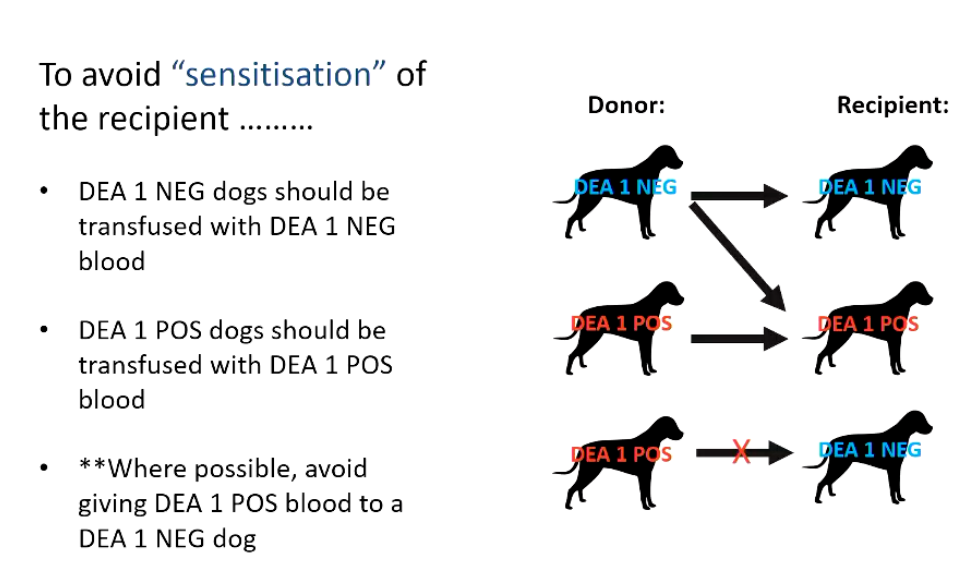
• Incompatible transfusions result in "sensitisation" of the recipient
Subsequent transfusions results in hemolytic transfusion reactions
What are the main features of DEA 1 blood groups?
• DEA 1 blood group
45% of dogs are DEA 1 positive
• DEA 1 is highly antigenic
Next time they encounter, will cause a very severe reaction
• Antibodies are "haemolysins" and "agglutinins"
Severe haemolytic reactions in sensitised individuals
How do we avoid sensitization in canines?
• To avoid sensitisation, best practice is to blood type prior to first transfusion and to transfuse with blood of the same type
Dogs don't have pre-existing allo-antibodies (compared with cats - don’t have to have a first transfusion to react)
First transfusions rarely result in haemolytic transfusion reactions (even if unmatched donor)
• If a second transfusion is required, it's imperative to perform a cross match
NB cross-matching should also be performed if the patient history is unknown as they may have received a previous transfusion
What is typing?
What is crossmatching?
Blood Typing
What it checks: Identifies your ABO group (A, B, AB, or O) and Rh factor (positive or negative) by testing for specific antigens on red blood cells and antibodies in plasma.
Why it matters: Establishes baseline compatibility so clinicians can pick appropriate donor units before transfusions or transplants.
Crossmatching
What it checks: Mixes the recipient’s serum or plasma with a sample of the donor’s cells (red blood cells for transfusions, or donor cells for transplants) to see if recipient antibodies attack or clump the donor cells.
Why it matters: Acts as a final safety check—even after blood typing and antibody screening—to prevent severe immune reactions or organ rejection.
What canine blood typing kits are available and most used?
Rapid-Vet H
Alvedia/DME Test

What are the Alvedia test results?

Describe how we avoid sensitization of the canine recipient during transfusion.
Okay to give DEA 1 Pos. a DEA 1 Neg. → but still may cause subsequent reactions
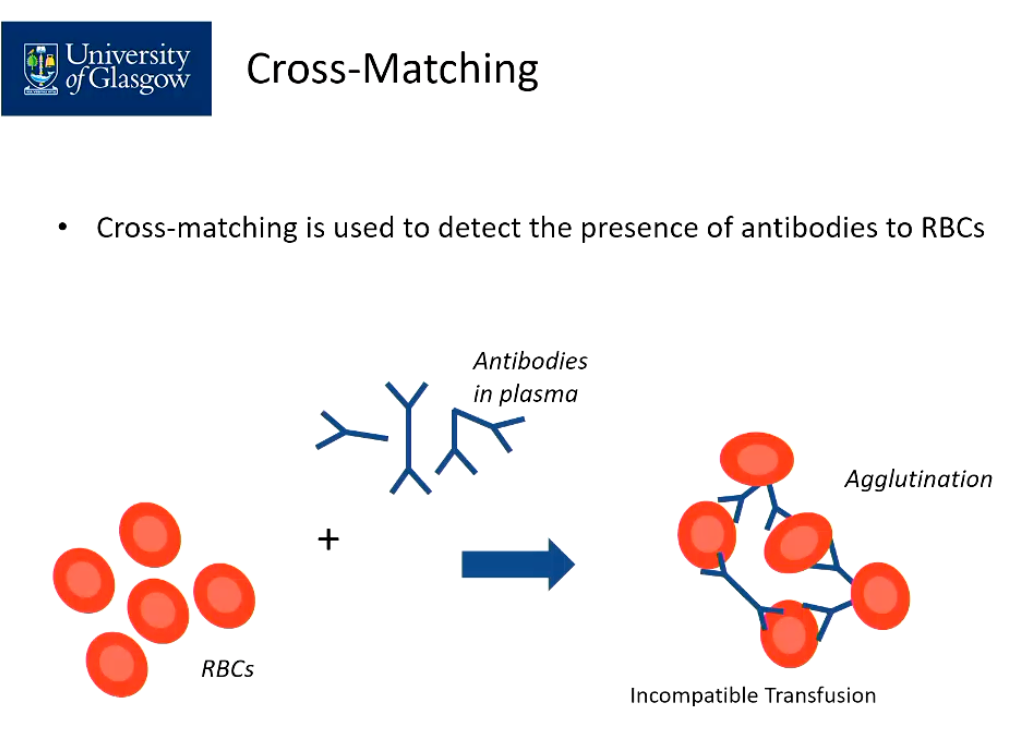
Describe how cross-matching occurs.
When should you cross match?
Mixing RBCs and Plasma, is preexisting antibodies → will get agglutination
When to consider cross-matching:
• Prior blood transfusion in dogs (if > 4 days since administered)
• In dogs with an unknown history e.g. rescue dogs
• In cats if AB blood-typing cards are unavailable
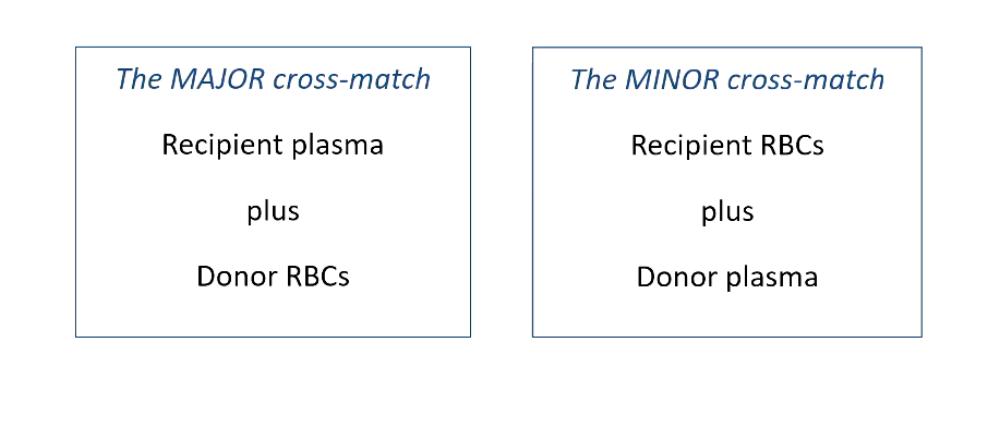
What are the major and minor cross-matches?
MAJOR CROSS MATCH
Definition: Combines the recipient's serum or plasma with the donor's red blood cells (RBCs).
Purpose: Checks for preformed or unexpected antibodies in the recipient's blood that could attack and destroy the donor's red blood cells.
Clinical Significance: This is the most critical cross-match test. A positive reaction (agglutination or hemolysis) indicates incompatibility, meaning the transfusion could cause a severe hemolytic transfusion reaction.
MINOR CROSS MATCH
Definition: Combines the donor's serum or plasma with the recipient's red blood cells (RBCs).
Purpose: Checks for antibodies present in the donor's plasma that could target antigens on the recipient's red blood cells.
Clinical Significance: This test carries less clinical importance because any donor antibodies are rapidly diluted within the large volume of the recipient's overall circulation. However, incompatible results are still avoided, and it may be more relevant when large volumes of plasma products are given.
What cross-matching kits exist?
In house cross-matching kits (Major X-match only) - for emergency scenario
Slide based cross matching (Major and Minor)
If do not have kits for cats - use the slide, agglutination is incompatible
Can send in to the lab (IDEX) - and they send product (2 day turnaround)

What defines the feline blood grouping system?
Defined by inherited antigens
AB blood-group system
(Mik)
• Cats differ from dogs in that they have naturally-occurring allo- antibodies
• Incompatible transfusion will result in a haemoytic transfusion reaction even if this is the first time the cat is transfused
Type A infused with type B blood: Get mild/moderate hemolytic transfusion reaction
Type B with type A blood: get SEVERE hemolytic transfusion reaction, life threatening
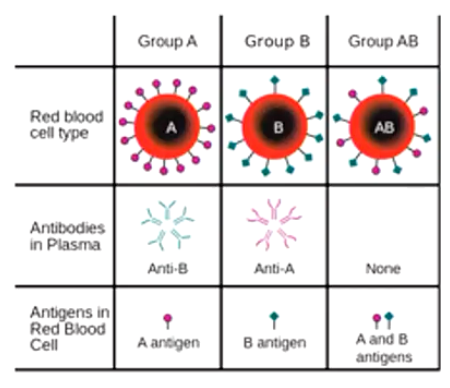
What determined the frequency of feline blood groups?
Frequency of blood types is dependent on
• Geographical location
• Breed of cat
- A (Siamese, Oriental, DSH, DLH) (68%)
- B (BSH, Birman, Abyssinian, Persian, Devon Rex) (30%)
- AB (rare, Bengals) (2%)
Cats with type AB blood don't have alloantibodies but should be
administered AB or A blood.

Describe aspects of a feline blood transfusion.
• Cats MUST be AB blood typed and/or cross-matched before their FIRST transfusion
• Mik antigen - first described in 2007 - present on some cats - may result in a haemolytic TR on subsequent transfusion even if AB matched first transfusion
What options exist for sourcing blood products?
Canine Blood Products:
1. Buy canine blood products from a blood bank e.g. Pet Blood Bank UK
2. Collect whole blood from a donor dog in the practice: keep a donor list
Feline Blood:
1. Collect whole blood from a feline donor in the practice: keep a donor register
What are the benefits of pet blood banks?
• Blood products can be stored on site for immediate use:
pRBCS in dedicated blood fridge
FFP and plasma in practice freezer
• Products are tailored to individual needs
One unit can help more than one patient
Minimize the risk of complications
• Allows for donation to be carried out in a calm and controlled setting
• Convenient for donor/donor's owner
Describe the main features of a suitable canine blood donor.
• Aged between 1-8 years old
• Healthy (CBC, serum biochemistry, UA) and not receiving any medication
• Fully vaccinated & wormed
• No travel history outside the UK
• Has not received a transfusion previously
• Has a good temperament (so sedation is not required)
• Ideally > 25kg
• Pre-transfusion PCV of > 35%
• Ideally DEA 1 negative
Describe the main features of a suitable feline blood donor.
• Aged between 1-8 years old
• Healthy (CBC, serum biochemistry, UA, echocardiography) and not receiving any medication
• Fully vaccinated & wormed (ideally indoor)
• No travel history outside the UK
• Has not received a transfusion previously
• FeLV/FIV negative
• Negative for Mycoplasma haemofelis
• > 4kg
• Pre-transfusion PCV of > 35%
• Blood type specific to recipient
TYPE A cats MUST be transfused with TYPE A blood (etc)
How much blood can be donated from cats/dogs?
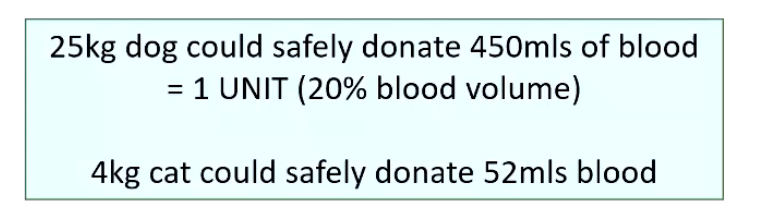
• 10%- 20% of blood volume every 8 weeks
• Calculate blood volume
66mls/kg lean bodyweight for cats
90 mls/kg in dogs
What equipment is needed for blood collection?
• 3 members of staff (one experienced in phlebotomy)
• Sterile scrub solution, EMLA cream and clippers
• Sedation for cats (if required for dogs)
• Ideally pre-place IV catheter (for fluid replacement)
• Dogs: Human blood collection bag pre-filled with anticoagulant, scales for weighing the blood unit
• Cats: Sandbag or small cushion, 19 - 21 gauge butterfly needle, three 20ml syringes prefilled with 2.6 mls of anticoagulant (acid citrate dextrose or citrate phosphate dextrose)
Why is the ratio of anticoagulant to blood so important?
May have consequences such as:
• CPD collections bags
• Anticoagulant for a full unit (500mls) of blood
NB If only collecting half a unit m(e.g. from a dog weighing < 25kg) remove half of the anticoagulant
For cats: 1.3mls CPD per 10mls blood (Ideal Ratio)

Describe how blood products are given (The practicalities).
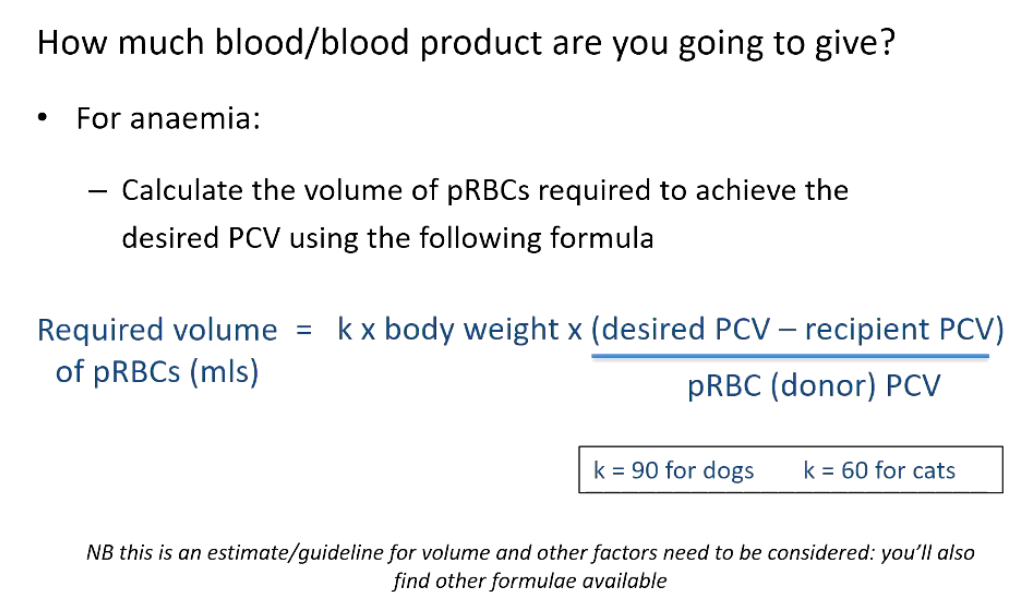
Remember - aiming to eliminate clinical signs - not entirely replace the hematocrit
How quickly should you administer the blood transfusion?
• Take into account the patient status
Start at 0.5-2mls/kg/hr for 30 minutes
Monitor for any reaction or adverse effects, then increase as follows:
Hypovolaemic patient; 20 mls/kg/hr
Normovolaemic patient; 5-10 mls/kg/hr
Cardiac or renal disease; 2 mls/kg/hr
Do not want to create volume overload
• Aim to administer the unit of blood/blood product within 4 hours
Key Points:
• Consider pre-treatment with anti- histamines
• Administer via a central or peripheral intravenous catheter (>22 gauge whenever possible)
- Intraosseus routes can be used as an alternative
• Use a filter in the giving set to capture any thrombi/microthrombi
Should blood products be heated prior to administration?
Ideally blood products should be gently warmed to between 24 and 37°C prior to administration
- NB care not to overheat/damage product
• Have a dedicated line for transfusion
with the exception of 0.9%NaCl or plasma avoid giving anything else through this line
What signs should you monitor for when looking for transfusion reactions?
