mod 5 - yr 12 bio
 Call Kai
 Learn
 Practice Test
 Spaced Repetition
 Match
 Flashcards
 Knowt Play
1/91

There's no tags or description
Looks like no tags are added yet.
92 Terms
what are DNA strands made of?
repeating nucleotides
what are nucleotides made of?
a phosphate,
deoxyribose sugar (or ribose sugar in RNA)
nitrogenous base (Adenine, Thymine, Guanine or Cytosine)

how many hydrogen bonds between A and T
2
how many hydrogen bonds between C and G
3
what is the advantage of weak hydrogen bonds in DNA
little effort is required to pull bases apart so DNA can replicate or be decoded to form proteins
what is the backbone of DNA strands made of?
alternating sugar and phosphate molecules
what does DNA’s antiparallel arrangement mean
parallel but run in opposite directions
how are DNA strands formed
by strong chemical bond between phosphate of one nucleotide to deoxyribose sugar of another
DNA replication step 1
The original or parent DNA molecule untwists. (by Helicase)
DNA replication step 2
The weak hydrogen bonds of the parent DNA molecule break causing the two strands to separate (or unzip). (by Helicase)
DNA replication step 3
Free DNA nucleotides within the cell pair with their complementary nucleotide on the unzipped strands
Hydrogen bonds form joining the bases
DNA polymerase joins the bases together
why is there are leading and lagging strand in DNA replication? (and what are Okazaki fragments?)
DNA Polymerase only works in one direction so as the replication fork moves forward, only one strand of DNA can be continuously replicated (leading strand)
the other lagging strand can only be replicated in short sections once there are enough free bases to use as a template (Okazaki fragments)
what must replication of each fragment begin with?
short RNA sequence (primer) requiring the enzyme Primase
the primer is later replaced with DNA by DNA polymerase
what are the fragments joined together by?
joined together to make a continuous strand by enzyme Ligase
DNA replication step 4
The nucleotides are joined by sugar phosphate bonds and a new DNA strand is formed
DNA replication step 5
Two identical daughter strands are formed each containing:
one strand from the parent molecule
one newly synthesised strand
requirements for DNA replication
DNA acts as a template
supply of all 4 nucleotides
enzymes to control the process
helicase (to untwist + separate DNA strands)
DNA polymerase (to join nucleotides together by joining sugar and phosphate)
ATP for energy for DNA polymerase to join nucleotides together
importance of exact DNA replication to the cell
all cell divisions require DNA replication to ensure daughter cells contain their genetic information for correct functioning/survival
this method ensures a complete and exact copy of DNA is passed onto new cells - so all cells contain the information they need to survive
if mutations occur, cell may not function properly and die
because DNA controls proteins that are made by the cell and proteins control almost all cell activities
how many DNA molecules is a chromosome
1
where is DNA located in eukaryotes?
Most of DNA is located in nucleus in eukaryotes
However some extra DNA is found in chloroplasts and mitochondria, which is found as smaller, circular molecules
how is DNA packaged?
DNA is wrapped around Histone proteins to form Nucleosomes
bead like structures made of long sequences of DNA wrapped around histone proteins
It is then wrapped into a spiral shape
Which is then folded back and forth into a protein scaffold
Which is then wrapped into a chromosome

what do karyotypes do
display chromosome contents of a cell, organised according to their number, size and type
somatic cell
any cell that is not a reproductive cell
how many chromosomes (and in how many pairs) do human somatic cells have
46, 23 pairs
Normal somatic human cells have a karyotype with 46 chromosomes (in 23 pairs) comprising:
22 pairs of autosomes
1 pair of s*x chromosomes (determine the s*x of an individual)
XX (female), XY (male)
homologous chromosomes
paired chromosomes which have the same length, centromere position and same genes at the same positions along their lengths
1 chromosome from each pair comes from one parent and the other one comes from the other parent
While homologous chromosomes have the same genes, they may have — versions of the genes (alleles)
different
e.g one chromosome may have a hair colour gene which says “make protein for red hair” and the other chromosome may say “make protein for blonde hair”
why do cells divide?
Growth of multicellular organisms – growth relies on mitotic division followed by cell assimilation, enlargement and differentiation
Individual cells cannot grow large because of SA:Vol limitations
The only way to grow larger is to produce many small cells
to repair damaged tissue and replacement of worn-out cells
Asexual reproduction – e.g growth of plans from cuttings
Genetic stability – mitosis ensures the precise and equal distribution of chromosomes to each daughter nucleus, so that all resulting cells have the same chromosome number and genetic information as each other and the original parent cell
cell cycle stages
G1 - cell growth
S - DNA duplication/synthesis
each of 46 chromosomes is duplicated by the cell
G2 - cell growth
M - mitosis
what happens in mitosis
During mitosis an exact copy of genetic material in the parent cell must be distributed to each daughter cell
Each stage of mitosis is designed to achieve equal and exact distribution of genetic material
Cell division occurs in a cycle and involves 2 main steps
Mitosis – division of nucleus
Cytokinesis – division of cytoplasm and organelles
what happens in interphase
DNA present as uncondensed chromatin
Chromatin: DNA that is spread out and diffused in the nucleus
DNA is contained within a clearly defined nucleus
Centrosomes and other organelles have been duplicated
Cell is enlarged in preparation for division
how many chromosomes in the nucleus before and after interphase
before interphase, there are 46 chromosomes in the nucleus but each one is a single unit
After interphase, there are still 46 chromosomes but with 2 identical chromatids each
what happens in prophase
Chromatin supercoils, condensing it into chromosomes (becoming visible under microscope) each containing 2 copies of DNA and 2 sister chromatids joined by a centromere
Nuclear membrane begins to break down and nucleus dissolves
Spindle begins to form from broken down material and extends across the cells

what happens in metaphase
condensed chromosomes line up along the equator of the cell, each attached to spindle fibres by a centromere

what happens in anaphase
continued contraction of spindle fibres causes sister chromatids to separate (and each become a chromosome)
Spindle fibres contract and pull daughter chromosomes towards opposite poles of the cell, with assistance of the centromere

what happens in telophase
Spindle fibres dissolve once the 2 chromosome sets arrive at the opposite poles of the cell
Chromosomes decondense
New nuclear membranes are formed around the chromosomes
what is cytokinesis
process of cytoplasmic division where the cell splits into 2 identical daughter cells
Occurs concurrently with telophase
how does cytokinesis happen in animal cells
After anaphase, microtubule filaments form a concentric ring around the centre of the cell
These microfilaments constrict to form a cleavage furrow, which deepens the periphery towards the centre
When the furrow meets in the centre, the cell becomes completely pinched off and 2 cells are formed

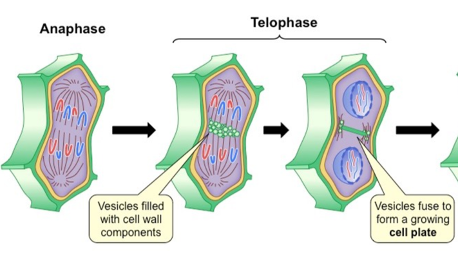
how does cytokinesis happen in plant cells
After anaphase, carbohydrate-rich vesicles form in a row at the centre of the cell
These vesicles fuse together and an early cell plate begins to form
The cell plate extends outwards and fuses with the cell wall, dividing the cell into 2 daughter cells
what is meiosis
Is the division of the nucleus to produce 4 gametes
Results in variation in an organisms offspring – i.e independent assortment of chromosomes and unique composition of alleles in daughter cells
During meiosis number of chromosomes is halved, occurring over 2 consecutive divisions
Only happens in gamete mother cells
purpose of meiosis
Create haploid gametes (with half the number of chromosomes) to ensure that when fertilisation occurs the offspring receive the correct amount of genetic information
Haploid cell: cell that contains a single, complete set of chromosomes (23 in humans)
Create genetic variation amongst those gametes (specialised reproductive cell that unites with another opposite-s*x cell during reproduction to form a new organism (i.e eggs and sperm))
what happens in interphase in meiosis
Cell growth, DNA replication, cell processes
Each uncoiled chromosome replicates to produce 2 identical chromatids

what happens in prophase I in meiosis
Chromosomes condense by coiling and become visible
Nuclear membrane dissolves
Bivalents form – pair of homologous chromosomes that link together
Crossing over occurs at points where the chromosomes touch (called chiasmata)

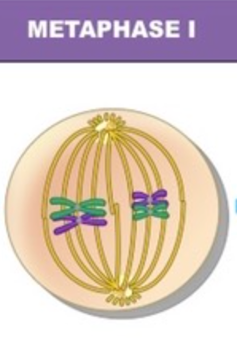
what happens in metaphase I in meiosis
Spindle fibres from opposing centrosomes connect to bivalents (at centromeres) and align them along the equator of the cell
Independent assortment occurs during this stage
what happens in anaphase I in meiosis
Spindle fibres contract and split the bivalent
Homologous chromosomes (still with 2 chromatids) move to opposite poles of the cell

what happens in telophase I in meiosis
Chromosomes decondense
Nuclear membrane may reform
Cell divides (cytokinesis) to form 2 haploid daughter cells
what happens in prophase II in meiosis
Chromosomes condense
nuclear membrane dissolves
centrosomes move to opposite poles (perpendicular to before)

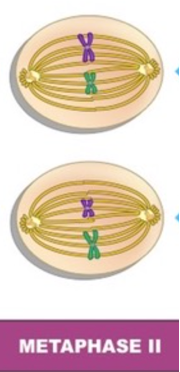
what happens in metaphase II in meiosis
spindle fibres from opposing centrosomes attach to chromosomes (at centromere) and align them along the cell equator
what happens in anaphase II in meiosis
centromeres split allowing spindle fibres to contract and pull the chromatids (now chromosomes) to opposite poles of the cell
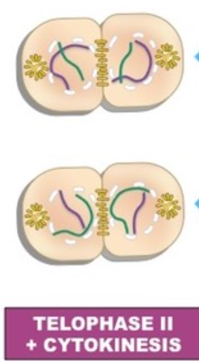
what happens in telophase II in meiosis
chromosomes decondense
nuclear membrane reforms
cytoplasm divides (cytokinesis) to form 4 haploid daughter cells
within each gamete there is a different genetic combination
how does meiosis creates genetic variation: independent assortment
occurs when homologous chromosomes line up on the equator during Metaphase I in meiosis
homologous chromosomes line up and separate randomly and independently of all other pairs so the number of different possible gametes is very large
the genetic content of the gametes is determined by how the chromosomes line up on the equator
e.g 2 pairs of chromosomes in a gamete mother cell would give:
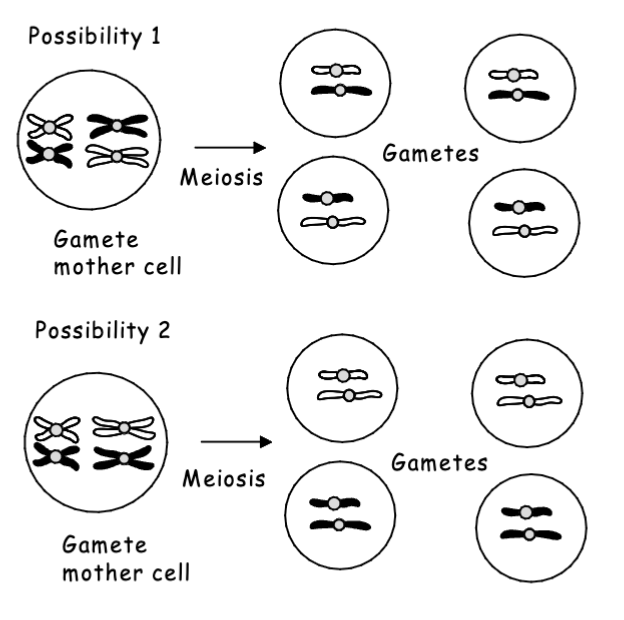
how does meiosis creates genetic variation: crossing over
takes place between the members of a homologous pair of chromosomes during Prophase I and involves the exchange of part of one chromatid with another
occurs at random
produces chromosomes with a new combination of genes
and variation in allele combinations for different genes
produces new variations of gametes – increases genetic diversity of potential offspring
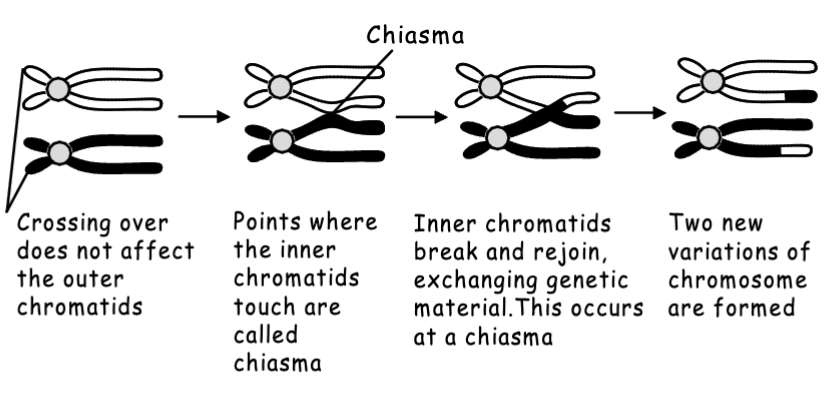
how does meiosis creates genetic variation: random segregation
Maternal and paternal chromosomes get sorted into gametes randomly
E.g a parent with Aa will have half of their gametes with A, the other half with a
where are alleles of the same gene found on?
homologous chromosomes
Meiosis ensures that homologous chromosomes are — and placed in — gametes
separated, different
Each homologous chromosome has an — chance of being segregated into a particular gamete
equal
how does this explain mendel’s law of segregation? (and what is mendels law of segregation?)
states that each organism carries 2 copies of a gene for a trait (alleles)
and these 2 alleles separate randomly during the formation of gametes so each gamete receives only 1 allele
what is mendels law of independent assortment?
Mendel found genes separate and move into gametes independently of each other
how can mendels law of independent assortment be explained?
by assuming the genes Mendel studied were on different chromosomes
Chromosomes can show independent assortment, and so would genes on different chromosomes
what is genetic variation in offspring determined by?
Is determined by the combinations of alleles of all their different genes
what is genetic variation in offspring important for
long term evolutionary change
what is genetic variation in offspring increased by
increased by both gamete formation (during meiosis) and sexual reproduction
meiosis allows for a — combination of existing genetic material to be formed
new
can occur via independent assortment and crossing over
how does independent assortment ensure variety in gametes?
different combinations of chromosomes (formed due to independent assortment) ensure a variety of gametes can be formed with different combinations of alleles for genes of those different chromosomes
The number of combinations formed is determined by 2n where n is the haploid number of chromosomes
what is fertilisation
Is the fusing of a haploid male gamete with a haploid female gamete to produce a diploid zygote with a new combination of genes (one set each from mother and father respectively)
what does fertilisation involve
random pairing of a male and female gamete and results in variation in allele combinations for each gene
i.e whether it is homozygous for a particular allele (2 of the same alleles of a gene) or heterozygous (2 different alleles of a gene)
fertilisation vs gamete formation: creating variation
Fertilisation creates variation in genotype for each gene
gamete formation creates variation in the combinations of alleles for different genes
similarities between mitosis and meiosis
Both preceded by interphase (including DNA replication)
Both divide according to a common pathway (PMAT)
Both involve their cytoplasm splitting via cytokinesis
differences between mitosis and meiosis: mitosis
Divisions – 1
No independent assortment
Synapsis – no tetrad/bivalent
Crossing over – doesn’t occur
Outcome – results in 2 daughter cells
Ploidy – daughter cells produced are diploid
Use – used to replicate body cells
Genetics – produced genetically identical cells
differences between mitosis and meiosis: meiosis
Divisions – 2
Independent assortment
Synapsis – tetrad/bivalents formed (pairs of homologous chromosomes)
Crossing over occurs (non-sister chromatids of homologous pairs may exchange genetic material)
Outcome – results in 4 daughter cells
Ploidy – daughter cells produced are haploid
Use – used to make sex cells (gametes)
Genetics – produces genetically distinct cells
continuity of a species
ongoing survival of species as a result of characteristics being passed from parents to offspring in a continuous lineage
genetic stability
passing on of consistently accurate genetic information
genetic variation
occasional introduction of variation of some genetic information (e.g mutations) so that species can adapt and survive in a changing environment
what does genetic continuity do
way of preserving genetic information across generations
Ensures continuation of a species so new cells or organisms have all the genes they require to survive
Lack of genetic continuity may result in disease and sometimes extinction
what does genetic continuity depend on
When a cells divides by mitosis, the 2 daughter cells must have the same number and type of genes as the original cell
When 2 sexually reproducing organisms breed, the resulting offspring must have the same number of genes as the parent organism
how does stability come about at a genetic level?
At a genetic level, stability arises when chromosomes are replicated accurately to create identical daughter chromosomes
how does stability come about at a species level?
At a species level, successful desirable traits must be passed on along with some random errors (may be introduced by mutation)
Allows a species to evolve if an environmental change occurs
Natural selection – allows individuals best suited to their
Mechanisms that have evolved to ensure genetic continuity + survival + continuity of a species (COFEN)
Consistent and accurate DNA replication prior to cell division (mitosis and meiosis)
Mitosis giving full sets of chromosomes in daughter cells
Meiosis ensures one of each type of chromosome goes to a gamete
So there are homologous pairs in the next generation
Orderly distribution of chromosomes when cells divide and when gametes form
Fertilisation methods that ensure that individuals of the same species breed successfully
Methods to ensure Embryo survival, such as production of large numbers or protection and nourishment of developing embryos
Natural selection so the fittest survive to reproductive age and pass on their genes
Mechanisms that ensure genetic variation in a species
Mutation – changes in DNA due to mutation may be spontaneous or mutagen-induced
Mixing of parental genes during sexual reproduction
brought about by crossing over and independent assortment during meiosis, and random fertilisation of gametes
what ensures that genetic information is stored in a stable form and passed on consistently?
if DNA repair enzymes continuously scan the DNA for errors in replication and replace incorrect or damaged nucleotides
example of genetic errors that threaten continuity of a species: XP
People who have the disease Xeroderma pigmentosum (XP) are unable to repair DNA
they are more vulnerable to DNA damage from UV rays and thus skin cancer
Why is Genetic Variation important?
It increases the chances of survival of a population in case of environmental change
e.g physical environment changes, introduction of diseases
Provides the necessary differences upon which natural selection acts
DNA in eukaryotes
Is contained within a nucleus
Is bound to histone proteins
Genomes contain large amounts of non-coding and repetitive DNA
Do not contain plasmids (but organelles such as the mitochondria and chloroplasts contain their own DNA)
Are linear in shape
DNA in prokaryotes
Main chromosome is circular in shape
Smaller than eukaryotic chromosomes
Not packaged with proteins
Not in a nucleus but found freely in the cytoplasm
Very little non-coding DNA – genes are closer to each other; genomes are more compact
May also have extra small circles of DNA called plasmids (not always present)
phenotype
the physical appearance/feature of an organism (often) caused by the genetic information that it has inherited from its parents
genotype
a description of the alleles of a gene that a particular organism
contains, normally denoted by letters
gene
A part of a chromosome which contains the information for a particular
characteristic
allele
different forms of a gene
how many sets of chromosomes in each cell and how many copies of each gene in the cell?
2 sets of chromosomes; thus has 2 copies of each gene
dominant form of a gene will — show up in the organism’s phenotype
always
Homozygous
Organism which possesses 2 identical forms of a gene
Heterozygous
Organism which possesses 2 different forms of a gene