Biochemistry Chapters 9 and 10
 Call Kai
 Learn
 Practice Test
 Spaced Repetition
 Match
 Flashcards
 Knowt Play
1/62

There's no tags or description
Looks like no tags are added yet.
63 Terms
Define carbohydrates
Essential macronutrients that serve as a primary source of energy
Explain the 3 functions of carbohydrates
Supply the body with energy by converting glucose to ATP
Stores chemical energy in carbon bonds
Provides accessible glucose for protein sparing and contributes sugar backbones for macromolecule synthesis
What are the two main types of carbohydrates?
Simple carbohydrates (mono and disaccharides)
Complex carbohydrates
Name 2 simple carbohydrates
Glucose and sucrose
Name 2 complex carbohydrates
Glycogen and cellulose
Draw the fischer projection of D-allose

Draw the fischer projection of D-glucose

Draw the fischer projection of D-mannose

Draw the fischer projection of D-galactose

Convert the Fischer projection of D-glucose to the Haworth structure of D-glucopyranose

What two substances can form stable ring structures by internal hemiacetal formation?
Aldopentoses and aldohexoses
What is the smallest carbohydrate?
Triose monosaccharide
What type of isomers are naturally occurring monosaccharides?
D isomers
What group does a reducing sugar contain?
Hemiacetal group
Define glycans
Polymers of disaccharide units linked together by glycosidic bonds
What type of isomers are α-D-fructofuranose and β-D-fructofuranose
Diastereomers
List the 4 rules in naming oligosaccharides
Write the sequence from left to right starting with the non-reducing monosaccharide
Specify D or L and a or B
Indicate the ring configuration with a suffix
Indicate the connected carbons (1—>4)
Explain the carbon linkage in maltose
(1→4) linkage between a-D-glucose and a-D-glucose
Explain the carbon linkage in lactose
(1→4) linkage between B-D-galactopyranose and a-D-glucose
Explain the carbon linkage in sucrose
(1→2) linkage between a-D-glucose and B-D-fructose
What are the principal storage polysaccharides of plants?
Amylose and amylopectin
What is the storage polysaccharide in plants?
Starch
What is the storage polysaccharide in animals?
Glycogen
What is the function of glycosylation?
Marks proteins for secretion from the cell by the post translational addition of oligosaccharides
Define heparin
Highly-sulphated glycosaminoglycan that acts as an anticoagulant since it tightly binds to antithrombin 3 and inhibits enzymes involved in blood clotting
Define O-linked glycans
Attached to proteins through the side chains of ser, thr, and tyr
Define N-linked glycans
Oligosaccharide chains attached to the amide nitrogen of asparagine with an Asn-X-Ser/Thr sequence on proteins

L-glyceraldehyde, Dihydroxyacetone, glycerol, D-glyceraldehyde; L-glyceraldehyde, Dihydroxyacetone, and D-glyceraldehyde are carbohydrates
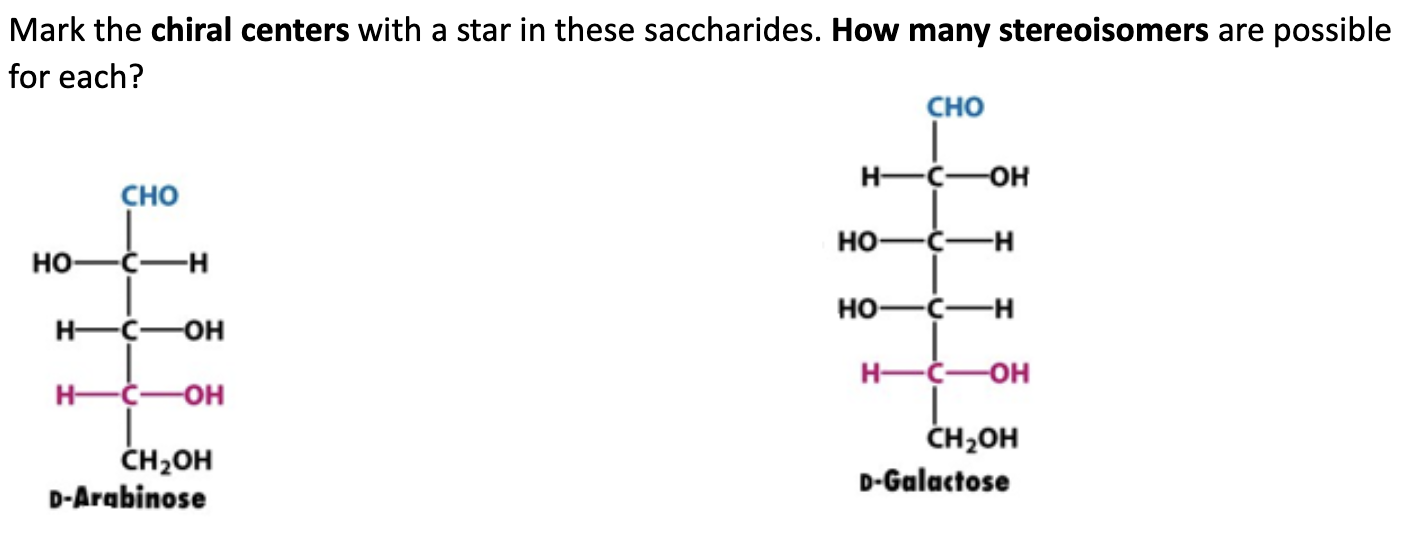
D-Argbinose: 3 main chain C’s are chiral, 8 stereoisomers
D-Galactose: 4 main chain C’s are chiral, 16 stereoisomers

Keto-L-pentose
D-glucose and D-mannose are what type of isomers?
Epimers
Define epimers
Molecules that have a different configuration at one chiral center
What is the function of the intramolecular cyclization reaction of glucose?
Generates a chiral center and forms a hemiacetal group and pyranose ring


What type of monosaccharide is shown?
What type of anomer is shown?
Name this molecule
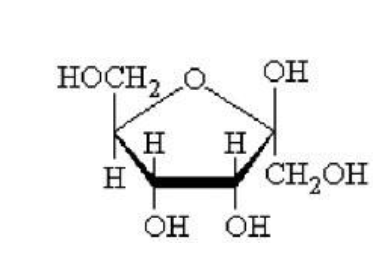
a. Ketose
b. B
C. Furanose
What happens to the aldehyde group of a monosaccharide in aldonic acid?
It is oxidized to form a carboxylic acid
What happens to the last carbon in the linear form of a monosaccharide in a uronic acid?
It is oxidized to form a carboxylic acid and the aldehyde remains unchanged
Define glycosidic bonds
Bonds that link monosaccharides in polysaccharides
Define a glycoside
A monosaccharide whose anomeric carbon atom has a glycosidic bond to an alcohol, amine, or thiol
Define sucrose
A non-reducing disaccharide formed by the condensation of one glucose molecule and one fructose molecule
Define maltose
A reducing disaccharide formed by two D-glucose molecules joined by an a(1→4) glycosidic bond
Since maltose is a reducing sugar, it has a positive Fehling’s test, which leads to the formation of what?
Cu2O precipitate
Define lactose
A reducing sugar formed by galactose and glucose
What monosaccharides are produced by the hydrolysis of sucrose
Glucose and fructose
What monosaccharides are produced by the hydrolysis of maltose
2 glucose molecules
What monosaccharides are produced by the hydrolysis of lactose
Glucose and galactose
What monosaccharides are produced by the hydrolysis of amylose
Glucose
What monosaccharides are produced by the hydrolysis of amylopectin
Glucose
When a sugar polymer has equal portions of reducing and non-reducing ends, what is it?
Linear
What is the difference between amylose and amylopectin?
Amylose forms linear polysaccharide chains made of a-D-glucose unites connected by a(1→4) glycosidic bonds that twist into a helical structure
Describe 3 similarities between glycogen and amylopectin
Contain 6000 residues
Have 1 reducing end and many nonreducing ends
Highly branched
Define amylase
A hydrolase that cleaves maltose units from the non-reducing ends of starch chains
Explain why cellulose is not highly branched
It does not have a(1→6) linkages
Define chitin
Found in insect and crustacean exoskeletons and is composed of N-acetylglucosamine subunits that form linear fibrils
What causes the elasticity and resistance to compression of connective tissue?
Carboxyl and sulfated groups in glycosaminoglycans
What are blood donor/receiver rules based on?
The presence or absence of antigens on red blood cells and antibodies in blood plasma
Define enatiomers
Nonsuperimposable mirror images
What type of isomers are the following molecules:

Enatiomers
What type of isomers are the following molecules:

Diasteroisomers
What type of isomers are the following molecules:

anomers
Define diasteroisomers
Isomers that are not mirror images
Define anomers
Isomers that differ at a new asymmetric carbon atom formed on ring closure
What causes the stability of crystalline fructose?
It adopts a cyclic six-membered structured