PSYC 360 Chapter 13 pptx
 Call Kai
 Learn
 Practice Test
 Spaced Repetition
 Match
 Flashcards
 Knowt Play
1/30

Earn XP
Description and Tags
PSYC 360 Drugs and Human Behavior
31 Terms

Chapter 13.
Opioids.


Opioids.
Opium is a naturally occurring substance derived from the poppy plant, Papaver somniferum.
• Has a 6,000-year-long history of medical use.
Opioids.
Drugs derived from opium.
Synthetic drugs with opiumlike effects.
Major effects of opioids.
Relieve pain and suffering.
Deliver pleasure and relief from anxiety.


Opium Cultivation.
Opium can be collected for only a few days of the plant’s life.
Opium harvesters make shallow cuts into the unripe seedpods in the evening.
• A white substance that oozes from the cuts during the night oxidizes to a red-brown color and becomes gummy.
• Scraped from the pod and collected in small balls in the morning.

Opium Cultivation.
Opium products.
• Morphine is extracted from raw opium and then heroin is derived.


History of Opium.
Egypt.
• 1500 BC: Ebers papyrus described the medical uses.
Opium played an important role in Greek medicine.
Arabic world.
Opium was used as a social drug.
Physicians wrote widely about the use of opium and described opioid addiction.


History of Opium.
Europe.
Opium started spreading in the 16th century.
Physicians developed a preparation called laudanum, a combination of strained opium and other ingredients.
Writers and opium.
1821: Thomas De Quincey published “Confessions of an English Opium-Eater.”
Elizabeth Barrett Browning and Samuel Taylor Coleridge wrote about the joys of opium.


History of Opium.
The Opium Wars.
1729: Opium smoking was outlawed in China.
Smuggling was profitable and widespread.
British East India Company was involved in opium trade with China indirectly.
Opium was legal in India.
Commissioner sent by the emperor of China confiscated the smuggled opium supplies from the merchants, which resulted in tensions between Britain and China.
Started in 1839 when a Chinese citizen was killed by drunken American and British sailors.


Morphine.
Morphine is the primary active ingredient in opium.
First isolated in 1806.
Named morphium after Morpheus, the god of dreams.
10 times as potent as opium.
Codeine is a secondary active alkaloid in opium.
First isolated in 1832.
Named after the Greek word for “poppy head.”


Morphine.
Morphine use spread because of two developments.
• Technological development.
• 1853: Hypodermic syringes allowed delivery of morphine directly into the blood.
• Political development.
• Widespread use during war provided relief from pain and dysentery to soldiers.
• Veterans returned addicted to morphine.
• Addiction was later called “soldier’s disease” or the “army disease.”


Heroin.
In 1874, two acetyl groups were attached to morphine to yield diacetylmorphine.
• Marketed with the brand name Heroin by Bayer Laboratories in 1898.
Three times as potent as morphine.
• Heroin enters the brain more rapidly since the two acetyl groups increase the lipid solubility of the heroin molecule.
Originally marketed as a nonaddictive cough suppressant that would replace morphine and codeine.
• Heroin was later linked to dependence.


Opioid Abuse before the Harrison Act.
Three types of opioid dependence were spreading in the United States.
Oral intake via patent medicines.
Opium smoking introduced by Chinese laborers.
Injection of morphine.
• The most dangerous form of use.
Percentage of Americans addicted to opioids at the start of the 20th century was:
Probably greater than at any other time before or since.
Possibly as high as 1 percent of the population.


Opioid Abuse before the Harrison Act.
Initially, opioid dependence was not viewed as a major social problem.
Opium smoking was limited to certain ethnic groups.
Patent medicines were socially acceptable.
Opioid addiction was viewed as a “vice of middle life.”
Typical user.
30- to 50-year-old white woman.
Purchased opioids legally as patent medicines.

Opioid Abuse after the Harrison Act.
Enforcement of the 1914 Harrison Act made opioids difficult to obtain.
• Only sources of drugs were illegal dealers.
The act resulted in changes in opioid use patterns.
Oral use declined.
Primary remaining group of users were those who injected morphine or heroin.
Cost and risk of use increased.
• The most potent method, the intravenous injection of heroin, was favored.
• Addicts were looked upon as criminals rather than as victims.


Opioid Abuse after the Harrison Act.
After the Second World War.
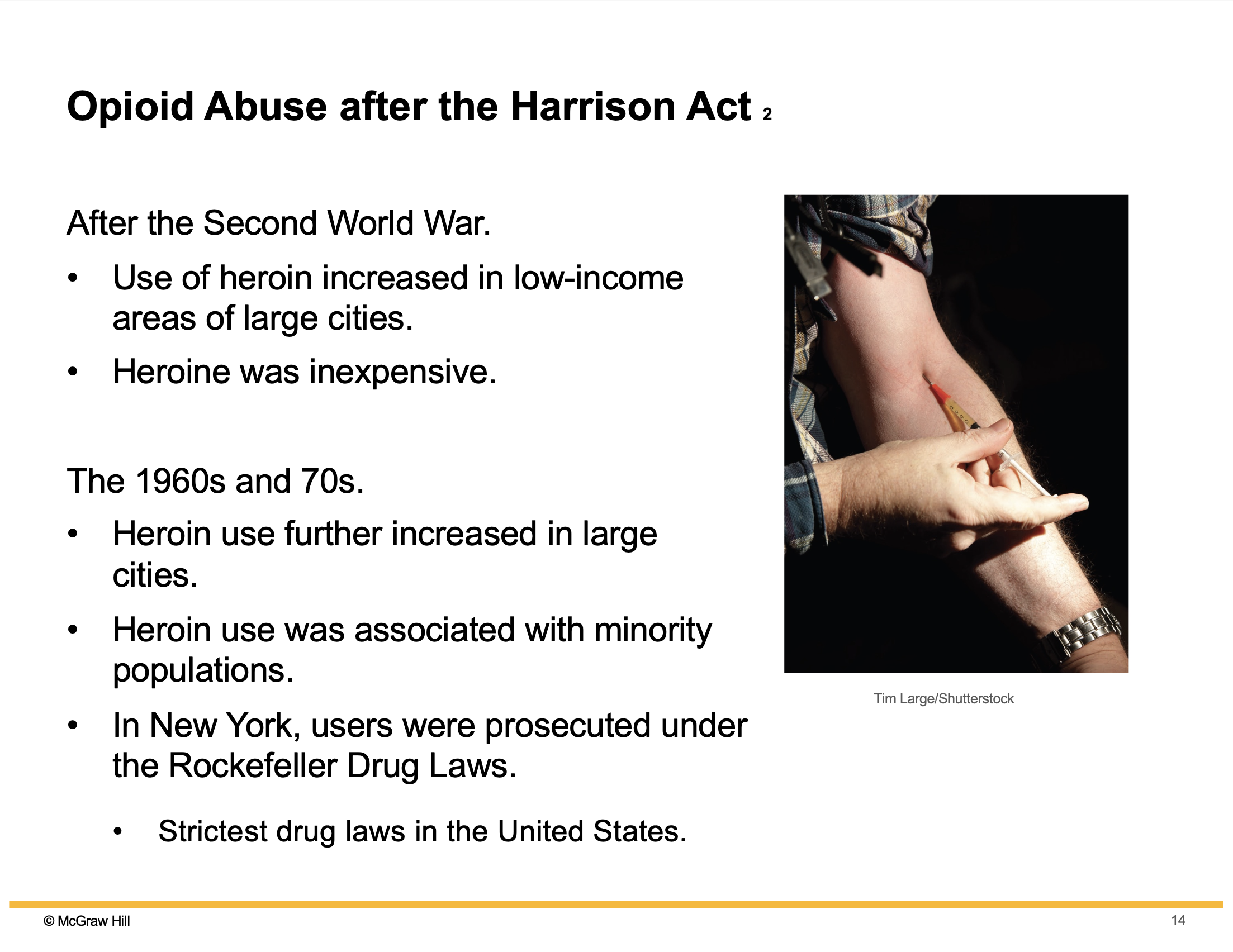
Use of heroin increased in low-income areas of large cities.
Heroine was inexpensive.
The 1960s and 70s.
Heroin use further increased in large cities.
Heroin use was associated with minority populations.
In New York, users were prosecuted under the Rockefeller Drug Laws.
• Strictest drug laws in the United States.

Heroin Use in Vietnam.
Heroin in Vietnam.
Inexpensive.
Pure.
Easy to obtain.
About 5.1 percent of 100,000 personnel tested positive for opioids in 1971.
Most users smoked or sniffed the drug because of the purity.
Most users stopped when they returned to the United States.

Heroin Use in Vietnam.
Important things learned from the Vietnam experience.
Under certain conditions, a relatively high percentage of individuals will use opioids recreationally.
Heroin addiction is not inevitable among occasional users.


Heroin Production and Purity.
Most of the heroin used in the United States is derived from poppies grown in Mexico and Colombia.
Purity of heroin has increased dramatically in recent years.
Mid-1970s through the mid-1980s: Purity varied from four to six percent.
1989: The average street purity was 25 percent.
Currently: Wholesale purity ranges between 51 and 83 percent.
2018 National Survey on Drug Use and Health.
Less than 2 percent of Americans reported ever having used
heroin.
0.3 percent reported use in the past year.


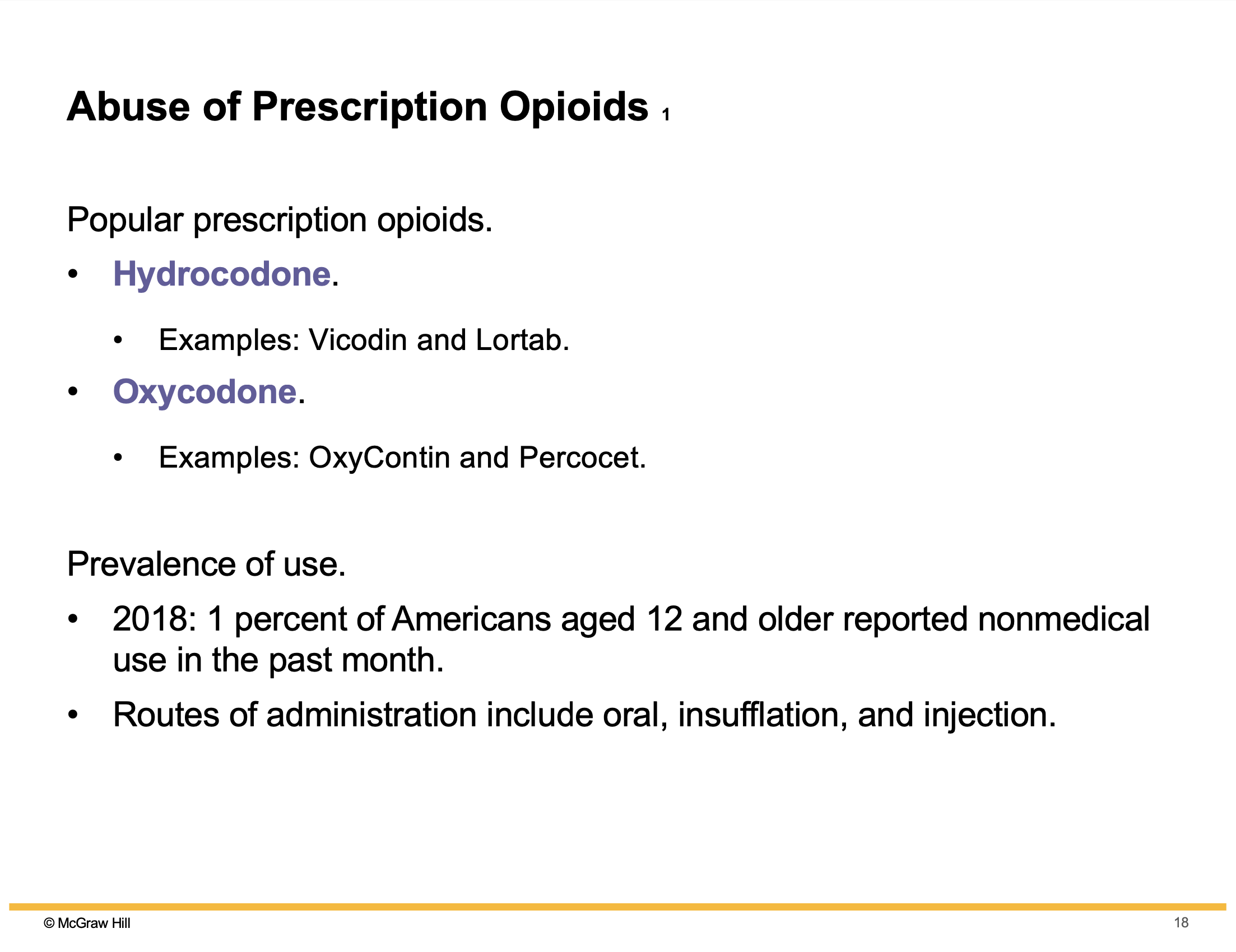
Abuse of Prescription Opioids.
Popular prescription opioids.
• Hydrocodone.
• Examples: Vicodin and Lortab.
• Oxycodone.
• Examples: OxyContin and Percocet.
Prevalence of use.
2018: 1 percent of Americans aged 12 and older reported nonmedical use in the past month.
Routes of administration include oral, insufflation, and injection.

Abuse of Prescription Opioids.
Safety concerns.
• Most opioid overdoses occur in combination with a sedative such as alcohol.


Figure 13.2: Narcotic Agents Isolated or Derived from Opium.


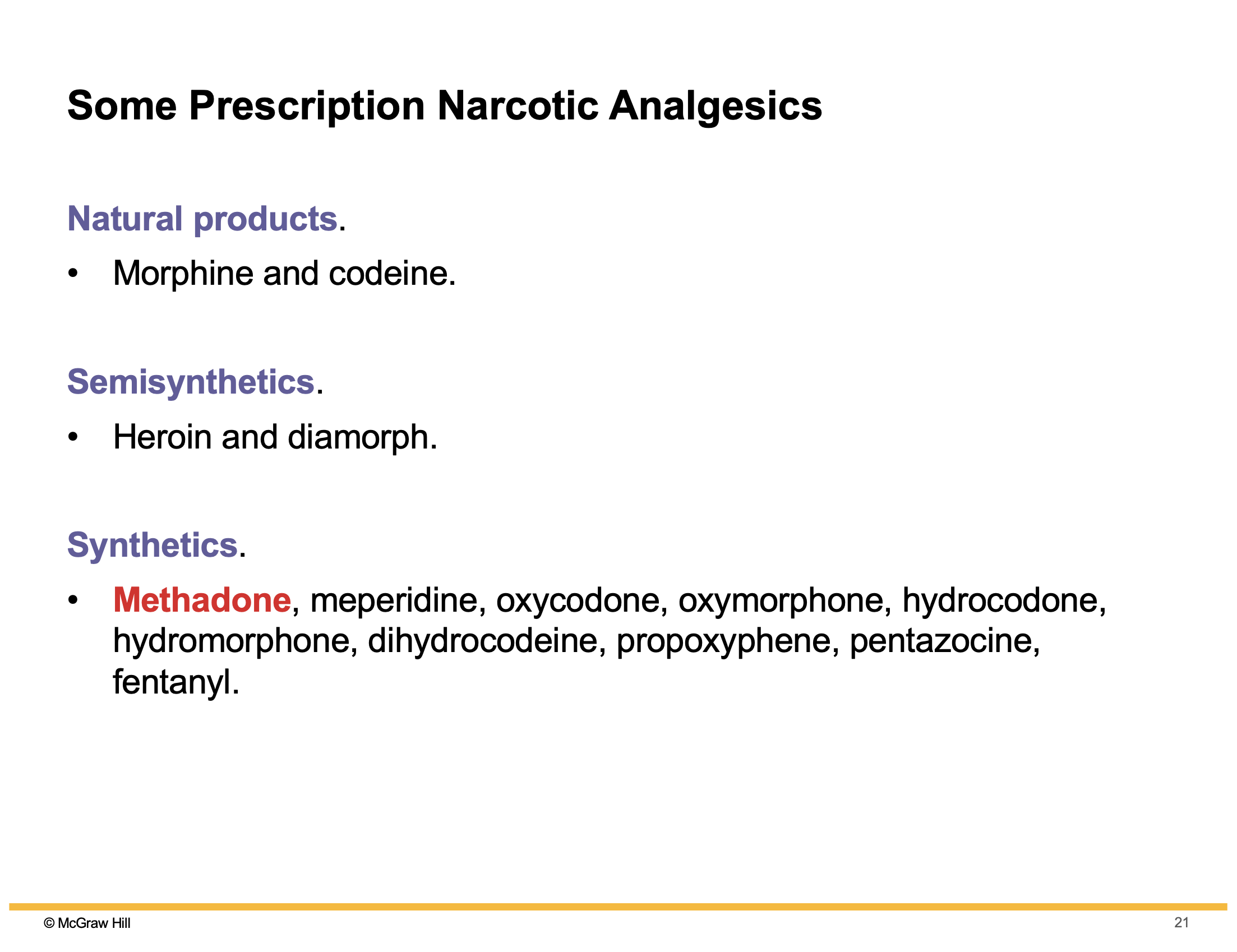
Some Prescription Narcotic Analgesics.
Natural products.
• Morphine and codeine.
Semisynthetics.
• Heroin and diamorph.
Synthetics.
• Methadone, meperidine, oxycodone, oxymorphone, hydrocodone, hydromorphone, dihydrocodeine, propoxyphene, pentazocine, fentanyl.

Mechanism of Action.
Natural activators of opioid receptors.
• Enkephalins: Found in brain extracts.
• Act like morphine and are many times more potent.
• Endorphins: Morphinelike substances found in brain tissue.
• Have potent opioid effects.
Endogenous opioids and opioid drugs have actions on several types of opioid receptors.
Mu and kappa receptors: Play a role in pain perception.
Delta receptors: Play a role in pain perception, but their role appears to be limited to chronic pain.

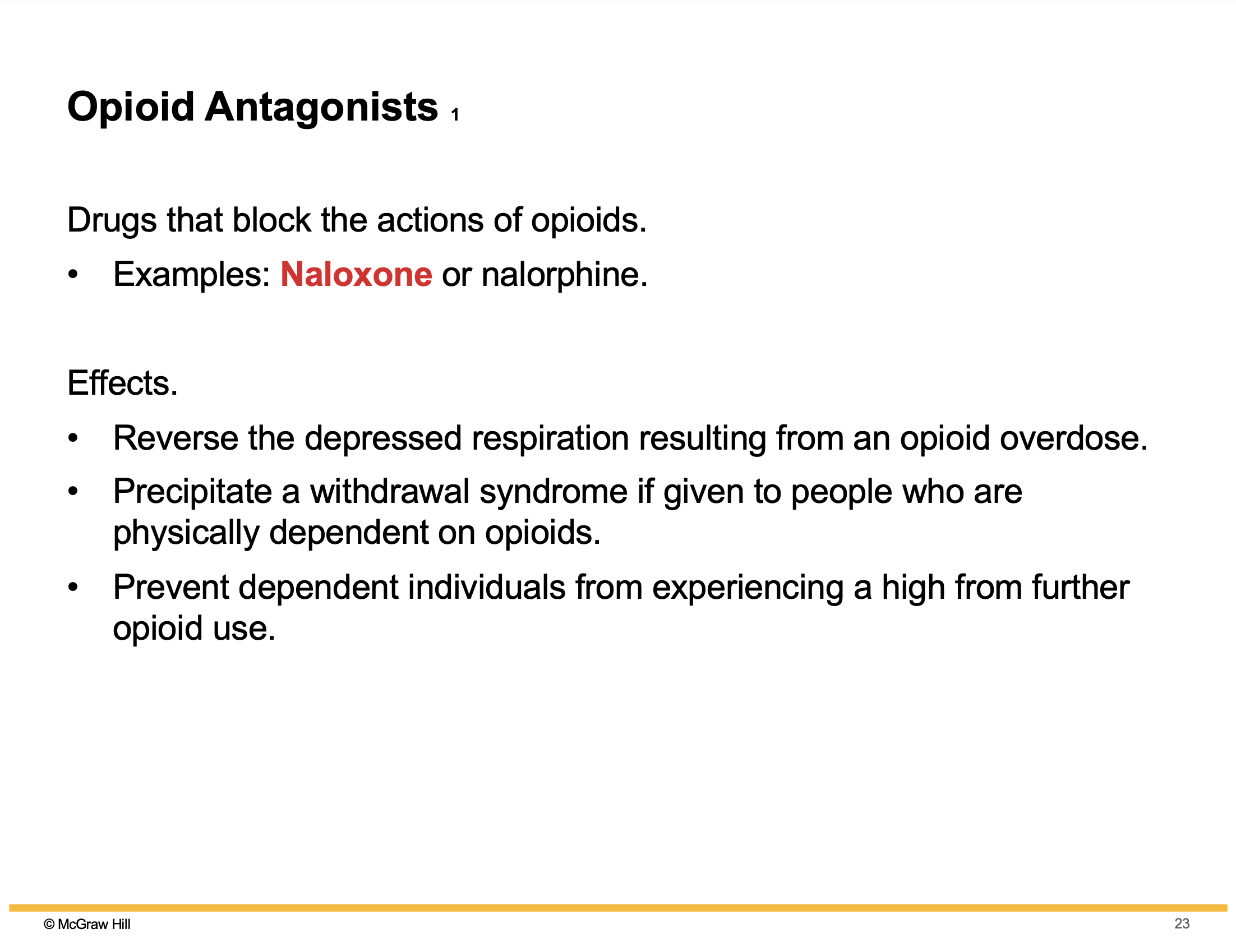
Opioid Antagonists.
Drugs that block the actions of opioids.
• Examples: Naloxone or nalorphine.
Effects.
Reverse the depressed respiration resulting from an opioid overdose.
Precipitate a withdrawal syndrome if given to people who are physically dependent on opioids.
Prevent dependent individuals from experiencing a high from further opioid use.

Opioid Antagonists.
Harm reduction strategy.
• Several cities have initiated programs that provide naloxone to illicit opioid users and their partners, friends, and slash or family members.
• Results in fewer overdose deaths.

Beneficial Uses of Opioids.
Pain relief.
Reduce the emotional response to pain.
Diminish the patient’s awareness of and response to the aversive stimulus.
Typically cause drowsiness but do not induce sleep.
Treatment of intestinal disorders.
Counteract diarrhea and the resulting dehydration.
Decrease the number of peristaltic contractions, which is the type of contraction responsible for moving food through the intestines.


Beneficial Uses of Opioids.
Cough suppressants.
Codeine has been widely used for its antitussive properties.
Dextromethorphan is more selective in its antitussive effects.
• Produces psychedelic effects at high doses.

Dependence Potential.
Tolerance.
• Develops to most effects.
• If used for pain relief, dose is increased to maintain constant effects.
• Cross-tolerance exists among all the opioids.
Physical dependence.
Opioid withdrawal is unpleasant but rarely life-threatening.
Withdrawal symptoms can be prevented with any opioid agonist.
• Legal methadone prevents withdrawal symptoms for as much as a day.


Table 13.2: Sequence of Appearance of Some of the Abstinence Syndrome Symptoms.
Signs | Approximate Hours after Previous Dose of Heroin and Slash or Morphine | Approximate Hours after Previous Dose of Methadone |
Craving for drugs, anxiety | 6 | 24 |
Yawning, perspiration, running nose, teary eyes | 14 | 34 to 48 |
Increase in above signs plus pupil dilation, goose bumps (pilorection), tremors (muscle twitches), hot and cold flashes, aching bones and muscles, loss of appetite | 16 | 48 to 72 |


Table 13.2: Sequence of Appearance of Some of the Abstinence Syndrome Symptoms.
Signs | Approximate Hours after Previous Dose of Heroin and Slash or Morphine | Approximate Hours after Previous Dose of Methadone |
Increased intensity of above, plus insomnia; raised blood pressure; increased temperature, pulse rate, respiratory rate and depth; restlessness; nausea | 24 to 36 | NA |
Increased intensity of above, plus curled-up position, vomiting, diarrhea, weight loss, spontaneous ejaculation or orgasm, hemoconcentration, increased blood sugar | 36 to 48 | NA |


Toxicity Potential.
Acute toxicity.
Opioids depress the respiratory centers in the brain.
Opioid agonists stimulate the brain area controlling nausea and vomiting.
Can be counteracted with naloxone.
Chronic toxicity.
• Associated with injection.
• Sharing needles can result in the spread of blood-borne diseases.


Misconceptions and Preconceptions.
Belief that injecting heroin or morphine gives intense pleasure unequaled by any other experience.
Some people report nausea and discomfort but continue use.
Tolerance to negative effects develops more rapidly compared to euphoric effects.
Withdrawal always involves excruciating pain.
• For users using a low daily drug dose, withdrawal is often similar to a mild case of the intestinal flu.
One injection gets a person addicted for life.
• Becoming dependent takes time and persistence.
