MIDTERM IBS - VERTEBRAL COLUMN AND THORAX
 Call Kai
 Learn
Learn Practice Test
 Spaced Repetition
 Match
Match Flashcards
 Knowt Play
1/158

There's no tags or description
Looks like no tags are added yet.
Name | Mastery | Learn | Test | Matching | Spaced | Call with Kai | Chat |
|---|
No analytics yet
Send a link to your students to track their progress
159 Terms
Hyoid bone, axial or appendicular?
axial skeleton
Hyoid bone, special feature:
does not articulate with any other bone
How is the hyoid bone suspended?
Suspended from the styloid processes by ligaments and muscles

Where is hyoid bone located? attachment site for what?
anterior neck between the mandible and larynx
attachment site of muscles of the neck and pharynx

Hyoid bone structure:
horizontal body, lesser horns and greater horns

Vertebral column makes up ____ of total height
2/5th
Vertebral column composed of series of bone called…
vertebrae
Vertebral column functions:
✓ strong, flexible rod
✓ encloses and protect the spinal cord
✓ supports the head
✓ attachment point for the ribs, pelvic girdle + muscles of the back and neck
Vertebrae # during development:
33 vertebrae
Vertebrae # when adult:
26 vertebrae
How many cervical vertebrae are there and where are they located?
7 – Cervical vertebrae in the neck region
How many thoracic vertebrae are there and where are they located?
12 - Thoracic vertebrae posterior to the thorax
How many lumbar vertebrae are there and what do they support?
5 – Lumbar vertebrae support the lower back
What does the sacrum consist of?
1 – Sacrum consists of five fused sacral vertebrae
What do the sacral vertebrae articulate with?
hip bones
What does the coccyx consist of?
1 – Coccyx consists of four fused coccygeal vertebrae
What does the coccyx form?
terminus of the vertebral column
What are the cervical vertebrae numbered?
C1–C7
What are the first two cervical vertebrae called?
Atlas - C1
Axis - C2
What are the thoracic vertebrae numbered?
T1–T12
What are the lumbar vertebrae numbered?
L1–L5

What are the coccygeal vertebrae numbered?
Co1–Co4
Which curves of the vertebral column are convex?
Cervical and lumbar curves

Which curves of the vertebral column are concave?
Thoracic and sacral curves
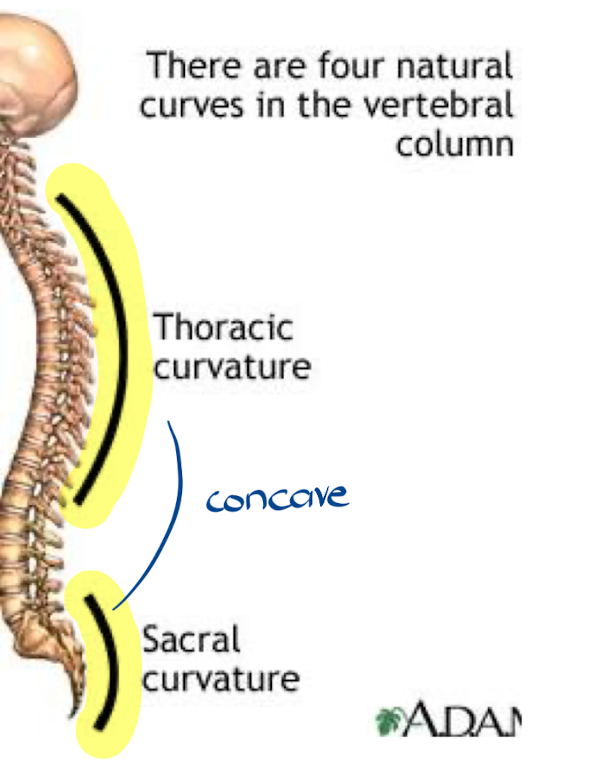
What type of curve does a fetus have?
single anteriorly concave curve

What are the primary curves?
thoracic and sacral curves
What do the primary curves retain?
original curvature of fetal life
What are the secondary curves?
cervical and lumbar curves
When do the secondary curves begin to form?
after birth
What are the functions of the curves of the vertebral column?
increase strength, maintain balance, absorb shocks, protect from fracture
What is scoliosis?
Lateral bending of the thoracic region

What causes scoliosis?
congenitally malformed vertebrae

What is kyphosis?
Increase in the thoracic curve (elderly)
What causes kyphosis?
Degeneration of the intervertebral discs

What is lordosis?
Increase in the lumbar curve
What causes lordosis?
Increased weight of the abdomen


Where do the anterior and posterior longitudinal ligaments run?
continuous bands down the front and back surfaces of the vertebrae
neck to the sacrum
What is the anterior ligament strongly attached to?
Bony vertebrae and the discs
What does the anterior ligament prevent?
Hyperextension of the spine

What does the posterior ligament attach more firmly to?
The discs
What does the posterior ligament resist?
Hyperflexion of the spine.


What is the ligamentum flavum?
short ligaments connecting laminae of adjacent vertebrae
What does the ligamentum flavum contain?
Strong elastic connective tissue
How does the ligamentum flavum respond to posture?
Stretches and recoils according to posture
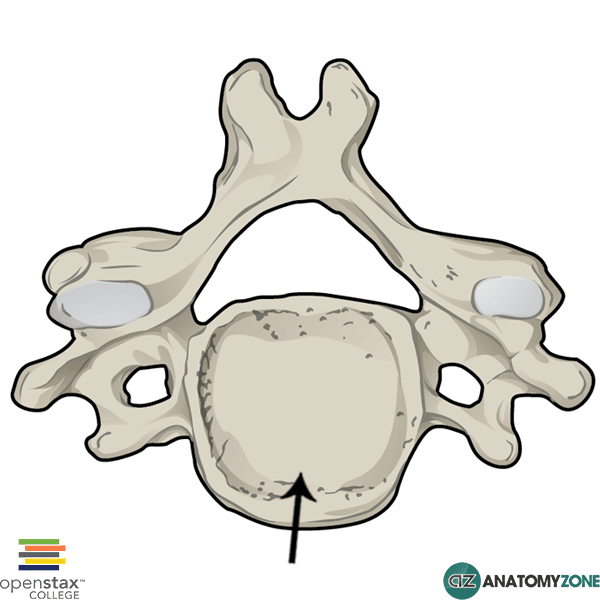
What is the vertebral body?
Thick, disc-shaped anterior portion
The vertebral body is the ____-_____ part of a vertebra
the vertebral body is the weight-bearing part of a vertebra
What are the roughened superior and inferior surfaces of the vertebral body for?
attachment of cartilaginous intervertebral discs
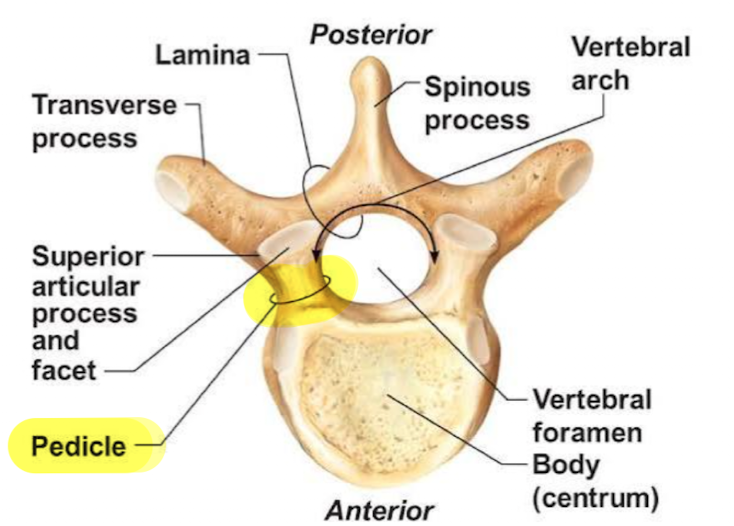
What are pedicles?
Two short, thick processes
Where do pedicles project from?
Posteriorly from the vertebral body
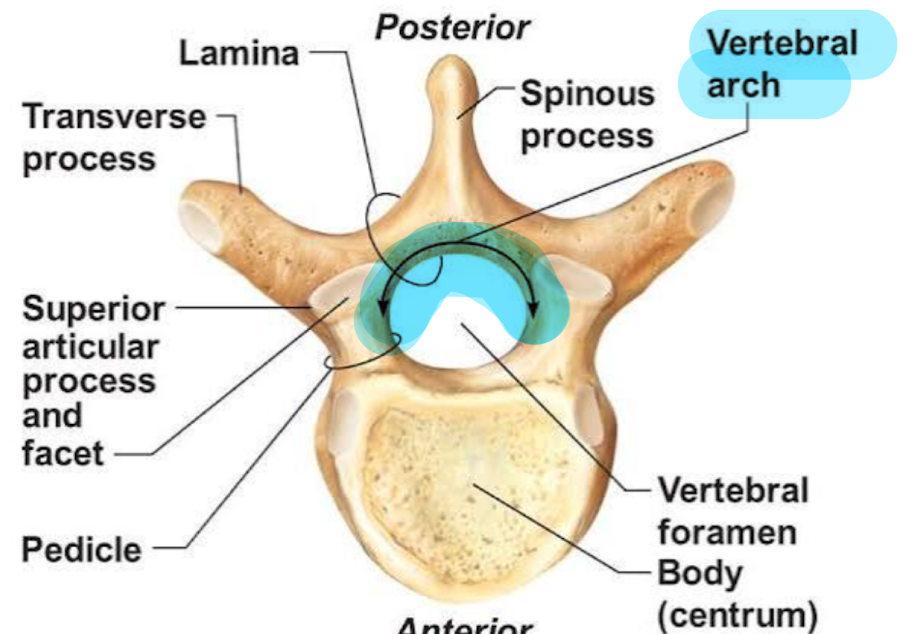
How is the vertebral arch formed?
union of pedicles with the flat laminae

Where does the vertebral arch extend?
Posteriorly from the body of the vertebra

How is the vertebral foramen formed?
vertebral body and the vertebral arch together

What does the vertebral foramen surround?
spinal cord
What does the vertebral foramen contain
adipose tissue
areolar connective tissue
blood vessels

How is the vertebral (spinal) canal formed?
vertebral foramina stacked one on top of the other
What are vertebral notches?
Superior and inferior indentations of pedicles

What do vertebral notches form?
opening between adjoining vertebrae

What is the intervertebral foramen?
Opening between adjoining vertebrae.
What does the intervertebral foramen permit?
passage of spinal nerve
How many processes arise from the vertebral arch?
7

What is the transverse process?
extends laterally on each side
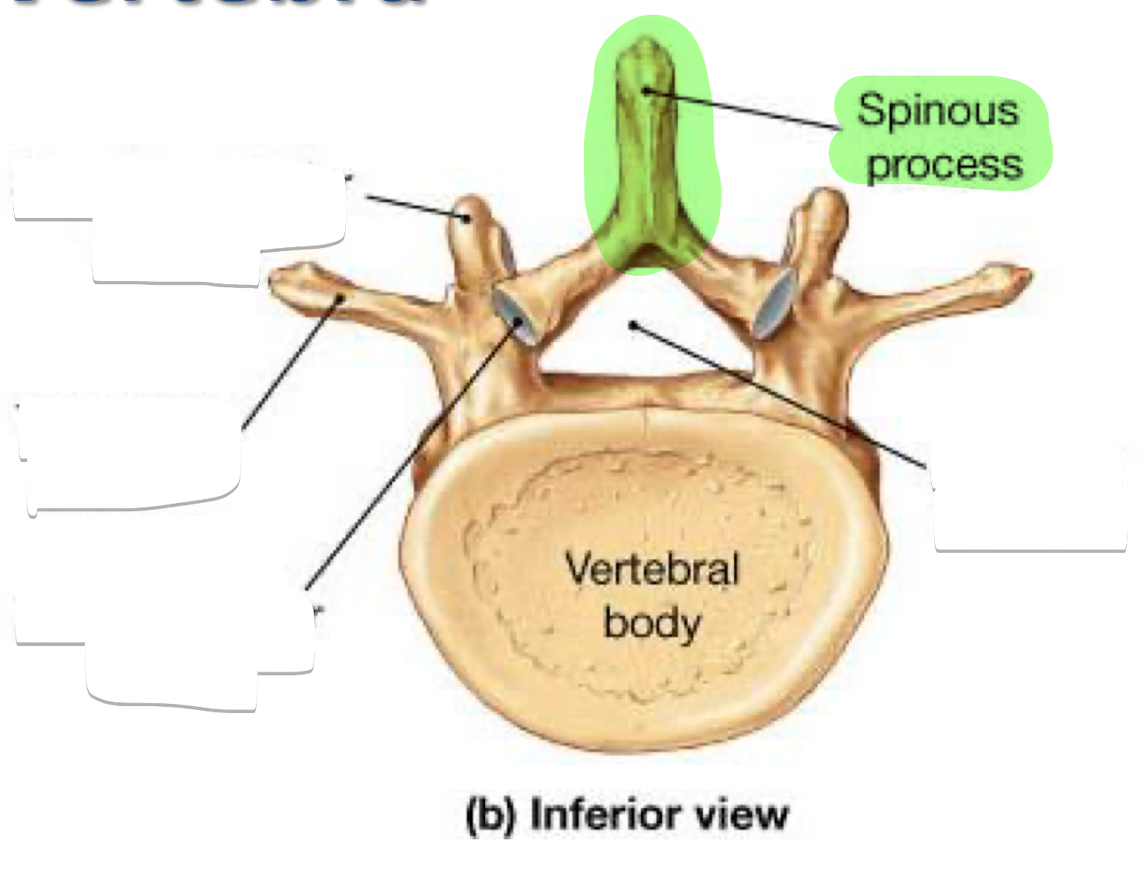
What is the spinous process?
projects posteriorly from the junction of the laminae.
What is the function of the transverse and spinous processes?
serve as points of attachment for muscles

How many superior and inferior articular processes are there?
two of each
What is the function of the four articular processes?
form joints with other vertebrae above or below

What are facets?
articulating surfaces of the articular processes
What covers the facets?
Hyaline cartilage
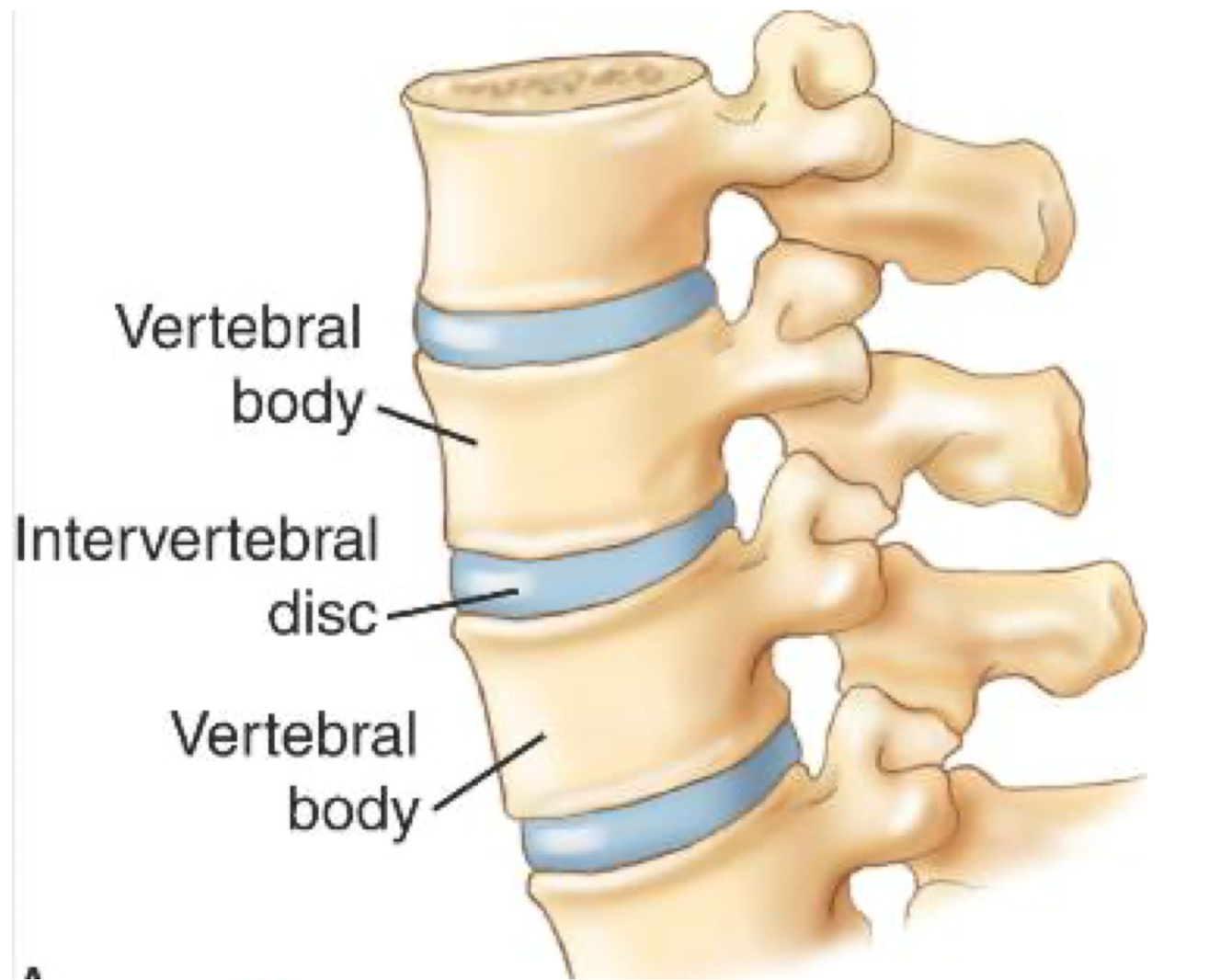
Where are intervertebral discs found?
Between the bodies of adjacent vertebrae

From which vertebra to which vertebra are intervertebral discs found?
second cervical vertebra to the sacrum
What do the superior and inferior surfaces of the intervertebral disc consist of?
thin plate of hyaline cartilage
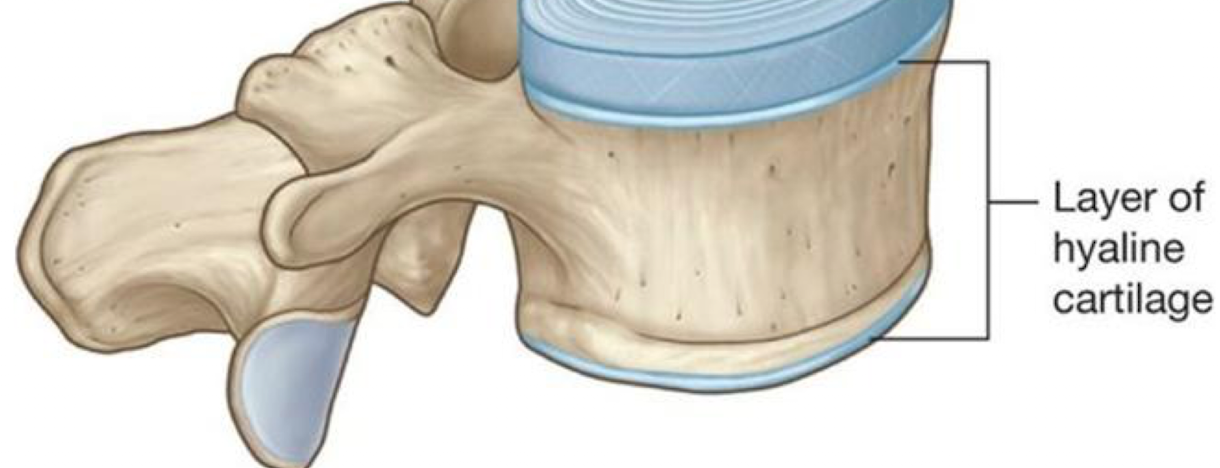
What are the two regions of an intervertebral disc?
Annulus fibrosus and nucleus pulposus


What is the annulus fibrosus?
outer fibrous ring of fibrocartilage

What is the nucleus pulposus?
inner soft, pulpy, highly elastic substance
What are the functions of intervertebral discs?
form strong joints
permit flexion, extension, and lateral bending of spine
absorb vertical shock during walking, jumping, running

What causes a herniated (slipped) disc?
Injury to the anterior and posterior ligaments

What happens to the nucleus pulposus during a herniated disc?
built up pressure
What does increased pressure in the nucleus pulposus lead to?
rupture of the annulus fibrosus

What happens when the annulus fibrosus ruptures?
nucleus pulposus herniates (protrudes) posteriorly
What does a herniated disc exert pressure on?
spinal nerves
What are the effects of a herniated disc?
Local weakness and acute pain
Where do herniated discs most often occur?
lumbar area

Which nerve may be compressed by a herniated disc?
sciatic nerve
Where does pain from sciatic nerve compression radiate?
calf → posterior thigh → even to the foot
What is flexion?
Anterior bending of the spine

What is extension?
Posterior straightening of the spine

What is lateral flexion?
Bending upper body to the right or left

What is rotation?
Vertebrae rotate on one another, longitudinal axis of spine

Which region of the spine has the greatest range of movement?
Cervical region
How does the size of cervical, thoracic, and lumbar vertebrae compare?
Cervical: Small
Thoracic: Larger
Lumbar: Largest
What foramina are present in cervical vertebrae?
1 vertebral, 2 transverse
What foramina are present in thoracic vertebrae?
1 vertebral formamen

What are the spinous processes of cervical vertebrae like?
Slender, often bifid
What are the spinous processes of thoracic vertebrae like?
Long, fairly thick, project inferiorly
What are the spinous processes of lumbar vertebrae like?
Short, blunt, project posteriorly
What are the transverse processes of cervical vertebrae like?
Small
What are the transverse processes of thoracic vertebrae like?
Fairly large
What are the transverse processes of lumbar vertebrae like?
Large and blunt
Are articular facets for ribs present in cervical vertebrae?
Absent
Are articular facets for ribs present in thoracic vertebrae?
Present
Are articular facets for ribs present in lumbar vertebrae?
Absent