BOSC1 Human Behavior
 Call Kai
 Learn
 Practice Test
 Spaced Repetition
 Match
 Flashcards
 Knowt Play
1/67

There's no tags or description
Looks like no tags are added yet.
68 Terms
= Individuals are less likely to offer help to a victim when other people are present
Reasons:
• Informational conformity (= if nobody is helping, it must be dangerous)
• Normative conformity (= following the rules of the group)
• Diffusion of responsibility (= there are so many people here, someone else will take care)
a) opinion -> experience, readings, observation
b) scientific study
c) meta-analysis = analysis of a lot of different studies
= Inclination, after an event has occurred, to see the event as having been predictable, despite there have been little or no objective basis for predicting it.
e.g. Picture with a hidden baby: after knowing it is there, it is obvious
Illusory correlations
= Perception of a relationship between variables even when no such relationship exists
Examples:
• Full moon and bad sleep
• Vaccine and autism
• Lucky socks
= Tendency to ignore base rate information and focus on specific information
e.g., after 9/11, no one wanted to fly even though they were more likely to die in a car crash
False consensus effect
= Belief that others share the same beliefs or thoughts Overestimation:
• People like the same food than you do
• People share the same political views
• People have the same complaints
Stages:
1. Encoding
2. Storage
3. Retrieval
Capacity: short-term vs long-term memory
Forgetting curve
• Organization
→ Acronyms: OCEAN/ FBIMTVUSAHBOCIA (→ split)
• Elaboration
= a strategy assigning meaningful information to something you are trying to remember
→ Dual coding = absorbing information in 2 different ways
• Transfer-appropriate processing
→ the mental processes used during learning match the processes needed later when you are tested (e.g., driving)
• The baker/baker paradox:
→ you can memorize things better when you visualize them
→ you should learn in the same context you are going to be tested in if you practice on the beach, you perform better on the beach
Method of loci
/memory palace
= you walk through your apartment in your mind and associate each memory with a room
3 stages:
• Identification of locations
• Encoding
• Retrieval
Remembering a guests name
• Decide to listen
• Use it again (2-3x in the conversation)
• Attach something (3 details method)
• Say it back
Retrieval practice
STTT (study & test x3) works the best
Why is it beneficial?
• Transfer-appropriate processing → same competencies in tests (retrieval) and exam (retrieval) ≠ restudy (encoding)
• Identification of gaps in knowledge
• Better learning in the next study episode
Massed vs distributed practice
Why is distributed practice better?
• Contextual variability
• Diminished effort in the massed condition
• Distributed practice → accessibility reduced to information → better learning
Why is massed practice preferred?
• Short-term retrieval fluency ≠ long-term learning
The PQ4R method
Used to better retain readings
• Preview
• Question
• Read
• Reflect
• Recite
• Review
Self-management
• matters but we are not very good at it
• One cannot manage others effectively before managing oneself effectively.
• These skills have a significant impact on a range of outcomes
• Lower stress
• Higher perceived control of time
• Better life satisfaction and well-being
• Better grades
• Better performance
• Increased citizenship behaviors
• The capacity to delay gratification is related to success
• Caused by the temporal discounting effect (= $60 now or $100 in 3 months, $65 now or $100 in 3 months,...)
= Tendency to underestimate how long a task will last
e.g. Sydney Opera House (expected: 1963, 7 mio $, reality: 1973 102 mio $)
to avoid:
• break down into steps
• use data (ask others, do it in a team)
The 168 exercise
= Keep track of your time
• 168h in a week
The time management matrix
= Eisenhauer Matrix
• urgent - not urgent
• important - not important
= priorities in life
• rocks = family, health, relationships
• pebbles = school, work
• sand = material possessions
→ if you start to fill the jar with sand, the rocks & pebbles won't fit
goals definition
“Object or aim of an action usually within a specified time limit.”
Different types of goals:
• Approach vs. avoidance goals ( approach more effective)
• Proximal (short-term) vs. distal (long-term) goals (both needed)
• Performance vs. behavioral goals (both needed)
What constitutes an effective goal?
• should be specific
• should be difficult/challenging
Why do specific/difficult goals have a positive effect on performance?
1. mediators
• Direction
→ risk: neglect of any other dimensions (being too focused on the goal) e.g. Wells Fargo – goal: each customer should have 8 products (they made them up)
• Intensity
• Persistence
• Increased knowledge/discovery of new strategies
2. moderators
• Ability (sufficient proficiency)
• Feedback
• Commitment (Assigned = self-set = participative)
• Task complexity (more effective for «simple» tasks)
Implementation intentions
• What, Where, When
• Inappropriate goal → Behavioral goal → Performance goal
Achieving your goals through self-management
• Setting specific and difficult goals
• Paper calendar vs. computer calendar
• Budgeting time
• Implementation intentions
• Monitoring goal progress
• Reflection
= Process by which individuals organize and interpret their sensory impressions to give meaning to their environment
• Trust and interpersonal relations
• Hiring and promotion decisions
= our judgment is clouded by the first impression we have of a person
• for managers: be attentive during the entire interview
= we hold more favorable impressions towards others who are similar to ourselves
Dangers:
• Surrounding ourselves with similar others
• Bias
= a positive impression in one specific area unconsciously influences how people judge that person or product's other, unrelated traits
= We do not judge people in isolation, but in comparison to others → impressions are distorted
• Tip for managers: use external benchmarks and not your impression
= We make internal attributions for others’ behavior (when external factors can be responsible)
→ for yourself: you blame external attribution e.g., France Télécom: “Employees should stop this 'fashion for suicide” (quote from CEO)
• Tip for managers: Question your beliefs
The Self-fulfilling prophecy
= “pygmalion effect”
→ people tend to rise (or sink) to the level of what others expect of them
1. Expectation (Person A)
2. Behavior (Person A)
3. Target Response (Person B)
4. Confirmation (Person A)
= Situation in which there is a risk of confirming, as self-characteristic, a negative stereotype about one's group
e.g., telling women that men & women perform the same in this math test lead to them performing the same, while they performed way worse without that
Structured interviews
Content:
Better Questions
Control ancillary (secondary) information
Evaluation:
Anchored rating scales
Questions:
Past behavior (best for structured interviews → most relevant to the job)
Situational
Background (describe what happened in the past, behavior: what you did/ how you reacted)
Job knowledge
Opinions/attitudes
Goals/aspirations
Self-description
Situation
Task
Action
Result
→ past behavior questions
System 1 and System 2 of thinking
System 1:
fast
instinctive
emotional
e.g. everyday decisions (name)
error-prone (more likely to make mistakes)
decision-making: heuristic, biases
System 2:
slow
conscious
logical
complex decisions
reliable (more time to develop a system)
e.g., do your taxes, 13499+464547=?
decision-making: rational decisions model
e.g., cognitive reflection test (test instinctive vs. actual answer)
Default heuristic bias
a mental shortcut your mind falls back on when you don’t have the time, information, or energy to think a decision through carefully. It’s the “go-to” rule of thumb that kicks in automatically.
The sunk cost fallacy
the tendency to keep investing in something because of what you’ve already put into it (time, money, effort), even when continuing no longer makes sense. The past cost is “sunk,” meaning it can’t be recovered, so rationally it shouldn’t influence what you do next.
e.g., Wisconsin vs. Michigan ski trip
Anchoring bias
= the tendency to rely too heavily on the first piece of information you encounter (the “anchor”) when making a judgment, even if that information is irrelevant or arbitrary. Later estimates then get pulled toward it instead of being made independently.
→ comes from the conflict between System 1 & 2
e.g., 75% off vs. putting the o.g. price and the new one
Framing effect
= tendency for people to react differently to the same information depending on how it’s presented, usually as a gain or as a loss. The facts stay identical, but the wording changes the choice.
e.g., COVID outbreak, 200 people saved vs 400 people die
Confirmation bias
= tendency to seek out, notice, interpret, and remember information in ways that support what you already believe, while overlooking or downplaying evidence that contradicts it
→ our brain does not like it if we disconfirm, but if we want to test a hypothesis, we have to disconfirm
Overcoming cognitive biases
Do not take into consideration past decisions (sunk cost fallacy)
Question the information provided (anchoring bias)
Reframe the information (framing effect)
Find how you could be wrong (confirmation bias)
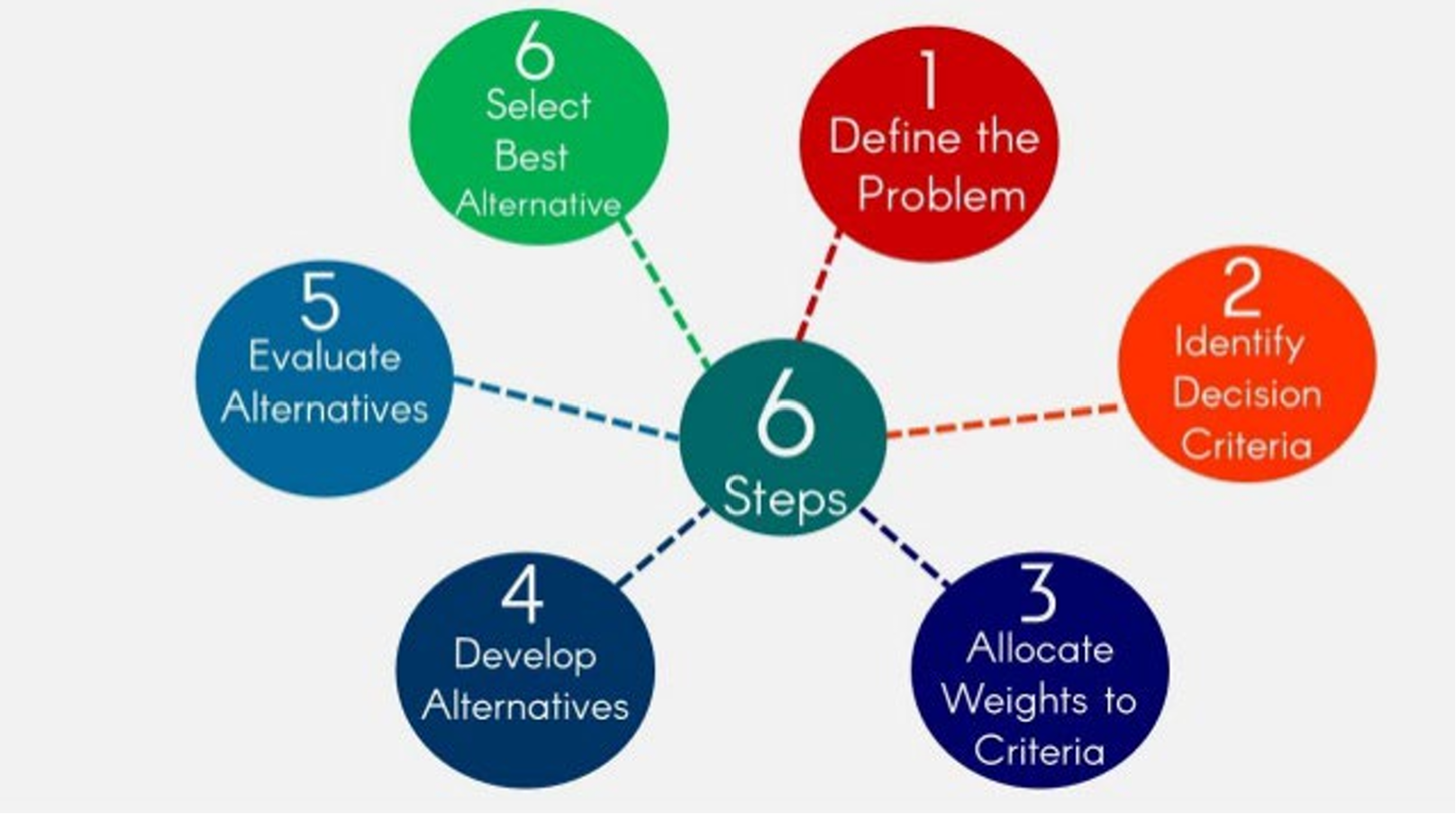
Rational decision-making model
The rational decision-making model
Locus of control
Internal locus of control:
better job performance
higher job satisfaction
participative leadership style: involving their subordinates in key decisions → think that others have the same mindset & do not need to be pushed to get things done
fit for performance: autonomy in their job
take responsibility & are more active (e.g., after a failure, they adapt instead of blaming others
persistent & delay gratification (don’t need immediate rewards to stay motivated)
don’t wait for others & look for information by themselves
External locus of control:
lower job performance
lower job satisfaction
coercive leadership style: use constraint → think that others need a strong leader to get motivated
fit for performance: outside control
The Dark Triad
psychological test
high score: more likely to act unethically & break rules
if you possess one, you are more likely to possess the others
most people score average: high & low are seldom
Psychopathy
low empathy & high impulsivity
deviant behavior & disregard for others
key characteristics: disinhibition (= inability to hold back impulses), meanness & boldness
Narcissism
vanity, self-superiority, entitlement, dominance & willingness to be admired by others.
belief that they deserve more than anybody else because they are better than everybody else
Machiavellianism
unprincipled, manipulative & cynical
principle: "the end justifies the means"
job experience & job performance relationship
post-hire experience: better performance over time
pre-hire experience: 1-3 months after hiring: better performance, 6-12 months: no correlation
schemas/habits or skills are different across jobs
Why do employers still require it?
recruitment is a decision-making process in a situation of limited information → HR & managers try to reduce uncertainty
professional socialization: familiar with job, community of practice, groups of professionals that have their codes and habits
Intelligence
Definition: individual’s ability to:
act purposefully
think rationally
deal effectively with the environment
the positive manifold:
= tendency that scores on different tests of intelligence correlate positively with each other
→ general intelligence (g)
CHC model of intelligence:
10 broad characteristics:
Fluid (reasoning & logic) → best g indicator
Cristallized (knowledge)
Visual (processing)
Short-term (memory)
Long-term (storage & retrieval)
Processing Speed
Auditory Processing
Intelligence tests: results = highly stable over time
Task performance:
capacity to solve new problems
capacity to learn quickly
the smarter, the better
→ intelligence also related to:
training performance
counterproductive work behaviors
income & career success
high school dropout, divorce & incarceration
Overconfidence bias/ Above average effect
= we all think that we are above average even though it can statistically not be true for everyone
Self-serving bias
Giving internal reasons for success
Giving externals reasons for failure
e.g. Kyrgios tennis player
The barnum effect
= tendency to see vague, general statements as accurate descriptions of yourself, even though they would fit almost anyone
e.g., Astrology
Type vs. trait approaches
Type approach:
Types are different from one another
People are put into categories
Qualitative differences between people
Ex: MBTI, DISC, Enneagram
Trait approach:
All people possess traits
Measure quantity of the trait
Normal distribution & most people possess average amount
Ex: Hogan assessments, HEXAPRO, Neo-PI
What is the big five model?
Personality
Coherent patterning over time and space of affect, behavior, cognition, and desire (Wilt & Revelle, 2009)

Openness to change
Facets:
Imagination
Willingness to experiment
Intellectual curiosity
Tolerance for diversity
It means:
complexity (over simplicity)
Creativity/intelligence
Interest in arts
interest in learning
Deepness of emotions
Difficult to observe
Number of books
Conscientiousness
Facets:
Orderliness
Sense of responsibility
Self-discipline
Deliberateness
That means:
Conscientiousness ≠ consciousness
Time orientation: future
Orderliness
Related positively to grades and attendance
Sense of competence
Need for achievement/ambition
Observable in work contexts
Extraversion
Facets:
Warmth
Outgoingness
Assertiveness
Activity level
Other characteristics:
Need for stimulation/risk-taking
Leadership/first to speak
Get bored more quickly
Number of connections
Positive emotions
Easiest trait to observe
Agreeableness
Facets:
Trust in others
Consideration
Compliance
Sympathy
Other characteristics:
Altruism and adaptation
Make compromises
Less conflicts
Leniency
Modesty
Difficult to observe (excepted when goals do not converge)
The role of personality at work (Big 5)
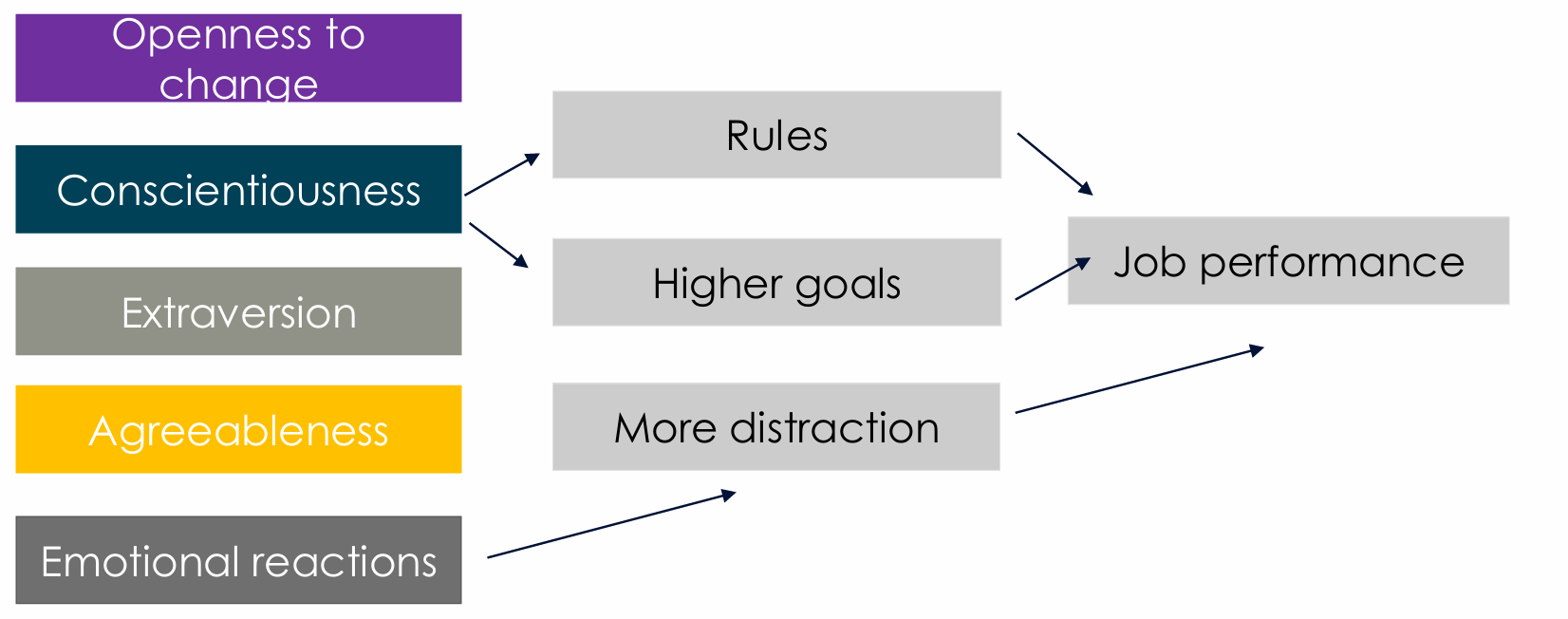
When does personality matter?
Emotional reactions
Work environments that generate stress (responsibilities, failures, toxic environments; Slaughter & Kausel, 2009)
Agreeableness
Teamwork
Can be negative in competitive jobs (politician)
Openness
Training performance
Extraversion
Leadership and sales
the hexagonal model of vocational interests by Holland
= to classify people & environments
professional & individual personality
“RIASEC” model
personality pattern: dominant & 2 secondary types → letters
look at occupation & sub-environment
job fits personality:
personally: less likely to change occupation
organization: higher performance & persistence
6 personalities:
conventional: efficient, careful, conforming, organized & conscientious, large organizations, subordinate roles, attention to detail (accountant, corporate manager)
enterprising: seek leadership, power & prestige, enjoy financial risks, competitive, energetic, ambitious, adventurous, sociable & self-confident (lawyer, real estate agent, public relations specialist)
social: humanistic, idealistic, responsible & concerned with the welfare of others, working in groups & sharing responsibilities, solve problems through discussion & interaction with others (social worker, teacher, counselor)
investigative: gathering info, discovering, analyzing & interpreting data, prefer working alone (biologist, economist)
artistic: value artistic qualities, need to express themselves, original, intuitive, imaginative (musician, interior decorator)
realistic: nature, physical, prefer action to thinking & concrete to abstract problems (mechanic, athlete, farmer)

Schwartz’s Universal Values
same values, but prioritize differently
= desirable goals → motivate action
not tied to specific contexts (vs. vocational interests)
get along with others who share similar values
openness to change vs. conservation
self-enhancement vs. self-transcendence
Universalism = welfare of people & nature, acceptance
Benevolence = welfare of contacts (‘in-group’) → affiliance
Tradition = customs & ideas of one’s culture/ religion
Conformity = restraint of impulses likely to upset/ harm others & violate social expectations → obedience & discipline
Security = safety, harmony & stability of society, relationships & self
Power = status, prestige, control over people & resources
Achievement = through demonstrating competence
Hedonism = pleasure/ sensuous gratification for oneself
Stimulation = excitement, novelty & challenge
Self-direction = independence, freedom, exploration, willingness to choose
Influences:
openness to change: creative, proactive, make suggestions, averse to organizational changes imposed by the hierarchy
conservation: flexible with changes imposed by superiors
self-transcendence: act altruistic, generosity
CEO’s values → organizational culture
benevolence → supportive culture
security → bureaucratic culture
self-direction → innovative culture
right-wing parties: security & achievement
left-wing parties: universalism & benevolence
personality:
extraverted: stimulation, hedonism, achievement & power
agreeableness: universalism, benevolence & conformity (low: power)
conscientious: conformity, security & achievement (low: stimulation)
openness to change: stimulation, self-direction & universalism (low: conformity, tradition & security)
work:
openness to change - conservation → risk - rules
self-transcendence - self-enhancement → results - relations

Why are emotions useful?
Alert and prioritization
Communication
Moral function
Learning
Reaction/action tendency
Joy:
Action tendency: Approach, sharing
Useful for: Makes you continue what you started, makes you attractive
Useful Situation: Social situations
Sadness
Action tendency: Leaving
Useful for: Makes you reflect and analyzes, help to get support
Useful situations: Failure
Fear
Action tendency: Hiding, flight
Useful for: Survival, danger avoidance
Useful situations: High-stakes situations
Anger
Action tendency: Fight
Useful for: Overcoming obstacles, injustice
Useful situations: Situations of injustice
Surprise
Action tendency: Stopping, searching
Useful for: Potential danger
Useful situations: New environment
Disgust
Action tendency: Rejection
Useful for: Survival
Useful situations: Presence of toxic food or person
The case of the patient SM
Patient SM impairments after her surgery:
Fear recognition
Personal space regulation
Fear of dangerous places
Fear of monetary loss
→ important to keep her safe
Amygdala Hijack
= When emotion takes over
amygdala responds to stress and disables your frontal lobes
→ activates the fight-or-flight response and disables rational, reasoned responses
How to respond
6 second rule: pause to prevent knee-jerk reaction
Name the emotion
Regulate breathing
Get up and move
What are emotions and why do they arise?
Situation + need that needs to be fulfilled
Emotions react with:
Facial expression
Action tendency
Subjective feeling
Appraisal
Physiological response
Affective events theory
Emotions (short-term) vs. mood (long-term)

Emotional labor in customer service jobs
Emotions should be in accordance with display rules
Customer service job
Caring professions
Social control jobs
Strategies
Surface acting → expressed
Deep acting → felt (maybe they act like that because they are dealing with their own problems)
Genuine emotional labor (genuinely empathizing)
Emotional dissonance
Expressed vs felt (surface acting)
Deep acting vs surface acting

The ability model of emotional intelligence
Perceiving
Understanding
Managing
Using
An example of EI test: Reading the Mind in the Eyes Test
Emotional intelligence relates to teamwork and good managers