Non-NMDA glutamate receptors
 Call Kai
 Learn
Learn Practice Test
 Spaced Repetition
 Match
Match Flashcards
 Knowt Play
1/11

There's no tags or description
Looks like no tags are added yet.
Name | Mastery | Learn | Test | Matching | Spaced | Call with Kai | Chat |
|---|
No analytics yet
Send a link to your students to track their progress
12 Terms
What changes in receptor composition can effect activity?
- Agonist and coagonist potency.
- Deactivation rate
- Ion permeation.
- Channel conductance
- GluN2 subunits affect pharmacology NMDAR
What are the types of non-NMDA glutamate receptors?
- AMPA Receptor
- Kainate Receptor
What genes code for AMPA receptors?
- GluA1
- GluA2
- GluA3
- GluA4
What genes code for Kainate receptors?
- GluK1
- GluK2
- GluK3
- GluK4
- GluK5
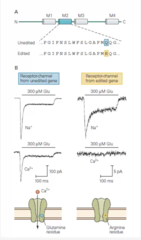
What are the differences between NMDA and Non-NMDA receptors?
- NMDA receptors are highly permeable to Ca²⁺, whereas non-NMDA receptors (e.g., AMPARs) generally are not.
- This permeability is determined by the amino acid sequence in the M2 domain.
- NMDA receptors have a positively charged arginine residue in the M2 domain, whereas non-NMDA receptors typically have an uncharged amino acid, such as glutamine.
Describe the function of AMPA receptors.
- AMPA receptors mediate fast excitatory transmission.
- AMPA receptors are co-expressed with NMDA receptors.
What drugs act on AMPA receptors?
- CNQX and NBQX can block AMPA receptors and Kainate receptors which allows identification of AMPA receptors from NMDA receptors.
- Perampanel is an AMPA receptors antagonist via binding to an allosteric site.
- Ampakines act at AMPA receptors which enhance response to glutamate.
Describe metabotropic glutamate receptors.
- GPCRs (class C family).
- Contain a large extracellular N-terminal domain where glutamate binds too.
- 8 subtypes: mGluR1 to mGluR8.
- 8 subtypes rae split into 3 groups.

Describe group 1 metabotropic glutamate receptors.
- Only mGluR1 and mGluR3.
- Post-synaptic (excitatory)
- GaQ/11 linked which increases Ca2+
Describe group 2 metabotropic glutamate receptors.
Only includes mGluR2 and mGluR3.
Describe group 3 metabotropic glutamate receptors.
- Includes mGluR4, mGluR6, mGluR7, and mGluR8
- Pre-synaptic neurone (inhibitiory).
- Gai linked to decrease cAMP production.
How do drugs act on metabotropic glutamate receptors?
- Drugs can distinguish between subtypes.
- Antagonists for group 1 can treat epilepsy, pain and parkinson's.
- Antagonists for group 2 can act as cognition enhancers.
- Positive allosteric modulators for group 3 can treat Parkinson's and anxiety.