Bone Development + Growth
 Call Kai
 Learn
 Practice Test
 Spaced Repetition
 Match
 Flashcards
 Knowt Play
1/20

There's no tags or description
Looks like no tags are added yet.
Name | Mastery | Learn | Test | Matching | Spaced | Call with Kai | Chat |
|---|
No analytics yet
Send a link to your students to track their progress
21 Terms
what are the types of bone growth and when do they occur
in utero:
intramembranous ossification
endochondral ossification
after birth:
appositional growth
longitudinal growth
what is intramembranous ossification and what does it make
uses fibrous membranes as a template to form most flat bones
what is endochondral ossification and what does it make
uses hyaline cartilage to form all other bones (including flat bones)
what is appositional growth and what does it do
uses epiphyseal plate to grow long bones
what is longitudinal growth and what does it do
uses periosteum and endosteum to grow all bones and make them thicker
intramembranous ossification: 1st step
ossification center (start of bone formation) will form when the mesenchymal stem cells differentiate into osteoblasts that will secrete fibers and osteoids

intramembranous ossification: 2nd step
the osteoids secreted by the osteoblasts trap the osteoblasts inside a now mineralized ECM matrix and become osteocytes

intramembranous ossification: 3rd step
the osteoids are laid down between blood vessels randomly, making trabeculae. the surrounding mesenchyme becomes the periosteum and endosteum. Then the external trabeculae are replaced with compact bone and the spongy bone stays inside and is filled with red bone marrow (hematopoietic stem cells)
endochondral ossification: 1st step
chondroblasts make hyaline cartilage, making a bone collar around the diaphysis and prevents nutrients from going to the cartilage, thus making the cartilage die

endochondral ossification: 2nd step
the cartilage in the center of the diaphysis calcifies and develops cavities

endochondral ossification: 3rd step
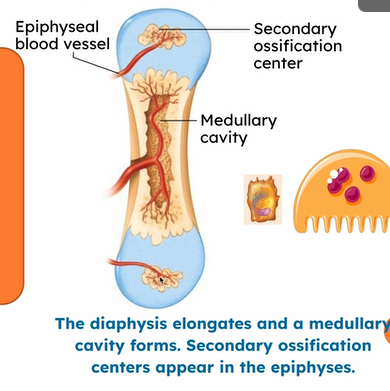
periosteal bud (a blood vessel) invades the internal cavity and brings osteoblasts and osteoclasts, creating spongy bone

endochondral ossification: 4th step
Then, the diaphysis elongates and a medullary cavity forms. More ossification appears in the epiphyses where basically the same steps happen in the epiphyses
Longitudinal growth: where does it happen
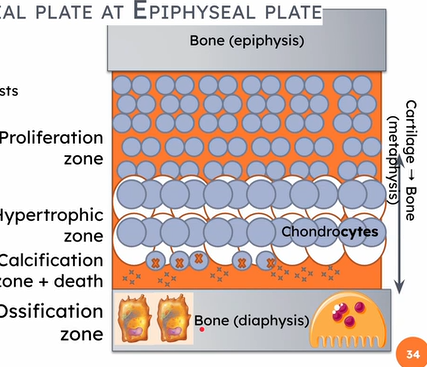
in the epiphyseal plate (remaining hyaline cartilage)
what are the 4 zones of the epiphyseal plate
Proliferation zone – the cartilage cells undergo hyperplasia
Hypertrophic zone – older cartilage cells grow by hypertrophy
Calcification zone – matrix becomes calcified and the cartilage cells begin to die
Ossification zone – new bone cells are forming from the calcification zone
how do the zones inside the epiphyseal plate allow for bone growth?
These zones inside the epiphyseal plate allow the space between the epiphysis and diaphysis to expand by slowly moving the ossification zone further up until there's no more epiphyseal plate and there's just a line, making the bone grow longitudinally

what is the relation between osteoclast and osteoblast activity in the periosteum and endosteum
More osteoblast activity at the periosteum, and osteoclast activity at the endosteum to balance the size of bone so it's not too heavy
what do growth hormones and thyroxine do for bone growth
stimulates epiphyseal plate activity
what do testosterone and estrogen do for bone growth
Promote osteoblast activity
Inhibit osteoclast activity
Promote calcification of bone
End growth by epiphyseal plate closure
how does cartilage grow?
through
appositional growth (similar to appositional growth for bone) - uses periochondrium to make it thicker
interstitial growth - cartilage cells grow through hyperplasia and hypertrophy
how does cartilage get their nutrients if they’re asvascular and not innervated?
from diffusion by the surrounding perichondrium, bone, or synovial fluid
is cartilage calcification good? why or why not?
not good. it shld only calcify in the epiphyseal plate. leads to
osteoarthritis (wear and tear)
chondrocytes will secrete calcium containing crystals