Genetics- MT 2- Lect 1 (09/18/2026)- LO6.2
 Call Kai
 Learn
Learn Practice Test
 Spaced Repetition
 Match
Match Flashcards
 Knowt Play
1/46

There's no tags or description
Looks like no tags are added yet.
Name | Mastery | Learn | Test | Matching | Spaced | Call with Kai | Chat |
|---|
No analytics yet
Send a link to your students to track their progress
47 Terms
Where does DNA Replication start from
Begin at sites called the origin of replications, where specific sequences of DNA are recognized by initiator proteins to start the replication process.
Is DNA replication fast accurate
Yes- The polymerases are faster in bacteria than eukaryotes usually
How are DNA strands separated
By breaking H-Bonds between complementary base pairs.
What does breaking the H-Bonds do
It forms the replication bubble that allows the two strands of DNA to be accessed for replication.
What does forming the replication bubble do
It allows for protein assembly
What is a replication bubble
A replication bubble is a section of DNA that has unzipped (opened up) so that DNA replication can occur.
Is DNA replication bidirectional in prokaryotes and Eukaryotes
Yes
What is the difference in the origins of replication between prokaryotes and eukaryotes
Pro only has one and eu has multiple
Replication bubble Purpose
Copy DNA
Transcription Bubble Purpose
Make RNA from DNA
Enzyme for the Replication Bubble
Helicase opens DNA; DNA polymerase copies it
Enzyme for transcription Bubble
RNA polymerase opens DNA and makes RNA
DNA strands used as templates for Replication Bubble
Both
DNA strands used as templates for Transcription Bubble
Only one
What are the other differences between Replication bubbles and transcription bubbles
Direction | Usually bidirectional | One direction for each transcription event |
Forks | Two replication forks | No replication forks |
Starting point | Origin of replication | Promoter |

DNA Replication Image in eukaryotes
Ends up with two daughter molecule
What does DNA Polymerase 1 do
RNA primers and replaces them with DNA during DNA replication in bacteria
Who won a nobel for purifying all the enzymes and all of the components required for replication in e-coli to have replication outside the cells?
Kornberg
How many chromosomes and what shape do prokaryotes have
1 circular chromosome
How many origins of replication do prokaryotes have
1
Where is the dna in Prokaryotes
Nucleoid Region
How many origins of rep in Eukaryotes
100s-1000s
Do prokaryotes have replication forks doe prokaryotic DNA Replication
Yes
Theta structure

What are the two steps for DNA Replication
Initiation and elongation
Initiation
Replication bubble is formed- RNA primers (5-10) nucleotides are required for DNA synthesis to start
Origin is recognized
Initiation proteins come in
Separation of strands happens with helicase opening up the replication bubble
Two replication forks
RNA primase lays down the RNA primers for DNA polymerase to start synthesizing DNA
Elongation
New strands of DNA are synthesised- 500 nucleotides per sec in bacteria only 50 per sec in humans- The RNA primers are replaced with DNA by DNA Polymerase I and then ligase seals it

DNA synthesis
the natural or artificial creation of new deoxyribonucleic acid (DNA) molecules by linking nucleotide building blocks together
Which direction is DNA synthesised
5’ phosphase end-3'-OH (hydroxyl) group
Deoxyribose vs ribose

What keeps the strands separated during elongation
Single- strand binding proteins
Does helicase work at one end or both
Both- the proteins etc are on both sides
Initiator Protein function
to recognize and bind to specific DNA sequences at the origin of replication, melt and unwind the double helix, and recruit downstream replication machinery like DNA helicases to start copying the genome
Explain how nucleotides get added
Template strands are read 3’-5’ but Nucleotides are added 5’-3’
DNA polymerase III goes along the template strands 3’-5’ direction and it adds the new nucleotides to the three prime end of the growing strand
Each Nucleotide comes as a tri-phosphate and is very unstable so the nucleotides want to form bonds. The bond between the alpha and beta phosphate is broken and the alpha attaches to the 3’ end of the DNA molecule along with its nucleotide
There are two reactions that are endergonic meaning they require energy, the addition of the 5’P of the dNTP (nucleotide + the triphosphate) to the 3’ OH of the growing strand and the phosphodiester bond formation
Energy is provided by the hydrolysis of the beta and gamma phosphates- exergonic reaction (hydrolysis of P-P)

Synthesis vs polymerization
DNA synthesis: Making a new DNA strand.
DNA polymerization: Joining nucleotides together by forming phosphodiester bonds.
Leading Strand
Continuous Polymerization- Grows in the direction of the fork
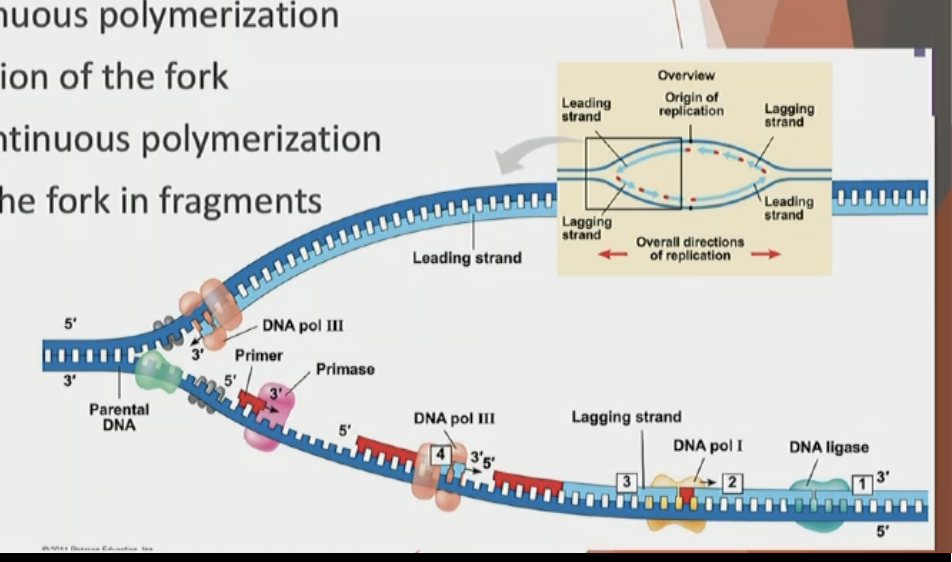
Lagging Strand
Discontinuous polymerization grows away from the fork in fragments
Initiation Proteins
Initiation proteins identify where to open the DNA, and helicase unzips it- related to origin of replication
Problem in linear chromosomes
The end does not get replicated because the primer can not be laid down on the lagging strand- replication machinery can not complete the 5’ ends of linear DNA
in most eukaryotic cells the ends become shorter after each round of replication
Does not happen in prokaryotes
Telomerase
Telomerase adds repetitive DNA sequences (TTAGGG in humans) to the 3′ end of the parental DNA strand- type of polymerase
why cant dna polymerase fill in the gap
DNA polymerase cannot fill the gap left by the last primer because there is no available 3′-OH to extend from- note another enzyme (RNA-ase or smt removes the rna primer)
Telomeres
are protective caps on chromosome ends- active in germ cells inactive in adult/ differentiated cells
Do X and Y chromosomes have the PAR1 and 2 regions
Yes—both the X and Y chromosomes have two shared pseudoautosomal regions, PAR1 and PAR2. They're at the tips and they’re what let X and Y pair and recombine during meiosis
why do we not want telomerase active in somatic cells
We generally don't want telomerase highly active in most somatic cells because it could allow damaged or abnormal cells to keep dividing, increasing the risk of cancer.
How do some cancer cells become immortal
they reactivate the telomerases- that allows them to bypass the signals for apoptosis because the chromosomes do not get short enough to signal it even when they should die
B vs Z form dna
B form= Right handed DNA normal bases
Z from= Left Handed DNA abnormal bases
Dna-binding proteins recognize the chemical differences derived form the arrangement of the bases in the major or minor grove of the double stranded DNA
Sequence-Specific