Knowbat ch. 2 - Population Geography
0.0(0)Studied by 2 people
Build your Mastery score
 Multiple Choice & FRQ
 Call Kai
Card Sorting
1/32

Earn XP
Description and Tags
33 Terms
1
New cards
age distribution/structure
the proportion of individuals of different ages within a population (non textbook)
2
New cards
agricultural density
The ratio of the number of farmers to the total amount of arable land (land suitable for agriculture)
3
New cards
arithmetic density
The total number of people divided by the total land area
4
New cards
Cairo Conference (1994)
United Nations held an International conference on population in 1994 in Cairo, Egypt. It's resulting Program of Action is the steering document for the United Nations. - The Conference adopted the Programme of Action by consensus, which emphasized the fundamental role of women's interests
in population matters and introduced the concepts of sexual and reproductive health and reproductive rights. A new definition of population policy was advanced, giving prominence to reproductive health and the empowerment of women. (non textbook)
in population matters and introduced the concepts of sexual and reproductive health and reproductive rights. A new definition of population policy was advanced, giving prominence to reproductive health and the empowerment of women. (non textbook)
5
New cards
carrying capacity
the population size of a species that the environment can sustain indefinitely, given the available resources
6
New cards
census
A complete enumeration of a population
7
New cards
child mortality rate
the number of deaths per thousand children in the first five years of those children's lives (non textbook)
8
New cards
contraception
prevention of pregnancy
9
New cards
Cornucopians
Relating to the belief that the world's natural and human resources are essentially unlimited and that conservation of resources or limitations on consumption or on population growth are unnecessary (non textbook)
10
New cards
crude death rate (CDR)
The total number of deaths in a year for every 1,000 people alive in the society.
11
New cards
crude birth rate (CBR)
The total number of live births in a year for every 1,000 people alive in the society.
12
New cards
demographic transition
the process of a change in a society's population from a condition of high crude birth and death rates and low rate of natural increase to a condition of low crude birth and death rates, low rate of natural increase, and higher total population
13
New cards
demography
The scientific study of population characteristics.
14
New cards
dependency ratio
The number of people under age 15 and over age 64 compared to the number of people active in the labor force
15
New cards
doubling time
The number of years needed to double a population, assuming a constant rate of natural increase.
16
New cards
ecumene
The portion of Earth's surface occupied by permanent human settlement.
17
New cards
epidemiological transition
The process of change in the distinctive causes of death in each stage of the demographic transition
18
New cards
infant mortality rate (IMR)
The total number of deaths in a year among infants under 1 year old for every 1,000 live births in a society.
19
New cards
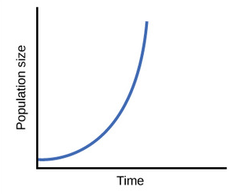
J-curve
when the projection population shows exponential growth (non-textbook)
20
New cards
life expectancy (longevity)
The average number of years an individual can be expected to live, given current social, economic, and medical conditions. Life expectancy at birth is the average number of years a newborn infant can expect to live
21
New cards
Malthus/Malthusian
idea that population growth is potentially exponential while the growth of the food supply or other resources is linear (non textbook)
22
New cards
natalism (pro- and anti-)
government policy that supports higher/lower birth rates
23
New cards
natural increase rate (NIR/RNI)
The percentage growth of a population in a year, computed as the crude birth rate minus the crude death rate.
24
New cards
Neomalthusians
argue characteristics of recent population growth make Malthus's thesis more frightening than when it was proposed
25
New cards
overpopulation
a situation in which the number of people in an area exceeds the capacity of the environment to support life at a decent standard of living
26
New cards
physiological density
The number of people per unit of area of arable land, which is land suitable for agriculture.
27
New cards
population agglomerations/population cluster
Two-thirds of the world's people live in four clusters-East Asia, South Asia, Europe, and Southeast Asia
28
New cards
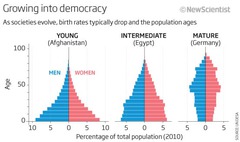
population pyramid
A bar graph that represents the distribution of the population by age and sex
29
New cards
replacement fertility
the average number of children born per woman—at which a population exactly replaces itself from one generation to the next, without migration (non textbook)
30
New cards
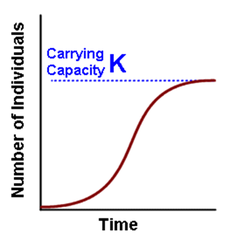
S-curve
traces the cyclical movement upwards and downwards in a graph, helps show the natural increase in population (non-textbook)
31
New cards
sex ratio
The number of males per 100 females in the population.
32
New cards
total fertility rate (TFR)
The average number of children a woman will have throughout her childbearing years.
33
New cards
zero population growth (ZPG)
A decline of the total fertility rate to the point where the natural increase rate equals zero.