L06: The climate of Earth (and other planets)
 Call Kai
 Learn
 Practice Test
 Spaced Repetition
 Match
 Flashcards
 Knowt Play
1/42

Earn XP
Description and Tags
Given by: Prof. Simon Tett
43 Terms
What three components must be considered when measuring the temperature of a planet?
Temperature
Heat (energy)
(Heat) flow/flux
Temperature
Determines which way heat flows and represents the amount of heat a body contains (K ‘Kelvin’ and oC)
Heat (energy)
The quantity of energy required to give an object its temperature (J; Jules)
(Heat) flow/flux
The rate of energy transfer (between objects) (J s-1 = W), possibly per unit area (W m-2)

What does this diagram show?
The model used to determine the average temperature of the Earth
What is the key concept of the model used to determine the average temperature of the Earth?
Heat in and out balance (equilibrium/’steady-state’ model)
What is the surface temperature of the Sun (oC)?
5,500oC
What happens to the Earth’s temperature when its distance from the Sun increases?
The volume of energy (heat) is decreased by distance squared
Energy flow from the Sun face on (total solar irradiance)
S0 = 1,361 W m-2
Total solar irradiance
The measure of power from the Sun’s electromagnetic radiation per unit area that reaches a specific surface
How is most of the day’s surface lit?
Obliquely (indirectly) lit
How reduced is the Sun’s average heat intensity?
By a factor of four
Heat from the Earth (thermal radiation)
The emission of infrared electromagnetic waves caused by the heat of the planet’s surface and atmosphere

What does this diagram show?
The albedo effect
How much of the Sun’s incoming energy does the Earth reflect (albedo effect)?
On average, 30%
How is most of the Sun’s incoming energy reflected (albedo effect) back into space?
From clouds, as water droplets scatter sunlight
Temperature of the Earth’s surface (K)
~225 K
How does the Sun emit radiation?
At visible wavelengths
How does the Earth emit radiation?
At infrared wavelengths
Equilibrium
A state in which opposing forces or influences are balanced
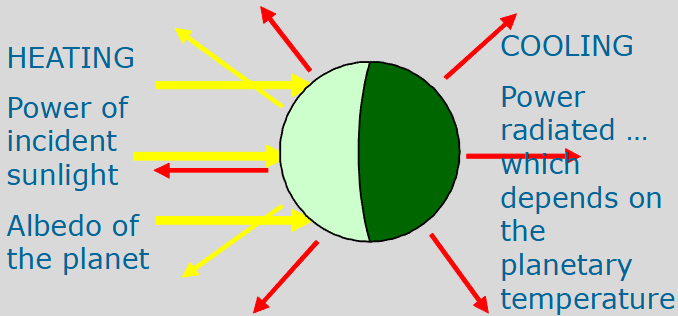
What does this diagram show?
What determines the temperature of a planet
What are the three stages when calculating the temperature of a planet?
Calculate the solar heating S0 of the planet using the distance from its sun S0/4
Multiply this by (1 - albedo %) to get radiation flux into the planet’s climate system
Find the temperature that gives a matching flux using Sigma x (t + 271oC)4
What other unit may astronomers use when calculating (1) a planets average distance from its sun?
1 AU (Astronomical Unit)

What does this diagram show?
Dynamic equilibrium

What does this diagram show?
The energy balance box model for calculating the temperature of a planet
What is the theoretical predicted temperature of the Earth (oC)?
-18oC
What is the observed mean temperature of the Earth (oC)?
15oC
Example: a moon in our solar system with no atmosphere
Enceladus (Saturn)
Why does Enceladus (Saturn) not have an atmosphere?
It is a ball of ice
Example: a planet in our solar system with almost no atmosphere
Mars
What percentage of the Earth’s atmosphere does Mars have?
Mass/m2 = 0.6%
Example: two planets in our solar system with an atmosphere
Earth and Venus
What is interesting about Venus’ atmosphere?
It is 90 times the mass of Earths and is mostly carbon dioxide
What is interesting about the Earth’s atmosphere?
It is mostly nitrogen, due to the fact that Earth has active tectonics
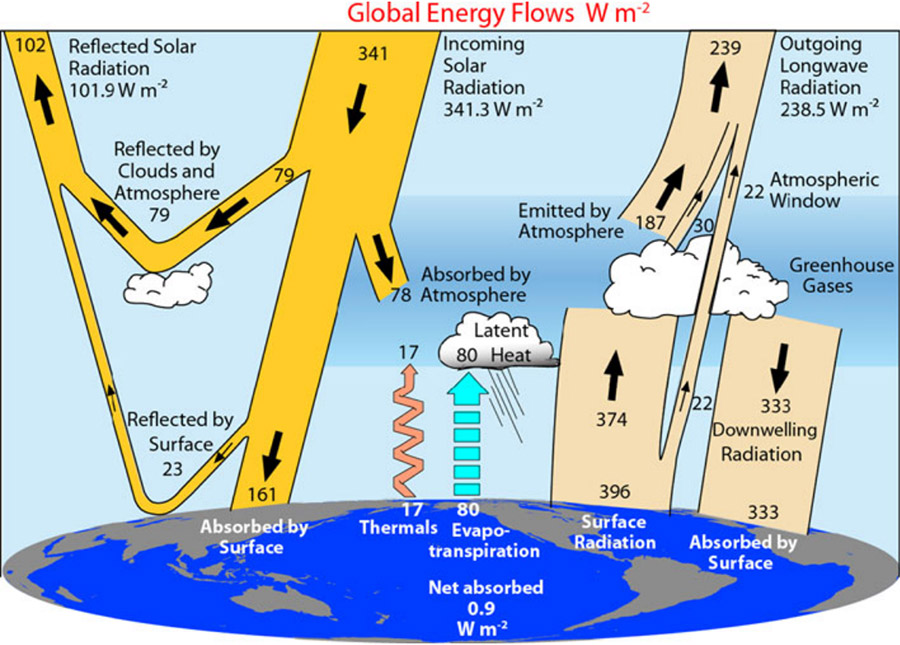
What does this diagram show?
Where the outgoing energy comes from/goes to on Earth
How much solar heating S0 does the top of the atmosphere receive using the distance from the Sun S0/4?
S0/4 = 340Wm-2 on average
What percentage of solar energy is absorbed by the Earth’s atmosphere and surface?
70%
What is responsible for absorbing, emitting, and reflecting solar radiation?
The atmosphere; clouds
What is the volume of outgoing solar radiation from the temperature of the atmosphere; clouds (km)?
~5.5 km
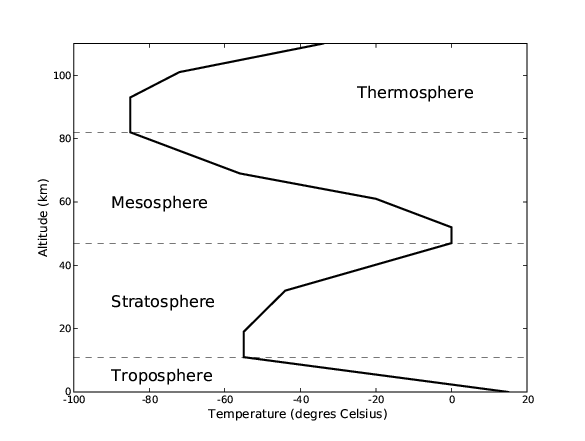
What does this diagram show?
The natural greenhouse gas effect throughout the layers of the atmosphere
How do the oceans influence energy balance changes and thus temperature changes?
They cover the most of the Earth’s surface and thus take time to respond to changes in energy balance and hence to changes in surface temperatures

What does this diagram show?
The rate of radiation absorption according to ocean depth
Where is most radiation absorbed by the ocean?
Near the surface (20m)