Animal Respiration: Gas Exchange, Ventilation & Transport
 Call Kai
 Learn
 Practice Test
 Spaced Repetition
 Match
 Flashcards
 Knowt Play
1/40

There's no tags or description
Looks like no tags are added yet.
41 Terms
What is the primary challenge of gas exchange for animal cells?
Animal cells need a constant supply of O2 for oxidative phosphorylation and must eliminate CO2, a waste product.
How do O2 and CO2 move in and out of animal cells?
They move by diffusion based on differences in partial pressure.
What is the significance of partial pressure in gas exchange?
Gases move between aqueous and gaseous phases according to their partial pressures.
What happens when the partial pressure of a gas is higher in the aqueous phase?
The gas will move into the gaseous phase.
What is the relationship between partial pressure and gas movement in a mixture?
Each gas moves according to its own partial pressure, regardless of other gases present.
What is the effect of diffusion distance on gas exchange?
The partial pressure drops off with the square of the distance, making it less efficient over longer distances.
How do vertebrates enhance gas exchange efficiency?
They have oxygen-carrying cells in the circulatory system.
What adaptation do insects have for gas exchange?
Insects have a tracheal system that consists of a network of air-filled tubes bringing air close to cells.
What is counter current exchange in fish gills?
It is a mechanism that allows for the most efficient exchange of gases between the circulatory system and water.
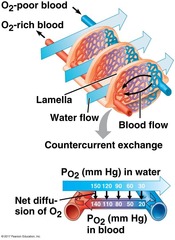
How do amphibians exchange gases?
Amphibians can exchange gases through their skin and also have lungs.
What is the structure of mammalian lungs?
Mammalian lungs consist of the nose, mouth, pharynx, larynx, trachea, bronchi, and bronchioles.
What is the function of the trachea in mammals?
The trachea is a stiff tube that maintains an open passage for air to enter the lungs.
What is the role of bronchi in the respiratory system?
Bronchi branch into smaller bronchioles that lead to the lungs.
How do birds ventilate their lungs?
Birds have a unidirectional airflow across parabronchi, preventing mixing of inhaled and exhaled air.
What is the significance of increasing surface area in gas exchange?
Increasing surface area enhances the efficiency of gas exchange.
What adaptations do gills provide for aquatic animals?
Gills increase surface area for gas exchange and are closely associated with flowing water.

What is the primary method of ventilation in amphibians?
Amphibians create positive pressure to force air into their lungs.
What limits the size of insects regarding gas exchange?
The efficiency of gas exchange decreases with depth in the tracheal system, limiting insect size.
What is the primary function of the respiratory system in animals?
To facilitate gas exchange, providing O2 to cells and removing CO2.
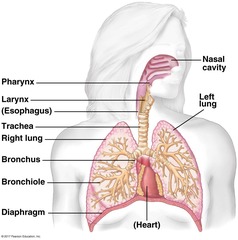
What do bronchioles lead into?
Alveoli

What is the function of surfactant in the alveoli?
It reduces surface tension, preventing alveoli collapse.
What is the first rule of lung ventilation?
Air moves from high pressure to low pressure.
What happens to pressure when gas is compressed into a smaller volume?
The pressure increases.
What happens to pressure when gas expands into a larger volume?
The pressure decreases.
How do mammals take in air?
By lowering lung pressure below atmospheric pressure.
What is the pressure relationship when air moves into the lung?
Patmospheric > Plung.
What is the pressure relationship when air moves out of the lung?
PLung > Patmospheric.
What keeps the lungs inflated?
Transpulmonary pressure, which is the pressure differential between the pleural cavity and the lung.
What happens if the pleural cavity wall is punctured?
The pressure differential is lost, resulting in a collapsed lung.
How do birds achieve gas exchange?
With 100% newly inhaled air.

What is the partial pressure of oxygen in the atmosphere?
Approximately 160 mmHg.
What is the primary control of respiration based on?
Monitoring CO2 levels, not O2 directly.
What enzyme is involved in the conversion of CO2 to carbonic acid?
Carbonic anhydrase.
What is the relationship between CO2 and pH?
Increased CO2 lowers pH.
What is the primary means of oxygen transport in the blood?
Binding to hemoglobin in erythrocytes.
What is the oxygen/hemoglobin dissociation curve shape?
S-shaped, indicating varying affinity for O2.
What happens to oxygen binding at higher partial pressures?
More O2 binds to hemoglobin until saturation.
What occurs in systemic capillaries regarding O2 and CO2?
O2 moves into tissues, CO2 moves into blood.
What percentage of CO2 is transported as dissolved CO2?
About 7%.
How is most CO2 transported in the blood?
Converted to carbonic acid.
What happens to carbonic acid in the alveoli?
It is reversed to reform CO2, which then diffuses into the alveoli.