Thermo Concepts (Ch.3 - Ch.4)
 Call Kai
 Learn
 Practice Test
 Spaced Repetition
 Match
 Flashcards
 Knowt Play
1/53

There's no tags or description
Looks like no tags are added yet.
54 Terms
phase
a quantity of matter that is homogeneous throughout in both chemical composition and physical structure
pure substance
is uniform and invariable in chemical composition
state principle
thermo state of a simple compressible system is completely defined by two independent, intensive propertiesn
simple compressible system
intensive states of systems of commonly encountered pure substances
p-v-t digram
3d model

phase diagram
property diagram

two-phase regions
two phases exist in equilibrium
liquid–vapor
solid–liquid,
solid–vapor.
saturation state
state at which a phase change begins or ends
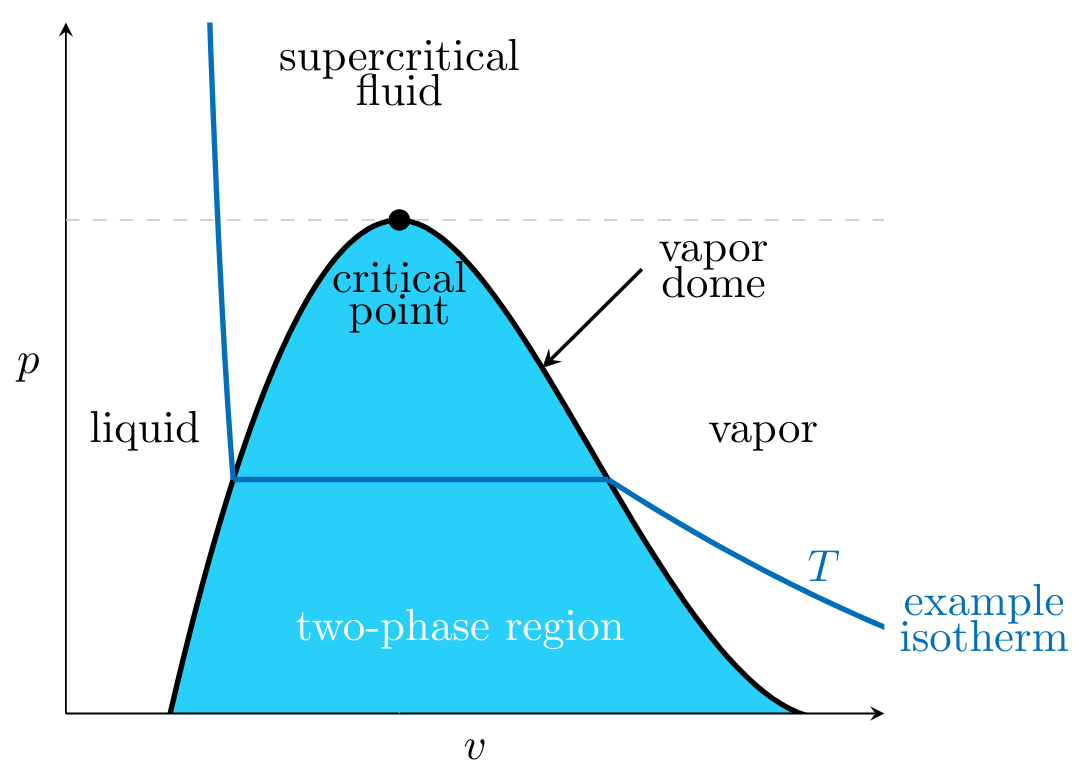
vapor dome
dome-shaped region composed of the two-phase liquid–vapor states
saturation temperature
temperature at which a phase change takes place at a given pressure
saturation pressure
pressure at which a phase change takes place at a given temperature
p–v diagram
pressure–specific volume plane
⭐T–v diagram
temp vs volume

compressed liquid (subcooled liquid)
temperature at these states is less than the saturation temperature at the given pressure
two-phase liquid–vapor mixture
distinguished from one another by the quality, an intensive property.
quality (x)
ratio of the mass of vapor present to the total mass of the mixture
only for saturated
x= 0 👉saturated liquid
x=1 👉 saturated vapor
x=vg−vfv−vf
v= given velocity

superheated vapor
states that would be attained by further heating while keeping the pressure constant.
enthalpy (hf, hg, hfg) (unit: kJ/kg)
constant pressure
h=hf+x(hg−hf)
specific internal energy(u, uf, ug) (unit: kJ/kg)
constant volume
u=uf+x(ug−uf)
specific volume (vf, vg, v) (unit: m³/kg)
v=vf+x(vg−vf)
specific heats (cυ, cp )
relate the temperature change of a system to the amount of energy added by heat transfer
universal gas constant R
8.314 kJ/mol
compressibility factor (Z)
RTpv
ideal gas model

2
For a simple compressible system, how many independent intensive properties must be specified to fix the state?
temperature
The ideal gas model includes the ideal gas equation of state to relate pressure specific volume and temperature, and the fact that the specific internal energy and specific enthalpy each depend only on ___________.
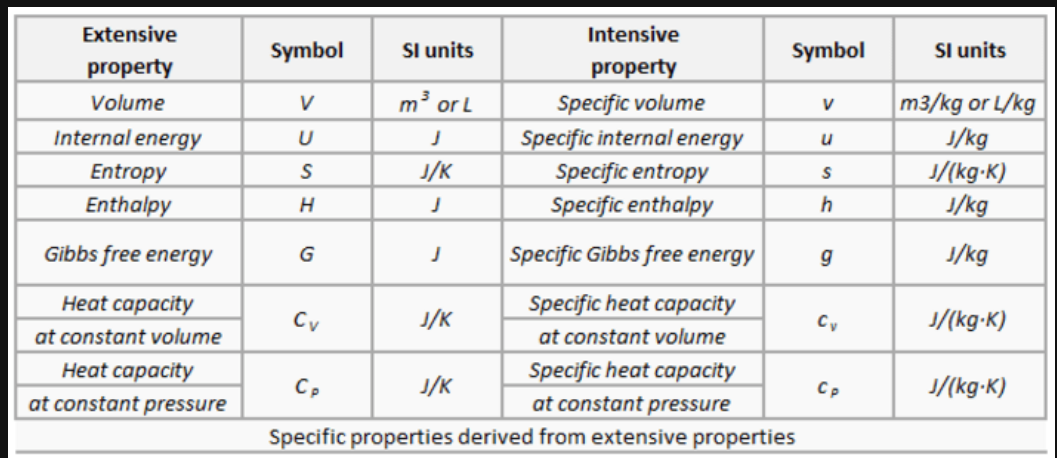
Intensive Properties
Temperature
Pressure
Specific heat cap (c )
specific internal energy (u)
specific enthalpy (h)
specific volume
True
T/F: For pure, simple, compressible systems, temperature and specific volume can be regarded as independent intensive properties.
False
T/F: If a closed system consisting of a simple compressible substance is at equilibrium, only one phase can be present.
True
T/F: The pressures listed in thermodynamic tables are absolute pressures, NOT gage pressures.
True
T/F: When an ideal gas undergoes a polytropic process with n = 1 the gas temperature remain constant.
False
T/F: A two-phase liquid-vapor mixture with equal volumes of saturated liquid and saturated vapor has a quality of 0.5.
True
T/F: As pressure increases toward the critical pressure, the values of vf and Ug approach each other.
False
T/F: For simple compressible systems, any two intensive thermodynamic properties fix the state.
True
A polytropic process for an ideal gas with n = k is adiabatic.
mass flow rates (m dot)
time rate of change of mass within the control volume
\frac{dmcv}{\differentialD t}=m_{i}-m_{e}
one-dimensional flow
The flow is normal to the boundary at locations where mass enters or exits the control volume.
All intensive properties assumed to be uniform across the inlet or exit area.
m˙=ρVAm˙=massflowrateρ=densityA=area
volumetric flow rate (units: m3/kg or ft3/s)
flow of volume
v= specific volume (m³/kg)
V= volume (m³)
m= mass (kg)

steady state
all properties are unchanging in time
mass flux
gives the time rate of mass flow per unit of area
flow work
account for the work associated with the pressure at the inlet and exit
energy rate balance
0=Qcv−Wcv+m˙((hi−hE)+2vi2−ve2+g(zi−ze)) Qcv= heat transfer
Wcv= work
m-dot= mass flow rate
hi= specific enthalpy (in)
he= specific enthalpy (out)
vi= velocity (in)
ve= velocity (out)
g= gravity
zi= heigth (in)
ze= height (out)

nozzle
a flow passage of varying cross-sectional area in which the velocity of a gas or liquid increases in the direction of flow.
accelerates flow

diffuser
the gas or liquid decelerates in the direction of flow

turbine
a device in which power is developed as a result of a gas or liquid passing through a set of blades attached to a shaft free to rotate

compressor (gas)
devices in which work is done on the gas flowing through them in order to change the state of the gas
pump (liquid)
devices in which work is done on the liquid flowing through them in order to change the state of the liquid
heat exchanger
used in
home ac systems
automotive systems
throttling calorimeter
a device for determining the quality of a two-phase liquid–vapor mixture

throttling process
When the flow through the valve or other restriction is idealized
system integration
combine components to achieve some overall objective
transient operation
state changes with time.