Bridge Step & TCA Cycle
 Call Kai
 Learn
 Practice Test
 Spaced Repetition
 Match
 Flashcards
 Knowt Play
1/29

There's no tags or description
Looks like no tags are added yet.
30 Terms
Why does sustained glycolysis require NAD+ recycling?
Glycolysis needs NAD+ for the GAP dehydrogenase reaction
If NAD+ is not regenerated from NADH, that reaction stops and glycolysis cannot continue
How do glycolysis, pyruvate oxidation, the TCA cycle, and oxidative phosphorylation connect?
Glycolysis converts glucose to pyruvate and makes ATP/NADH
Pyruvate oxidation makes acetyl-CoA and NADH
The TCA cycle oxidizes acetyl groups to CO2 and makes NADH/FADH2
Oxidative phosphorylation uses those electron carriers to drive ATP synthesis.
What role does ATP play in cellular energy metabolism?

What accompanies carbon oxidation in metabolism?
Reduction of an electron acceptor, such as NAD+ being reduced to NADH.
NAD+ accepts electrons and is reduced to NADH
NADH carries those high-energy electrons for later use
What happens to free-energy release when a carbon compound is more reduced?
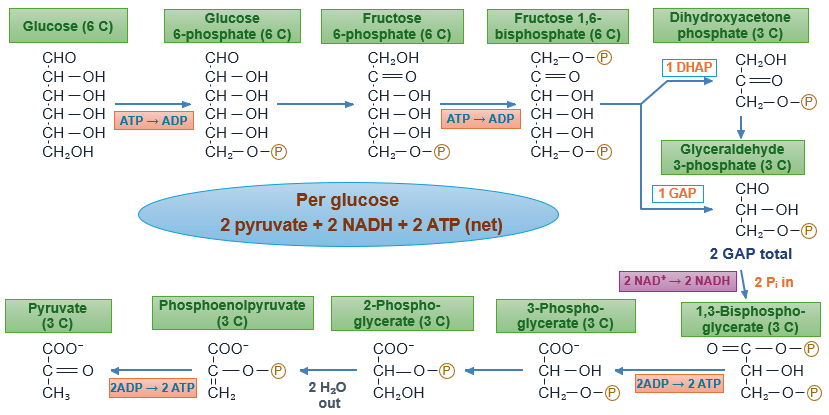
What are the net products of glycolysis per glucose that enter the next stages of metabolism?
Two pyruvate, two NADH, and two net ATP

Why does pyruvate still contain usable energy after glycolysis?
Glycolysis only partially oxidizes glucose
Glycolysis → pyruvate has ΔG°′ of approx. −146 kJ mol−1
Pyruvate still contains oxidizable carbon that can be further converted to CO2
Complete glucose oxidation has ΔG°′ of approx. −2,840 kJ mol−1
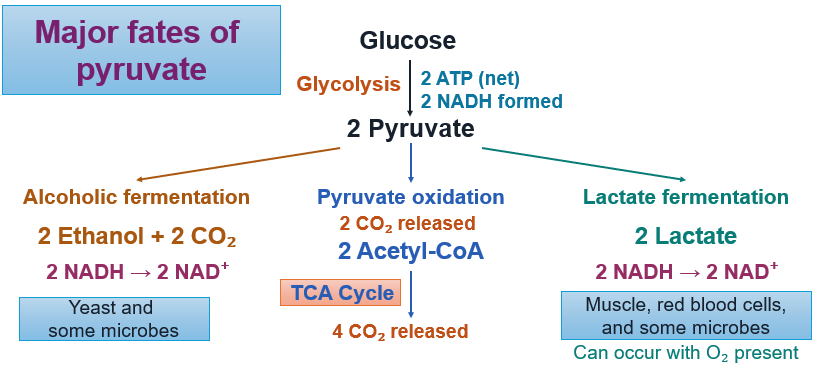
What are the major fates of pyruvate shown in the lecture?
Alcoholic fermentation to ethanol and CO2
Lactate fermentation to lactate
Pyruvate oxidation to acetyl-CoA followed by the TCA cycle
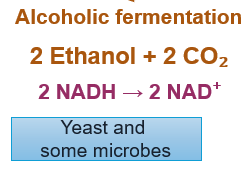
What is the key purpose of fermentation?

Write the lactate dehydrogenase reaction.
Pyruvate + NADH + H+ ⇌ lactate + NAD+
Regenerated NAD+ allows GAPDH reaction of glycolysis to continue
The enzyme itself produces no ATP
What is the net outcome of converting one glucose to two lactate molecules?
Two net ATP and zero net NADH
The NADH made in glycolysis is consumed to regenerate NAD+
Why do mature human red blood cells produce lactate even when O2 is available?
They lack mitochondria and rely on glycolysis for ATP
Use lactate formation to regenerate NAD+
In exercising muscle, lactate formation can support rapid NAD+ recycling while mitochondrial respiration continues
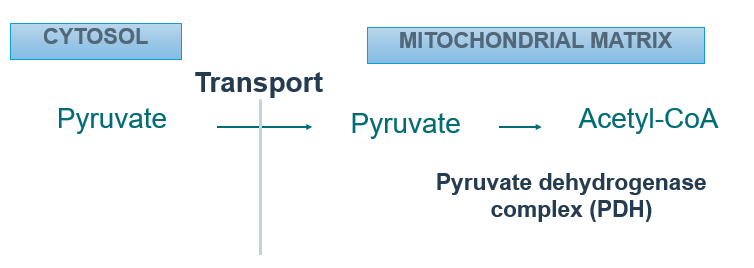
Where does the bridge step occur in eukaryotic cells?
In the mitochondrial matrix
Before the bridge step, pyruvate is transported from the cytosol into the matrix
Cytosolic NADH transfers its electrons through shuttles

What is the overall bridge-step reaction?
Pyruvate + CoA-SH + NAD+ → acetyl-CoA + CO2 + NADH + H+
Per glucose: 2 acetyl CoA, two CO2, and two NADH produced
NAD+ is reduced to NADH

What molecule enters the TCA cycle, and what molecule accepts it?
A 2-C acetyl group from acetyl-CoA enters, and a 4-C oxaloacetate accepts it to form 6-C citrate
Oxaloacetate → citrate → isocitrate → alpha-ketoglutarate → succinyl-CoA → succinate → fumarate → malate → oxaloacetate

What are the products of one TCA-cycle turn per acetyl-CoA?
Three NADH, one FADH2, one GTP, and two CO2
Oxaloacetate is regenerated

What does acetyl-CoA carry into the TCA cycle?
A two-carbon acetyl group attached to CoA by a thioester bond
The thioester bond’s hydrolysis drives citrate formation
CoA-SH gets released when acetyl enters the cycle

What happens in TCA steps 1 and 2?
Citrate synthase combines the two-carbon acetyl group with four-carbon oxaloacetate to form six-carbon citrate, releasing CoA-SH
Aconitase rearranges citrate into isocitrate by repositioning the hydroxyl group.

Why is isocitrate ready for oxidation whereas citrate is not?

What happens in TCA steps 3 and 4?
Isocitrate dehydrogenase converts 6-C isocitrate to 5-C alpha-ketoglutarate, producing one NADH and releasing one CO2
Alpha-ketoglutarate dehydrogenase converts 5-C alpha-ketoglutarate to 4-C succinyl-CoA, producing one NADH and releasing one CO2.
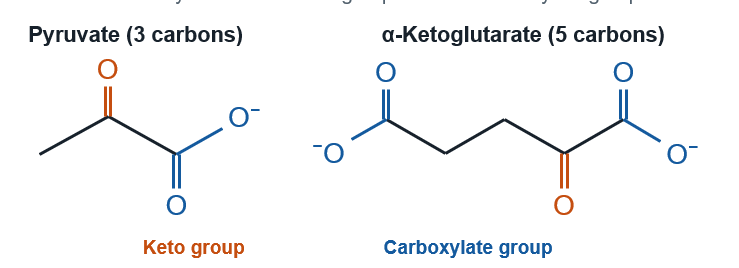
What structural feature do pyruvate and alpha-ketoglutarate share?
What shared reaction do pyruvate and alpha-ketoglutarate undergo in energy metabolism?
Oxidative decarboxylation
CO2 is released and NAD+ is reduced to NADH

What happens in TCA step 5?
Succinyl-CoA synthetase converts succinyl-CoA + GDP + Pi to succinate + CoA-SH + GTP.
Substrate-level phosphorylation.
Directly forms GTP without an electron transport chain or proton gradient.

[Slide 22] What happens in TCA steps 6, 7, and 8?
Succinate dehydrogenase converts succinate to fumarate and reduces FAD to FADH2
Fumarase adds H2O to fumarate, producing malate
Malate dehydrogenase oxidizes malate to oxaloacetate and reduces NAD+ to NADH

What is the yield of one TCA turn per acetyl-CoA?
Three NADH
One FADH2
One GTP or ATP equivalent
Two CO2
Where is most energy captured during the TCA cycle?
Six NADH
Two FADH2
Two GTP/ATP equivalents
Four CO2
What do the bridge step plus two TCA turns produce per glucose?
Eight NADH
Two FADH2
Two direct ATP equivalents
Six CO2
This excludes glycolysis and ATP later made by oxidative phosphorylation

Track the carbon balance from one glucose through complete oxidation.
One glucose has six carbons and becomes two pyruvate with six total carbons
The bridge step releases two CO2 and produces two acetyl groups with four total carbons
Two TCA turns release four more CO2, totaling six CO2