Chapter 21: Lecture Test Prep Questions
 Call Kai
 Learn
 Practice Test
 Spaced Repetition
 Match
 Flashcards
 Knowt Play
1/85

There's no tags or description
Looks like no tags are added yet.
86 Terms
Which of the following blood vessels carries blood away from the heart to other organs?
Arteries
Which of the following blood vessels carries blood from the tissues back to the heart?
Veins
A blockage in the proximal portion of the right subclavian artery will not only affect circulation to the right arm, but also to the
Left vertebral artery
The bronchial arteries arise from the
Thoracic aorta
A blockage in the external iliac artery will reduce blood flow to the
Femoral artery
In resting individuals, which vessels serve as a large blood reservoir from which blood can be quickly diverted to other vessels as needed?
Veins & venules
The layer of a blood vessel that is in direct contact with the blood is the [ 1] while the layer of the vessel that is made up of smooth muscle & elastic fibers is the [2].
1. Tunica interna
2. Tunica media
Which of the following structures is used to control the flow of blood through a capillary bed?
Precapillary sphincters
Which of the following types of tissues contains continuous capillaries?
All of these choices
The alternate route of blood flow to a body part through an anastomosis is called
Collateral circulation
The largest driving force for pulling fluid from the interstitial spaces & back into the capillaries is
Blood colloid osmotic pressure
Cardiac output is dependent on both
Heart rate & stroke volume
Vascular resistance depends on all of these factors EXCEPT FOR
Glucose content of the blood
Which of the following would NOT result in an increase in arterial blood pressure?
Increased arteriolar vasodilation
Which of the following would NOT result in an increase in systemic vascular resistance?
Decreased length of the systemic circulatory route
The right common carotid artery branches directly off the
Brachiocephalic trunk
Which of the following is NOT a contribution of the cardiovascular system to other body systems?
Blood carries carbon dioxide to body tissues & removes oxygen for use by other organs
The cardiovascular center is located
In the medulla oblongata
Pericardial arteries supply blood to the
Tissues of the pericardial sac
Which of the following hormones would NOT stimulate changes that lead to an increase in arterial blood pressure?
Atrial natriuretic peptide (ANP)
Blood flow passing through the posterior aspect of the knee is achieved through the
Popliteal arteries
Abnormal conditions such as atherosclerosis & patent (open) ductus arteriosus cause a large increase in the
Pulse pressure
The branches from the ascending aorta that supply blood to the cardiac muscle are the
Coronary arteries
Direct pressure from the outside of the neck onto the carotid sinuses should stimulate the carotid sinus reflex & slow the heart rate & lower blood pressure.
True
Massaging the neck over the carotid sinus might lead to a reduction in blood pressure due to nerve impulses traveling through the glossopharyngeal (IX) nerves arriving at the medulla oblongata.
True

Which of the labeled layers in the diagram of the arterial wall is composed of a simple squamous epithelium, a basement membrane & a layer of elastic tissue?
A

Which labeled structure in the figure is a metarteriole?
B
A blockage to one or both of the inferior phrenic veins will cause a backup of blood into which structure?
The diaphragm

Which of the capillaries shown in the figure has an incomplete or absent basement membrane?
C

Which of the types of capillaries shown in the figure is commonly found in the kidneys, villi of the small intestine, choroid plexuses, & some endocrine glands?
B
Which of the following would NOT occur in response to hypovolemic shock?
Release of atrial natriuretic peptide (ANP)
All the veins of the systemic circulation eventually drain into the
Superior & inferior vena cava & coronary sinus
The pulmonary trunk divides into
Right & left pulmonary arteries
Which of the following vessels supplies blood to the intestines?
Mesenteric artery
Which of the following vessels drains blood from the lower leg?
Tibial vein
Which of the following vessels drains blood from the head & neck?
Jugular vein
Which of the following vessels carries the venous blood from the lower body into the right atrium?
Inferior vena cava
When the umbilical cord is tied after birth, the umbilical arteries close by filling in with
Connective tissue
The tunica interna of [1] is thin with a fenestrated internal elastic lamina that disappears distally, while the tunica interna of [2] is made of endothelium & a basement membrane with no internal elastic lamina.
1. Arterioles
2. Veins

Which vessel in the figure is labeled "B"?
Right subclavian artery
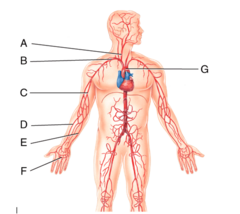
Which vessel in the figure is labeled "A"?
Right common carotid artery

Which vessel in the figure is labeled "B"?
Left femoral vein

Which vessel in the figure is labeled "C"?
Left great saphenous vein

Which vessel in the figure is labeled "F"?
Left anterior tibial vein
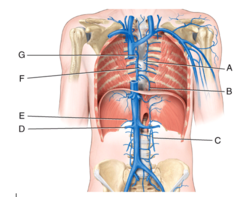
Which vessel in the figure is labeled "C"?
Left gonadal vein

Which vessel in the figure is labeled "D"?
Right renal vein

Which vessel in the figure is labeled "G"?
Azygos vein
In the fetal heart, several structures allow blood from the left and right sides to mix. When the newborn takes its first breath, these structures must close to ensure that oxygenated blood from the left side does not mix with deoxygenated blood from the right side. Which of the following closed structures prevent this mixing between the systemic & pulmonary circulation after the umbilical cord is cut?
D. Both A & B
During embryonic development, blood vessels are formed by
Angioblasts
During embryonic development, blood cells are formed from
Pluripotent stem cells
Normal blood pressure for a young adult male is less than
120/80
Which of the following types of blood vessels have high, pulsing blood pressure?
Arterioles
What would the mean arterial pressure be for an individual with a blood pressure of 120/80?
93.3
Which of the following effectors would NOT be activated as described below in response to hypovolemic shock?
Decreased blood flow to the kidneys
The pulmonary circulatory route carries blood from the
Right ventricle to the left atrium
Emphysema is a chronic obstructive pulmonary disease (COPD) that causes progressive destruction of alveoli (air sacs) in the lungs leading to a decreased ability to exhale. How does this disease affect carbon dioxide levels in the blood?
They increase
Into which of the following categories would an individual with a blood pressure of 145/95 be placed?
Stage 1 hypertension
Which of the following categories of hypertension drugs lower blood pressure by blocking formation of angiotensin II, which results in vasodilation & decreased aldosterone secretion?
ACE inhibitors
Which of the following veins drains the muscles, bones & skin of the hand of the forearm?
D. B & C
The chemical histamine causes capillary walls to become more permeable. Excess histamine secretion, as might be seen in allergic responses, might lead to
Edema
Which pairing is matched correctly regarding the structure of an artery?
D. tunica intima - has a basement membrane & an internal elastic lamina
Which is a true statement?
C. An example of a muscular artery is the brachial
artery
Which is not a feature of the capillaries?
B. Connect arterioles to veins
The largest blood reservoir when the body is at rest is found in the:
A. Veins
Collateral circulation is due to anastomoses.
True
Which statement is true about capillary exchange?
C. Substances pass through the capillaries via fenestrations
Which statement is true of capillary exchange?
B. Blood hydrostatic pressure is lower at the venous end of a capillary
Edema is defined as the excess volume of blood in the capillaries.
False
Which statement is not true of the hemodynamics of blood flow?
D. A decrease in lumen diameter decreases blood pressure
Which of the following is not considered a factor in vascular resistance?
C. The pH of the blood
Which statement is not true of venous return to the heart?
C. The respiratory pump increase venous return to the
left atrium
Velocity of blood slows as the cross-sectional area of the vessel decreases.
False
Which of the following is not true?
A. The cavities in the temporal bone are called carotid sinuses.
Chemoreceptors are associated with all of the following except:
B. Being located near the proprioceptors
Pulmonary blood vessels constrict in response to hypoxia whereas blood vessels in the systemic circulation dilate in response to low oxygen.
True
Which of the following pulse locations do not match correctly?
B. Radial artery - within the axilla
A well-trained athlete would have a slow heart rate called:
Bradycardia
Which of the following is true?
Subtracting the diastolic pressure from the systolic pressure indicates the pulse pressure
Which of the following is not one of the negative feedback systems that responds to hypovolemic shock?
Release of local vasoconstrictors
Which type of shock is caused by inappropriate dilation of the small vessels?
1. anaphylactic shock 2. hypovolemic shock
3. obstructive shock 4. septic shock
1 & 4
Which vessels unite to form the hepatic portal vein?
Superior mesenteric & splenic veins
Which statement does not describe pulmonary circulation?
Pulmonary circulation carries deoxygenated blood from the left ventricle to the lungs
Which of the following is incorrect following birth?
The foramen ovale allows continued passage of blood to the left ventricle
The pluripotent stem cell is a type of cell that develops into a blood cell.
True
Aging has all of these effects on the heart except:
1. increase in maximum heart rate
2. loss of contractile strength
3. increase in systolic blood pressure
4. increase in compliance
1 & 4 are correct

Identify the structure indicated in the diagram.
Tunica media