Principles of Chemistry 1 University of Iowa Final
 Call Kai
 Learn
 Practice Test
 Spaced Repetition
 Match
 Flashcards
 Knowt Play
1/211

There's no tags or description
Looks like no tags are added yet.
212 Terms
Sig Figs
1) All nonzero digits are significant
2) zeroes between nonzero digits are always significant
3)zeroes at the beginning of a number are never significant
4)zeros at the end of the number are significant if the number contains a decimal point.
adding and subtracting sig figs
same number of decimal places as the measurement with fewest decimal places.
50.61+4.338+208.2= 263.148
sooo... 263.1
multiplying and dividing sig figs
same number of sig figs as the measurement with fewest sig figs
6.221 x 5.2= 32.3492
sooo... 32
Empedocles
Q: Are there fundamental Substances?
A: yes, air, fire, water
Democritus
Q: Is matter continuous or particulate?
A: Particulate ("atom" from Greek atomos= indivisible)
John Dalton
Daltons Atomic Theory
1) All matter consists of tiny indivisible atoms.
2) Atoms of an element are identical, but different from those other elements
3) Atoms of one element cannot be converted into those of another element.
4) Compounds result from chemical combinations of different elements; atom ratios are integers.
Law Of Conservation of Mass
mass of one side of the equation equals mass of the other side
Law of Constant Composition
In a compound the relative numbers and kinds of atoms are constant ex: water is always H2O
Law of Multiple Proportions
ratios are small whole numbers
Are John Dalton's Postulates always true?
Nope!
-isotopes exist etc.
J.J Thomson
-cathode rays are independent of the electrode material
-Cathode rays are streams of negatively charged particles (now called electrons)
Robert Millikan
Oil Drop experiment
-caused oil drops to become charged and observed their behavior in an electric field.This led to charge of electron
Thomson's Plum Pudding Model
Evenly distributed mass and positive charge (cookie)
Small embedded negative particles (chocolate chips)
Ernest Rutherford
discovered nature of radioactivity
Proposed nuclear atom as:
-very small, dense, positive nucleus
-surrounded by negative electrons
Rutherford's Gold Foil experiment
studied angles at which alpha particles were scattered after passing through thin gold foil
-disproved plum pudding modelof atom
Isotopes
atoms with identical atomic numbers (same number of protons) but different mass numbers (different # of neutrons)
-atomic number (z)= number of protons
-mass number (A)= number of protons+ neutrons

atomic mass
mass of a single atom in atomic mass units (amu)
mass spectrometer
instrument that can determine very accurate mass measurements and isotopic abundance
atomic weight
average atomic mass of all of the isotopes of an element weighted by the relative abundance of each isotope expressed in amu.
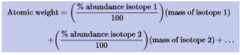
The seven diatomic molecules
H,O,N,F,Cl,Br,I
Molecular Compound
contain only non metals of metalloids
Ions
formed when atoms gain or lose electrons
cation
positive ion formed when electrons are lost
anion
negative ion formed when electrons are gained
Ion trend
metals tend to form cations and nonmetals tend to form anions
Ammonium

Cyanide

Hydroxide

Peroxide

Nitrate

Nitrite

Sulfate

Sulfite

perchlorate

Chlorate

Chlorite

hypochlorite

Carbonate

Phosphate

acetate

permanganate

Mercury

Ionic Compound
a compound that contains both positively and negatively charged ions
-metals and non metals
-zero charge
Naming Ionic Compounds
metal name + nonmetal name +ide
or metals with different oxidation states
metal name(oxidation state as roman numerals) + nonmetal name +ide
Naming Molecular Compounds
(prefix+ 1st element) + (prefix + 2nd element with ide)
prefixes:
1=mono
2=di
3=tri
4= tetra
5=penta
6= hexa
7= hepta
8=octa
9=nona
10= deca
dichromate

permanganate

thiocyanate

Oxyanions
occur when elements combine with oxygen to produce polyatomic anions
x root -ate
x root -ite
(nitrate vs nitrite)
Binary Aqueous Acids
Acids yield H+ ions in water
hydro+ partial element name with ic suffix+ acid
HCl--> hydrochloric acid
HI--> Hydroiodic acid
Oxoacids
contains hydrogen, oxygen, and a third element
Partial element name + suffix + acid
H2SO4 sulfuric acid
HNO3 nitric acid
Hydrocarbons
compounds of carbon and hydrogen
one carbon: meth-
two carbons: eth-
three carbons: prop-
Alkalines
hydrocarbons with only single bonds
prefix+ and
alcohols
hydrocarbons with only single bonds
prefix+ anol
Antoine Lavoisier
established chemistry as a science
- first stated law of conservation of mass
-recognized oxygen and hydrogen
-metric system
-authored first chem book
Formula Weight/ molecular weight
sum of the atomic mass of the atoms in the chemical formula of a substance
Percent Composition
(# atoms of an element)(atomic weight of element)/ (formula weight of substance) * 100
empirical formula

molecular formula
find molecular mass and then take number given divided by this number multiply that by empirical formula
combustion reactions
only contain C,H,O
Theoretical Yield
quantity of product calculated form when all of the limiting reactant is consumed
actual yield
amount of product actually obtained ( can never be greater than the theoretical yield
Percent Yield
= actual/initial
water
polarity makes it a very special substance

solvent
substance in greatest quantity
solute
substances dissolved in solvent
non electrolytes
no ions mean no conduction
-molecular compounds
weak electrolytes
very little ions means weak conduction
strong electrolytes
great number of ions means strong conduction
-ionic compounds
Strong Acids
HCl, HBr, HI, HClO3, HClO4, HNO3, H2SO4
Strong Bases
LiOH, NaOH, KOH, RbOH, CsOH, Ca(OH)2, Sr(OH)2, Ba(OH)2
monoprotic acids
produce one H+ molecule
diuretic acids
produces two H+ per molecule
Organic Acids
Molecular acids such as acetic acid only gives up one H+ per molecule despite having a total of 4 H atoms
Solubility Guidelines
Cl-,Br-, I- are soluble unless with
Ag+, Hg2^2+, Pb^2+
Solubility Guidelines
SO4^2- soluble unless with
Sr^2+, Ba^2+, Hg2^2+, Pb^2+
Solubility Guidelines
S^2-, OH- soluble with
NH4+, alkali metals, Ca^2+, Sr^2+, and Ba^2+
Solubility Guielines
CO3^2-, PO4^3- soluble with
NH4+, and alkali metal
molecular equation, total ionic equation, net ionic equation

concentration/ molarity
M= moles of solute/ liters of solution
titrant
a solution of accurately known concentration
analyte
solution of unknown concentration
end point
experimentally measured titrant volume required to completely react with the analyte
oxidation reduction reactions
there is a net movement of electrons from one reactant to or towards another
OIL (electrons) RIG (electrons)
Oxidation Number
hypothetical number assigned to an
individual atom or ion using a set of rules to keep track of
electrons transferred in redox reactions
oxidation number of pure elements
H2, P4, Na for example = zero
oxidation number of monatomic Ions
= its ionic charge
Fe^2+ is 2+
Br^- is 1-
oxidation number of combined hydrogen
+1
Oxidation number of combined oxygen
-2
Oxidation number of halogens in binary salts
-1
Activity Series
used to predict whether certain metals will be oxidized by an acid or metal salt
-on the chart any metal can be oxidized by one below it
- only metals above hydrogen are able to react with acids to form H2
-ease of oxidation increases as you go up.
empirical formula
simplest form of contend (reduce ratios)
Energy
capacity to do work or transfer heat
J = kg(m/s)^2
work (w)
energy expended when an object is moved by a force (mechanical work)
w= force x distance
fx d = m x a x d
J= kg (m/s)^2
Heat or thermal energy (q)
energy transferred between objects resulting in a temperature change
Thermodynamics
the study of energy and its transformations
Thermochemistry
study of chemical reactions and energy changes involving heat
Kinetic Energy
Ek = 1/2 mv^2
potential
energy of position or condition of an object
Electrostatic Potential Energy
Eel= kQ1Q2/d
d= distance (m)
Q= charge (C, coulombs)
k= 8.99 x 10^9 J*m/C^2